

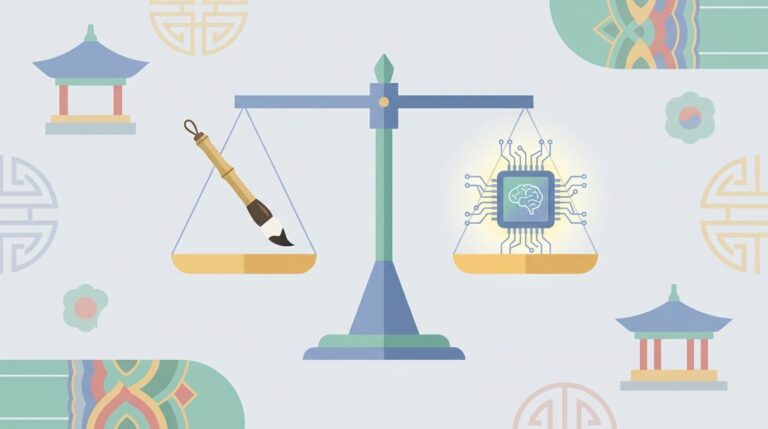
AI, Art, and the Law: Who Really Owns the Masterpiece?
Phase 1: Empathy (스토리 몰입형 오프닝)
안녕하세요! 매일한글 (Daily Hangul)‘s Senior Editor and your trusted culture navigator here.
Imagine this: You are watching a highly anticipated K-Drama. The breathtaking background music (OST) makes you tear up, and the stunning visual effects leave you speechless. Later, you find out that both the music and the digital art were generated by an advanced AI. Instantly, a heated debate sparks online among Korean netizens: “Who actually owns the copyright? The AI developer? The prompt engineer? Or is it public domain?”
If you’ve ever tried to discuss these complex, cutting-edge topics in Korean, you might have felt your vocabulary hitting a wall. Discussing AI and copyright requires more than just basic conversational skills; it demands high-level, nuanced terms of debate, legal concepts, and culturally polite ways to express disagreement. Today, we are diving deep into the world of C2-level Korean to help you articulate your thoughts on AI authorship and copyright ownership with absolute confidence and sophistication.
Phase 2: Deep Dive into 3 Essential Expressions (핵심 표현 3선 심층 분석)
1. 창작의 주체 (Chang-jak-ui ju-che)
- Pronunciation: Chang-jak-ui ju-che (Sounds like “chahng-jahg-ee joo-cheh”)
- Meaning: The subject of creation / The creative entity
- K-Culture Moment: Often debated on Korean tech talk shows like SBS Special or in intellectual forums discussing whether AI can be recognized as an artist in its own right.
- Editor’s Insight: In Korean, 주체 (ju-che) refers to an agent or entity that has autonomy and self-determination. By calling something a ‘창작의 주체’, you are arguing whether it possesses genuine, autonomous creative spirit, rather than being a mere tool (도구).
- Situation Spectrum: Casual (🚫) | Semi-formal (⚠️) | Formal (✅)
- 🤔 Think About It: Does your native language distinguish between a “creative tool” and a “creative entity” as sharply as the Korean distinction between ‘도구’ (dogu) and ‘주체’ (ju-che)?
2. 저작권을 귀속시키다 (Jeo-jak-gwon-eul gwi-sok-si-ki-da)
- Pronunciation: Jeo-jak-gwon-eul gwi-sok-si-ki-da (Sounds like “juh-jahg-gwon-eul gwee-sog-shee-kee-dah”)
- Meaning: To attribute/vest copyright ownership to (someone/an entity)
- K-Culture Moment: This formal legal phrasing is constantly used in news reports covering the Korea Copyright Commission’s (한국저작권위원회) latest rulings on AI-generated webtoons.
- Editor’s Insight: The verb 귀속시키다 (gwi-sok-si-ki-da) means to make a right, property, or status belong to a specific person or group. It is a highly sophisticated, formal term perfect for legal, academic, or professional discussions.
- Situation Spectrum: Casual (🚫) | Semi-formal (⚠️) | Formal (✅)
- 🤔 Think About It: Why does Korean use active causative forms like ‘귀속시키다’ (to cause to vest) rather than just saying “given to”? It highlights the deliberate legal action behind the decision.
3. 선례를 남기다 (Seon-rye-reul nam-gi-da)
- Pronunciation: Seon-rye-reul nam-gi-da (Sounds like “suhn-ryeh-reul nahm-gee-dah”)
- Meaning: To set a precedent
- K-Culture Moment: Used by Korean tech lawyers debating how the current court rulings on AI art will affect the future of the webtoon (웹툰) and gaming industries.
- Editor’s Insight: 선례 (seon-rye) means “prior example” or “precedent.” In a rapidly evolving field like AI, setting a precedent (‘선례를 남기다’) determines the future trajectory of the entire creative industry.
- Situation Spectrum: Casual (⚠️) | Semi-formal (✅) | Formal (✅)
- 🤔 Think About It: How heavily does your country’s legal system rely on setting precedents compared to the statutory framework in Korea?
Phase 3: Textbook Korean vs. Real Korean (교과서 한국어 vs. 진짜 한국어)
Situation 1: Expressing that AI-created works cannot be copyrighted.
- 📖 Textbook Korean: 인공지능이 만든 것은 저작권이 없어요. (In-gong-ji-neung-i man-deun geos-eun jeo-jak-gwon-i eops-eo-yo.)
- Translation: Things made by AI do not have copyright.
- 🗣️ 진짜 한국어: AI 창작물은 현행법상 저작물성을 인정받기 어렵습니다. (AI chang-jak-mul-eun hyeon-haeng-beop-sang jeo-jak-mul-seong-eul in-jeong-bat-gi eo-ryeop-seub-ni-da.)
- Translation: Under current law, it is difficult for AI creations to be recognized as copyrightable subject matter (copyrightability).
- 💡 왜 다를까? (Why the difference?): At a C2 level, using precise legal terminology like 현행법상 (under current law) and 저작물성 (copyrightability/status as a work of authorship) instantly elevates your professional credibility in a debate.
Situation 2: Emphasizing that human effort was involved in the prompt engineering.
- 📖 Textbook Korean: 사람이 명령어를 열심히 썼어요. (Sa-ram-i myeong-ryeong-eo-reul yeol-sim-hi sseos-eo-yo.)
- Translation: A human wrote the commands very hard.
- 🗣️ 진짜 한국어: 프롬프트 입력 과정에 인간의 창조적 기여가 개입되었습니다. (Peu-rom-peu-teu im-ryeok gwa-jeong-e in-gan-ui chang-jo-jeok gi-yeo-ga gae-ip-doe-eot-seub-ni-da.)
- Translation: Human creative contribution was intervened/involved in the prompt input process.
- 💡 왜 다를까? (Why the difference?): Saying “wrote commands hard” sounds elementary. Utilizing concepts like 창조적 기여 (creative contribution) and 개입 (intervention/involvement) sounds highly sophisticated and aligns with actual legal arguments used in intellectual property discussions.
Phase 4: K-Culture Deep Dive & Non-verbal Manners (비언어적 매너)
4-1. Nunchi (눈치) & Gesture
When engaging in high-level intellectual debates in Korea, keeping the peace (화합 – hwa-hap) is crucial, even when you disagree.
* The “Soften-the-Blow” Nod: Before stating a opposing view, nod slowly and say “물론 말씀하신 취지는 충분히 이해합니다만…” (Of course, I fully understand your point, but…). This shows deep respect and high nunchi.
* The Humble Palm: When gesturing towards your colleague or opponent, keep your hand open with your fingers together, palm facing slightly upward. Pointing with a single finger is considered extremely aggressive and rude in professional Korean settings.
4-2. Cultural Insight: The Korean Webtoon Industry & AI Art
Korea is the global powerhouse of Webtoons (웹툰). Recently, several webtoon production companies faced severe backlash from local readers when it was suspected they used AI generators to finish background scenes. Korean readers value the “정성” (jeong-seong – sincerity/devotion) of the artist. The debate in Korea isn’t just legal; it is highly emotional, centered around whether AI-generated content dilutes the soul and effort of human artists.
Phase 5: Interactive Roleplay Scenario (실전 롤플레이)
Characters
- 민우 (Min-woo): An intellectual property attorney at a top Seoul law firm. Pragmatic and precise.
- 지현 (Ji-hyun) [You]: An AI tech policy researcher advocating for modernizing copyright laws.
민우: 지현 씨, 현행 저작권법상 저작물은 '인간의 사상과 감정을 표현한 창작물'로 규정되어 있습니다. AI 창작물에 저작권을 부여할 수 없다는 건 명백한 사실 아닙니까?

지현: 🎭 (차분하면서도 확신에 찬 어조로) 물론 민우 변호사님의 말씀도 일리가 있습니다. 하지만 프롬프트 엔지니어링 과정에 개입된 인간의 창조적 기여를 단순히 무시할 수는 없다고 봅니다.

민우: 🎭 (안경을 고쳐 쓰며 부드럽게 반박한다) 창조적 기여라니요? AI는 단지 무수한 데이터를 학습해서 도출한 결과물에 불과합니다. 개발자가 코딩한 알고리즘의 작동 방식을 인간의 창작으로 볼 수 있을까요?

지현: 🎭 (상대의 눈을 지긋이 바라보며) 카메라가 처음 등장했을 때도 같은 논쟁이 있었습니다. 하지만 결국 사진도 창작물로 인정받았죠. AI 역시 창작의 주체가 아닌, 새로운 시대의 정교한 도구로 보아야 합니다.

민우: 하지만 사진은 셔터를 누르는 순간의 구도와 조도가 인간에 의해 즉각 통제됩니다. AI는 어떤 결과가 나올지 인간이 완전히 예측하거나 통제할 수 없지 않습니까?

지현: 🎭 (미소를 지으며 부드럽게 반론을 제기한다) 그렇기에 법을 개정하여 'AI 저작권'이라는 새로운 형태의 독자적 권리를 귀속시킬 수 있는 법적 프레임워크를 마련해야 합니다.

민우: 그런 법적 선례가 전 세계적으로 아직 미비한 상황에서, 우리가 먼저 위험한 선례를 남길 필요가 있을까요?

지현: 오히려 IT 강국인 한국이 이 분야에서 선도적인 가이드라인을 제시한다면, 글로벌 시장에서 매우 긍정적인 선례를 남길 수 있는 기회라고 확신합니다.
🔀 Choose Your Response! (인터랙티브 분기점)
How would you react to Min-woo’s final point about the risks of setting a precedent?
- A) [Best] “선례가 없다는 이유로 변화를 피하기보다, 규제 샌드박스를 통해 점진적인 도입을 모색하는 것이 합리적입니다.” (Instead of avoiding change because there is no precedent, it is rational to seek gradual introduction through regulatory sandboxes.)
- Feedback: Excellent! You used high-level economic policy terminology (규제 샌드박스 – regulatory sandbox) which perfectly matches a C2-level debate.
- B) [Bad] “법이 너무 옛날 방식이라 그래요. 빨리 안 바꾸면 우리나라만 뒤처집니다.” (It’s because the law is too old-fashioned. If we don’t change it quickly, only our country will fall behind.)
- Feedback: Too emotional and casual. Using phrases like “너무 옛날 방식” sounds overly colloquial for a professional debate.
- C) [Risk] “법률가들이 기득권을 지키기 위해 변화를 거부하는 것 아닌가요?” (Aren’t legal professionals refusing change just to protect their vested interests?)
- Feedback: Extremely confrontational. In Korean professional settings, accusing the other party’s profession of protecting “기득권” (vested interests) will instantly shut down any productive dialogue.
Phase 6: 10-Second Emotion Shadowing Drill (감정 섀도잉 드릴)
Practice speaking with the correct pauses (/) and emotional tone.
- [😌 차분하고 논리적으로 – Calm and Logical]
- “AI 창작물은 / 단순히 결과물만 볼 것이 아니라, / 프롬프트 입력 과정에 개입된 / 인간의 노력을 인정해야 합니다.”
- (AI creations should not be judged solely on the final output; the human effort involved in the prompt input process must be recognized.)
- [🤔 설득력 있게 대안을 제시하며 – Persuasively Suggesting Alternatives]
- “글로벌 표준이 없는 지금이야말로, / 한국이 앞장서서 / 합리적인 선례를 남길 수 있는 / 골든타임입니다.”
- (Now, while there are no global standards, is the golden time for Korea to take the lead and set a reasonable precedent.)
Phase 7: K-Culture Mini Dictionary (미니 사전)
- 저작물성 (Jeo-jak-mul-seong) | Copyrightability
- The legal status of being recognized as a genuine work of authorship. Crucial in AI debates.
- 창작의 고통 (Chang-jak-ui go-tong) | The pain of creation
- A highly common expression in Korea used to describe the immense effort artists put into their work. Netizens argue AI bypasses this “pain of creation.”
- 창작 생태계 (Chang-jak saeng-tae-gye) | Creative ecosystem
- Refers to the industry network of artists, platforms, and readers. Used when discussing how AI affects artists’ livelihoods.
- 법적 공백 (Beop-jeok gong-baek) | Legal vacuum/lacuna
- The state where no laws exist yet to regulate new technologies. Korea is actively trying to fill this “법적 공백” regarding AI.
Phase 8: Survival Kit for Travelers & Expats (여행자/거주민 생존 키트)
Survival Expressions for Tech Expos/Seminars in Seoul
- “AI 관련 법적 규제 현황은 어떻게 되나요?” (What is the current status of legal regulations regarding AI?)
- Pro Tip: Use this at any tech seminar in Gangnam or Yeouido to instantly spark a deep conversation with industry experts.
- “실례지만, 이 세션의 발표 자료를 받아볼 수 있을까요?” (Excuse me, but could I get the presentation materials for this session?)
- Pro Tip: Networking is crucial. Always ask politely for materials to secure their contact info.
- “저작권 분쟁 소지를 최소화하려면 어떻게 해야 하죠?” (What should we do to minimize the potential for copyright disputes?)
- Pro Tip: A very professional phrasing often used in business-to-business (B2B) meetings.
Editor’s Travel Note
If you are attending international tech or law conferences in Seoul (such as at COEX in Gangnam), make sure to download the Naver Map App (네이버 지도) for flawless subway and walking navigation. Google Maps is often outdated in Korea due to security laws. Disclaimer: App interfaces and subway fares may change; please verify on the official app store before downloading.
Phase 9: “Going One Step Deeper” – Thinking Question (한 발 더 깊이)
Korean society values “정 (Jeong – deep attachment/affection)” and “정성 (Jeong-seong – sincerity/devotion)”. This deeply influences how Koreans view technology. While Western debates on AI art often focus heavily on the financial and strict legal framework of copyrights, the debate in Korea frequently touches upon whether an entity without human “soul” or “jeong-seong” can truly be called an artist. This cultural background is why the public sentiment towards AI-generated webtoons remains highly sensitive.
💬 Your Turn: How does your culture view the balance between technological efficiency and human craftsmanship? Let us know in the comments below! (이 주제에 대한 여러분의 생각을 댓글로 알려주세요!)
Phase 10: FAQ & Common Mistakes (오해 방지)
Q: Can AI itself be registered as a copyright holder under current Korean law?
A: No. Under the current South Korean Copyright Act (저작권법), a creator is strictly defined as a “natural human being” (자연인). Therefore, an AI system cannot hold copyrights.
Q: Can a prompt engineer own the copyright of the AI output?
A: It is extremely difficult. The Korea Copyright Commission recently ruled that simply typing in text prompts does not constitute enough “creative expression” to grant copyright ownership to the prompter, unless significant human post-editing is applied.
Q: Is all AI art free to use in Korea?
A: Not necessarily. While the AI art itself might not have copyright protection, if the AI was trained on copyrighted Korean webtoons or illustrations without permission, it could still lead to intellectual property infringement lawsuits.
🚨 Common Mistakes Alert!
- Mistake 1: Saying “AI 저작권을 줘요” (Give AI copyright).
- Correct Action: Use “AI 창작물에 저작권을 귀속시키다” (Vest copyright to AI creations) for professional contexts.
- Mistake 2: Using “명령어” (commands) during a formal panel discussion.
- Correct Action: Use the industry-standard term “프롬프트” (Prompt) or “입력 조건” (Input criteria).
- Mistake 3: Saying “법이 나빠요” (The law is bad).
- Correct Action: Use “법률적 공백이 존재합니다” (A legal vacuum exists) to sound objective and professional.
Phase 11: Action Mission (액션 미션)
- 🥉 Bronze Mission: Read the roleplay scenario in Phase 5 out loud twice to practice natural pacing and advanced vocabulary.
- 🥈 Silver Mission: Write a 3-sentence opinion in Korean about AI art using the term ‘창작의 주체’ and share it on your social media, tagging
#DailyHangul! - 🥇 Gold Mission: Watch a short Korean news clip on YouTube about “AI 웹툰 논쟁” (AI Webtoon Debate) and try to spot at least two vocabulary words we discussed today.
Phase 12: Interactive Quiz Challenge (인터랙티브 퀴즈)
1. Which term is the most professional way to say “to vest/attribute copyright”?
a) 저작권을 주다
b) 저작권을 귀속시키다
c) 저작권을 이기다
🔍 Show Answer & Explanation
Correct Answer: b) 저작권을 귀속시키다
Explanation: While ‘주다’ (to give) is grammatically correct, ‘귀속시키다’ (to vest/attribute legally) is the precise C2-level legal term required for formal discussions.
2. Fill in the blank:
“AI 창작물의 저작권 보호 여부는 앞으로의 한국 콘텐츠 시장에 중요한 ( )를 남길 것입니다.”
a) 숙제 (Homework)
b) 선례 (Precedent)
c) 핑계 (Excuse)
🔍 Show Answer & Explanation
Correct Answer: b) 선례 (Precedent)
Explanation: The sentence discusses how the decision on AI copyright will set a crucial legal “precedent” (선례) for the future of the Korean content market.







