

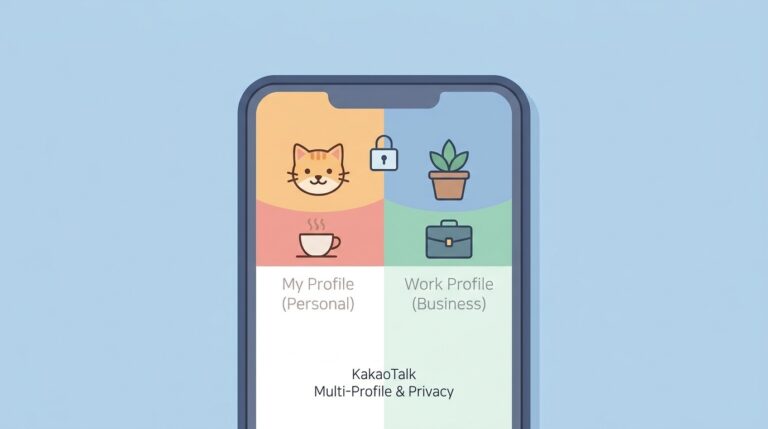
Master KakaoTalk’s ‘Multi-Profile’ Like a Native: The Ultimate Guide to Boundary Management in Korean Social Life
Phase 1: Empathy (Welcome, My Friend!)
안녕하세요! It’s your K-Culture Navigator and senior editor at Daily Hangul.
Imagine this: You’ve just landed a fantastic job at a trendy marketing agency in Seoul. Your team leader, Team Leader Kim (김 팀장님), adds you on KakaoTalk. Suddenly, your weekend camping photos, your late-night aesthetic stories, and your passionate K-pop fanboying/fangirling profile layouts are laid bare to your boss. You feel exposed, but you can’t just block them.
Welcome to the complex ecosystem of Korean corporate and social boundaries. In Korea, where KakaoTalk is the absolute epicenter of both personal life and professional communication, maintaining a work-life balance is a subtle art.
Enter 멀티 프로필 (Multi-Profile)—KakaoTalk’s feature that lets you show different profiles to different groups. But setting it up isn’t just a technical task; it’s a social dance. Today, we’re diving deep into the C2-level nuances of boundary-setting, private life protection, and how to discuss these social boundaries in fluent, natural Korean. This guide is built on real experiences of global professionals navigating Korean work culture.
Phase 2: Deep Dive into 3 Essential Expressions
1. 공과 사를 구분하다 (Gong-gwa sa-reul gubun-hada)
- Pronunciation: [Gong-gwa sa-reul gu-boon-ha-da] (Think of gong as “gong” on a drum, sa as in “sa-lon”)
- Meaning: To separate public/professional matters from private/personal ones.
- K-Culture Moment: Often heard in office dramas like My Mister or Misaeng, where a senior scolds a junior who lets personal feelings affect work decisions.
- Editor’s Insight: ‘공’ (公) means public/official, and ‘사’ (私) means private. In Korea’s historically collectivist culture, the boundaries can easily blur. Using this phrase shows a high level of professional self-awareness.
- Situation Spectrum: Casual ✅ | Semi-formal ✅ | Formal ✅
- 🤔 Think About It: How does the boundary between “public” and “private” differ in your home country compared to Korea, where coworkers might follow your personal social media?
2. 선을 넘다 (Seon-eul neom-da)
- Pronunciation: [Seon-eul neom-da] (Pronounced like “Sun-ul num-da”)
- Meaning: To cross the line / overstep boundaries.
- K-Culture Moment: Famously popularized globally by the movie Parasite, where Mr. Park repeatedly mentions people who “cross the line.”
- Editor’s Insight: This is a vital C2 expression. It’s not just about physical lines; it refers to intrusive questions about marriage, salary, or personal habits. Setting a KakaoTalk Multi-Profile is an elegant, non-verbal way of telling someone, “Don’t cross the line.”
- Situation Spectrum: Casual ✅ | Semi-formal ✅ | Formal ⚠️ (Use cautiously with higher-ups)
- 🤔 Think About It: Why do you think indirect boundary-setting (like using Multi-Profiles) is preferred in Korea over direct confrontation?
3. 사생활을 침해하다 (Sasaenghwal-eul chimhae-hada)
- Pronunciation: [Sa-saeng-hwal-eul chim-hae-ha-da] (Rhymes with “Sah-sang-hwal-ul chim-hae-ha-da”)
- Meaning: To invade or violate someone’s privacy.
- K-Culture Moment: Used in legal dramas or serious discussions when journalists or bosses probe too deeply into an individual’s personal life.
- Editor’s Insight: This is a highly formal and strong phrase. While “선 넘다” is colloquial, “사생활 침해” is the official, legal-sounding term to express that a boundary has been seriously breached.
- Situation Spectrum: Casual ⚠️ | Semi-formal ✅ | Formal ✅
- 🤔 Think About It: Is viewing a subordinate’s KakaoTalk profile background considered “privacy invasion” in your culture?
Phase 3: Textbook Korean vs. Real Native Korean
Situation 1: Explaining why you use Multi-Profiles
- 📖 Textbook Korean: “저는 회사 사람들에게 제 사생활을 보여주고 싶지 않아서 멀티 프로필을 사용합니다.”
(I use multi-profile because I do not want to show my private life to company people.) - 🗣️ 진짜 (Real) Korean: “퇴근 후 제 일상은 지켜내고 싶어서, 회사용이랑 개인용 프로필을 철저히 분리해서 써요.”
(I want to protect my life after work, so I strictly separate my profile into work and personal ones.) - 💡 Why the difference? The real Korean version uses “지켜내고 싶어서” (wanting to protect/guard), showing a more proactive, emotional boundary, and uses “철저히 분리하다” (strictly/thoroughly separate) which sounds much more sophisticated and natural for a C2 speaker.
Situation 2: Gently warning a friend who is oversharing at work
- 📖 Textbook Korean: “회사 사람들에게 사생활 사진을 보여주지 마십시오.”
(Do not show photos of your private life to company people.) - 🗣️ 진짜 (Real) Korean: “회사 사람한테 어디까지 오픈할지는 선 딱 긋는 게 나아. 괜히 말 나와.”
(It’s better to draw a clear line on how much you open up to coworkers. Otherwise, people will start gossiping for nothing.) - 💡 Why the difference? “선 딱 긋다” (to draw a sharp line) is a common idiomatic expression. “괜히 말 나와” is a crucial cultural idiom meaning “it will only cause unnecessary rumors/talk.”
Phase 4: K-Culture Deep-Dive & Non-verbal Manners
4-1. The Subtle Art of ‘Nunchi’ (눈치) on KakaoTalk
In Korea, communication is highly contextual. Leaving your profile picture blank (so-called ‘기기’ or 기본 프로필) can sometimes make people worry that something is wrong, or that you have blocked them. Setting up a “clean, professional” Multi-Profile (usually containing a neat landscape photo, a simple quote, or a professional headshot) for business contacts is the ultimate ‘Nunchi’ move. It shows you are professional, responsive, yet unavailable for personal intrusion.
4-2. The Evolution of Work Culture: ‘Work-Life Balance’ (워라밸)
Historically, Korean company culture expected employees to share every aspect of their lives. However, the MZ Generation (millennials and Gen Z) ushered in the era of 워라밸 (Work-Life Balance). KakaoTalk’s Multi-Profile, introduced in 2021, became the digital tool that facilitated this cultural shift. It represents a compromise between the collectivist demand for connectedness and the modern individual’s right to digital privacy.
Phase 5: Interactive Roleplay Scenario
Setting: A trendy cafe near Gangnam Station. You are talking to your close Korean colleague, Ji-a (지아), who is known for her social savvy.
Characters:
- Ji-a (지아): Senior designer at your firm. Very friendly but knows exactly how to handle office politics.
- You: A newly hired senior global strategist, navigating Korean social hierarchies.
1. 지아: (커피를 마시며 걱정스러운 듯) 민우 씨, 어제 김 팀장님이 민우 씨 카톡 프로필 사진 얘기하는 거 들었어요?
   (Ji-a: [Drinking coffee, looking worried] Min-woo, did you hear Team Leader Kim talking about your KakaoTalk profile picture yesterday?)

2. You: (깜짝 놀라며) 제 프로필이요? 주말에 서핑하러 가서 친구들이랑 맥주 마시는 사진 올려둔 것 때문인가요?
   (You: [Surprised] My profile? Is it because of the photo of me drinking beer with friends after surfing last weekend?)

3. 지아: (고개를 끄덕이며) 네, 그 사진 보시고 주말에 아주 고삐 풀린 망아지처럼 논다고 농담 반 진담 반으로 말씀하시더라고요.
   (Ji-a: [Nodding] Yeah, he saw that and said half-jokingly, half-seriously, that you run wild like an untamed pony on weekends.)

4. You: (한숨을 쉬며) 아, 진짜 사생활 침해 아닌가요? 퇴근하고 주말에 뭘 하든 공과 사는 구분해 주셨으면 좋겠어요.
   (You: [Sighing] Ah, isn't that totally an invasion of privacy? I wish he would separate public and private life, regardless of what I do after work or on weekends.)

5. 지아: (미소를 지으며 꿀팁을 준다는 듯) 그러니까요! 그래서 한국 직장인들은 다 '멀티 프로필' 써요. 민우 씨 아직 설정 안 했어요?
   (Ji-a: [Smiling, as if giving a pro-tip] Exactly! That's why Korean office workers all use 'Multi-Profiles.' Haven't you set yours up yet?)

6. You: (머리를 긁적이며) 아, 어떻게 지정하는지는 아는데... 회사 분들한테만 다른 프로필을 보여주는 게 티가 나지 않을까 걱정돼요.
   (You: [Scratching your head] Ah, I know how to set it up, but... I'm worried it might look too obvious that I'm showing a different profile only to coworkers.)

7. 지아: (손사래를 치며) 에이, 요즘은 그게 예의예요! 회사용 프로필은 그냥 깔끔한 풍경 사진에 '근무 중 연락 가능' 정도로 해두면 아무도 신경 안 써요.
   (Ji-a: [Waving her hand] Oh, come on, these days that's actually considered polite! For the work profile, just put a clean landscape photo and write 'Available during work hours,' and no one will care.)

8. You: (안도의 한숨을 쉬며) 그렇군요. 괜히 선 넘는 말 듣느니, 당장 오늘 저녁에 멀티 프로필로 싹 다 정리해야겠어요.
   (You: [Sighing in relief] I see. Instead of hearing things that cross the line, I should clean everything up with Multi-Profiles tonight.)
🔀 Interactive Choice Point
How would you reply to Ji-a’s advice about setting up your work profile?
- A. “귀찮은데 그냥 김 팀장님 차단하면 안 돼요?” (It’s tedious, can’t I just block Team Leader Kim?)
- B. “좋은 생각이네요. 회사 사람들을 멀티 프로필 그룹에 싹 다 묶어서 넣어버려야겠어요.” (Good idea. I should bundle all the company people into the Multi-Profile group and be done with it.)
- C. “에이, 저는 제 개성을 숨기고 싶지 않아요. 팀장님이 눈치를 기르셔야죠!” (Hey, I don’t want to hide my individuality. The team leader needs to develop some Nunchi!)
Feedback:
- Best Choice: B — Highly pragmatic and culturally astute. Bundling all professional contacts immediately solves future boundary issues smoothly.
- Bad Choice: A — Highly risky. Blocking a boss on KakaoTalk makes you look “Uncontactable” (차단 상태), which in Korea can lead to serious professional red flags.
- Risk Choice: C — Extremely idealistic. While true, demanding a Korean superior to change their “Nunchi” before you adapt will likely result in an uncomfortable work life.
Phase 6: 10-Second Emotional Shadowing Drill
Practice saying these with the exact emotional nuance to sound 100% native. The slash / represents a natural micro-pause.
- [🥺 Resentful & Frustrated]
“아니, / 주말에 맥주 한잔한 게 / 그렇게 눈치 볼 일인가요?”
([Ani, / jumale maekju hanjan-han ge / geuroke nunchi bol il-in-gayo?])
(I mean, / is having a beer on the weekend / really something I should be self-conscious about?) -
[😏 Determined & Savvy]
“괜히 선 넘는 말 듣기 싫어서, / 회사 사람들이랑은 / 철저하게 선을 그으려고요.”
([Gwaen-hi seon neom-neun mal deutgi sil-eoseo, / hoesa saram-deul-irang-eun / cheol-jeo-ha-ge seon-eul geu-eu-ryeo-go-yo])
(I don’t want to hear comments that cross the line, / so I plan to draw a strict line / with company people.)
Phase 7: K-Culture Mini-Dictionary
- 공사구분 (Gong-sa-gu-bun) | Public-Private Distinction
- Usage: A cornerstone trait of highly professional employees in modern Korea. Often paired with the verb ‘철저하다’ (to be thorough).
- 안읽씹 (An-it-ssip) | Leaving on ‘Unread’
- Usage: Read-and-ignore is ‘읽씹’, but ‘안읽씹’ is intentionally not opening the chat to avoid leaving a read receipt (the yellow ‘1’ disappearing), maintaining personal space.
- 프로필 조용히 바꾸기 (Profile Joyong-hi Baggugi) | Change Profile Quietly
- Usage: A KakaoTalk feature where you can update your profile without letting it notify your friends list via the “Updated Profile” tab. Vital for stealth updates.
- 주말 차단 (Jumal Chadan) | Weekend Blocking
- Usage: Temporarily blocking or turning off notifications for work-related group chats during weekends to safeguard one’s mental peace.
Phase 8: Survivor Kit for Expats in Korea
Survival Expressions TOP 3
- “단톡방 알림 좀 꺼둘게요.” [Dan-tok-bang allim jom kkeo-dul-ge-yo]
- Meaning: I’ll turn off notifications for the group chat for a bit.
- Pro Tip: Use this when a work chat gets too noisy during your off-hours.
- “퇴근 후에는 카톡 확인이 좀 늦을 수 있습니다.” [Toe-geun hu-e-neun katok hwagin-i jom neuj-eul su itsseumnida]
- Meaning: Check-ins on KakaoTalk might be delayed after work hours.
- Pro Tip: Say this politely during your first week to set expectations early.
- “사적인 연락은 자제해 주셨으면 합니다.” [Sa-jeok-in yeon-rak-eun ja-jae-hae ju-syeot-eumyeon ham-nida]
- Meaning: I would appreciate it if you refrained from making personal contact.
- Pro Tip: Use this firm, formal C2 expression if a coworker or client crosses boundaries late at night.
Editor’s Travel & Life Note
If you are living and working in Korea, make sure you configure your KakaoTalk Customer Support Center settings to manage your privacy settings. You can also utilize Naver Map to find “work-friendly cafes” where you can log off from digital stress. Disclaimer: App interfaces and Kakao policies may change; always check the latest version updates.
Phase 9: “Going Deeper” (A Cultural Reflection)
In many Western cultures, privacy is protected by default; you rarely share your personal instant messenger with your employer. In Korea, however, KakaoTalk functions as both a personal playground and an official communication channel. This dual nature forces modern Koreans to perform “digital emotional labor” (감정 노동) by maintaining multiple personas. It’s not about being fake; it’s about 예의 (Ye-ui)—showing respect to others by presenting the most appropriate version of yourself depending on the context.
💬 Your Turn: Have you ever had to hide your social media or private life from your boss or colleagues? How do you manage your digital boundaries? Let us know in the comments below!
Phase 10: FAQ & Common Mistakes
Q: Can people tell if they are on my KakaoTalk Multi-Profile?
A: Officially, KakaoTalk does not notify users that they are viewing a Multi-Profile. However, if they compare profiles with another coworker who has your main profile, or if your profile suddenly looks drastically barren compared to before, they might suspect it. To prevent this, make sure your Multi-Profile looks realistic and complete.
Q: Is it considered rude to set my boss to a Multi-Profile?
A: Not at all. In fact, many bosses prefer it because they also want to maintain a professional distance. It is actually considered polite as it keeps your personal lifestyle (which might distract or make them feel uncomfortable) out of the professional sphere.
Q: Can I set different music (profile BGM) for different profiles?
A: Yes, you can customize everything, including the background, status message, stickers, and profile music, specifically for your target group.
🚨 Common Mistakes Alert!
- Mistake 1: Using the exact same photo but just hiding the status message.
- Correct Action: If you use a Multi-Profile, make the corporate one look distinct (e.g., a simple, professional profile picture).
- Mistake 2: Adding your boss to the Multi-Profile group but forgetting to add new coworkers who join later.
- Correct Action: Whenever a new contact is added, immediately assign them to their corresponding profile group before they view your main profile.
- Mistake 3: Ranting about work on your personal profile while assuming your coworker “friends” won’t tell the boss.
- Correct Action: Keep personal rants completely offline or restricted to close, non-work friends.
Phase 11: Action Mission
- 🥉 Bronze Mission: Open your KakaoTalk right now and create one Multi-Profile using a neutral landscape photo.
- 🥈 Silver Mission: Draft your professional status message (e.g., “업무 시간 외에는 연락이 늦을 수 있습니다”) and apply it to your corporate group.
- 🥇 Gold Mission: Use the phrase “공과 사를 구분하다” in a sentence with a Korean friend this week to explain your digital habits.
- 🎮 K-Culture Mission: Watch an episode of a Korean office drama (like Misaeng or Business Proposal) and spot how different characters use their phones/KakaoTalk in front of their bosses.
Phase 12: Interactive Quiz Challenge
Test your knowledge of high-level Korean social boundaries!
1. Which expression best describes “drawing a firm line to protect your privacy”?
- A) 선을 넘다 (Seon-eul neom-da)
- B) 선을 긋다 (Seon-eul geut-da)
- C) 눈치를 보다 (Nunchi-reul bo-da)
2. True or False: Setting a blank, default profile is always the best way to handle corporate contacts in Korea.
- True / False
🔍 Reveal Answers & Explanations
- Correct Answer: B) 선을 긋다.
- Explanation: “선을 긋다” means to draw a line (set boundaries). “선을 넘다” means to cross the line, and “눈치를 보다” means to study others’ reactions.
- Correct Answer: False.
- Explanation: Leaving your profile completely blank can sometimes make people think you blocked them or that something bad happened. Setting a neat, simple Multi-Profile is much more professional and polite.







