

Step into Korea: Surviving the Dreaded “Elevator Inspection” Day! 🚧
안녕하세요! (An-nyeong-ha-se-yo!) Your friendly Korean neighborhood bestie and Daily Hangul Editor is here! 👋
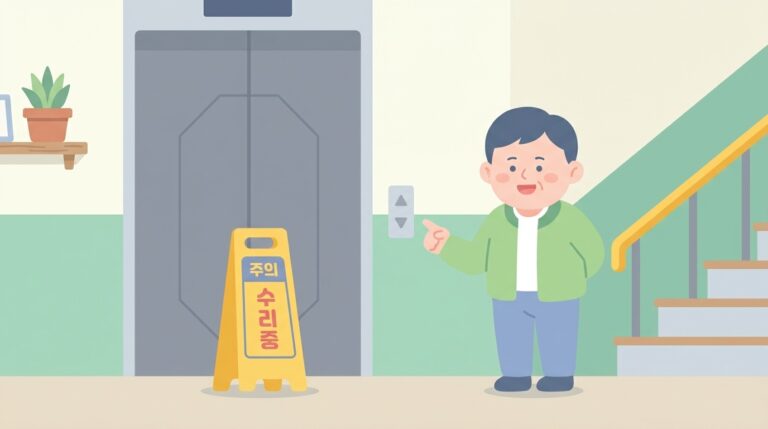
Imagine this: You are living in a beautiful, high-tech Korean apartment (아파트 – A-pa-teu) on the 18th floor. You are all dressed up, ready to meet your friends, and you walk out to the hallway. You press the elevator button, but it doesn’t light up. Instead, there is a big red sign on the door, and a friendly neighbor is looking at you with a sympathetic smile, saying: “점검 중이에요.” (Jeom-geom jung-i-e-yo.)
Oh no! You have to walk down 18 flights of stairs!
In Korea, apartments are highly managed, and elevator inspections (엘리베이터 점검 – El-li-be-i-teo jeom-geom) happen regularly to keep everyone safe. If you don’t know the basic words, you might get trapped on the top floor or walk into an awkward silent stare-down in the lobby. Don’t worry! Today, we are going to learn 3 super easy expressions to survive this exact situation. Let’s dive in!
Phase 2: Top 3 Survival Expressions
1. 점검 중이에요 (Jeom-geom jung-i-e-yo)
- Pronunciation: Jum-gum joong-ee-yo (Sounds like “Jump-gum” but without the ‘p’ sound!)
- Meaning: It is under inspection / maintenance.
- K-Culture Moment: You will see this written on a bright yellow safety cone blocking the elevator doors. Neighbors might point at it and say this to save you from pressing the dead button.
- Editor’s Insight: “중” (jung) means “middle” or “in the process of.” So, “점검” (inspection) + “중” (in progress) + “이에요” (is/am/are) = “It is currently being inspected.”
- Situation Spectrum: Casual: 점검 중이야 (⚠️) | Semi-formal: 점검 중이에요 (✅) | Formal: 점검 중입니다 (✅)
- 🤔 Think About It: In your home country, do people warn each other when the elevator is broken, or do they just walk away? In Korea, sharing this quick info is a warm way of showing “Jeong” (정 – community affection)!
2. 몇 층 가세요? (Myeot cheung ga-se-yo?)
- Pronunciation: Myut cheung gah-seh-yo? (“Myeot” rhymes with “shut”, “cheung” sounds like “chung” as in Chung-King!)
- Meaning: Which floor are you going to?
- K-Culture Moment: When the elevator is super crowded, and you are standing right next to the button panel (the designated “button captain”), you politely press the button for others.
- Editor’s Insight: “몇” (myeot) means “how many/which” and “층” (cheung) means “floor.” It is the ultimate elevator etiquette phrase in Korea!
- Situation Spectrum: Casual: 몇 층 가? (⚠️) | Semi-formal: 몇 층 가세요? (✅) | Formal: 몇 층 가십니까? (🚫 – too dramatic!)
- 🤔 Think About It: Why do Koreans ask this so often? Because pressing buttons for others, even strangers, is a small but deeply rooted manner in Korean high-rise culture.
3. 걸어 가야 돼요 (Geor-eo ga-ya dwae-yo)
- Pronunciation: Guh-ruh gah-yah dwae-yo (Rhymes with “Color” + “gah-ya” + “dwail-yo” without the ‘l’.)
- Meaning: I have to walk. / We must take the stairs.
- K-Culture Moment: You say this with a dramatic sigh to your roommate or on the phone when the elevator is out of service.
- Editor’s Insight: “걸어서” (by walking) + “가다” (to go) + “야 돼요” (have to). It’s a great survival phrase for when transportation fails!
- Situation Spectrum: Casual: 걸어 가야 돼 (✅ – to friends) | Semi-formal: 걸어 가야 돼요 (✅) | Formal: 걸어가야 합니다 (✅)
- 🤔 Think About It: Koreans walk a lot! Taking the stairs is often jokingly called “stair diet” (계단 다이어트). Let’s stay positive!
Phase 3: Textbook vs. Real Life Korean
Situation A: Asking if the elevator is working
- 📖 Textbook Korean: 엘리베이터가 작동합니까? (El-li-be-i-teo-ga jak-dong-hap-ni-ka? – “Does the elevator function?”)
- 🗣️ Real Life Korean: 엘리베이터 돼요? (El-li-be-i-teo dwae-yo? – “Does the elevator work?”)
- 💡 Why the difference? The textbook version sounds like a robot or a mechanic checking the system. Real Koreans just use “돼요?” (Does it work/Is it okay?) for everything!
Situation B: Expressing that you are using the stairs
- 📖 Textbook Korean: 저는 계단을 이용하여 올라가겠습니다. (Jeo-neun gye-dan-eul im-yong-ha-yeo ol-ra-ga-get-seup-ni-da. – “I shall ascend utilizing the stairwell.”)
- 🗣️ Real Life Korean: 걸어 올라갈게요. (Geor-eo ol-ra-gal-ge-yo. – “I’ll walk up.”)
- 💡 Why the difference? Keep it simple! “걸어” (walk) and “올라갈게요” (will go up) is conversational, friendly, and natural.
Phase 4: K-Culture & Elevator Etiquette
4-1. The Art of “Nunchi” (눈치) in the Elevator
In Korea, elevators are “quiet zones.” People rarely have loud, active conversations with strangers. Instead, they practice Nunchi (the art of reading the room).
* The Eyes: Look at the floor number display above the door, or look at your phone. Avoid direct, intense eye contact with strangers.
* The Nod: If a neighbor makes eye contact, do not say “Hi, how is your day?” Just give a gentle, silent 15-degree nod of the head. It’s polite and highly appreciated!
4-2. The “Ppalli-Ppalli” (빨리빨리) Button
Have you ever noticed how fast Koreans press the “Close Door” (닫힘 – Dat-him) button? It is the ultimate manifestation of “Ppalli-Ppalli” (hurry, hurry) culture. However, if you see someone walking towards the elevator, holding the “Open” (열림 – Yeol-rim) button is considered extremely polite!
Phase 5: Interactive Roleplay Scenario
Let’s practice! You are in your apartment lobby, ready to go up to your room on the 5th floor. You meet Min-su (민수), a friendly neighbor who lives next door.
Min-su: 안녕하세요! (An-nyeong-ha-se-yo!)
[😊 Smiling and nodding politely]
You: 안녕하세요! (An-nyeong-ha-se-yo!)
[😊 Smiling back]
Min-su: 혹시... 위층 가세요? (Hok-si... wi-cheung ga-se-yo?)
[🤔 Pointing towards the stairs]
"By any chance... are you going upstairs?"
You: 네, 5층 가요. (Ne, o-cheung ga-yo.)
[🙋♂️ Pointing to yourself]
"Yes, I'm going to the 5th floor."
Min-su: 아, 지금 엘리베이터 점검 중이에요. (Ah, ji-geum el-li-be-i-teo jeom-geom jung-i-e-yo.)
[🤦♂️ Sighing slightly and pointing to the yellow sign]
"Ah, the elevator is under inspection right now."
You: 아... 정말요? (Ah... jeong-mal-yo?)
[😮 Looking surprised]
"Ah... really?"
Min-su: 네, 그래서 우리 걸어 가야 돼요. (Ne, geu-rae-seo u-ri geor-eo ga-ya dwae-yo.)
[😅 Shrugging shoulders with a laugh]
"Yes, so we have to walk up."
You: 아이고... 같이 가요! (Ai-go... gat-i ga-yo!)
[👟 Taking the first step toward the stairs]
"Oh dear... let's go together!"
Min-su: 그래요, 힘내요! (Geu-rae-yo, him-nae-yo!)
[💪 Making a mini fist of encouragement]
"Sure, let's find some strength!"
🔀 Your Turn! What do you say to Min-su next?
Choose your response:
* A) “저는 그냥 여기서 기다릴게요.” (Jeo-neun geu-nyang yeo-gi-seo gi-da-ril-ge-yo. – “I’ll just wait here.”)
* B) “괜찮아요. 계단 운동해요!” (Gwen-chan-ah-yo. Gye-dan un-dong-hae-yo! – “It’s okay. Let’s do some stair exercise!”)
* C) “싫어요! 너무 힘들어요.” (Sil-heo-yo! Neo-mu him-deul-eyo. – “I hate it! It’s too hard.”)
🧐 Feedback on Your Choice:
- If you chose A (Risk): Honest, but you might be waiting for 2 hours! Inspections take time.
- If you chose B (Best): Fantastic! You sound incredibly positive, energetic, and your neighbor will love your friendly vibe!
- If you chose C (Bad): Oops! Too honest and a bit too negative for an A1 level polite chat. Min-su might feel awkward!
Phase 6: 10-Second Emotion Shadowing
Read these out loud with the correct feeling! The slash / means a tiny pause.
- [😮 Surprised & Sad]
아… / 점검 중이에요?
(Ah… / jeom-geom jung-i-e-yo?)
“Ah… is it under inspection?” -
[😩 Exhausted but cute]
아이고… / 걸어 가야 돼요.
(Ai-go… / geor-eo ga-ya dwae-yo.)
“Oh my… we have to walk.” -
[😊 Bright & Friendly]
몇 층 / 가세요?
(Myeot cheung / ga-se-yo?)
“Which floor / are you going to?”
Phase 7: K-Culture Mini Dictionary
- 점검 (Jeom-geom) | Inspection / Check-up. Used for elevators, cars, and gas pipes.
- 계단 (Gye-dan) | Stairs. If you live on the 2nd floor, using the Gye-dan is a great daily habit!
- 아파트 (A-pa-teu) | Apartment. In Korea, this refers to high-rise residential complexes, often with their own parks and security guards.
- 점검 중 (Jeom-geom-jung) | Under Maintenance. A common sign you will see on public escalators, toilets, and elevators.
Phase 8: Traveler’s Survival Kit
Survival Vocab TOP 3
- 고장 (Go-jang) – Broken / Out of order. (If the elevator is completely dead, this word is on the sign.)
- 몇 층? (Myeot cheung?) – Which floor? (Short version for casual situations).
- 계단 어디예요? (Gye-dan eo-di-yeo-yo?) – Where are the stairs?
📌 Editor’s Travel Note:
If you are traveling in Korea, download the Naver Map App immediately. It shows you exit numbers of subway stations and tells you exactly which exits have working elevators or escalators. Essential for heavy luggage carriers!
Phase 9: Deep Dive into Korean Culture
In Korea, apartments are not just buildings; they are tiny cooperative societies. Because millions of people live closely in high-rises, there is a strong emphasis on “not bothering neighbors” (민폐 – Min-pye). This is why you will notice that people talk in whispers inside elevators. Sharing the news about a “점검” (inspection) is a small act of kindness to save your neighbor’s precious time!
💬 Your Turn: Have you ever experienced a broken elevator in a foreign country? How did you handle it? Tell us in the comments below!
Phase 10: FAQ & Common Mistakes
Q: What is the difference between “고장” (Go-jang) and “점검” (Jeom-geom)?
A: 고장 means the elevator is broken unexpectedly. 점검 means a routine safety check-up that was planned.
Q: Can I say “엘리베이터 안 돼요” (El-li-be-i-teo an dwae-yo)?
A: Yes! That is a perfect, natural way to say “The elevator is not working.”
Q: What should I do if I get stuck inside?
A: Press the yellow phone button labeled 비상 호출 (Bi-sang ho-chul – Emergency Call). Korean apartment security guards are active 24/7!
🚨 Common Mistakes Warning Board
- Mistake 1: Saying “엘리베이터가 고장 중이에요” (X) -> 고장 is a noun, not an action. Say “엘리베이터가 고장 났어요” (O) – The elevator broke.
- Mistake 2: Standing too close to people in the elevator. Keep a respectful arm-length distance if space allows!
Phase 11: Action Mission!
- 🥉 Bronze: Say “점검 중이에요” out loud 5 times in front of your mirror.
- 🥈 Silver: Draw a post-it note with “점검 중” and post it on your door as a fun Korean study reminder.
- 🥇 Gold: Next time you use an elevator with a Korean speaker, ask them: “몇 층 가세요?”
Phase 12: Interactive Quiz Challenge
Q1. What does “점검 중” mean?
- A) The elevator is fast.
- B) The elevator is under inspection.
- C) The stairs are closed.
Click for Answer & Explanation
Answer: B!
“점검” means inspection, and “중” means in progress. You did great!
Q2. Fill in the blank: “몇 _____ 가세요?” (Which floor are you going to?)
Click for Answer & Explanation
Answer: 층 (cheung)
“층” means floor in Korean!
Q3. True or False: It is polite to loudly greet every stranger in a Korean elevator.
Click for Answer & Explanation
Answer: False!
Koreans prefer quiet politeness (Nunchi and a soft nod) rather than loud greetings in enclosed spaces.
See you in the next lesson! Keep practicing, and stay safe on those stairs! 화이팅! (Hwai-ting! – Fighting!)







