

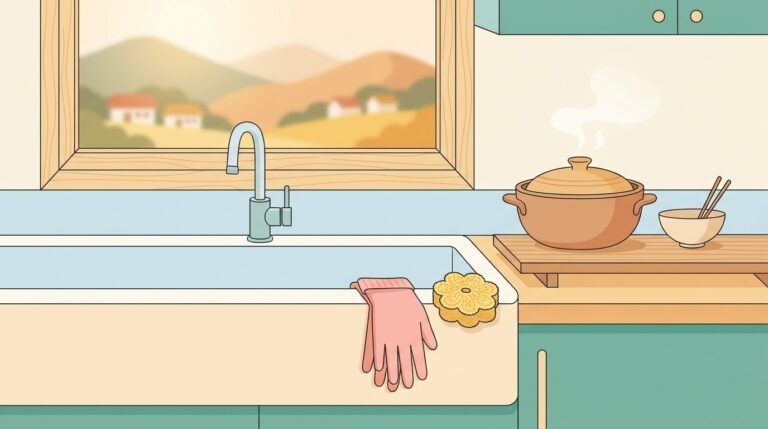
Done with Dinner? Let’s Tackle the Dishes like a K-Drama Pro!
Phase 1: Empathy (Welcome to the Kitchen, Bestie!)
안녕하세요! (An-nyeong-ha-se-yo!) Welcome back to Daily Hangul. I’m your resident K-culture navigator and Korean bestie!
Picture this: You just finished a delicious, comforting meal of Kimchi Bokkeumbap (fried rice) with your Korean roommates or host family. Everyone is full, happy, and laughing. But then, you look at the sink. It’s piled high with red-stained plates and oily pans.
You want to be a helpful guest or a great roommate by offering to do the dishes, but suddenly, your mind goes blank. “How do I say ‘I’ll do the dishes’ without sounding like a robot?” or “What if I accidentally use super stiff, textbook language that ruins the warm, cozy vibe?”
Don’t worry! Doing the dishes—설거지 (seol-geo-ji)—is one of the ultimate bonding activities in Korean households and K-dramas (think of those sweet scenes where the main leads accidentally touch hands while reaching for the sponge!). Today, we are going to learn how to offer, share, and talk about washing dishes like a real local. Let’s dive in!
Phase 2: Deep-Dive into 3 Essential Expressions
Let’s learn the top 3 magic sentences you need in the kitchen.
1. 제가 설거지할게요! (Je-ga seol-geo-ji-hal-ge-yo!)
- Pronunciation: Jay-ga sul-guh-jee-hal-gay-yo! (Sounds like “Jay-ga” + “soul-go-jee” + “hal-kay-yo”)
- Meaning: “I will do the dishes!”
- K-Culture Moment: You’ll hear this constantly in reality shows like Three Meals a Day (삼시세끼). The youngest member or a polite guest quickly jumps up to say this to show respect and gratitude after a meal.
- Editor’s Insight: The ending -ㄹ게요 (-l-ge-yo) expresses a friendly promise or a polite declaration of your intention. It sounds incredibly helpful and warm.
- Situation Spectrum: Casual (⚠️ – use “내가 할게!” instead) / Semi-formal (✅) / Formal (✅)
- 🤔 Think About It: In many Western cultures, a host might insist on doing the dishes alone to make the guest feel pampered. In Korea, actively offering to do the dishes is seen as a beautiful way to share the warmth of a shared meal. What is it like in your country?
2. 제가 도와줄게요. (Je-ga do-wa-jul-ge-yo.)
- Pronunciation: Jay-ga doh-wah-jool-gay-yo. (Sounds like “doh-wah” + “jool-gay-yo”)
- Meaning: “I’ll help you.” / “Let me help you.”
- K-Culture Moment: The classic K-drama kitchen scene! One person is washing, and the other quietly stands next to them to dry or put the dishes away while sharing a deep, heart-to-heart conversation.
- Editor’s Insight: This is perfect when someone is already at the sink, and you want to be their co-pilot. It splits the chore and doubles the bonding time.
- Situation Spectrum: Casual (⚠️ – use “도와줄게”) / Semi-formal (✅) / Formal (✅)
- 🤔 Think About It: How does helping with chores build intimacy in relationships? Why do you think so many romantic K-drama scenes happen in front of a kitchen sink?
3. 물만 조금 묻혀 놓으세요. (Mul-man jo-geum mut-hyeo no-eu-se-yo.)
- Pronunciation: Mool-man jo-gum moot-hyeo no-uh-say-yo. (Sounds like “Mool-man” + “jo-gum” + “moot-chuh” + “no-se-yo”)
- Meaning: “Just soak them in water for now.” (Literally: “Just put a little water on them.”)
- K-Culture Moment: When a Korean mom or a sweet older friend wants to rest after eating but plans to wash up later, they’ll say this so the leftover food doesn’t dry and stick to the plates.
- Editor’s Insight: This is a highly practical phrase! 묻히다 (mut-hi-da) means to smear or wet, and -어 놓다 (-eo no-ta) means to do something in advance for later use.
- Situation Spectrum: Casual (⚠️ – use “물만 좀 묻혀 놔”) / Semi-formal (✅) / Formal (✅)
- 🤔 Think About It: Koreans love efficiency! Soaking dishes saves water and soap later on. Does your family soak dishes immediately, or do you wash them right away?
Phase 3: Textbook Korean vs. Real Korean
Let’s compare what the old textbooks teach you versus how real Koreans actually talk in the kitchen.
Situation A: Offering to do the dishes
- 📖 Textbook: “제가 식기를 세척하겠습니다.” (Je-ga sik-gi-reul se-cheok-ha-get-seup-ni-da.)
- Why it’s weird: This sounds like you are a professional industrial dishwasher operating a machine. Too stiff!
- 🗣️ Real Korean: “설거지는 제가 할게요!” (Seol-geo-ji-neun je-ga hal-ge-yo!)
- 💡 Why it’s better: Friendly, natural, and immediately puts the host at ease.
Situation B: Asking where the dish soap is
- 📖 Textbook: “식기 세척제는 어디에 위치합니까?” (Sik-gi se-cheok-je-neun eo-di-e wi-chi-hap-ni-da?)
- Why it’s weird: Sounds like a formal detective locating a missing object.
- 🗣️ Real Korean: “세제 어디 있어요?” (Se-je eo-di is-seo-yo?)
- 💡 Why it’s better: Simple, conversational, and uses the daily word 세제 (se-je) instead of the technical term.
Phase 4: K-Culture Deep-Dive & Non-Verbal Manners
4-1. The Art of “Nunchi” (눈치) at the Sink
In Korea, action speaks louder than words. If you want to show your hosts or friends that you have incredible 눈치 (Nunchi – situational wit), don’t just stand there waiting to be asked.
* The Move: Gently stand up, gather the chopsticks and spoons first, and bring them to the sink.
* The Gesture: Keep your head slightly bowed in a respectful, polite posture while saying “제가 할게요!” with a bright smile. If they refuse once (which is common courtesy in Korea), offer one more time with a soft laugh. If they refuse a second time, you can step back and say “잘 먹었습니다!” (Thank you for the meal!).
4-2. The “Rubber Glove” Culture (빨간 고무장갑)
Have you ever noticed those bright, iconic pink/pinkish-red rubber gloves in almost every Korean kitchen? They are called 고무장갑 (go-mu-jang-gap). They are a staple of Korean house chores, especially for protecting hands from cold water and strong dish soap. Putting them on is the ultimate symbol that you are ready to get down to business!
Phase 5: Interactive Roleplay Scenario
Meet Ji-hoon (지훈), your Korean host. You’ve just finished eating a delicious home-cooked dinner at his apartment in Seoul.
The Kitchen Dialogue (8-Turns)
- Ji-hoon: (Yawning slightly) 아, 배부르다! 진짜 잘 먹었다. (Ah, bae-bu-reu-da! Jin-jja jal meog-eot-da.)
“Ah, I’m full! That was a great meal.” - You: 🎭 (Smiling warmly) 저도 정말 맛있게 먹었어요. 지훈 씨, 설거지는 제가 할게요! (Jeo-do jeong-mal mas-it-ge meog-eot-eo-yo. Ji-hoon ssi, seol-geo-ji-neun je-ga hal-ge-yo!)
“I really enjoyed it too. Ji-hoon, I’ll do the dishes!” - Ji-hoon: 🎭 (Waving hands in refusal) 에이, 아니에요! 손님인데 그냥 두세요. 제가 할게요. (E-i, a-ni-e-yo! Son-nim-in-de geu-nyang du-se-yo. Je-ga hal-ge-yo.)
“Oh, no! You’re a guest, just leave it. I’ll do them.” - You: 🎭 (Step closer to the sink, picking up a sponge) 아니에요! 준비하느라 고생하셨으니까 제가 돕고 싶어요. (A-ni-e-yo! Jun-bi-ha-neu-ra go-saeng-ha-shyeos-seu-ni-kka je-ga dop-go sip-eo-yo.)
“No, really! You worked hard preparing it, so I want to help.” - Ji-hoon: 🎭 (Smiling gratefully) 그래요? 그럼 같이 해요! 제가 물로 헹굴게요. (Geu-rae-yo? Geu-rom gat-i hae-yo! Je-ga mul-lo heng-gul-ge-yo.)
“Really? Then let’s do it together! I’ll rinse them with water.” - You: 🎭 (Nodding eagerly) 네, 좋아요! 세제는 어디 있어요? (Ne, jo-a-yo! Se-je-neun eo-di is-seo-yo?)
“Yes, sounds good! Where is the dish soap?” - Ji-hoon: 싱크대 아래 서랍에 있어요. 고무장갑 끼고 하세요! (Sing-keu-dae a-rae seo-rap-e is-seo-yo. Go-mu-jang-gap kki-go ha-se-yo!)
“It’s in the drawer under the sink. Wear the rubber gloves!” - You: 🎭 (Putting on the gloves) 네, 고마워요. 시작할게요! (Ne, go-ma-wo-yo. Si-jak-hal-ge-yo!)
“Okay, thanks. Let’s start!”
🔀 Your Turn: Interactive Choice!
How do you respond when Ji-hoon insists on doing them alone in Turn 3?
- A) “네, 알겠습니다!” (Ne, al-get-seup-ni-da! / “Okay, I understand!”) and sit back on the couch.
- Feedback: Risk! While polite, it might make you look a little too eager to avoid work. In Korea, offering at least twice shows sincerity!
- B) “아니에요! 제가 꼭 하고 싶어요.” (A-ni-e-yo! Je-ga kkok ha-go sip-eo-yo. / “No! I really want to do it.”) while gently taking the sponge.
- Feedback: Best! It shows warm determination and care for your host. It will definitely put a warm smile on Ji-hoon’s face.
- C) “싫어요. 설거지하기 귀찮아요.” (Sil-eo-yo. Seol-geo-ji-ha-gi gwi-chan-a-yo. / “No, I don’t want to. Washing dishes is annoying.”)
- Feedback: Bad! Oh no, absolute disaster! This is super rude and will ruin the warm atmosphere instantly.
Phase 6: 10-Second Emotion Shadowing Drill
Let’s practice speaking with raw, natural emotions! Pay attention to the pauses (/) and the feelings.
[😊 Energetically & Warmly]- 설거지는 / 제가 / 할게요! (Seol-geo-ji-neun / je-ga / hal-ge-yo!)
- “I will / do / the dishes!”
[🥺 Gently pleading & Sincere]- 아니에요, / 제가 / 도울게요. (A-ni-e-yo, / je-ga / do-ul-ge-yo.)
- “No, really, / let me / help.”
Phase 7: K-Culture Mini Dictionary
- 고무장갑 (Go-mu-jang-gap) | Rubber Gloves | The iconic pink gloves used for doing dishes, cleaning, and making Kimchi to protect your skin.
- 수세미 (Su-se-mi) | Sponge / Scrubber | The sponge used to clean dishes. They often come in cute handmade crochet shapes in Korean homes!
- 식기건조대 (Sik-gi-geon-jo-dae) | Dish Drying Rack | The rack next to the sink where you stack the clean, wet dishes to air-dry.
- 싱크대 (Sing-keu-dae) | Kitchen Sink | Derived from the English word “sink,” this refers to the entire kitchen counter sink area.
Phase 8: Survival Kit for Travelers
Survival Expressions TOP 3
- 이거 어디에 둘까요? (I-geo eo-di-e dul-kka-yo?)
- Meaning: Where should I put this?
- Pro Tip: Use this when you are drying dishes and don’t know which cabinet they belong to.
- 뜨거운 물 잘 나와요? (Tteu-geo-un mul jal na-wa-yo?)
- Meaning: Does the hot water run well?
- Pro Tip: Helpful in older guesthouses or traditional homes during winter.
- 행주 어디 있어요? (Haeng-ju eo-di is-seo-yo?)
- Meaning: Where is the dishcloth?
- Pro Tip: Use this to wipe down the table after washing the dishes to finish the job beautifully.
Editor’s Travel Note
When staying at an Airbnb or a Hanok (traditional house) guest house in Korea, always check the trash disposal rules near the sink. Food waste (음식물 쓰레기 – eum-sik-mul sseu-re-gi) must be separated strictly from general trash. To make sure you don’t get lost in translation or find the nearest convenience store for official trash bags, search for directions on the Naver Map App which is the absolute gold standard for navigation in Korea.
Note: Local waste disposal guidelines can change depending on the district, so always double-check with your host.
Phase 9:
Frequently Asked Questions (FAQ)
Q: What does "제가 설거지할게요! (Je-ga seol-geo-ji-hal-ge-yo!)" mean in Korean and how do you pronounce it?
A: In Korean, "제가 설거지할게요! (Je-ga seol-geo-ji-hal-ge-yo!)" is pronounced [Jay-ga sul-guh-jee-hal-gay-yo! (Sounds like "Jay-ga" + "soul-go-jee" + "hal-kay-yo"] and means: "I will do the dishes!"
Q: What does "제가 도와줄게요. (Je-ga do-wa-jul-ge-yo.)" mean in Korean and how do you pronounce it?
A: In Korean, "제가 도와줄게요. (Je-ga do-wa-jul-ge-yo.)" is pronounced [Jay-ga doh-wah-jool-gay-yo. (Sounds like "doh-wah" + "jool-gay-yo"] and means: "I'll help you." / "Let me help you."
Q: What does "물만 조금 묻혀 놓으세요. (Mul-man jo-geum mut-hyeo no-eu-se-yo.)" mean in Korean and how do you pronounce it?
A: In Korean, "물만 조금 묻혀 놓으세요. (Mul-man jo-geum mut-hyeo no-eu-se-yo.)" is pronounced [Mool-man jo-gum moot-hyeo no-uh-say-yo. (Sounds like "Mool-man" + "jo-gum" + "moot-chuh" + "no-se-yo"] and means: "Just soak them in water for now." (Literally: "Just put a little water on them.")







