

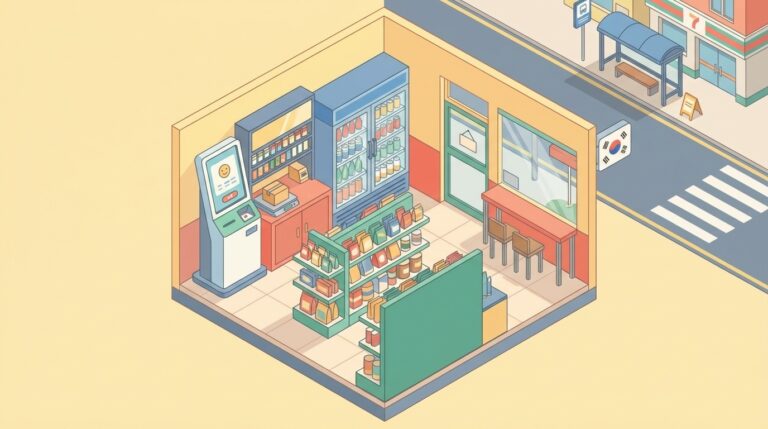
Master Korean Convenience Store Courier Services Like a Local: A C1 Guide to C-Store Shipping
Phase 1: Empathy (Welcome to the Ultimate Life Hack)
안녕하세요! Welcome back to another Masterclass by Daily Hangul, your cultural navigator in Korea!
Imagine this: You’ve just spent the afternoon hunting down the perfect K-beauty products or vintage K-pop albums in Hongdae. Now, your suitcase is bursting at the seams, and you still have two cities left on your itinerary. Or perhaps you’re living in Korea, and you need to return an online shopping fail but dread going to the official post office during your busy work hours.
Enter the unsung hero of Korean daily life: the Convenience Store Courier Service (편의점 택배 – Pyeon-ui-jeom Taek-bae). Available 24/7 at almost every GS25 or CU, this service is a marvel of Korean efficiency. However, navigating the self-service kiosks with their rapid-fire Korean prompts, handling weight scales, and interacting with busy store clerks can induce major public anxiety.
In this C1 guide, we are bypassing the basic textbook vocabulary to explore the precise linguistic nuances, cultural etiquette (or “Nunchi”), and high-level idiomatic expressions you need to manage packages like a true native. Let’s make your life in Korea hassle-free!
Phase 2: Deep Dive into 3 Essential Expressions
To sound sophisticated and natural, you need more than just “택배 보내고 싶어요” (I want to send a package). Here are three high-level expressions that will instantly elevate your status from a clueless tourist to a seasoned resident.
1. 무게 측정하고 접수해 주세요 (Muge cheok-jeong-hago jeop-su-hae ju-se-yo)
- Pronunciation: Moo-ge chuk-jung-ha-go jup-soo-hae joo-seh-yo (Think “moo-ge” like moo followed by get without the ‘t’).
- Meaning: “Please weigh this and register the shipment.”
- K-Culture Moment: In K-Dramas like Our Beloved Summer, characters often drop off packages at convenience stores, casually handing them over after weighing them on the kiosk scale.
- Editor’s Insight: At Korean convenience stores, you usually weigh the package on a digital scale built into the postbox kiosk. Saying “무게 측정” (measuring weight) and “접수” (official registration/reception) shows you understand the step-by-step logistical system.
- Situation Spectrum: Casual: ⚠️ | Semi-formal: ✅ | Formal: ✅
- 🤔 Think About It: In many Western countries, post office staff do everything for you. Why do you think Korea shifted to a hybrid self-service model in retail environments?
2. 반값택배로 부칠게요 (Ban-gkap-taek-bae-ro bu-chil-ge-yo)
- Pronunciation: Bahn-gkap-taek-bae-ro boo-cheel-geh-yo (Sounds like “Bahn” + “Ghap” as in gap + “taek-bae”).
- Meaning: “I will send this via Half-Price Delivery.”
- K-Culture Moment: This is the ultimate budget hack popularized by K-university students on YouTube vlogs. It uses the logistics network of the convenience store chain itself to deliver from one branch to another for half the cost of regular home delivery.
- Editor’s Insight: “부치다” (bu-chi-da) is a beautiful, native Korean verb specifically used for sending mail or packages, distinct from the generic “보내다” (bo-nae-da).
- Situation Spectrum: Casual: ✅ | Semi-formal: ✅ | Formal: 🚫
- 🤔 Think About It: How does the linguistic distinction between “부치다” (to post/send mail) and “보내다” (to send anything) reflect the historical importance of postal communication in Korea?
3. 송장 출력해서 카운터로 가져갈게요 (Song-jang chul-ryeok-hae-seo ka-un-teo-ro ga-jeo-gal-ge-yo)
- Pronunciation: Song-jang chool-ryuk-hae-suh kah-oon-tuh-ro gah-juh-gahl-geh-yo (Like “song-jang” + “chul” as in chill + “yup”).
- Meaning: “I will print the waybill and take it to the counter.”
- K-Culture Moment: You will hear this exact phrase when a store clerk is busy and wants to guide you through the process without holding up the line.
- Editor’s Insight: “송장” (Song-jang) is the technical term for a shipping label or waybill. Using this word instead of “스티커” (sticker) or “표” (ticket) immediately signals C1 proficiency.
- Situation Spectrum: Casual: ⚠️ | Semi-formal: ✅ | Formal: ✅
- 🤔 Think About It: Using precise business/logistics terms in public spaces shows respect for the clerk’s professional time. How does your culture view public administrative interactions?
Phase 3: Textbook Korean vs. Real-World Korean
Let’s compare the sterile sentences taught in overseas classrooms with the snappy, efficient phrasing used by actual Koreans.
Situation 1: Asking if the store accepts packages
- 📖 Textbook: “여기에서 택배를 보낼 수 있습니까?” (Yeo-gi-ee-seo taek-bae-reul bo-nael su it-seum-ni-ka?)
- 🗣️ Real-World: “여기 택배 접수 돼요?” (Yeo-gi taek-bae jeop-su dwae-yo?)
- 💡 Why the Difference? C1 speakers drop unnecessary particles (에서, 를) and replace the rigid “보낼 수 있습니까” with the active, colloquial “접수 돼요?” (Is registration possible?).
Situation 2: Informing the clerk that you’ve finished the kiosk process
- 📖 Textbook: “기계로 등록을 완료했습니다. 여기 종이가 있습니다.”
- 🗣️ Real-World: “기계로 접수 다 하고 송장 뽑았어요. 여기요.”
- 💡 Why the Difference? Real Koreans use “다 하고” (all done) instead of the dry “완료했습니다” (completed) and use the native verb “뽑다” (to pluck/print out) instead of “출력하다” in everyday speech.
Phase 4: K-Culture Deep Dive & Non-Verbal Etiquette
4-1. Nunchi (눈치) & Kiosk Gestures
In Korea, speed and consideration for others in line are forms of politeness. When using the courier kiosk, if you see someone waiting behind you, it is polite to make brief eye contact, bow your head slightly, and speed up your typing.
When handing over the printed waybill (송장) and package to the cashier, always use both hands. Using one hand to hand over items is considered dismissive, especially in transactional relationships.
4-2. The “Half-Price Delivery” (반값택배) Phenomenon
This cultural phenomenon is driven by the country’s unparalleled convenience store density (GS25 and CU have over 30,000 stores combined). Because Koreans live in highly dense urban neighborhoods, walking 3 minutes to a nearby store to pick up a package is often preferred over waiting for home delivery, especially for safety-conscious single-person households.
Phase 5: Real-World Roleplay Scenario
Characters & Context
- 유진 (Yujin – Store Clerk): A busy college student working the afternoon shift at a GS25 in Gangnam.
- 마이클 (Michael – Learner): A C1 level expat trying to return a jacket purchased online.
[Scene: Inside a bustling GS25 during the lunch rush. Michael is holding a taped cardboard box and stands before the Courier Kiosk (포스트박스).]

1. 마이클: (정중하게 목례하며) 저기요, 이거 택배 보내려는데 기계가 먹통이 된 것 같아요.
   (Excuse me, I'm trying to send a package, but the machine seems to be frozen.)

2. 유진: (계산기 바코드를 찍으며) 아, 그거 가끔 렉 걸려요. 화면 밑에 리셋 버튼 한번만 눌러주시겠어요?
   (Ah, that freezes sometimes. Could you press the reset button at the bottom of the screen just once?)

3. 마이클: (버튼을 누르고 화면이 켜지자) 오, 되네요! 일반 택배로 회원 접수하면 되죠?
   (Oh, it works! I should do 'Member Registration' for regular shipping, right?)

4. 유진: 네, 미리 예약하셨으면 휴대폰 번호 입력하시고 로그인하시면 돼요.
   (Yes, if you made a reservation beforehand, just input your phone number and log in.)

5. 마이클: (무게를 측정하고 나서) 다 됐습니다! 송장 출력해서 붙여서 드리면 되나요?
   (All done! Should I print the waybill, stick it on, and give it to you?)

6. 유진: 아뇨, 바코드가 찍혀야 해서 송장의 고객 보관용 부분만 뜯어서 카운터로 가져와 주세요.
   (No, because we need to scan the barcode, please tear off just the customer copy of the waybill and bring it to the counter.)

7. 마이클: (송장을 들고 카운터로 오며) 네, 여기 있습니다. 선불로 계산할게요.
   (Yes, here it is. I'll pay in advance/pre-paid.)

8. 유진: 바코드 찍었습니다. 총 3,800원입니다. 결제는 카드로 도와드릴게요.
   (Barcode scanned. That'll be 3,800 KRW. I will help you pay by card.)
🔀 Interactive Choice Points
How should Michael respond to a sudden prompt on the kiosk asking for extra insurance for high-value items?
- A) “그냥 기본으로 할게요. (I’ll just go with the basic option.)”
- Feedback: Best! Keeps the transaction swift and avoids paying unnecessary surcharges for everyday items.
- B) “귀중품이라 걱정되는데 어떡해요? (I’m worried because it’s a valuable. What should I do?)”
- Feedback: Risk. The clerk is busy handling a line. It is better to make your choice before approaching the counter or read the policy yourself.
- C) “보험 안 해요. 필요 없어요. (No insurance. Don’t need it.)”
- Feedback: Bad. A bit too blunt/curt for Korean service standards, though grammatically correct.
Phase 6: 10-Second Emotion Shadowing Drill
Practice these natural pauses (/) and emotional cues to master native rhythm.
[😊 Friendly and Polite]
“저기요 / 이거 반값택배로 / 보낼 수 있을까요?”
(Jeo-gi-yo / i-geo ban-gkap-taek-bae-ro / bo-nael su i-sseul-ka-yo?)-
[🤔 Sightly confused but courteous]
“무게가 안 재지는데 / 저울 한번 / 확인해 주시겠어요?”
(Mu-ge-ga an jae-ji-neun-de / jeo-ul han-beon / hwa-gin-hae ju-si-ge-sseo-yo?)
Phase 7: K-Culture Mini Dictionary
- 반값택배 (Ban-gkap Taek-bae) | Half-Price Courier | A ultra-budget logistics service operating between convenience stores of the same brand.
- 송장 (Song-jang) | Waybill/Shipping Label | The printed sticky paper detailing sender/receiver information and barcodes.
- 선불/착불 (Seon-bul / Chak-bul) | Prepaid / Cash on Delivery | Prepaid is “선불”, COD is “착불”. Most convenience store shipments prefer “선불”.
- 수거 (Su-geo) | Courier Pick-up | The act of the main delivery truck collecting packages from the store, usually once a day around 3 to 5 PM.
Phase 8: Survivor’s Travel Kit
Survival Phrases
- “테이프하고 박스 있어요?” (Te-i-peu-ha-go bak-seul-it-seo-yo?)
- Pro Tip: Convenience stores do not usually provide boxes for free. You must bring your item already packed.
- “택배 수거해 갔나요?” (Taek-bae su-geo-hae gat-na-yo?)
- Pro Tip: Ask this if you want to know if your package will ship today or tomorrow.
- “기계 화면이 안 눌려요.” (Gi-gye hwa-myeon-i an nul-ryeo-yo?)
- Pro Tip: Useful when the touchscreen is unresponsive.
Editor’s Travel Note
Before heading out, download the GS25 나만의냉장고 or CU Pocket app to pre-register your shipping addresses. Doing this allows you to simply scan a QR code at the kiosk to print your waybill instantly without typing Korean addresses on screen. Note: App layouts and services are subject to change over time.
Phase 9: “A Step Deeper” (Cultural Reflection)
In Korea, the convenience store is not just a commercial outlet; it is an infrastructure anchor. The absolute trust required to leave your valuable packages in an open bin in a corner of a 24-hour store, secure in the knowledge that they will be safely scanned, sorted, and delivered within 24 hours, speaks volumes about the high social trust and communal safety of South Korea.
💬 Your Turn: How does the package shipping experience in your country compare to this hyper-convenient, trust-based Korean system? Let us know in the comments below!
Phase 10: FAQ & Avoiding Common Mistakes
Q: Can I ship internationally using convenience stores?
A: Yes, select major GS25 and CU branches equipped with Postbox services offer international shipping via DHL or EMS, though not all locations support this.
Q: What is the maximum weight limit for convenience store packages?
A: Generally, packages must weigh under 20kg to 25kg, and the sum of the three sides (width + length + height) must not exceed 160cm.
Q: Can I use credit cards issued outside of Korea for payment?
A: Yes, standard overseas Visa/Mastercard credit cards are widely accepted at the POS counters of GS25, CU, and 7-Eleven.
🚨 Common Mistakes Alert!
- Mistake 1: Bringing an unpacked item expecting the store clerk to pack it for you.
- Correct Action: Packages must be fully boxed, taped, and sealed before you arrive.
- Mistake 2: Sticking the customer receipt portion of the waybill onto the box.
- Correct Action: Only stick the shipping label on the box. Keep the receipt portion with the barcode for the cashier to scan.
Phase 11: Action Mission
- Bronze Medal: Go to your nearest GS25 or CU, find the “Postbox” machine, and switch the language to Korean to explore the UI.
- Silver Medal: Take a picture of your printed waybill (blocking private information) and share it on Instagram tagging
#DailyHangulto show off your intermediate skills. - Gold Medal: Successfully ship a gift to a Korean friend using the 반값택배 (Half-Price Delivery) option completely in Korean!
Phase 12: Interactive Quiz Challenge
Test your convenience store mastery!
1. Which term refers to “Cash on Delivery”?
- A) 선불 (Seon-bul)
- B) 착불 (Chak-bul)
- C) 반값 (Ban-gkap)
See Answer
Correct Answer: B) 착불 (Chak-bul)
* Explanation: ‘착’ (arrival) + ‘불’ (pay). It means paying for delivery upon arrival.
2. True or False: You should paste both the shipping label and the customer receipt barcode directly onto the package.
See Answer
Correct Answer: False
* Explanation: You must peel off and keep the customer receipt portion so the cashier can scan it at the counter for billing.







