

안녕하세요! Welcome to Daily Hangul! 🇰🇷
안녕하세요! (An-nyeong-ha-se-yo!) I am your chief editor and native culture navigator at Daily Hangul. Have you ever watched a Korean variety show like Running Man or Knowing Bros and wondered why everyone bursts into laughter when someone slips on a banana peel or does a funny dance?
That is called 몸개그 (Mom-gae-geu)—slapstick or physical comedy! Even if you don’t speak perfect Korean yet, physical humor connects us all. Today, we are going to learn 3 super easy, beginner-friendly Korean words used in variety shows when physical comedy happens. By the end of this, you’ll be laughing and reacting just like a real Korean variety star! Let’s dive in! 🎉
Phase 2: Top 3 Variety Show Words for “Mom-gae-geu”
1. 몸개그 (Mom-gae-geu)
- Pronunciation: Mom-gae-geu (Sounds like “Mom” + “get” without the ‘t’ + “goo” with a short ‘u’)
- Meaning: Body Gag / Slapstick Comedy
- K-Culture Moment: When a comedian trips on purpose, wears a funny costume, or does a silly face to make people laugh.
- Editor’s Insight: This word combines 몸 (mom – body) and 개그 (gae-geu – gag/comedy). It is the ultimate word for physical humor!
- Situation Spectrum: Casual ✅ | Semi-formal ⚠️ | Formal 🚫
- 🤔 Think About It: Why do you think physical comedy is so popular across different cultures?
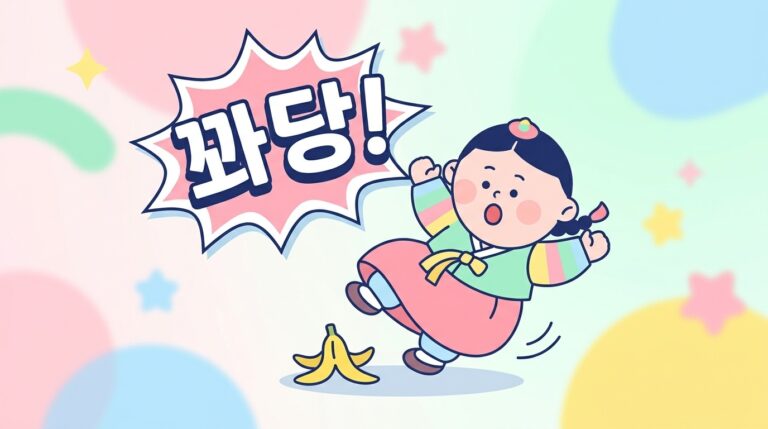
2. 꽈당 (Kkwa-dang)
- Pronunciation: Kkwa-dang (Emphasize the double ‘K’ sound! Sounds like a loud “Kwah-dahng!”)
- Meaning: Thud! / Ker-plop! (The sound of falling)
- K-Culture Moment: You will see this word in big, colorful subtitles on screen when a cast member falls down on a slippery floor.
- Editor’s Insight: This is an onomatopoeia (sound word). Saying it out loud instantly makes a clumsy fall sound adorable and funny!
- Situation Spectrum: Casual ✅ | Semi-formal ⚠️ | Formal 🚫
- 🤔 Think About It: Do you have a favorite sound word for falling in your language?
3. 허당 (Heo-dang)
- Pronunciation: Heo-dang (Sounds like “Huh” + “dahng”)
- Meaning: A lovable, clumsy person who looks smart but makes silly mistakes.
- K-Culture Moment: When a handsome actor comes on a variety show and immediately drops their name tag or gets lost.
- Editor’s Insight: Calling someone a 허당 (heo-dang) is actually very affectionate! It means they are clumsy but cute.
- Situation Spectrum: Casual ✅ | Semi-formal ⚠️ | Formal 🚫
- 🤔 Think About It: Who is the biggest “Heo-dang” in your friend group?
Phase 3: Textbook Korean vs. Real Korean
Let’s compare how textbooks teach falling vs. how variety shows actually say it!
Situation 1: Describing someone falling
- 📖 Textbook: 넘어졌어요. (Neo-meo-jyeo-sseo-yo.) = “I fell down.”
- 🗣️ Real Korean: 꽈당 했어요! (Kkwa-dang hae-sseo-yo!) = “I went splat!”
- 💡 Why is it different? Variety shows love dramatic, cute, and lively sound effects over dry dictionary words.
Situation 2: Calling someone clumsy
- 📖 Textbook: 서투른 사람 (Seo-tu-reun sa-ram) = “An unskilled person.”
- 🗣️ Real Korean: 허당 (Heo-dang) = “A lovable klutz.”
- 💡 Why is it different? “허당” adds a friendly, warm, and humorous vibe instead of sounding mean.
Phase 4: K-Culture Deep Dive & Non-Verbal Manners
4-1. The “Ah-cha!” Hand Gesture
In Korean variety shows, when someone does a 몸개그 (Mom-gae-geu), other cast members often put their hands over their mouths in mock shock, or clap their hands rapidly while laughing. If you want to react naturally, clap your hands loudly while saying “대박!” (Dae-bak! – Amazing!).
4-2. The Golden Rule of Korean Slapstick
Korean variety shows love physical games (like paper cup stacking or soapy slides). The key cultural code here is 망가짐 (Mang-ga-jim)—which means “letting yourself ruin your cool image for the sake of laughter.” It shows you are humble and warm-hearted!
Phase 5: Real-Life Roleplay Scenario
Meet Minji (민지), your funny Korean friend, and Jiho (지호), the king of clumsiness. You are all watching a fun variety game in a park.
- Minji: 저기 봐요! 지호가 또 넘어진다! (Jeo-gi bwa-yo! Ji-ho-ga tto neom-eo-jin-da!)
- 🎭 Points playfully at Jiho.
- You: 어? 진짜요? (Eo? Jin-jja-yo?)
- 🎭 Look over with wide eyes.
- Jiho: 꽈당! (Kkwa-dang!)
- 🎭 Slipped on the wet grass and landed on his bottom.
- Minji: 하하하! 완전 몸개그다! (Ha-ha-ha! Wan-jeon mom-gae-geu-da!)
- 🎭 Claps hands while laughing loudly.
- You: 지호 씨 진짜 허당이에요. (Ji-ho ssi jin-jja heo-dang-i-e-yo.)
- 🎭 Gigglng warmly.
- Jiho: 아파요~ 근데 웃기죠? (A-pa-yo~ geun-de ut-gi-jyo?)
- 🎭 Rubs his back but smiles proudly.
- Minji: 응, 진짜 웃겨! 최고! (Eung, jin-jja ut-gyeo! Choe-go!)
- 🎭 Gives two thumbs up.
- You: 지호 씨, 괜찮아요? (Ji-ho ssi, gwen-chan-a-yo?)
- 🎭 Offers a hand to help him up.
🔀 Interactive Choice
What will you say to Jiho now?
* A. “몸개그 대박이에요!” (Mom-gae-geu dae-bak-i-e-yo! – Your physical comedy is awesome!)
* B. “조심하세요.” (Jo-sim-ha-se-yo. – Please be careful.)
* C. “바보예요?” (Ba-bo-yeo-yo? – Are you an idiot?)
Feedback:
- Choice A (Best): Perfect! It praises his humor and makes him feel like a variety show star.
- Choice B (Safe): Good, polite, and caring. A bit serious, but very sweet!
- Choice C (Risk): Too harsh! Even in casual settings, calling someone a
Frequently Asked Questions (FAQ)
Q: What does "몸개그 (Mom-gae-geu)" mean in Korean and how do you pronounce it?
A: In Korean, "몸개그 (Mom-gae-geu)" is pronounced [Mom-gae-geu (Sounds like "Mom" + "get" without the 't' + "goo" with a short 'u'] and means: Body Gag / Slapstick Comedy
Q: What does "꽈당 (Kkwa-dang)" mean in Korean and how do you pronounce it?
A: In Korean, "꽈당 (Kkwa-dang)" is pronounced [Kkwa-dang (Emphasize the double 'K' sound! Sounds like a loud "Kwah-dahng!"] and means: Thud! / Ker-plop! (The sound of falling)
Q: What does "허당 (Heo-dang)" mean in Korean and how do you pronounce it?
A: In Korean, "허당 (Heo-dang)" is pronounced [Heo-dang (Sounds like "Huh" + "dahng"] and means: A lovable, clumsy person who looks smart but makes silly mistakes.






