

안녕하세요! Welcome back to Daily Hangul! ☕
Have you ever watched a K-Drama where the main characters sit in a cozy, wooden traditional tea house (Hanok) or a trendy Seoul cafe, sharing warm looks over steaming cups? Maybe you’ve dreamed of visiting a Korean friend’s home and having them offer you a drink, but suddenly felt your throat go dry. “What do I say when they ask what I want? How do I politely decline or ask for water?”
Don’t worry! Today, your ultimate Korean culture navigator is here to guide you through the beautiful, cozy world of “Tea Time” (차 마시기 – Cha Masigi) in Korea. By the end of this guide, you’ll sound like a natural, polite guest who knows exactly how to enjoy a warm cup of tea with Korean friends.
Phase 2: Top 3 Essential Expressions for Tea Time
Let’s dive into the three most important phrases you need when someone invites you for tea or coffee!
1. 차 한잔하실래요? (Cha han-jan hasilleoyo?)
- Pronunciation: Cha han-jan ha-sil-lae-yo? (Sounds like: “Cha han-jan ha-sheel-lay-yo?”)
- Meaning: “Would you like to have a cup of tea?” (Literally: “Shall we do one cup of tea?”)
- K-Culture Moment: You’ll hear this constantly in romance K-Dramas. When a character wants to extend a conversation or find an excuse to spend more time with someone, they softly ask, “Cha han-jan hasilleoyo?”
- Editor’s Insight: Although “차” (cha) means tea, in modern Korea, this phrase actually invites you for any beverage—including coffee, juice, or ade! It’s a warm invitation to talk and connect.
- Situation Spectrum: Casual: ⚠️ (Use “차 한잔할래?” instead) | Semi-formal: ✅ | Formal: ✅
- 🤔 Think About It: In your home country, do people ask to “grab a coffee” even if they plan to drink tea? How does this compare to Korea’s “차 한잔”?
2. 아무거나 괜찮아요. (A-mu-geo-na gwaen-cha-na-yo.)
- Pronunciation: Ah-moo-guh-nah gwaen-chah-nah-yo.
- Meaning: “Anything is fine with me.”
- K-Culture Moment: When visiting a Korean colleague’s office or home, they might open their fridge and list options: “녹차, 커피, 주스… 뭐 드릴까요?” (Green tea, coffee, juice… what can I get you?). Replying with a gentle smile and “Amugeona gwaenchanayo” shows you are easygoing and don’t want to trouble the host.
- Editor’s Insight: While this is highly polite, if the host insists, you can choose a specific drink. Pair this with a polite nod!
- Situation Spectrum: Casual: ✅ | Semi-formal: ✅ | Formal: ⚠️
- 🤔 Think About It: Does saying “anything is fine” sound polite or passive-aggressive in your native language? In Korea, it represents the cultural value of not wanting to burden your host.
3. 잘 마실게요. (Jal ma-sil-ge-yo.)
- Pronunciation: Jal mah-sheel-gae-yo.
- Meaning: “I will enjoy drinking this.” (Literally: “I will drink well.”)
- K-Culture Moment: When your friend places a beautiful mug of warm barley tea (boricha) or a sweet iced Americano in front of you. Before your first sip, you look them in the eye and say this with joy!
- Editor’s Insight: This is the beverage equivalent of “잘 먹겠습니다” (Jal meok-get-seumnida – I will eat well). It shows immediate appreciation for the host’s effort.
- Situation Spectrum: Casual: ⚠️ (Use “잘 마실게!”) | Semi-formal: ✅ | Formal: ✅
- 🤔 Think About It: Why does Korean have specific phrases for acknowledging hospitality before consuming food or drink? It highlights the deep appreciation of shared meals and hospitality.
Phase 3: Textbook Korean vs. Real Korean
Let’s upgrade your Korean so you don’t sound like a rigid robot!
Scenario 1: Ordering your drink
- 📖 Textbook Korean: “저는 커피를 원합니다.” (Jeo-neun keo-pi-reul won-hap-ni-da. – I want coffee.)
- 🗣️ Real Korean: “저는 따뜻한 아메리카노로 할게요!” (Jeo-neun tta-tteut-han ah-me-ri-ka-no-ro hal-ge-yo! – I’ll go with a hot Americano!)
- 💡 Why the difference? Saying “원합니다” (won-hap-ni-da) sounds like you are making a dramatic demand in a movie. Using “~로 할게요” (I’ll go with ~ / I’ll choose ~) sounds incredibly natural, friendly, and soft.
Scenario 2: When offered a drink you can’t have (e.g., caffeine sensitivity)
- 📖 Textbook Korean: “아니요, 저는 커피를 안 마십니다.” (Aniyo, jeoneun keopireul an masimnida. – No, I do not drink coffee.)
- 🗣️ Real Korean: “아, 괜찮아요! 혹시 따뜻한 물 한 잔 있을까요?” (Ah, gwaen-cha-na-yo! Hok-shi tta-tteut-han mul han jan is-seul-kka-yo? – Oh, I’m okay! By any chance, could I have a cup of warm water?)
- 💡 Why the difference? Directly saying “I don’t drink this” can create an awkward wall. Saying “괜찮아요” (I’m fine) followed by a polite request for water makes the rejection soft and smooth.
Phase 4: K-Culture Deep Dive & Manner Tips
4-1. The Art of Hands (두 손 – Du Son)
When your Korean host hands you a cup of tea, always receive it with both hands. Even if the cup is small, touch the side of the cup with your left hand while holding it with your right hand. This simple gesture instantly shows deep respect! Conversely, if you are offering a cup to someone older or a host, use both hands to hand it over.
4-2. Traditional Tea Houses (찻집 – Chat-jip)
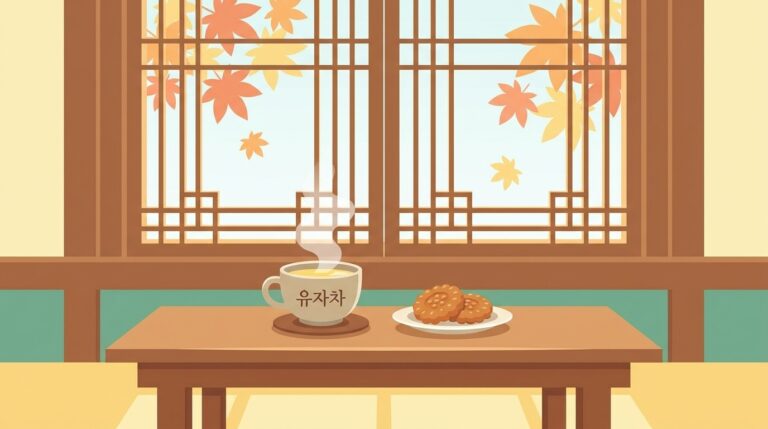
While Seoul is famous for its vibrant cafe scene, visiting a traditional tea house in Insadong or Bukchon Hanok Village is a must. Here, you don’t just drink tea; you experience Jeong (정 – deep affection and attachment). Traditional teas like Omija-cha (five-flavor berry tea) or Yuja-cha (citron tea) are served with small traditional snacks like Yakgwa (sweet honey cookies). Remember to savor the scent of the tea first before taking a sip!
Phase 5: Real-Life Roleplay Scenario
Setting: You are visiting your Korean colleague, Ji-won (지원), at her cozy apartment in Seoul. She has invited you over after a long autumn walk.
- Ji-won: “우리 집은 처음이죠? 들어오세요!” (Uri jibeun cheoeumijo? Deureo-oseyo!)
🎭 (Welcoming you with a big smile and gesturing inside) - You: “초대해 주셔서 감사합니다!” (Chodae-hae jusyeoseo gamsahamnida!)
🎭 (Taking off your shoes at the entrance and bowing slightly) - Ji-won: “날씨가 많이 춥죠? 따뜻한 차 한잔하실래요?” (Nalssiga mani chupjyo? Ttatteut-han cha han-jan hasilleoyo?)
🎭 (Rubbing her hands together to show warmth) - You: “네, 좋아요!” (Ne, jo-a-yo!)
🎭 (Nodding happily) - Ji-won: “녹차도 있고, 달콤한 유자차도 있어요. 뭐 드릴까요?” (Nokchado itgo, dalkomhan yujachado isseoyo. Mwo deurilkkayo?)
🎭 (Opening her kitchen cabinet to show you the options) - You: “아무거나 괜찮아요!” (Amugeona gwaenchanayo!)
🎭 (Smiling and sitting politely at the table) - Ji-won: “그럼 달달한 유자차로 준비할게요.” (Georeom daldalhan yujacharo junbi-halgeyo.)
🎭 (Brewing the tea and placing a warm mug in front of you with both hands) - You: “와, 향이 너무 좋아요! 잘 마실게요.” (Wa, hyangi neomu jo-a-yo! Jal masilgeyo.)
🎭 (Receiving the mug with both hands and breathing in the sweet citrus aroma)
🔀 Choose Your Next Move!
Situation: Ji-won asks if you want some sweet Korean traditional snacks (Yakgwa) to go with the tea.
- Option A: “아니요, 배불러요.” (Aniyo, baebulleoyo. – No, I’m full.)
- Option B: “우와, 약과 좋아해요! 감사합니다!” (Uwa, yakgwa jo-a-hae-yo! Gamsahamnida! – Wow, I love Yakgwa! Thank you!)
- Option C: “안 먹어요.” (An meogeoyo. – I don’t eat that.)
💡 Feedback on Your Choice:
- Best Choice (Option B): Excellent! Showing excitement for traditional snacks makes the host incredibly happy. You’ve earned 100 friendship points!
- Risk (Option A): While honest, saying “배불러요” right away can feel a bit blunt. If you really are full, try: “정말 맛있겠는데 지금 너무 배가 불러서 아쉬워요!” (It looks delicious but I’m so full, what a pity!)
- Bad Choice (Option C): Oh no! “안 먹어요” sounds very harsh and rude in Korean culture. Avoid this direct negative phrase at all costs!
Phase 6: 10-Second Emotion Shadowing Drill
Let’s practice speaking with real Korean emotions! Pay attention to the pauses (/) and the feelings in the brackets.
[😊 Welcoming and warm]
“날씨가 추우니까 / 따뜻한 차 / 한잔하실래요?”
(Nalssiga chu-u-ni-kka / tta-tteut-han cha / han-jan ha-sil-lae-yo?)-
[🥰 Deeply touched and polite]
“어머, / 준비해 주셔서 / 정말 감사합니다!”
(Eomeo, / junbi-hae ju-syeo-seo / jeongmal gam-sa-ham-ni-da!) -
[😋 Excited and hungry]
“와! / 이거 제가 / 정말 좋아하는 / 차예요!”
(Wa! / I-geo je-ga / jeongmal jo-a-ha-neun / cha-yeo-yo!)
Phase 7: K-Culture Mini Dictionary
- 다도 (Da-do) | Tea Ceremony | The traditional Korean art of preparing and drinking tea with meditative manners.
- 사랑방 (Sarang-bang) | Reception Room | Traditionally, the room in a Hanok house where guests were welcomed and treated to tea and poetry.
- 정 (Jeong) | Warm feeling of attachment | The invisible social bond of affection, sharing, and deep connection in Korea.
- 디카페인 (Di-ka-pe-in) | Decaf | Essential word when ordering coffee or tea if you are sensitive to caffeine!
Phase 8: The Traveler’s Survival Kit
Survival Phrases TOP 3
- 따뜻한 물 좀 주시겠어요? (Tta-tteut-han mul jom ju-si-ges-seo-yo?)
- “Could I please have some warm water?” (Pro Tip: Essential in cold seasons!)
- 화장실 어디예요? (Hwa-jang-sil eo-di-ye-yo?)
- “Where is the restroom?” (Pro Tip: Crucial after drinking lots of tea!)
- 여기가 커피가 맛있나요? (Yeo-gi-ga keo-pi-ga mas-in-na-yo?)
- “Is the coffee good here?” (Pro Tip: Ask locals to find hidden cafe gems!)
📝 Editor’s Travel Note
When searching for the absolute best, aesthetic tea houses in Seoul, do not use Western map apps (they often lose GPS signals in narrow Hanok alleys!). Download the Naver Map App (네이버 지도 앱 다운로드) to find precise, hidden local spots in Insadong and Samcheong-dong. Note: Store opening hours in Korea can change seasonally, so check the Naver app for real-time updates!
Phase 9: “One Step Deeper” (Thinking Corner)
In many Western cultures, asking a guest “What would you like to drink?” is a prompt for them to state their exact personal preference. However, in Korea, the dance of offering tea is wrapped in 눈치 (Nunchi – relational awareness). By saying “아무거나 괜찮아요” (Anything is fine), a Korean guest minimizes their footprint, ensuring they do not demand something the host doesn’t have. It is a beautiful game of mutual consideration.
💬 Your Turn: How do you politely accept or refuse a drink in your culture? Leave a comment below and share your thoughts with our global Daily Hangul family!
Phase 10: FAQ & Common Mistakes
Q: Can I ask for an “Iced Americano” at a traditional tea house?
A: Traditional tea houses usually focus on herbal and leaf teas. However, many modern Hanok cafes offer both traditional teas and standard espresso drinks! It’s always okay to check the menu first.
Q: Is it rude if I don’t finish my tea at a Korean host’s house?
A: Not at all! Drinking at least a few sips with compliments (like “향이 정말 좋아요” – The scent is wonderful) is enough to show appreciation.
Q: What is the difference between “차” (Cha) and “홍차” (Hong-cha)?
A: “차” is the general word for all teas. “홍차” (Hong-cha) specifically means black tea (literally “red tea” due to its dark reddish hue).
🚨 Common Mistakes Alert!
- Mistake 1: Grabbing the cup with only one hand from an elder.
- Correct Action: Support the bottom or side of the cup with your left hand.
- Mistake 2: Saying “맛없어요” (Mat-eops-eo-yo – It tastes bad) if you dislike a herbal tea.
- Correct Action: Gently say “조금 낯설지만 건강해지는 맛이네요!” (It’s a bit unfamiliar, but it tastes healthy!).
- Mistake 3: Slurping loudly in a formal setting.
- Correct Action: Sip quietly. Though in some noodle shops slurping is okay, during tea time, quiet sipping is preferred.
Phase 11: Action Mission!
- 🥉 Bronze Mission: Pronounce “차 한잔하실래요?” three times out loud in front of a mirror with a warm smile!
- 🥈 Silver Mission: Write down “아무거나 괜찮아요” in the comments of this post!
- 🥇 Gold Mission: Use “잘 마실게요!” the next time a friend, colleague, or barista hands you a beverage.
- 🎮 K-Culture Mission: Watch your favorite K-drama today and spot the exact moment someone suggests grabbing coffee or tea. Pay attention to their hand gestures!
Phase 12: Interactive Quiz Challenge
Test your knowledge below to see if you are a true Tea Time Master!
1. Match the Phrase!
What should you say right before drinking the tea your host prepared?
* A) 맛없어요 (Mat-eops-eo-yo)
* B) 잘 마실게요 (Jal ma-sil-ge-yo)
* C) 아무거나 (A-mu-geo-na)
👀 Tap here for the Answer!
Correct Answer: B) 잘 마실게요!
This shows your host that you appreciate their hospitality and are excited to enjoy the drink. Option A means “It tastes bad,” and Option C is too abrupt without “괜찮아요.”
2. True or False?
In Korea, “차 한잔하실래요?” only means you can drink herbal green tea.
* A) True
* B) False
👀 Tap here for the Answer!
Correct Answer: B) False!
In modern daily Korean, this phrase is a general invitation to hang out over any drink, including coffee, juice, or sodas!






