

Master the Art of Yutnori: How to Play and Banter Like a Local During Seollal
Phase 1: Empathy (Your First Seollal Board Game Battle)
안녕하세요! (An-nyeong-ha-se-yo!) Your favorite K-Culture Navigator and Daily Hangul Editor is back!
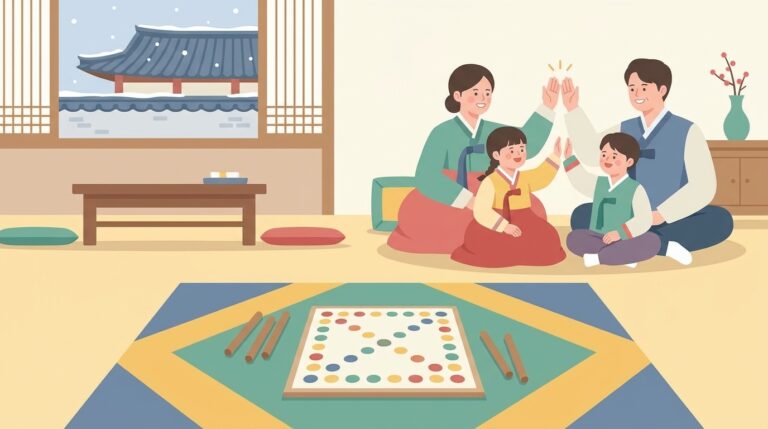
Picture this: It’s Seollal (설날 – Korean Lunar New Year). You’re sitting on a cozy floor mat with your partner’s family or close Korean friends. The smell of fresh tteokguk (rice cake soup) fills the air. Suddenly, a wooden board and four banana-shaped sticks are placed in the center. Everyone starts shouting with excitement. It’s time for Yutnori (윷놀이)!
When it’s your turn to throw the sticks, you want to do more than just smile politely. You want to join the playful trash-talking, celebrate your luck, and maybe tease your opponents when you knock their piece off the board. Many learners tell me, “I knew how to say ‘hello’ and ‘thank you’, but I felt so left out because I didn’t know how to banter during the game!” Don’t worry. This guide is built from real-world experiences to help you blend right in and become the life of the Seollal party!
Phase 2: Deep-Dive into 3 Essential Expressions
Let’s master three killer expressions that will make you sound incredibly natural and passionate during the game.
1. 한 번만 봐주세요! (Han beon-man bwa-ju-se-yo!)
- Pronunciation: Hahn beon-mahn bwah-joo-seh-yo! (Sounds like “Han burn-man” + “wah-juice-yo” without the ‘ice’)
- Meaning: “Please let me off just this once!” / “Have mercy!”
- K-Culture Moment: You will see this constantly in variety shows like Runnning Man or Going SEVENTEEN whenever a member is about to get caught or eliminated. They look with puppy eyes and beg for mercy.
- Editor’s Insight: The verb ‘보다’ (to see) is used here metaphorically to mean “to overlook” or “to show leniency.” It’s the perfect, polite-yet-playful phrase when you make a bad move or want to beg your father-in-law not to catch your token.
- Situation Spectrum: Casual ✅ | Semi-formal ✅ | Formal ⚠️
- 🤔 Think About It: In Korean culture, pleading playfully actually builds warmth (Jeong / 정) rather than showing weakness. How does your culture view asking for a second chance in games?
2. 역전할 수 있어요! (Yeok-jeon-hal su it-eo-yo!)
- Pronunciation: Yuhk-jeon-hahl soo eess-uh-yo! (Sounds like “Yuck-jeon” + “hal sue eat-so-yo”)
- Meaning: “We can turn this game around!” / “A comeback is possible!”
- K-Culture Moment: Used during intense sports broadcasts or when an underdog team in a drama suddenly starts winning against all odds.
- Editor’s Insight: Yeok-jeon (역전) means a reversal or comeback. In Yutnori, the tide can turn in a single turn because you can get extra turns. Saying this boosts team morale!
- Situation Spectrum: Casual ✅ | Semi-formal ✅ | Formal ✅
- 🤔 Think About It: Korean culture highly values perseverance and “never giving up” (Guk-bok / 극복). This phrase embodies that exact spirit.
3. 잡았다! (Ja-bat-da!)
- Pronunciation: Jah-baht-dah! (Sounds like “Jah-baht-dah” with a sharp snap at the end)
- Meaning: “Caught you!” / “Gotcha!”
- K-Culture Moment: The triumphant shout when a detective catches a culprit in a K-thriller, or when a player catches an opponent’s piece in a board game.
- Editor’s Insight: In Yutnori, landing on an opponent’s piece “catches” it, sending it back to the start and giving you an extra throw. Shouting “잡았다!” with high energy is half the fun!
- Situation Spectrum: Casual ✅ | Semi-formal ⚠️ (Use ‘잡았습니다’ for formal) | Formal 🚫
- 🤔 Think About It: Is it polite to gloat in your culture? In Korea, a lively “잡았다!” among family is seen as healthy, passionate engagement in the game.
Phase 3: Textbook Korean vs. Real Korean
Let’s compare the stiff textbook language with what Koreans actually scream over the game board!
Situation 1: When praying for a great throw
- 📖 Textbook: “좋은 결과가 나오기를 바랍니다.” (I hope a good result comes out.)
- 🗣️ 진짜 한국어: “제발 도 아니면 모!” (Please, it’s either Do or Mo! / All or nothing!)
- 💡 Why is it different? Do (one step) and Mo (five steps) represent the extremes of Yutnori throws. Saying “도 아니면 모” is the Korean equivalent of “All or nothing” or “Go big or go home.”
Situation 2: Celebrating an extra turn
- 📖 Textbook: “기회가 한 번 더 생겼습니다.” (Another opportunity has arisen.)
- 🗣️ 진짜 한국어: “대박, 한 번 더 던진다!” (Awesome, I throw again!)
- 💡 Why is it different? Textbook Korean is too passive. Real players use Daebak (대박) to express instant excitement and focus on the action (던진다 – throwing).
Phase 4: K-Culture Deep-Dive & Non-verbal Manners
4-1. Nunchi (눈치) & Gesture Etiquette
- The Double-Hand Throw: When throwing the four Yut sticks, throwing them too high or outside the mat is considered bad form (and messy!). Cup them in both hands, make eye contact, and toss them gently onto the blanket.
- The Mock Disappointment: If you throw a Nak (낙 – when a stick falls off the mat, resulting in a foul), immediately put your hands on your head in a dramatic, humorous “Oh no!” pose. It shows you are highly invested in the family fun.
4-2. The Seollal Vibe
During Seollal, Yutnori brings together three generations. It’s one of the rare times you’ll see a Korean grandfather laughing loudly and high-fiving his teenage grandchildren. It’s the ultimate icebreaker for a multicultural family!
Phase 5: Real-Life Roleplay Scenario
Setting: The living room of Min-jun’s family on Seollal afternoon. The blanket is spread out.
Characters:
* Min-jun (민준): Your energetic Korean friend.
* Emoni (어머니): Min-jun’s sweet but highly competitive mother.
* You (우정/U-jeong – Friend): Ready to win.
- 민준: (Rubbing his hands) 자, 이번에는 우리 팀 차례야. 대박 가자!
(Ja, i-beon-e-neun u-ri tim cha-rye-ya. Dae-bak ga-ja!)
“Okay, it’s our team’s turn now. Let’s go big!” - 어머니: (Laughing) 너네 팀은 아직 저 뒤에 있잖니. 역전은 힘들어~
(Neo-ne tim-eun a-jik jeo dwi-e it-jan-ni. Yeok-jeon-eun him-deul-eo~)
“Your team is still way behind. A comeback is going to be tough~” - You: (Holding the Yut sticks with both hands) 🎭 Smiling confidently 어머니, 두고 보세요. 역전할 수 있어요!
(Eo-meo-ni, du-go bo-se-yo. Yeok-jeon-hal su it-eo-yo!)
“Mother, just you watch. We can turn this game around!” - 어머니: 오~ 자신감 좋은데? 한 번 던져봐!
(Oh~ ja-sin-gam jo-eun-de? Han beon deon-jyeo-bwa!)
“Oh~ love the confidence! Give it a throw!” - You: (Tosses the sticks onto the mat… it’s a Yut – four flat sides up! You get an extra throw!)
(Tosses) 🎭 Jumping up with joy 대박! 윷이다! 한 번 더 던진다!
(Dae-bak! Yut-i-da! Han beon deo deon-jin-da!)
“Jackpot! It’s a Yut! I throw again!” - 민준: (Screaming) 와! 대박! 진짜로 역전하겠는데? 어머니 긴장하세요!
(Wa! Dae-bak! Jin-jja-ro yeok-jeon-ha-get-neun-de? Eo-meo-ni gin-jang-ha-se-yo!)
“Wow! Daebak! We might actually turn this around! Get nervous, Mom!” - 어머니: (Playfully shielding the board) 아이고, 우리 말 잡히겠네. 안 돼!
(Ai-go, u-ri mal jap-hi-get-ne. An dwae!)
“Oh dear, our piece is going to get caught. No!” - You: (Pretending to throw) 🎭 Winking playfully 잡았다! 어머니, 한 번만 봐드릴까요?
(Ja-bat-da! Eo-meo-ni, han beon-man bwa-deu-ril-kka-yo?)
“Gotcha! Mother, should I let you off just this once?”
🔀 Interactive Choice Point
How do you respond to Mother’s nervous laugh?
- Option A: “그냥 잡을게요! 미안해요!” (I’ll just catch you! Sorry!)
- Option B: “어머니니까 특별히 봐드릴게요!” (Since it’s you, Mother, I’ll let you off specially!)
- Option C: “도 아니면 모니까 그냥 갈게요.” (It’s all or nothing, so I’ll just keep going.)
Feedback on Your Choice:
- Best (Option B): Incredibly sweet and high in Nunchi. It shows respect while keeping the game playful and fun. Mother will love you!
- Risk (Option A): A bit too blunt. While fair in game terms, saying “Sorry, I’ll catch you” lacks that cheeky banter flavor.
- Bad (Option C): Too mechanical. It sounds like you are reading a rulebook instead of bonding with the family.
Phase 6: 10-Second Emotion Shadowing Drill
Practice these with the exact emotional tones indicated!
- [😊 Excited and confident]
역전할 수 / 있어요! / 제발 / 모 나와라!
(Yeok-jeon-hal su / it-eo-yo! / Je-bal / mo na-wa-ra!)
“We can make a comeback! / Please / roll a Mo!” -
[🥺 Cute, begging with puppy eyes]
어머니, / 진짜 / 한 번만 / 봐주세요~
(Eo-meo-ni, / jin-jja / han beon-man / bwa-ju-se-yo~)
“Mother, / seriously, / just this once / let me off~”
Phase 7: K-Culture Mini-Dictionary
- 말 (Mal): Literally “horse.” In Yutnori, this refers to your game tokens/pieces that travel around the board.
- 낙 (Nak): A foul throw where at least one stick rolls completely off the designated mat. Your turn is canceled!
- 윷 (Yut): A throw where all four flat sides face up. Moves you 4 spaces and earns you a bonus throw.
- 모 (Mo): A throw where all four round sides face up. Moves you 5 spaces and earns you a bonus throw.
Phase 8: Traveler’s Survival Kit
Survival Phrases
- 이거 어떻게 해요? (I-geo eo-tteok-hae-yo?) | “How do I do this?” (Pro Tip: Use when you are confused about game rules)
- 제 차례인가요? (Je cha-rye-in-ga-yo?) | “Is it my turn?”
- 잘 먹었습니다! (Jal meog-eot-seub-ni-da!) | “Thank you for the meal!” (Essential to say to hosts after eating Seollal feast)
Editor’s Travel Note:
If you are invited to a Korean home during Seollal, it is customary to bring a small gift like fresh fruit or a set of traditional snacks. Use the KakaoMap App to find local gift shops or tteok (rice cake) bakeries near your host’s home. Note: Local shop hours may vary during public holidays.
Phase 9: “Going Deeper” (Thought Reflection)
Yutnori is not just a board game; it’s a reflection of Korean collectivism. Unlike individualistic games, Yutnori is almost always played in teams (편 / pyeon). You win together, you lose together, and you plan strategies together. It teaches players that success is sweeter when shared with the community.
💬 Your Turn: Does your culture have a traditional board game played during major holidays? How do you cheer for your team? Let us know in the comments below!
Phase 10: FAQ & Avoiding Mistakes
Q: What is the most common mistake foreigners make during Yutnori?
A: Throwing the sticks too high like dice! If the sticks bounce off the mat, it’s a foul (Nak). Always toss them gently underhand so they stay on the blanket.
Q: Can I use casual banban (반말) like “잡았다!” with older family members?
A: In the heat of the game, shouting “잡았다!” (Gotcha!) is perfectly acceptable as a spontaneous exclamation. However, avoid saying things like “너 나와” (You, come out). Keep your direct banter polite by adding “~요” (e.g., “잡았습니다!” or “봐주세요!”).
Q: What if I don’t know the rules at all?
A: Don’t worry! Koreans love teaching the rules of Yutnori. Simply look at your partner and say, “도와주세요!” (Help me!). They will gladly tell you where to move your piece.
🚨 Common Mistakes Warning Board
- Mistake: Throwing sticks over the head. ➡️ Correct Action: Keep your throws low and directed towards the center of the mat.
- Mistake: Moving the game piece (Mal) yourself without asking. ➡️ Correct Action: Ask your team first: “이거 어디로 가요?” (Where does this go?).
- Mistake: Sitting silently. ➡️ Correct Action: Show energy! Even simple sounds like “우와!” (Woah!) or “아깝다!” (So close!) keep the atmosphere warm.
Phase 11: Action Mission
- Bronze Medal: Say “역전할 수 있어요!” out loud 3 times in front of the mirror with your fist clenched.
- Silver Medal: Find a video of variety show stars playing Yutnori on YouTube, and identify when they shout “잡았다!”.
- Gold Medal (K-Culture Mission): During this Seollal, play a round of Yutnori (even online or mobile apps) and use at least two phrases from this guide!
Phase 12: Interactive Quiz Challenge
Test your Seollal gaming survival skills!
1. What does “도 아니면 모” mean in everyday Korean life?
a) Eat rice cake soup
b) All or nothing / High risk, high return
c) Let’s go home early
Click here for the Answer & Explanation
Correct Answer: b)
“도” (Do) is the smallest move (1 step) and “모” (Mo) is the largest move (5 steps). Thus, “도 아니면 모” translates to “Either a 1 or a 5,” meaning “all or nothing!”
2. True or False: If a stick lands outside the blanket mat, you get an extra throw.
Click here for the Answer & Explanation
Correct Answer: False!
If a stick lands outside the designated mat area, it is called 낙 (Nak), which is a foul. Your turn is canceled immediately!







