

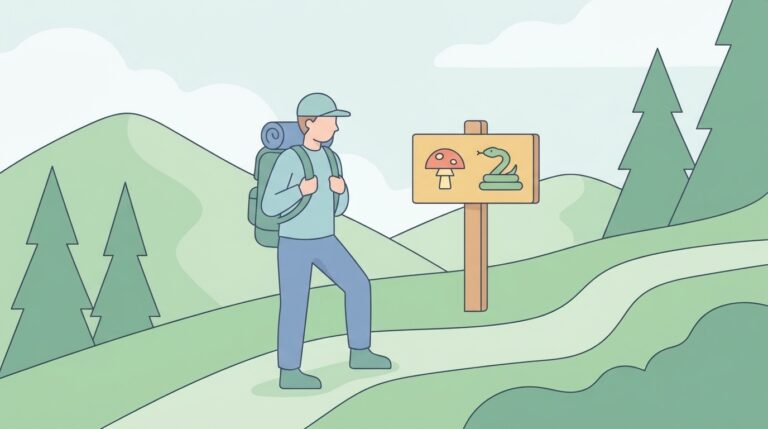
Survival in the Korean Wilds: How to Identify Toxic Mushrooms and Venomous Snakes Like a Local
Phase 1: Empathy (공감)
안녕하세요! It’s your Daily Hangul editor and your trusted local culture navigator here! 🌲✨
Imagine this: You are hiking up the breathtaking Bukhansan (북한산) in autumn, surrounded by a gorgeous canopy of crimson maple leaves. You spot some plump, delicious-looking wild mushrooms growing near a damp log, or perhaps you hear a sudden rustling in the tall grass. A fellow hiker stops and says, “함부로 만지면 큰일 나요!” (If you touch it carelessly, you’ll be in big trouble!)
In Korea, hiking isn’t just a hobby; it’s a national passion. But our beautiful mountains are also home to highly toxic flora and fauna, such as the deadly Destroying Angel mushroom (독우산광대버섯) and the venomous short-tailed viper (쇠살모사). Knowing how to identify these dangers and express urgency in advanced Korean isn’t just an academic exercise—it could literally save your life. Today, we’re diving deep into the high-stakes world of wilderness survival, C1-style! Let’s get you prepared to navigate the Korean wild like an absolute pro.
Phase 2: Key Expressions Deep Dive (핵심 표현 3선 심층 분석)
1. 스치기만 해도 치명적이다 (seuchi-gi-man hae-do chi-myeong-jeok-i-da)
- Pronunciation: Seu-chee-ghee-mahn hae-doh chee-myeong-jeog-ee-dah (Rhymes with “touchy-key-man”… but with a soft “s” sound)
- Meaning: It is fatal/deadly even if you just brush against it.
- K-Culture Moment: You will hear this dramatic phrase in medical K-Dramas like Hospital Playlist or survival thrillers when doctors or experts warn characters about highly toxic substances or severe allergies.
- Editor’s Insight: 치명적 (Fatal/Deadly) usually means causing death physically, but in modern slang, it can also mean “fatal charm” (e.g., 치명적인 매력). However, in the wilderness, keep it literal! 스치다 means to graze or brush past lightly, emphasizing the extreme danger of the organism.
- Situation Spectrum: Casual (⚠️) | Semi-formal (✅) | Formal (✅)
- 🤔 Think About It: How does your native language describe extreme vulnerability? Is there a physical action (like “brushing past”) that conveys such immediate danger?
2. 색깔이 화려할수록 독성이 강하다 (saek-kkal-i hwa-ryeo-hal-su-rok dok-seong-i gang-hada)
- Pronunciation: Saek-kkah-lee hwah-ryeo-hahl-soo-rog dog-seong-ee gahng-hah-dah
- Meaning: The more colorful it is, the stronger the toxicity.
- K-Culture Moment: This is a classic Korean safety proverb repeated by seasoned hikers (등산 마니아) and forest rangers on documentary shows like VJ On-the-Scene (VJ 특공대).
- Editor’s Insight: This sentence utilizes the grammar pattern -(으)ㄹ수록 (the more [A], the more [B]). It’s a gold standard C1 structure to show proportional relationships. While generally true for mushrooms, remember that some deadly Korean mushrooms look deceptively plain!
- Situation Spectrum: Casual (✅) | Semi-formal (✅) | Formal (✅)
- 🤔 Think About It: In Korean culture, excessive flamboyance is often met with suspicion (both in nature and human behavior). Does your culture have a similar warning about bright colors?
3. 온몸에 독기가 퍼지기 전에 해독해야 합니다 (on-mom-e dok-gi-ga peo-ji-gi jeon-e hae-dok-hae-ya ham-ni-da)
- Pronunciation: Ohn-mohm-eh dog-ghee-gah peo-jee-ghee jeon-eh hae-dog-hae-yah hahm-nee-dah
- Meaning: We must detoxify/administer anti-venom before the poison spreads throughout the entire body.
- K-Culture Moment: The climatic line in historical dramas (사극) when a character is struck by a poisoned arrow, or in modern action-thrillers set in the Korean countryside.
- Editor’s Insight: 독기 (毒氣) refers to poisonous energy or venom, but it is also used metaphorically to describe a fierce, venomous look in someone’s eyes (독기를 품다). 해독 (Detoxification) is the exact medical term for countering venom.
- Situation Spectrum: Casual (🚫) | Semi-formal (✅) | Formal (✅)
- 🤔 Think About It: The word ‘독기’ combines poison with ‘기’ (energy/qi). Why do you think Korean conceptualizes poison as a form of moving energy?
Phase 3: Textbook Korean vs. Real-World Korean
Situation 1: Warning someone not to touch a suspicious mushroom
- 📖 Textbook Korean: “그 버섯은 위험하오니 만지지 마십시오.” (That mushroom is dangerous, so please do not touch it.) – Sounds like a robotic automated announcement in a subway station.
- 🗣️ Real-World Korean: “그거 독버섯일지도 몰라요. 함부로 손댔다가는 큰일 나요!” (That might be a poisonous mushroom. If you touch it recklessly, you’ll be in deep trouble!)
- 💡 Why the difference? Real Koreans use the conditional pattern -다가는 to express a strong warning about a negative consequence if a certain action is continued.
Situation 2: Explaining a snake bite emergency
- 📖 Textbook Korean: “뱀에게 물리었을 때는 병원에 가야 합니다.” (When bitten by a snake, you must go to the hospital.) – Too simplistic for a C1 speaker.
- 🗣️ Real-World Korean: “살모사한테 물린 것 같아요! 독이 퍼지지 않게 빨리 묶고 119 부릅시다!” (I think they were bitten by a viper! Let’s tie it quickly so the venom doesn’t spread and call 119!)
- 💡 Why the difference? Real-world emergency speech relies on rapid, high-impact verbs like 묶다 (to tie/bind) and immediate call-to-actions.
Phase 4: K-Culture Deep Dive & Non-Verbal Manners
4-1. Nunchi (눈치) & Non-Verbal Wilderness Etiquette
- Keep Your Distance & Bow: If you encounter a forest ranger (산림청 요원) or a seasoned hiker warning you about wildlife, do not step closer to look. Step back immediately, nod deeply, and cross your arms in an ‘X’ shape if you want to visually confirm, “No touching!”
- The “Quiet” Warning: In Korea, shouting loudly in the mountains (야호 – Yahoo) is actually discouraged nowadays because it disturbs wildlife and can trigger panic. Speak in a firm, urgent, but controlled low tone when warning someone of a snake.
4-2. Mountain Culture in Korea
Korea is 70% mountainous. Mountain culture is huge, complete with high-tech colorful hiking gear, post-hike meals of Makgeolli (막걸리) and Pajeon (파전), and deep respect for forest preservation. Because foraging for wild greens (산나물) is popular among the older generation, the government actively runs campaigns every autumn warning against “blind foraging” (야생버섯 채취 금지).
Phase 5: Real-World Roleplay Scenario
Setting: A foggy trail on Jirisan (지리산). You (Alex) are hiking with Min-jun, an experienced local hiker, when you spot a strange, glowing mushroom and a rustling snake nearby.
- Min-jun: (Urgetly stopping you) 🎭 Alex, stop! 아, 잠깐만요! 발밑에 그거 보지 마세요. 움직이지 마세요!
- Alex: (Startled) 왜 그러세요, 민준 씨? 무슨 문제라도 있어요?
- Min-jun: 🎭 Pointing carefully 저기 낙엽 사이에 뱀 머리 보여요? 삼각 머리잖아요. 쇠살모사예요!
- Alex: 헉, 독사인가요? 스치기만 해도 치명적이라던 그 살모사요?
- Min-jun: 맞아요. 색깔이 화려할수록 독성이 강하다는데, 저 녀석은 보호색을 띠고 있어서 더 무서워요.
- Alex: 옆에 있는 저 예쁜 빨간 버섯은 어때요? 엄청 맛있어 보이는데…
- Min-jun: 🎭 Shaking his head vigorously 절대 안 돼요! 온몸에 독기가 퍼지기 전에 병원 가고 싶지 않으시면 손도 대지 마세요.
- Alex: 알겠습니다. 자연은 멀리서 볼 때만 아름답네요. 얼른 다른 길로 가요!
🔀 Interactive Choice Points
- Choice A: “이거 그냥 놔두면 다른 사람도 다치니까 돌로 쳐서 잡을까요?” (Shall we kill it with a stone so others don’t get hurt?)
- Feedback (Bad): Risk of getting bitten! Vipers strike rapidly when threatened. Never attack wildlife in Korean National Parks; it is illegal and highly dangerous.
- Choice B: “사진만 얼른 찍고 조용히 뒤로 물러서서 우회해요.” (Let’s just take a quick photo and quietly step back to detour.)
- Feedback (Best): Perfect safety and legal protocol. You preserve wildlife while keeping yourself safe.
- Choice C: “경찰서에 전화해서 뱀 치워달라고 해요!” (Let’s call the police station to remove the snake!)
- Feedback (Risk): Emergency calls should go to 119 (Fire & Rescue), not the local police, and they usually only dispatch for active threats in residential areas.
Phase 6: 10-Second Emotion Shadowing Drill
Practice these high-stakes sentences with the exact emotional pauses (/) and inflections!
[🚨 Panic & Urgency]
“움직이지 마세요! / 저 뱀은 독사에요! / 물리면 / 정말 큰일 나요!”
(Uhm-jik-ee-jee mah-seh-yo! / Jeo baem-eun dog-sah-yeo! / Mool-ree-myeon / jeong-mahl keun-il nah-yo!)-
[⚠️ Firm Warning]
“그 버섯 / 화려해 보이죠? / 색깔이 화려할수록 / 독성이 강한 법이에요!”
(Geu beo-seot / hwah-ryeo-hae boy-jyo? / Saek-kkal-i hwah-ryeo-hahl-su-rok / dok-seong-i gang-han beop-ee-eh-yo!)
Phase 7: K-Culture Mini-Dictionary
- 독버섯 (dok-beo-seot) | Poisonous Mushroom | Often used metaphorically in news articles to describe harmful, toxic trends or scam websites popping up rapidly.
- 살모사 (sal-mo-sa) | Viper (specifically Gloydius species) | Literally translates to “the snake that kills its mother.” It represents lethal venom in Korean folklore.
- 해독제 (hae-dok-je) | Antidote / Anti-venom | Essential vocabulary at any Korean pharmacy or emergency room if poisoned.
- 약초 (yak-cho) | Medicinal Herb | The opposite of toxic plants; highly sought after by Korean elders for longevity.
Phase 8: Traveler’s Survival Kit
Survival Phrases TOP 3
- 여기 독사에 물린 사람이 있어요! 빨리 구급차 보내주세요!
(Yeo-gi dok-sa-e mul-rin sa-ram-i isseo-yo! Ppal-ri gu-geup-cha bo-nae-ju-seh-yo!)- Pro Tip: Use this when calling 119. Say “Dok-sa” (poisonous snake) so they bring the correct anti-venom.
- 이거 먹어도 안전한 야생 버섯인가요?
(I-geo meog-eo-do an-jeon-han ya-saeng beo-seot-in-ga-yo?)- Pro Tip: Show a photo to a local park ranger if you are unsure.
- 해독제가 있습니까?
(Hae-dok-je-ga it-seum-ni-ka?)- Pro Tip: Ask this immediately upon arriving at a rural clinic (보건소).
Editor’s Travel Note
Before hiking in Korea, download the National Park Service App or use Naver Map which marks safety centers and ranger stations clearly. Cell reception is excellent even on top of mountain peaks in Korea, so don’t hesitate to call 119. Disclaimer: Emergency services and wildlife situations can vary; always consult official Korea National Park Service updates before traveling.
Phase 9: “Going Deeper” (한 발 더 깊이)
Korea’s collective culture extends even into the wilderness. If you hike in Korea, you’ll notice hikers constantly sharing snacks, warning strangers of slippery rocks, or pointing out wild plants. This communal spirit, known as 정 (Jeong), means that if an older Korean hiker tells you not to touch a mushroom, they aren’t lecturing you—they are actively protecting you as one of their own. Embracing these warnings is a way of accepting Korean community care.
💬 Your Turn: Have you ever gone hiking in Korea? What kind of wild animals or plants did you encounter? Let us know in the comments below!
Phase 10: FAQ & Common Mistakes
Q: Can I use seawater or alcohol to sterilize a Korean snakebite?
A: Absolutely not! In Korea, old myths suggest pouring alcohol (like Soju) on a wound, but this dilates blood vessels and spreads the venom faster. Wash it with clean stream water only and immobilize the limb.
Q: Are all plain-looking brown mushrooms in Korea safe to eat?
A: No. One of the most dangerous mushrooms in Korea, the Poison Fire Coral (붉은사슴뿔버섯), can look like young edible ginseng or plain ginger roots when young. Never consume wild mushrooms based on appearance.
Q: What is the fastest way to get emergency help in the Korean mountains?
A: Look for the metal Safety Location Markers (국정기준점/등산로 위치 표지판) placed along the trails. Quote the numbers on them to 119 so helicopters can locate you instantly.
🚨 Common Mistakes Alert!
- Mistake 1: Calling vipers “뱀” (baem) in emergencies.
- Correct Action: Say 독사 (dok-sa) or 살모사 (sal-mo-sa) to ensure medical staff prepare anti-venom.
- Mistake 2: Sucking out venom with your mouth.
- Correct Action: Use a commercial suction device or simply tie the wound gently above the bite and wait for 119.
- Mistake 3: Saying “이 버섯 이쁘다” (This mushroom is pretty) in a formal ecology setting.
- Correct Action: Use terms like 화려하다 (splendid/flamboyant) to describe toxic warn colors professionally.
Phase 11: Action Mission & Participation
- 🥉 Bronze Mission: Write the phrase “독버섯 조심하세요!” (Watch out for poisonous mushrooms!) in your study notebook three times.
- 🥈 Silver Mission: Share a picture of a mushroom or snake from your home country on Instagram, tag
@DailyHangul, and use the C1 grammar -(으)ㄹ수록 to describe it! - 🥇 Gold Mission: Roleplay Phase 5’s dialogue with an AI language partner, practicing your best panicked and warning voices.
Phase 12: Interactive Quiz Challenge
Test your survival instincts!
- Which C1 expression describes something that is lethal with even the slightest touch?
- True or False: In Korea, 112 is the number you call for a snake bite emergency.
🔍 Click to reveal Answers & Explanations!
- Answer 1: 스치기만 해도 치명적이다 (Fatal even if you just brush against it).
- Answer 2: False! You must call 119 for medical emergencies and rescue operations in Korea. 112 is for police/crime reporting.







