

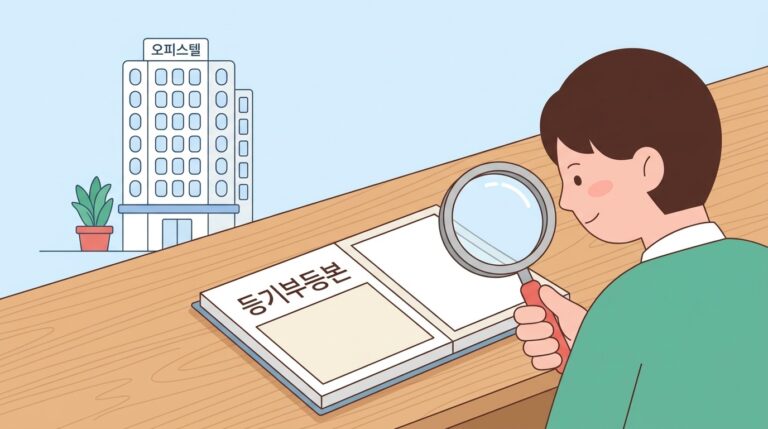
Master the ‘Deunggi-bu Deungbon’: Your Ultimate Guide to Deciphering Korean Real Estate Registers like a Pro
Phase 1: Empathy (Interactive Opening)
안녕하세요! It’s your K-culture navigator and Korean bestie from Daily Hangul (매일한글)!
Imagine this: You’ve finally found your absolute dream Officetel (오피스텔) in the heart of Hongdae. It has a gorgeous view, it’s close to the station, and the rent is surprisingly reasonable. You are ready to sign the contract, but then the estate agent (공인중개사) slides a multi-page, dense document covered in legal jargon across the table.
“여기 등기부등본 확인해 보세요 (Take a look at the certified copy of the register here),” they say casually.
Your heart sinks. Words like 근저당권 (collateral security), 가압류 (provisional attachment), and 임차권등기명령 (leasehold registration order) blur together. You feel the sweat building up. If you sign without fully understanding this paper, you risk losing your deposit (보증금)—a nightmare scenario often dramatized in K-dramas, but a very real threat in South Korea’s unique Jeonse/Wolse rental market.
Don’t panic! Today, we are going to break down the 등기부등본 (Deunggi-bu Deungbon)—the holy grail of Korean real estate security. By the end of this guide, you won’t just look at this document; you will actively analyze it like a seasoned Korean legal expert. Let’s dive in!
Phase 2: Deep Dive into 3 Essential Expressions
1. 등기부등본을 떼다 (Deung-gi-bu-deung-bon-eul tte-da)
- Pronunciation: Deung-gi-bu-deung-bon-eul tte-da (Sounds like “Deung-gee-boo deung-bone-ul tteh-dah”)
- Meaning: To issue/print a certified copy of the real estate register.
- K-Culture Moment: In the hit drama Because This Is My First Life (이번 생은 처음이라), you see characters meticulously checking apartment papers. When someone says, “등기부등본 떼어 봤어?” (Have you pulled the register?), they are checking if the property is legally safe.
- Editor’s Insight: The verb 떼다 literally means “to peel off” or “to detach,” but in administrative contexts, it means to officially issue or print out a document. Always make sure the date on the top right of the printed document is today’s date!
- Situation Spectrum: Casual ✅ | Semi-formal ✅ | Formal ✅
- 🤔 Think About It: In your home country, is it easy for an individual to look up the public debt history of a property online within 5 minutes? Korea’s digital registry system makes this incredibly fast!
2. 융자가 끼어 있다 (Yung-ja-ga kki-eo it-da)
- Pronunciation: Yung-ja-ga kki-eo it-da (Sounds like “Yung-jah-gah kkee-uh eet-dah”)
- Meaning: The property is leveraged with loans/mortgages (literally: “Loans are wedged in”).
- K-Culture Moment: You will hear this constantly during apartment hunting. A broker might try to soothe your worries by saying, “융자가 조금 끼어 있긴 한데, 건물 시세에 비하면 아주 안전해요.” (There are some loans wedged in, but compared to the market price of the building, it’s very safe.)
- Editor’s Insight: 융자 means loan or mortgage, and 끼다 means to be inserted or jammed in between. When a building has “융자가 많이 끼어 있다,” it means the landlord borrowed heavily using the building as collateral. If things go south, your deposit might be at risk!
- Situation Spectrum: Casual ✅ | Semi-formal ✅ | Formal 🚫 (In official contracts, the formal term 채권최고액 or 근저당권 is used instead.)
- 🤔 Think About It: Why do you think Koreans use the verb “끼다” (to be wedged/sandwiched) for debts? It beautifully visualizes how debt sits uncomfortably between the owner and the tenant.
3. 대항력을 갖추다 (Dae-hang-ryeok-eul gat-chu-da)
- Pronunciation: Dae-hang-ryeok-eul gat-choo-dah (Sounds like “Dae-hahng-ryuk-ul gaht-choo-dah”)
- Meaning: To acquire opposing power / legal opposability (the right to stay in the property and defend your deposit against third parties).
- K-Culture Moment: This is the ultimate shield for tenants in Korea. To get this power, you must complete your move-in report (전입신고) and obtain a fixed date stamp (확정일자) on your contract at the local community center (주민센터).
- Editor’s Insight: 대항 (Dae-hang) means opposition/resistance, and 력 (Ryeok) means power. It is your legal “shield.” Without this, if the landlord changes or the building goes to auction, you could be evicted without getting your deposit back.
- Situation Spectrum: Casual ⚠️ | Semi-formal ✅ | Formal ✅
- 🤔 Think About It: How does your country protect tenants from sudden changes in property ownership?
Phase 3: Textbook Korean vs. Real-Life Korean
Let’s compare the sterile sentences of standard textbooks with how real negotiations actually sound.
Situation 1: Asking the broker if there are any mortgages on the house.
- 📖 Textbook: “이 건물에 저당권이 설정되어 있습니까?” (Is a mortgage established on this building?)
- 🗣️ Real-Life: “혹시 이 집 융자 많이 끼어 있어요?” (By the way, is this place heavily leveraged with loans?)
- 💡 Why is it different? The textbook phrase is too formal and sounds like you are auditing the broker. The real-life phrase is natural, polite, and shows you actually understand how the market works.
Situation 2: Pointing out a clean register with no debts.
- 📖 Textbook: “등기부등본의 을구가 깨끗합니다.” (The ‘Eul-gu’ section of the register is clean.)
- 🗣️ Real-Life: “등기부 보니까 대출 하나도 없는 깨끗한 집이네요.” (Looking at the register, this is a clean house with absolutely zero loans.)
- 💡 Why is it different? While “을구” (Section B of the register) is technically correct, locals simply say “대출 없는 집” (house with no loans) or “깨끗한 집” (clean house) to express that a property is safe.
Phase 4: K-Culture Deep Dive & Non-verbal Manners
4-1. The Art of “Nunchi” (눈치) at the Real Estate Agency
When looking at the Deunggi-bu Deungbon, do not just look at the paper. Look at the broker’s reactions.
* The Paper Double-Check: When the broker shows you the document, trace your finger along the 갑구 (Gap-gu: Ownership) and 을구 (Eul-gu: Mortgages). Even if you don’t fully understand it, doing this sends a strong signal: “I am a smart tenant who knows my rights. Do not try to trick me.”
* The Date Verification: Always look at the bottom or top of the page for the issuing date and time. It must say today’s date (오늘 날짜). If it was printed last week, politely say: “오늘 날짜로 다시 한 번 떼어주실 수 있나요?” (Could you please pull a copy with today’s date?)
4-2. The “Jeonse” (전세) Culture Shift
Korea’s unique Jeonse system (where you give a massive interest-free loan/deposit to the landlord instead of paying monthly rent) makes analyzing the register 100 times more critical than in other countries. With monthly rent (Wolse), your risk is limited. With Jeonse, your entire life savings are on the line. This is why understanding terms like 근저당 (collateral security) is a survival skill, not just a linguistic one.
Phase 5: Real-Life Roleplay Scenario
Character Cast:
- Mr. Kim (김 중개사): A friendly but fast-talking, typical Korean real estate broker.
- Jessie (제시): A smart C1-level foreigner who is determined not to get scammed.
[Scene: A bright real estate agency in Mapo, Seoul. Tea is served.]
- 김 중개사: (등기부등본을 테이블에 올려놓으며) 자, 제시 씨! 계약하기 전에 등기부 한번 같이 보시죠. 아주 깨끗합니다!
(Sets the document on the table. “Alright, Jessie! Before we sign, let’s look at the register together. It’s very clean!”) - 제시: (안경을 고쳐 쓰며) 네, 보여주세요. 음… 여기 갑구에 신탁등기가 되어 있네요? 이건 무슨 뜻인가요?
(Adjusts glasses. “Yes, please show me. Hmm… I see a trust registration in the ‘Gap-gu’ section? What does this mean?”) - 김 중개사: (살짝 당황하며 손사래를 친다) 아, 그건 형식적인 거예요! 시행사가 신탁회사에 관리를 맡겨둔 거라 걱정 안 하셔도 돼요.
(Slightly flustered, waving hands. “Oh, that’s just a formality! The developer left the management to a trust company, so you don’t need to worry.”) - 제시: (단호하지만 차분하게) 신탁등기가 되어 있으면 임대차 계약할 때 신탁회사 동의서가 필요하잖아요. 동의서 받아주실 수 있나요?
(Firmly but calmly. “If there is a trust registration, we need a consent form from the trust company when signing the lease. Can you obtain that consent form for me?”) - 김 중개사: (제시의 전문성에 놀라며) 아… 역시 제시 씨 잘 아시네! 당연히 계약일 전까지 딱 받아서 보여드리죠.
(Surprised by Jessie’s knowledge. “Ah… of course, you know your stuff, Jessie! I will absolutely get that and show it to you before the contract date.”) - 제시: (미소를 지으며 을구를 가리킨다) 고맙습니다. 그리고 여기 을구에 채권최고액이 설정되어 있네요. 이 건물 시세 대비 몇 퍼센트 정도인가요?
(Smiles and points to ‘Eul-gu’. “Thank you. And there is a maximum debt amount set here in ‘Eul-gu’. What percentage is this compared to the market value of the building?”) - 김 중개사: (계산기를 두드리며) 여기 보시면 시세가 10억인데 대출은 1억밖에 안 잡혀 있어요. 아주 안전한 비율입니다.
(Tapping on a calculator. “If you look here, the market price is 1 billion won, but the loan is only set at 100 million. It’s a very safe ratio.”) - 제시: (고개를 끄덕인다) 알겠습니다. 계약 당일에 임대인 국세 완납 증명서도 같이 확인할 수 있게 준비 부탁드려요.
(Nods. “I see. Please also prepare the landlord’s national tax payment certificate so we can check it together on the day of the contract.”)
🔀 Interactive Choice Point!
How should Jessie proceed with the final confirmation?
- Choice A: “믿고 진행할게요. 오늘 계약금 바로 송금할게요!” (I trust you. I’ll transfer the down payment right away today!)
- Choice B: “안전한지 확인차, 등기부 사본 한 부만 제가 가질 수 있게 복사해 주세요.” (Just to make sure it’s safe, please make a copy of this register for me to keep.)
- Choice C: “좋습니다. 계약서 특약 사항에 ‘입주 다음 날까지 담보권을 설정하지 않는다’는 문구를 넣어주세요.” (Great. Please add a clause in the special terms of the contract saying ‘No security rights shall be established until the day after moving in.’)
Feedback:
- Choice A (Risk 🚨): Too hasty! Even with a low mortgage ratio, without special clauses in the contract, the landlord could take out a loan on the very day you move in before your shield (대항력) activates.
- Choice B (Bad ⚠️): Merely holding a printed copy from today does not prevent the landlord from changing the ownership or getting more loans tomorrow.
- Choice C (Best 🏆): Absolute pro-move! Because your “opposing power” (대항력) takes effect at 00:00 the day after you report your move-in, this special clause prevents the landlord from sneaky bank borrowings on your moving day.
Phase 6: 10-Second Emotional Shadowing Drill
Let’s practice saying the most crucial line of the roleplay with the correct emotion and rhythm to sound natural.
“등기부 보니까 / 융자가 좀 끼어 있네요. / 이거 안전한 거 맞죠?”
(Looking at the register, there are some loans wedged in. This is safe, right?)
- Tone Guide:
[🤨 Polite but slightly suspicious, keeping a sharp eye] - Rhythm Marks:
- 등기부 보니까 (pause) /
- 융자가 좀 끼어 있네요 (slight pause) /
- 이거 안전한 거 맞죠? (slightly rising intonation at the end)
Phase 7: K-Culture Mini Dictionary
- 갑구 (Gap-gu) | Owner’s Section | The first section of the register showing who owns the property, history of ownership, and any issues like seizures (압류).
- 을구 (Eul-gu) | Debt & Rights Section | The second section showing mortgages, loans, and other third-party rights on the property.
- 확정일자 (Hwak-jeong-il-ja) | Fixed Date Stamp | An official stamp received at the community center or online to prove your lease contract existed on that specific date. Crucial for deposit protection.
- 소액임차인 (So-aek-im-cha-in) | Small-sum Tenant | A tenant with a relatively small deposit who gets priority legal protection to reclaim at least a portion of their deposit even if the building goes bankrupt.
Phase 8: Survivor Kit for Travelers & Expats
Survival Phrases TOP 3
- “오늘 날짜 등기부등본 보여주세요.”
- O-neul nal-jja deung-gi-bu-deung-bon bo-yeo-ju-se-yo.
- Pro Tip: Say this immediately when entering a real estate agency to look at an apartment.
- “전입신고랑 확정일자는 어디서 받나요?”
- Jeon-ip-sin-go-rang hwak-jeong-il-ja-neun eo-di-seo ban-na-yo?
- Pro Tip: Usually done at the local community center (주민센터) governing your new neighborhood.
- “계약서에 특약 사항 추가해 주세요.”
- Gye-yak-seo-e teuk-yak sa-hang chu-ga-hae ju-se-yo.
- Pro Tip: Essential when adding protecting clauses for your deposit.
Editor’s Travel & Living Note
To check properties yourself, you can use the official government website: the Supreme Court Internet Registry (인터넷 등기소). It costs about 700 to 1,000 KRW to view or print a register. Always make sure you have a Korean payment method ready!
(Disclaimer: Website policies and fees are subject to change according to government regulations.)
Phase 9: “A Step Deeper” (Cultural Reflection)
In many Western cultures, renting a home is relatively straightforward—you sign, pay a deposit of 1 or 2 months’ rent, and move in. In Korea, however, because of the enormous financial scale of the Jeonse system and high-deposit Wolse, housing is deeply tied to security, trust, and complex legal structures. Checking the Deunggi-bu Deungbon isn’t considered rude or overly cautious; it is respected as a sign of financial maturity. Showing up prepared command respect from landlords and brokers alike.
💬 Your Turn: Have you ever looked up a property’s legal history in your own country? Let us know in the comments below how it differs from Korea’s system!
Phase 10: FAQ & Common Mistakes
Q: Can anyone pull a ‘Deunggi-bu Deungbon’ for any building, even if they don’t own it?
A: Yes! Unlike in some countries where only owners or lawyers can access property deeds, anyone in Korea can pull the register of any building online as long as they know the exact address.
Q: What should I do if the landlord has unpaid national taxes (국세체납)?
A: If a landlord defaults on taxes, the government has the right to seize and sell the house before you get your deposit back. Always ask to see their 국세/지방세 완납증명서 (Tax Payment Certificates) before signing a high-deposit contract.
Q: The broker says the mortgage in ‘Eul-gu’ was already paid off, but it still shows on the paper. Is this safe?
A: If a mortgage is paid off, it should have a red line striking through it. If there is no red strike-through line, the loan is still active on paper. Demand that the landlord officially register the cancellation (말소) before or on the day of payment.
🚨 Common Mistakes Alert!
- Believing “Trust me, I own this building”: Always check the ID card of the landlord and compare it with the name and resident registration number listed in 갑구 (Gap-gu) of the register.
- Signing without checking on the exact contract day: A register shown to you during the house tour last week might have new loans taken out on it today. Always request a freshly printed copy right before signing.
- Skipping ‘전입신고’ (Move-in report): No matter how much you trust your landlord, if you don’t do your move-in report and get your 확정일자 (Fixed Date) immediately, your legal priority rank in court is zero.
Phase 11: Action Mission
- Bronze Medal: Go to the Supreme Court Internet Registry (인터넷 등기소) and try to navigate the site to find the search bar.
- Silver Medal: Read through the roleplay in Phase 5 out loud using the emotional markers in Phase 6.
- Gold Medal: Share this post on your social media and tag a friend who is planning to move or study abroad in Korea!
🎮 K-Culture Mission: The next time you watch a modern K-drama featuring a character moving houses (like Fight for My Way or Run On), look closely at the paperwork they hold. See if you can spot the word 등기부 or 계약서!
Phase 12: Interactive Quiz Challenge
Test your real estate survival skills!
Q1. Which section of the register should you look at to verify the actual owner of the building?
- A) 을구 (Eul-gu)
- B) 갑구 (Gap-gu)
- C) 표제부 (Pyo-je-bu)
Click to reveal the Answer & Explanation
Correct Answer: B) 갑구 (Gap-gu)
Explanation: The ‘Gap-gu’ (갑구) section shows everything related to ownership rights, including the current owner’s name, address, and national ID prefix. ‘Eul-gu’ (을구) shows debts/mortgages, and ‘Pyo-je-bu’ (표제부) describes the physical structure of the building.
Q2. True or False: Your tenant shield (대항력) is fully activated immediately the moment you sign the contract at the real estate agency.
- A) True
- B) False
Click to reveal the Answer & Explanation
Correct Answer: B) False
Explanation: Signing the contract is not enough! You must physically move in, register your move-in status (전입신고) at the community center, and get your fixed date stamp (확정일자). Your opposing power activates at 00:00 AM the following day.







