

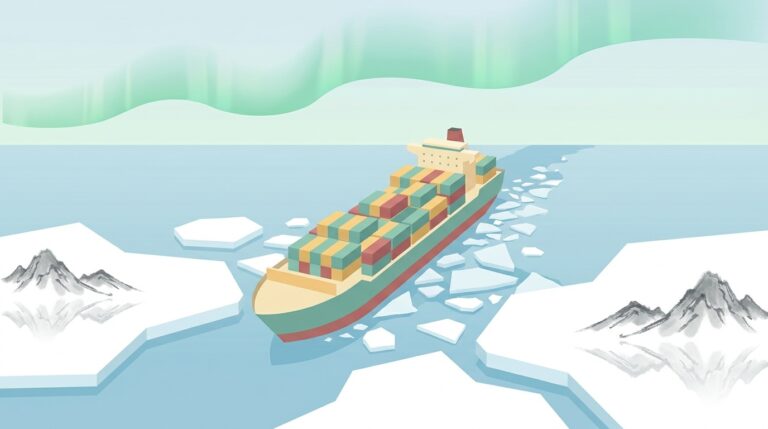
Navigating the Frozen Frontier: Economic Boons and Ecological Woes of the Arctic Shipping Passage
안녕하세요! Welcome back to another premium edition of Daily Hangul (매일한글). I’m your chief editor and resident cultural navigator, here to guide you through the deepest waters of the Korean language.
Today, we are diving deep—literally and intellectually. For our C2-level learners, we are tackling a highly sophisticated, multi-layered global topic that is frequently debated in Korean academic, economic, and environmental forums: The opening of the Northern Sea Route (북극 항로 개척) and its double-edged sword of economic promise and ecological peril.
If you’ve ever tried to discuss global logistics or environmental policy in Korean and felt your vocabulary falling short of your intellect, this guide is your ultimate rescue raft. Let’s master the art of high-level Korean debate together!
Phase 1: Empathy & Real-World Friction
Picture this: You are attending a high-level academic seminar in Seoul, or perhaps sharing a premium craft beer with Korean colleagues in Yeouido. The topic shifts to global warming. You want to express how the melting of the Arctic ice is a tragic ecological crisis, but paradoxically, a massive shortcut for maritime logistics that South Korea—as a major shipbuilding and export-reliant powerhouse—cannot easily ignore.
Many advanced learners freeze here. They know basic terms like “지구 온난화” (global warming) or “돈” (money), but lack the nuanced, high-register vocabulary to articulate complex, systemic trade-offs. This isn’t just about translating English policy jargon into Korean; it’s about capturing the specific rhetoric, tension, and socio-economic anxiety that Koreans feel when balancing industrial survival with global environmental stewardship. Today, we bridge that gap.
Phase 2: Deep-Dive into 3 Essential C2 Expressions
Let’s analyze three advanced expressions that will instantly elevate your discourse from “fluent” to “deeply intellectual.”
1. 양날의 검 (Yang-nal-ui geom)
- Pronunciation: Yang-nal-ui geom (Sounds like “yahng-nal-ee gum” with a soft, rolling ‘l’)
- Meaning: Double-edged sword
- K-Culture Moment: In Korean socioeconomic documentaries (like SBS Special or KBS Docu 3일), major technological breakthroughs or geopolitical shifts are almost always framed as a 양날의 검.
- Editor’s Insight: While English speakers say “double-edged sword,” Koreans use this to describe structural dilemmas where the benefits (이득) and risks (위험) are inherently inseparable. It is highly effective in formal essays and debates.
- Situation Spectrum: Casual ⚠️ | Semi-formal ✅ | Formal ✅
- 🤔 Think About It: Is there an equivalent concept in your culture that balances industrial progress with nature, or do you view them as completely separate entities?
2. 이해득실을 따지다 (I-hae-deuk-sil-eul tta-ji-da)
- Pronunciation: I-hae-deuk-sil-eul tta-ji-da (The ‘tta’ requires a tense, doubled ‘t’ sound, like the ‘t’ in ‘stop’)
- Meaning: To weigh the pros and cons; to calculate gains and losses / interests
- K-Culture Moment: Used extensively in political dramas like Chief of Staff (보좌관) when strategists map out policy consequences behind closed doors.
- Editor’s Insight: ‘이해’ (interests/understanding) + ‘득실’ (gain and loss). Combining these creates a highly sophisticated verb phrase used when evaluating massive projects like the Arctic Route.
- Situation Spectrum: Casual 🚫 | Semi-formal ✅ | Formal ✅
- 🤔 Think About It: How does your home country weigh the “이해득실” when it comes to international environmental treaties?
3. 생태계 교란 (Saeng-tae-gye gyo-ran)
- Pronunciation: Saeng-tae-gye gyo-ran (“Sang-ta-gyuh gyoh-rahn”)
- Meaning: Ecological disruption / ecosystem disturbance
- K-Culture Moment: Frequently appears in Korean news reports discussing the impact of microplastics, invasive species, or heavy shipping noises in pristine marine areas.
- Editor’s Insight: While “환경 오염” (environmental pollution) is a B1-level term, 생태계 교란 specifically points to the systemic breakdown of natural habitats, perfect for C2-level ecological critique.
- Situation Spectrum: Casual 🚫 | Semi-formal ⚠️ | Formal ✅
- 🤔 Think About It: Why does the term “교란” (disturbance/chaos) carry a heavier emotional weight in Korean than simply saying “damage”?
Phase 3: Textbook vs. Real-Life Korean
When discussing complex maritime logistics, textbook phrases can sound incredibly robotic or overly simplistic.
Scenario 1: Explaining the economic benefits
- 📖 Textbook Korean: 북극 항로는 배가 빨리 갈 수 있어서 돈이 절약됩니다. (The Arctic route saves money because ships can go fast.)
- 🗣️ Real-Life C2 Korean: 북극 항로 개척은 운송 경로 단축을 통한 물류비 절감 및 시간적 부가가치 창출을 의미합니다. (Opening the Arctic route signifies logistics cost reduction and the creation of temporal value-added through shortened transit paths.)
- 💡 Why the difference? C2 discourse in Korean heavily utilizes Sino-Korean abstract nouns (물류비 절감, 부가가치 창출) to compress complex economic dynamics into professional, authoritative sentences.
Scenario 2: Expressing concern about oil spills in the Arctic
- 📖 Textbook Korean: 북극에서 배 사고가 나면 기름 때문에 환경이 아파요. (If a ship accident happens in the Arctic, the environment hurts because of oil.)
- 🗣️ Real-Life C2 Korean: 극지방에서의 유류 유출 사고는 저온 환경 특성상 자연 분해가 어려워 치명적인 생태적 재앙으로 이어질 수 있습니다. (Due to the low-temperature environment, oil spills in polar regions decompose slowly, potentially leading to a catastrophic ecological disaster.)
- 💡 Why the difference? Using precise scientific and logical linkages (저온 환경 특성상, 생태적 재앙) displays true academic fluency and rhetorical control.
Phase 4: K-Culture Deep-Dive & Non-Verbal Etiquette
4-1. The Art of
Frequently Asked Questions (FAQ)
Q: What does "양날의 검 (Yang-nal-ui geom)" mean in Korean and how do you pronounce it?
A: In Korean, "양날의 검 (Yang-nal-ui geom)" is pronounced [Yang-nal-ui geom (Sounds like "yahng-nal-ee gum" with a soft, rolling 'l'] and means: Double-edged sword
Q: What does "이해득실을 따지다 (I-hae-deuk-sil-eul tta-ji-da)" mean in Korean and how do you pronounce it?
A: In Korean, "이해득실을 따지다 (I-hae-deuk-sil-eul tta-ji-da)" is pronounced [I-hae-deuk-sil-eul tta-ji-da (The 'tta' requires a tense, doubled 't' sound, like the 't' in 'stop'] and means: To weigh the pros and cons; to calculate gains and losses / interests
Q: What does "생태계 교란 (Saeng-tae-gye gyo-ran)" mean in Korean and how do you pronounce it?
A: In Korean, "생태계 교란 (Saeng-tae-gye gyo-ran)" is pronounced [Saeng-tae-gye gyo-ran ("Sang-ta-gyuh gyoh-rahn"] and means: Ecological disruption / ecosystem disturbance







