

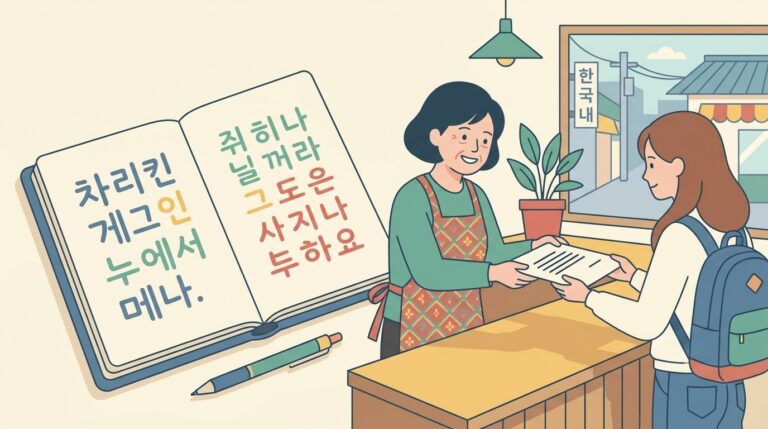
Signing Your First Part-time Job Contract in Korea: A Friendly Guide for Beginners
Phase 1: Empathy (Welcome, My Friend!)
안녕하세요! (Annyeonghaseyo!) Hello! I am your lead editor and your personal “K-culture navigator” from Daily Hangul.
Imagine this: You finally landed your dream part-time job (알바 – Alba) at a cozy, aesthetic cafe in Hongdae or a bustling convenience store featured in your favorite K-dramas! You are super excited, but then the owner slides a piece of paper across the table: the dreaded 근로계약서 (Geunlo-gyeyakseo – Labor Contract). 📝
Your heart beats fast. “What if I sign the wrong thing? What does this mean?” Don’t worry at all! Every international student and traveler in Korea feels this exact same way. Today, we are going to break down the absolute essentials of a Korean part-time contract using super-easy, beginner-friendly A1 Korean. By the end of this guide, you will feel confident enough to say, “Let’s sign!”
Phase 2: Top 3 Essential Expressions for Your Contract
Let’s look at the three most important phrases you will hear or say when discussing your contract.
1. 근로계약서 써요? (Geunlo-gyeyakseo sseoyo?)
- Pronunciation: Geun-lo-gyae-yak-seo sseo-yo? (Sounds like “Gun-law gae-yack-suh suh-yo?”)
- Meaning: “Do we write/sign a labor contract?”
- K-Culture Moment: In K-Dramas, you often see a hardworking main character demanding their rights from a grumpy boss. Asking this question shows you are smart and know your rights!
- Editor’s Insight: The verb 쓰다 (sseuda) means “to write,” but in this context, it means “to fill out and sign.”
- Situation Spectrum:
- Casual: 근로계약서 써? (⚠️ Only for close friends)
- Semi-formal: 근로계약서 써요? (✅ Perfect for your boss)
- Formal: 근로계약서를 작성합니까? (✅ Very formal business setting)
- 🤔 Think About It: In your home country, do people always sign a contract before starting a small part-time job? In Korea, it is legally required for everyone!
2. 시급이 얼마예요? (Sigeubi olmayeyo?)
- Pronunciation: See-gup-ee ol-mah-yae-yo? (Sounds like “See-goop-ee ul-mah-yea-yo?”)
- Meaning: “How much is the hourly wage?”
- K-Culture Moment: In food delivery or convenience store vlogs, Korean creators always check their “시급” (hourly pay) to calculate how many cups of Tteokbokki they can buy.
- Editor’s Insight: “시” (si) means hour, and “급” (geup) means payment. Together, it’s your hourly rate.
- Situation Spectrum:
- Casual: 시급 얼마야? (⚠️ Too rude for your boss!)
- Semi-formal: 시급이 얼마예요? (✅ Best polite option)
- 🤔 Think About It: Korea updates its minimum wage every year. Asking this politely is a normal and respected business practice.
3. 언제 사인해요? (Eonje sainhaeyo?)
- Pronunciation: Eon-jae sah-een-hae-yo? (Sounds like “Un-jae sign-hae-yo?”)
- Meaning: “When do I sign?”
- K-Culture Moment: Signing a document is a big moment of commitment, often highlighted in slow-motion in K-dramas.
- Editor’s Insight: Koreans use the English word “사인” (sign/signature) very naturally. You don’t need to learn a hard word for “signature” yet!
- Situation Spectrum:
- Casual: 언제 사인해? (⚠️)
- Semi-formal: 언제 사인해요? (✅)
Phase 3: Textbook Korean vs. Real-Life Korean
Let’s compare what dry textbooks teach you versus what nice, real-life Koreans actually say.
Situation 1: Asking about the working hours
- 📖 Textbook Korean: 근무 시간이 어떻게 되십니까? (Geunmu sigani eotteoke doesimnikka? – “What are the hours of your shift?”) -> Too stiff and scary!
- 🗣️ Real-Life Korean: 몇 시부터 몇 시까지 해요? (Myeot sibuteo myeot sikkaji haeyo? – “From what time to what time do I work?”)
- 💡 Why the difference? Real people prefer simple, direct time words (몇 시 – what time) over heavy administrative words (근무 시간 – duty hours).
Situation 2: Confirming your pay day
- 📖 Textbook Korean: 임금 지급일은 언제입니까? (Imgeum jigeubireun eonjeimnikka? – “When is the date of wage disbursement?”) -> Sounds like a lawyer!
- 🗣️ Real-Life Korean: 월급날이 언제예요? (Wolgeubnari eonjeyeyo? – “When is pay day?”)
- 💡 Why the difference? “월급” (monthly salary) or “돈” (money) is the everyday word that warm, friendly bosses use.
Phase 4: K-Culture Deep Dive & Non-Verbal Manners
4-1. The “Two-Hand” Rule (두 손)
When your boss hands you the contract, or when you hand it back after signing, never use one hand! Always use two hands to give and receive documents. This simple gesture shows high respect in Korean culture. Also, make a slight nod of your head as you receive it.
4-2. The “Stamp” Culture (도장 – Dojang)
While signatures (사인) are widely accepted for part-time jobs today, you might still see older bosses asking for a “도장” (Dojang – personal name stamp). Don’t panic! If you don’t have one, just politely ask: “사인도 괜찮아요?” (Sain-do gwen-chan-ah-yo? – Is a signature okay too?).
Phase 5: Interactive Roleplay Scenario
Meet Min-ho (민호), the friendly manager of “Sky Cafe.” He is super nice and wants to help you sign your first contract!
- Manager Min-ho: “어서 오세요! 우리 같이 근로계약서 써요.” (Welcome! Let’s write the labor contract together.)
- You (Politely): “네, 사장님!” (Yes, boss!)
- Manager Min-ho: “여기 시급이랑 일하는 시간 적었어요.” (I wrote the hourly wage and working hours here.)
- You: “아, 감사합니다! 몇 시부터 몇 시까지 해요?” (Ah, thank you! From what time to what time do I work?)
- Manager Min-ho: “오후 2시부터 6시까지예요.” (It is from 2:00 PM to 6:00 PM.)
- You: “네, 확인했습니다. 월급날은 언제예요?” (Yes, confirmed. When is pay day?)
- Manager Min-ho: “매달 10일이에요! 여기에 사인해 주세요.” (It’s the 10th of every month! Please sign here.)
- You (Using two hands): “네, 여기요!” (Yes, here it is!)
🔀 Your Turn! Choose Your Path:
- A) Sign immediately without looking closely because you are shy.
- Feedback (Bad): Oh no! Even if the boss is nice, always review the numbers first. Say “잠시만요” (Just a second) and read carefully!
- B) Ask “시급이 얼마예요?” politely to double-check the wage written on the paper.
- Feedback (Best!): Excellent! Checking the wage shows you are attentive and professional.
- C) Throw the pen and say “돈 더 주세요!” (Give me more money!).
- Feedback (Risk!): Oh dear! You might get fired before you even start! Maintain harmony (인화 – Inhwa).
Phase 6: 10-Second Emotion Shadowing Drill
Try speaking these like a real K-drama star! Pay attention to the pauses (/).
[😊 Excited and Polite]- 근로계약서 / 써요? (Geun-lo-gyae-yak-seo / sseo-yo?)
[🤔 Curious and Bright]- 시급이 / 얼마예요? (See-gup-ee / ol-mah-yae-yo?)
[💖 Grateful and Soft]- 감사합니다! / 여기 / 사인 있어요. (Gam-sa-ham-ni-da! / yeo-gi / sah-een eess-eo-yo.)
Phase 7: K-Culture Mini Dictionary
- 알바 (Alba) | Part-time job (derived from the German word ‘Arbeit’).
- 시급 (Sigeup) | Hourly rate / wage.
- 월급 (Wolgeup) | Monthly pay / salary.
- 사장님 (Sajangnim) | Boss / Store Owner (Literally “Company President”. Use this to call your boss!).
Phase 8: Survivor Kit for Travelers
Survival Phrases TOP 3
- 이거 뭐예요? (Igeoseo mwoyeyo?) – What is this? (Great when pointing at a difficult word in the contract).
- 도와주세요. (Dowajuseyo.) – Please help me.
- 여기에요? (Yeogiyeyo?) – Is it here? (Asking where to sign).
Editor’s Travel Note ✈️
Before you start any part-time job in Korea, you must have a valid visa and obtain permission from the immigration office. Use the Government 24 Official Portal to check your visa’s working hours limits! Always stay safe and legal.
Phase 9: “A Step Deeper” (Cultural Reflection)
In Western cultures, contracts are seen as strictly legal, cold documents. However, in Korea, signing a “근로계약서” is also a bridge of trust (신뢰 – Sillae) between “사장님” (the owner) and “알바생” (the worker). Many owners treat their part-timers like family, often giving them free meals (밥) or snacks.
💬 Your Turn: Would you prefer a strictly professional boss, or a warm, family-like Korean “Sajangnim” who buys you food? Let us know in the comments below!
Phase 10: FAQ & Common Mistakes
Q: Can I work without a contract in Korea?
A: No! Legally, every business owner in Korea must write a contract with their employees. If they refuse, it is a red flag. Always ask for “근로계약서”!
Q: What if I don’t understand the Korean words in the contract?
A: It is 100% okay to ask for a translated version (often available in English or Chinese) or use a translator app. A good boss will happily wait for you to understand.
Q: How do I address my boss at a part-time job?
A: Always call them 사장님 (Sajangnim). Never call them by their first name, as it is considered impolite in Korea.
🚨 Common Mistakes Alert!
- Mistake 1: Handing the signed paper with one hand. (Fix: Use both hands!)
- Mistake 2: Not checking the “주휴수당” (weekly holiday allowance) if you work over 15 hours a week.
- Mistake 3: Signing before the dates and hours are filled in.
Phase 11: Action Mission
- 🥉 Bronze: Say “근로계약서 써요?” out loud 3 times in front of your mirror.
- 🥈 Silver: Take a screenshot of Phase 7 (Mini Dictionary) and save it to your phone photos!
- 🥇 Gold: Next time you go to a Korean restaurant or cafe, look at the staff and mentally whisper: “저기 사장님이 계신다!” (There is the Sajangnim!).
Phase 12: Interactive Quiz Challenge
Test your knowledge below!
Q1. What is the polite way to ask your boss about pay day? (Click to reveal answer)
Answer: 월급날이 언제예요? (Wolgeubnari eonjeyeyo?)
Explanation: This is the most natural and polite way to ask in daily life!
Q2. True or False: You should hand the contract to your boss with one hand to look cool. (Click to reveal answer)
Answer: False!
Explanation: You must use both hands (두 손) to show respect in Korea.







