

Phase 1: Empathy (An Open Invitation to My Korean Kitchen)
안녕하세요! (Annyeonghaseyo!) Hello there, my dear friend! I’m the lead editor at Daily Hangul, your native cultural navigator.
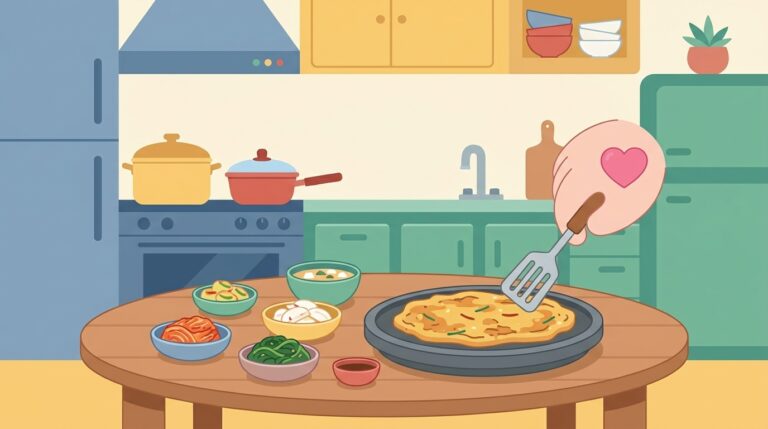
Imagine this: You are invited to a Korean friend’s house for a casual dinner. You walk in, and the kitchen counter is absolutely overflowing. There are giant mixing bowls filled with seasoned vegetables, a mountain of marinated meat, and enough banchan (side dishes) to feed an entire neighborhood. Gasping, you say, “Wow, you prepared so much!” Your friend chuckles and replies, “아, 제가 원래 손이 좀 커요 (Ah, jega wonrae son-i jom keoyo).”
You look down at their hands. They look… completely normal-sized? You feel a sudden wave of confusion. “Wait, did they just say they have big hands? Are we measuring glove sizes, or is there some secret meaning I missed?”
Don’t worry! You haven’t missed a physical growth spurt. You’ve just encountered one of Korea’s most beloved body-part idioms (관용 표현 – gwanyong pyohyeon). In Korea, daily conversations are heavily woven with these figurative expressions. Without them, you might understand every single word grammatically but completely miss the warmth, humor, or sarcasm behind what is actually being said.
Today, we are going to master three essential Korean body idioms that will instantly upgrade your Korean from “textbook-stiff” to “warm, natural, and culturally savvy.”
Phase 2: Deep Dive into 3 Essential Body Idioms
1. 손이 크다 (Son-i Keuda)
- Pronunciation: [Son-i keu-da] (Sounds like “Sohn-ee Keu-dah”)
- Meaning: Literally “To have big hands” ➔ Fig. “To be incredibly generous, especially with food or spending; to make/do things on a grand scale.”
- K-Culture Moment: You will hear this constantly in family-themed K-Dramas like Reply 1988 (응답하라 1988), where the mothers whip up mountains of food for a simple lunch, or in mukbang shows where hosts cook massive portions.
- Editor’s Insight: This expression carries a highly positive, affectionate nuance. It praises someone’s hospitality and open-handed nature. However, it can occasionally be used with a gentle sigh of worry when someone cooks way too much food and wastes it.
- Situation Spectrum: Casual (✅) / Semi-formal (✅) / Formal (⚠️ – use with honorifics like ‘손이 크십니다’)
- 🤔 Think About It: In many Western cultures, being generous with food is appreciated, but efficiency is also highly valued. In Korea, serving an overwhelming amount of food is a direct representation of Jeong (정 – deep affection/bonding). Is there an equivalent idiom in your native language that links a physical trait to generosity?
2. 발이 넓다 (Bal-i Neolbda)
- Pronunciation: [Bal-i neolb-da] (Sounds like “Bahl-ee neolp-dah”)
- Meaning: Literally “To have wide feet” ➔ Fig. “To have a wide social circle; to be very well-connected.”
- K-Culture Moment: Think of that one K-Pop idol who seems to be best friends with literally everyone in the industry, from rookie actors to legendary sunbaes (seniors). Koreans would look at them and say, “와, 진짜 발이 넓다!” (Wow, they are so well-connected!)
- Editor’s Insight: This is the perfect Korean equivalent to being a “social butterfly” or “highly networked.” It’s a great compliment to pay someone who always seems to know a guy who can help with anything.
- Situation Spectrum: Casual (✅) / Semi-formal (✅) / Formal (🚫 – too colloquial for highly official corporate pitches, but fine in casual business networking)
- 🤔 Think About It: Why “wide feet”? Imagine someone taking giant, wide steps that cover a massive territory, meeting people everywhere they step. How does your culture describe someone who knows everyone?
3. 귀가 얇다 (Gwi-ga Yalbdah)
- Pronunciation: [Gwi-ga yalp-da] (Sounds like “Gwee-gah yahlp-dah”)
- Meaning: Literally “To have thin ears” ➔ Fig. “To be gullible; easily swayed by other people’s opinions or sales pitches.”
- K-Culture Moment: Imagine a character in a K-Drama who goes to a department store to buy a simple moisturizer but gets talked into buying a 10-step luxury skincare set by a smooth-talking salesperson.
- Editor’s Insight: Be careful! This expression has a slightly vulnerable or self-deprecating tone. It’s perfectly fine to use it to describe yourself self-deprecatingly (“내가 귀가 좀 얇아서…” – Because I’m a bit gullible…), but saying it directly to someone else’s face might sound a bit critical unless you are close friends.
- Situation Spectrum: Casual (✅) / Semi-formal (⚠️ – use with caution) / Formal (🚫)
- 🤔 Think About It: “Thin ears” suggest that sounds and opinions pass right through without being filtered by critical thinking. It’s a beautiful visual metaphor for susceptibility!
Phase 3: Textbook Korean vs. Real-Life Korean
Let’s look at how native Koreans actually use these concepts to sound natural and lively, compared to stiff, literal textbook translations.
Situation 1: Describing a friend who knows everyone at a party
- 📖 Textbook Korean: “그 사람은 친구가 아주 많고 사교적입니다.”
(Geu saram-eun chingu-ga aju man-go sagyojeog-imnida.)
“That person has many friends and is very sociable.” - 🗣️ 진짜 진짜 한국어 (Real-Life): “그 친구 진짜 발이 넓어서 모르는 사람이 없어!”
(Geu chingu jinjja bal-i neolbeoseo moreuneun saram-i eopseo!)
“That friend is so well-connected, they literally know everyone!” - 💡 Why is it different? The textbook version is grammatically perfect but sounds like a description from a psychology report. The real-life version using “발이 넓다” injects instant warmth, casual flow, and vivid imagery.
Situation 2: Warning a friend not to buy something impulsively
- 📖 Textbook Korean: “남의 말을 쉽게 믿고 물건을 사지 마세요.”
(Nam-ui mal-eun swipge mitgo mulgeon-eul saji maseyo.)
“Do not buy things by easily believing what other people say.” - 🗣️ 진짜 진짜 한국어 (Real-Life): “너 귀 얇으니까 지름신 강림하기 전에 얼른 나와!”
(Neo gwi yarbeunikka jireumsin gangrimhagi jeone eolleon nawa!)
“You’re gullible, so get out of there before the ‘impulse-buying god’ possesses you!” - 💡 Why is it different? Combining “귀가 얇다” with trendy slang like Jireumsin (지름신 – the fictional deity of impulse shopping) makes you sound like a genuine, caring Korean best friend rather than an instruction manual.
Phase 4: K-Culture Deep Dive & Non-Verbal Cues
4-1. The Body Language of Korean Idioms
When Koreans use these idioms, they often pair them with subtle, universally understood non-verbal gestures:
* For “귀가 얇다” (Thin Ears): Lightly pinch your own earlobe and wiggle it while shaking your head playfully. This non-verbal cue signals, “Ah, my ears are so thin, I fell for it again!”
* For “손이 크다” (Big Hands): When describing someone’s massive portion of food, extend both hands outward in a wide circle as if holding a giant cauldron.
4-2. The “Jeong” (정) Behind Big Hands
In Korean food culture, particularly when eating out or visiting a home, leaving the table completely clean can sometimes make a host worry that they didn’t prepare enough. This is why mothers and grandmotherly restaurant owners possess “손이 크다” tendencies. It is an act of deep affection. If a restaurant owner gives you free extra portions (called 서비스 – seobiseu), smiling and saying “우와, 사장님 진짜 손이 크시네요!” (Wow, boss, you really have big hands!) will make their day and earn you a permanent spot in their heart.
Phase 5: Real-Life Roleplay Scenario
Context & Characters
You are visiting your Korean friend Minji (민지) at her apartment. She invited you over for a “light, casual lunch.” However, as you step into her kitchen, you see enough food to host a full-scale banquet.
Minji: "어서 와! 배고프지? 그냥 가볍게 비빔밥이랑 전 몇 개만 준비했어."
(Eoseo wa! Baegopeuji? Geunyang gabyeopge bibimbap-irang jeon myeot gae-man junbi-haesseo.)
Minji: "Welcome! You must be hungry. I just lightly prepared some bibimbap and a few savory pancakes."

You: "(Looking at the table overflowing with 10 different side dishes) 🎭 (Gasping with wide eyes) 우와, 민지야... 이게 '가볍게' 준비한 거야?"
(Uwa, Minji-ya... ige 'gabyeopge' junbi-han geoya?)
You: "Wow, Minji... is this what you call 'lightly' prepared?"

Minji: "응! 우리 집안 내력이야. 우리 엄마도 음식을 항상 많이 하시거든."
(Eung! Uri jiban naeryeok-iya. Uri eomma-do eumsik-eul hangsang mani hasigeodeun.)
Minji: "Yeah! It runs in our family. My mom always cooks a lot too."

You: "🎭 (Nodding warmly) 역시 피는 못 속이네. 너 진짜 손이 크다!"
(Yeoksi pi-neun mot sogine. Neo jinjja son-i keuda!)
You: "As expected, genetics don't lie. You really have 'big hands' (are very generous)!"

Minji: "하하, 맞아. 사실 나 어제 마트 갔다가 세일하길래 이 재료들 다 사 버렸어."
(Haha, maja. Sasil na eoje mateu gattaga seilhagillae i jaeryodeul da sa beoryeosseo.)
Minji: "Haha, true. Actually, I went to the mart yesterday and bought all these ingredients just because they were on sale."

You: "🎭 (Teasing playfully) 혹시 마트 직원의 말에 솔깃해서 다 산 거야? 너도 참 귀가 얇아."
(Hoksi mateu jigwon-ui mal-e solgithaeseo da san geoya? Neo-do cham gwi-ga yarba.)
You: "By any chance, did you buy it all because you were swayed by the clerk? Your 'ears are thin' (gullible) too!"

Minji: "들켰네! 맞아, 나 귀가 너무 얇아서 큰일이야. 참, 내일 내 친구 지수도 오기로 했는데 같이 볼래?"
(Deulkyeonne! Maja, na gwi-ga neomu yarbaseo keuniriya. Cham, naeil nae chingu Jisu-do ogiro haenneunde gachi bollae?)
Minji: "You caught me! Yeah, my ears are so thin, it's a real problem. By the way, my friend Jisu is coming over tomorrow too, do you want to meet up together?"

You: "지수? 너 진짜 아는 사람 많다. 너도 발이 참 넓어!"
(Jisu? Neo jinjja aneun saram manta. Neo-do bal-i cham neolbeo!)
You: "Jisu? You really know so many people. Your 'feet are truly wide' (well-connected) too!"

Minji: "에이, 넓긴! 그냥 맛있는 거 같이 나눠 먹는 걸 좋아할 뿐이야. 얼른 먹자!"
(Ei, neolbgin! Geunyang masinneun geo gachi nanwo meogneun geol joahal ppuniya. Eolleon meokja!)
Minji: "Oh, wide my foot! I just like sharing delicious food with others. Let's eat!"
🔀 Interactive Choice Point
Now, Minji offers you a massive third helping of her delicious Kimchi pancake, even though you are completely stuffed. How do you respond?
- A: “아니요, 괜찮습니다. 너무 배불러요.”
- B: “우와, 민지 진짜 손이 커서 배가 터질 것 같아! 그래도 너무 맛있으니까 더 먹을게!”
- C: “너는 왜 이렇게 손이 크니? 음식을 버리면 안 돼.”
💡 Feedback on Your Choice:
- Selection A (Bad): While polite, it sounds very formal and a bit cold among friends. It shuts down her hospitable energy abruptly.
- Selection B (Best!): Perfect! You used the idiom “손이 크다” playfully, acknowledged her generous nature, and showed appreciation for her cooking. This builds instant intimacy (Jeong).
- Selection C (Risk): Too blunt and critical! In Korea, lecturing a friend about food waste when they prepared a meal for you can sound extremely rude, even if you are close.
Phase 6: 10-Second Emotional Shadowing Drill
To sound like a native speaker, you must mimic the melody of Korean emotions. Practice speaking these aloud with the emotional cues and natural pauses (/):
- [🥺 Playfully Teasing & Accusing]
“너 진짜 / 귀가 얇아서 / 어떡하냐~?”
(Neo jinjja / gwi-ga yarbaseo / eotteokhan-ya~?)
“What am I going to do with you / since your ears are so thin (gullible)~?” -
[😊 Amazed & Grateful]
“우와! / 사장님 진짜 / 손이 크시네요! / 서비스 감사합니다!”
(Uwa! / Sajangnim jinjja / son-i keusineyo! / Seobiseu gamsahamnida!)
“Wow! / Boss, you really / have big hands! / Thank you for the freebie!”
Phase 7: K-Culture Mini Dictionary
- 인맥 (In-maek) | Noun | Social network/connections. Linked closely with having “wide feet” (발이 넓다).
- 지름신 (Jireum-sin) | Slang | The “impulse-buying god.” Often possesses people with “thin ears” (귀가 얇은 사람).
- 서비스 (Seobiseu) | Noun | Free food, drinks, or items given by shops as a token of goodwill (not customer service in the English sense).
- 정 (Jeong) | Noun | Deep emotional bonding, affection, and mutual attachment that defines close relationships in Korea.
Phase 8: Survivor Kit for Travelers
Survival Expressions TOP 3
- “양 많이 주세요!” [Yang mani juseyo!] ➔ “Please give me a large portion!” (Pro Tip: Use this at traditional markets!)
- “추천해 주실 만한 거 있나요?” [Chucheon-hae jusil man-han geo innayo?] ➔ “Is there anything you would recommend?”
- “진짜 최고예요!” [Jinjja choegoyeyo!] ➔ “This is truly the best!”
Editor’s Travel Note
When traveling around Korea to try local delicacies, do not just rely on global search engines. To find authentic local spots where owners have “big hands” and serve massive portions of delicious food, make sure to download the Naver Map App or look up reviews on Kakao Maps. Searching for terms like “가성비 맛집” (great value-for-money restaurant) on these local platforms will lead you straight to culinary heaven.
(Disclaimer: Restaurant operational hours and menu prices are subject to change; please verify on local apps before visiting.)
Phase 9:
Frequently Asked Questions (FAQ)
Q: What does "손이 크다 (Son-i Keuda)" mean in Korean and how do you pronounce it?
A: In Korean, "손이 크다 (Son-i Keuda)" is pronounced [Son-i keu-da] and means: Literally "To have big hands" ➔ Fig. "To be incredibly generous, especially with food or spending; to make/do things on a grand scale."
Q: What does "발이 넓다 (Bal-i Neolbda)" mean in Korean and how do you pronounce it?
A: In Korean, "발이 넓다 (Bal-i Neolbda)" is pronounced [Bal-i neolb-da] and means: Literally "To have wide feet" ➔ Fig. "To have a wide social circle; to be very well-connected."
Q: What does "귀가 얇다 (Gwi-ga Yalbdah)" mean in Korean and how do you pronounce it?
A: In Korean, "귀가 얇다 (Gwi-ga Yalbdah)" is pronounced [Gwi-ga yalp-da] and means: Literally "To have thin ears" ➔ Fig. "To be gullible; easily swayed by other people's opinions or sales pitches."







