

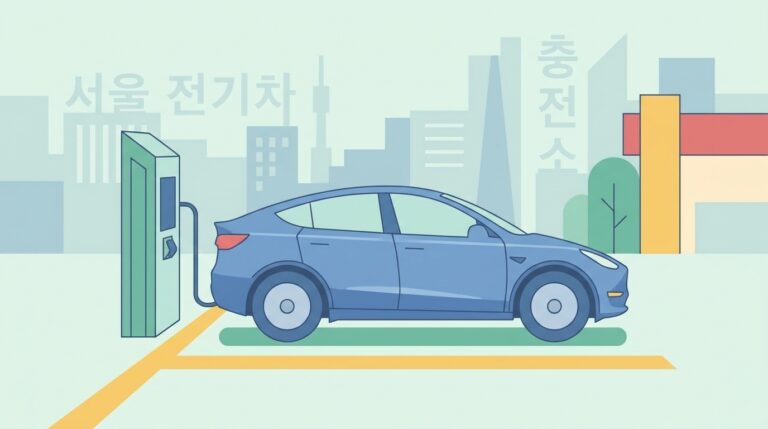
Master the Road: How to Avoid Korea’s Dreaded EV Charging Zone Parking Fines
Phase 1: Empathy (An On-the-Road Drama)
안녕하세요! It’s your K-culture navigator and Daily Hangul editor here.
Imagine this: You’ve finally rented that sleek, high-tech EV for an epic road trip down to Jeju Island or a coastal drive in Gangneung. You find a perfect parking spot, grab a quick ice americano (아아), and return only to find a bright yellow slip or a digital warning on your windshield.
“Wait, I only parked there for five minutes!” you might think.
In South Korea’s highly digitized, eco-conscious landscape, parking in or blocking an Electric Vehicle (EV) charging zone is no longer just an etiquette faux pas—it’s a heavily regulated offense monitored by automated cameras and vigilant citizens using national reporting apps. Navigating this as a C2-level speaker means mastering the highly specific legal and bureaucratic jargon while knowing how to explain yourself fluently if you ever find yourself in a tight spot. Let’s make sure your driving experience in Korea remains pristine and fine-free!
Phase 2: Deep-Dive into Top 3 Advanced Expressions
1. 충전 방해 행위 (Chung-jeon bang-hae haeng-wi)
- Pronunciation: Choong-jeon (like ‘choong’ in ‘choong-sil’) bang-hae (rhymes with ‘hang-hae’) haeng-wi (‘haeng-we’)
- Meaning: EV Charging Obstruction Activity
- K-Culture Moment: You’ll see this exact phrase on heavy banners hung around public parking lots, apartment complexes, and department store garages.
- Editor’s Insight: This isn’t just a generic term for “blocking.” It is the official legal term used in South Korea’s “Eco-Friendly Vehicles Act.” It encompasses parking a non-EV, blocking the path, or leaving a fully charged EV plugged in for too long.
- Situation Spectrum: Casual 🚫 | Semi-formal ⚠️ | Formal ✅
- 🤔 Think About It: How does Korea’s rapid adaptation of technology reflect in its quick codification of laws? In your country, is “obstruction” of charging stations prosecuted as strictly as a traffic violation?
2. 과태료가 부과되다 (Gwa-tae-ryo-ga bu-gwa-doe-da)
- Pronunciation: Gwa-tae-ryo (‘gwa’ + ‘tae’ + ‘ryo’ like ‘yawn’) ga bu-gwa (‘boo-gwa’) doe-da (‘dweh-dah’)
- Meaning: To be assessed/levied an administrative fine
- K-Culture Moment: Often heard in civil complaints office disputes or when debating legal boundaries with parking attendants.
- Editor’s Insight: Do not confuse 과태료 (administrative fine/non-criminal infraction) with 벌금 (criminal fine). For EV parking violations, you face a 과태료 of up to 100,000 KRW, or even up to 500,000 KRW if you physically damage the charging infrastructure.
- Situation Spectrum: Casual 🚫 | Semi-formal ⚠️ | Formal ✅
- 🤔 Think About It: Korean legal terms separate non-criminal regulatory fines (과태료) and criminal fines (벌금) very strictly. Does your native language have distinct everyday words for these two?
3. 이동 주차를 요구하다 (I-dong ju-cha-reul yo-gu-ha-da)
- Pronunciation: Ee-dong (‘ee-dong’ as in movement) ju-cha (‘joo-chah’) reul yo-gu (‘yo-goo’) ha-da
- Meaning: To request/demand that a vehicle be moved to another parking space
- K-Culture Moment: When a neighbor or building security guard politely calls your phone number (usually displayed on your dashboard) asking you to move your car.
- Editor’s Insight: At a C2 level, instead of saying “차 좀 빼주세요” (Please take your car out), using the formal phrasing “이동 주차를 요구하다” shows high linguistic sophistication, often used when documenting incidents or dealing with rental agencies.
- Situation Spectrum: Casual ⚠️ | Semi-formal ✅ | Formal ✅
- 🤔 Think About It: Displaying your phone number on the dashboard is standard etiquette in Korea due to tight parking spaces. How do you balance privacy concerns with community convenience?
Phase 3: Textbook Korean vs. Real-Life Korean
Situation 1: Warning someone that they shouldn’t park there
- 📖 Textbook: “여기에 주차하시면 벌금을 낼 수 있습니다.” (If you park here, you might pay a fine.)
- 🗣️ Real-Life: “거기 전기차 구역이라 잘못하면 바로 단속돼서 과태료 나와요.” (That’s an EV zone, so if you’re not careful, you’ll get caught/monitored immediately and fined.)
- 💡 Why the Difference?: Locals use “단속되다” (to be caught/clamped down by enforcement) and “과태료 나오다” (for a fine to be issued) rather than the generic “벌금을 내다.”
Situation 2: Asking a building office if the EV spot is monitored
- 📖 Textbook: “이곳은 주차 금지 구역입니까?” (Is this a no-parking zone?)
- 🗣️ Real-Life: “여기 전기차 충전 구역 상시 단속 구간인가요? 주민 신고 앱으로 들어가는 곳인가요?” (Is this EV charging area subject to constant enforcement? Is this an area where people report through the community app?)
- 💡 Why the Difference?: Nowadays, most fines are generated via the “Safety Report App” (안전신문고) uploaded by citizens. Knowing if an area is “상시 단속” (constant enforcement) is crucial.
Phase 4: K-Culture Deep-Dive & Non-Verbal Manners
4-1. The Dashboard Phone Number Etiquette
In Korea, it is standard to have a small temporary card with your phone number on your dashboard (주차 알림판). If you block someone or park near an EV zone temporarily, expecting a call is normal.
* Non-verbal Tip: If you receive a call to move your car, bowing slightly (about 15 degrees) when you meet the driver waiting for you, and saying “죄송합니다, 바로 빼겠습니다!” (I’m sorry, I’ll move it right away!) is vital to keeping the peace.
4-2. The “Safety Report App” (안전신문고) Culture
Korea is highly digitized. Citizens can take a photo of your car parked in an EV space, upload it to the Safety Report App, and within days, your rental agency will forward you a bill. This citizen-led monitoring is called ‘생활불편신고’ (reporting everyday inconveniences) and is a massive part of Korea’s highly organized communal pressure system.
Phase 5: Real-Life Roleplay Scenario
Characters:
- 지우 (Ji-woo): Your Korean friend who is navigating the car into a crowded department store parking lot.
- You (C2 Level Speaker): The vigilant co-pilot looking out for fines.
[Scene: Inside a bustling subterranean parking lot in Starfield Mall, Hanam]
- Ji-woo: (Sighing, looking at the dashboard) 아, 진짜 주차할 데가 하나도 없네. 어? 저기 한 자리 비었다! 빨리 가보자.
(Ah, seriously, there’s not a single parking spot. Oh? There’s one over there! Let’s go quick!) - You: (Squinting) 지우야, 잠깐만. / 저기 바닥에 파란색으로 표시되어 있잖아. / 저거 전기차 충전 구역(EV Zone) 같은데?
(Ji-woo, wait a second. It’s marked in blue on the floor over there. Isn’t that an EV charging zone?) - Ji-woo: 엇, 진짜네… 근데 우리 10분만 있다가 바로 나올 건데 그냥 잠깐 세워두면 안 될까? 요즘 설마 바로 잡겠어?
(Ah, you’re right… But we’re leaving in 10 minutes anyway, can’t we just park there for a sec? Surely they wouldn’t catch us immediately nowadays?) - You: 🎭 (Seriously, holding your hand up slightly) 안 돼. 요즘은 시민 신고 앱 때문에 잠깐 세워둬도 뒤차가 바로 사진 찍어서 신고하면 빼도 박도 못하고 충전 방해 행위로 과태료 부과돼.
(No way. These days, because of citizen reporting apps, even if you park for a bit, if the car behind us takes a photo and reports it, we’re stuck and we’ll be fined for EV charging obstruction.) - Ji-woo: 에이, 그래도 5분 정도 회차하는 건 괜찮지 않아?
(Come on, isn’t it fine to just idle or stop for like 5 minutes?) - You: 🎭 (Shaking your head firmly) 규정이 강화되어서 단 1분만 주차해도 예외 없이 단속 대상이야. 괜히 과태료 10만원 내지 말고 저기 지하 4층으로 내려가보자.
(The regulations got stricter, so even parking for just 1 minute makes you subject to enforcement without exception. Let’s not waste 100,000 KRW on a fine and try heading down to B4 instead.) - Ji-woo: 와, 너 한국 도로교통법 완전 꿰고 있구나? 덕분에 큰돈 아꼈다. 바로 내려갈게!
(Wow, you really know Korean road laws inside out, don’t you? Saved me a fortune. Heading down right away!)
🔀 Interactive Decision Point
If Ji-woo suggests parking in the EV spot because his car is a hybrid (하이브리드), how do you respond?
- Option A: “하이브리드 차량은 어차피 친환경차니까 법적으로 무조건 상시 주차 가능해!”
- Feedback: Bad. Hybrid cars cannot park in EV charging spots unless they are actively plugging in and charging (for plug-in hybrids). Simply parking there without charging is still considered “충전 방해 행위.”
- Option B: “일반 하이브리드는 충전 케이블 연결 안 하면 단속 대상이니까, 마음 편하게 일반 구역 찾아보자.”
- Feedback: Best! Accurate, legally sound, and shows perfect cultural/regulatory understanding.
- Option C: “민원 신고 들어와도 렌터카면 과태료 안 나오니까 대충 세우자.”
- Feedback: Risk. Rental car companies will charge your credit card directly along with an administrative fee if a fine is levied.
Phase 6: 10-Second Emotional Shadowing Drill
Practice saying this naturally to show deep worry and fluent warning tones.
- Sentence: “거기 / 전기차 충전 구역이라 / 잠깐만 대도 / 바로 신고당해서 / 과태료 나와요!”
- Rhythm & Intonation:
Go-gi / jeon-gi-cha choong-jeon goo-yeok-i-ra / jam-ggan-man dae-do / ba-ro sin-go-dang-hae-seo / gwa-tae-ryo na-wa-yo! - Emotion Milestone:
[😰 Worried and urgent—as if trying to stop a friend from making a huge mistake]
Phase 7: K-Culture Mini-Dictionary
- 안전신문고 (An-jeon-sin-mun-go) | Safety Report App: An official government app where any resident can instantly report traffic, safety, and parking violations.
- 친환경자동차법 (Chin-hwan-gyeong-ja-dong-cha-beop) | Eco-friendly Vehicles Act: The umbrella law that regulates green energy transport and specifies punishments for blocking EV charging stations.
- 손괴 (Son-goe) | Destruction/Damage: Legally damaging charging cables or stations. This leads to a massive 500,000 KRW fine.
- 회차 (Hoe-cha) | Turn-around/Entry-exit: Entering a parking facility and leaving within the free grace period (usually 10–30 minutes).
Phase 8: Traveler’s Survival Kit
Survival Expressions TOP 3
- “여기에 전기차 충전 구역 단속 카메라가 있나요?”
- Pronunciation: Yeo-gi-e jeon-gi-cha choong-jeon goo-yeok dan-sok ka-me-ra-ga in-na-yo?
- Pro Tip: Ask this to the security desk if you’re unsure if a spot is actively monitored.
- “충전이 끝났는데 왜 차를 안 빼시는지 확인해 주실 수 있나요?”
- Pronunciation: Choong-jeon-i kkeut-nat-neun-de wae cha-reul an pae-si-neun-ji hwa-gin-hae ju-sil su in-na-yo?
- Pro Tip: Use this when calling building management to complain about someone blocking your EV rental charger.
- “죄송합니다, 길을 잘못 들어 잠시 정차 중이었습니다. 바로 이동하겠습니다.”
- Pronunciation: Joe-song-ham-ni-da, gil-eul jal-mot deul-eo jam-si jeong-cha joong-i-eot-seum-ni-da. Ba-ro i-dong-ha-get-seum-ni-da.
- Pro Tip: If a traffic officer or building guard catches you stopped in an EV zone.
Editor’s Travel Note
When driving in Korea, make sure to download the Naver Map App for accurate GPS navigation. It even alerts you to nearby EV charging stations and indicates whether they are currently occupied or broken down in real-time. Do note that parking regulations are updated frequently, so always defer to local signs over old blog posts.
Phase 9: “Going Deeper” (C2 Cultural Reflection)
Korea’s swift transition toward EV adoption is backed by a collective social consensus: resources must be shared efficiently. Because land is highly limited and parking spaces are notoriously scarce in major metropolitan areas like Seoul, parking in an EV space without charging is viewed not merely as a minor infraction, but as an act of “civic selfishness” that harms others. This is why the citizen-led 안전신문고 app is so heavily utilized.
💬 Your Turn: How does your home country handle the balance between private driver convenience and public utility infrastructure? Let us know in the comments below!
Phase 10: FAQ & Common Mistakes
Q: Can I park in an EV space if I drive a plug-in hybrid?
A: You can only park there while actively charging. Once the charging is complete, you must move the vehicle. Remaining parked after charging is completed is also categorized as an obstruction.
Q: What is the fine for parking a regular gasoline car in an EV spot?
A: It is a flat 100,000 KRW fine for parking a non-electric vehicle in an EV charging zone.
Q: Is there a grace period for parking in an EV spot?
A: No. Under the current law, there is zero grace period. Even stopping for a brief minute to drop someone off can be flagged and fined via photo reporting.
🚨 Common Mistakes Warning Board
- Mistake 1: Thinking “I’ll just turn on my hazard lights (비상등) and run inside for a minute.”
- Correct Action: Hazard lights do not grant immunity. Never leave your car unattended in an EV zone.
- Mistake 2: Assuming apartment parking complexes are exempt from the law.
- Correct Action: The Eco-friendly Vehicles Act applies to all public and residential parking structures, including private apartment complexes.
- Mistake 3: Not realizing that parking in front of the EV space (blocking the path) is also a 100,000 KRW fine.
- Correct Action: Always ensure there is enough clearance space for EVs to enter and connect the cable.
Phase 11: Action Mission & Engagement
- Bronze Mission: Read the roleplay scenario out loud once, focusing on the pronunciation of 과태료 (Gwa-tae-ryo).
- Silver Mission: Share this post on your social media with the hashtag
#DailyHangulto save your expat friends from a 100,000 KRW fine! - Gold Mission: Next time you pass an EV charging spot in Korea, look for the warning sign and read the words 충전 방해 행위 금지 out loud!
Phase 12: Interactive Quiz Challenge
1. What is the fine for damaging an EV charger or intentionally defacing the lines of the spot?
- A) 10,000 KRW
- B) 100,000 KRW
- C) 500,000 KRW
👀 Click here for the Answer & Explanation!
Answer: C) 500,000 KRW
Explanation: While simply parking there gets you a 100,000 KRW fine, physically damaging or obstructing the facility itself (손괴) carries a much heavier administrative penalty of 500,000 KRW.
2. True or False: If my car is fully charged, I can leave it plugged in overnight at a rapid charging station.
👀 Click here for the Answer & Explanation!
Answer: False
Explanation: At rapid charging stations (급속충전기), you are limited to a maximum parking time (usually 1 hour). Staying past that limit makes you subject to a fine even if you are an EV.







