

Master Shopping for Contact Lenses in Korea: The Friendly Guide to Finding Your Perfect Fit!
Phase 1: Empathy (Welcome, My Friend!)
안녕하세요! (Annyeonghaseyo!) Hello! It’s your Korean bestie and Daily Hangul’s Senior Editor here!
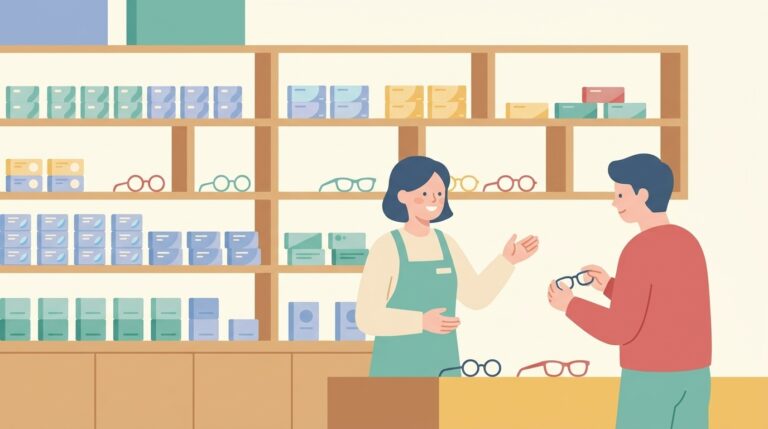
Imagine this: You are exploring the gorgeous streets of Hongdae or Myeongdong, and you realize you are down to your last pair of contact lenses. Your vision is getting a bit blurry, and you need a fresh pack now. You spot a sleek, modern Korean optician shop (안경점 – an-gyeong-jeom), but as you walk near the door, your heart starts racing.
“How do I say ‘contact lenses’? Will they understand my prescription? What if they ask about my base curve?”
Don’t panic! Buying lenses in Korea is actually incredibly fast, surprisingly affordable, and you don’t even need a doctor’s prescription from home in most retail shops. Today, we are going to walk through the glass doors together. By the end of this guide, you’ll confidently walk into any Korean optician and walk out with the perfect pair of lenses!
Phase 2: Deep Dive into 3 Key Expressions
Let’s learn the three absolute lifesaver phrases you need at the counter.
1. 렌즈 있나요? (Len-jeu in-na-yo?)
- Pronunciation: Len-jeu (sounds like “len-zoo” but with a soft ‘j’) in-na-yo (sounds like “een-nah-yo”).
- Meaning: “Do you have contact lenses?” / “Are lenses available?”
- K-Culture Moment: In K-Dramas, when characters want to switch up their style from “nerdy glasses” to “idol-chic,” they head to the nearest shop and ask this first.
- Editor’s Insight: In Korean, we shorten “contact lenses” to just 렌즈 (len-jeu). It’s simple, sweet, and instantly understood.
- Situation Spectrum:
- Casual: 렌즈 있어? (len-jeu isseo?) ⚠️ (Only for close friends)
- Semi-formal: 렌즈 있나요? (len-jeu in-na-yo?) ✅ (Perfect for shopping!)
- Formal: 렌즈 있습니까? (len-jeu is-seup-ni-ka?) 🚫 (Too stiff, like military talk)
- 🤔 Think About It: In English, we specify “contact lenses” so we don’t confuse them with camera lenses. But in Korea, context is king! If you are in an eyewear shop, just saying “렌즈” is more than enough.
2. 제 시력은… 이에요. (Je si-ryeok-eun… i-e-yo.)
- Pronunciation: Je (“jeh”) si-ryeok-eun (“she-ryuck-eun”) … i-e-yo (“ee-eh-yo”).
- Meaning: “My eyesight/prescription is [number].”
- K-Culture Moment: Korean opticians use the decimal system for eyesight (e.g., -1.5, -2.0) rather than the fraction system (like 20/20).
- Editor’s Insight: If you don’t know your exact Korean decimal number, just show them a photo of your current lens box! They can read the power (diopter, e.g., -3.50) instantly.
- Situation Spectrum:
- Semi-formal: 제 시력은 -3.0이에요. (Je si-ryeok-eun ma-i-neo-seu sam-jeom-yeong i-e-yo.) ✅
- 🤔 Think About It: Why does Korea use decimals? It’s part of the streamlined, metric-friendly health checks in East Asia. It makes comparing numbers super easy!
3. 일회용으로 주세요. (Il-hoe-yong-euro ju-se-yo.)
- Pronunciation: Il-hoe-yong (“eel-hway-yong”) euro (“oo-ro”) ju-se-yo (“joo-she-yo”).
- Meaning: “Please give me daily disposables (one-day lenses).”
- K-Culture Moment: Koreans love convenience! “Daily disposables” are extremely popular because of active lifestyles and late-night study or work sessions.
- Editor’s Insight: 일회용 (il-hoe-yong) literally means “one-time use.” If you want monthly lenses, you say 한 달용 (han-dal-yong).
- Situation Spectrum:
- Semi-formal: 일회용으로 주세요. ✅ (Polite and direct)
Phase 3: Textbook Korean vs. Real-Life Korean
Let’s compare what dry textbooks teach you versus what cool, real-world Koreans actually say!
Situation A: Asking for a prescription eye test
- 📖 Textbook Korean: “검안을 받고 싶습니다.” (Geom-an-eul bat-go sip-seup-ni-da. – “I would like to receive an optometric examination.”)
- 🗣️ Real-Life Korean: “시력 검사 할 수 있어요?” (Si-ryeok geom-sa hal su is-seo-yo? – “Can I get an eye test?”)
- 💡 Why is it different? The textbook version is grammatically correct but sounds like a medical textbook. Real locals use the active, friendly phrase “시력 검사” (eyesight test).
Situation B: Asking for colored contact lenses
- 📖 Textbook Korean: “미용 콘택트렌즈를 보여주세요.” (Mi-yong kon-taek-teu-len-jeu-reul bo-yeo-ju-se-yo. – “Please show me cosmetic contact lenses.”)
- 🗣️ Real-Life Korean: “컬러 렌즈 보여주세요.” (Keol-reo len-jeu bo-yeo-ju-se-yo. – “Please show me color lenses.”)
- 💡 Why is it different? Nobody says “cosmetic contact lenses” in real life! Everyone calls them “컬러 렌즈” (color lenses) or “써클 렌즈” (circle lenses).
Phase 4: K-Culture Deep Dive & Non-verbal Manners
4-1. Nunchi & Eye Contact Manners
When you enter a Korean optician store, you’ll notice the staff are incredibly attentive. This is called 눈치 (Nunchi – quick situational awareness).
* The Gesture: When they hand you your lenses or your change, they will often use both hands, or place their left hand under their right elbow. This is a sign of deep respect. Receive the items with both hands to show you respect them back!
4-2. The Korean “Circle Lens” Phenomenon
In Korea, eye styling is a major part of the K-Beauty routine. Many K-Pop idols wear 써클 렌즈 (circle lenses) to make their irises look larger and more expressive. Don’t be surprised if the staff asks if you want natural tones like brown/black, or idol-style colors like gray and blue!
Phase 5: Interactive Roleplay Scenario
Let’s step into a trendy eyewear shop in Hongdae called “Lensey”. You are speaking with Minji, a friendly shop assistant.
- Background: K-Pop music is playing gently in the background. The shelves are lined with colorful lens boxes.
Dialogue
- Minji (Staff): “안녕하세요! 어떤 렌즈 찾으세요?”
(An-nyeong-ha-se-yo! Eo-tteon len-jeu chat-eu-se-yo?)
🎭 smiling and bowing slightly
“Hello! What kind of lenses are you looking for?” -
You: “안녕하세요. 일회용 렌즈 있나요?”
(An-nyeong-ha-se-yo. Il-hoe-yong len-jeu in-na-yo?)
🎭 pointing gently to the daily lens display
“Hello. Do you have daily disposable lenses?” -
Minji (Staff): “네, 많아요! 시력이 어떻게 되세요?”
(Ne, manh-a-yo! Si-ryeok-i eo-tteok-he doe-se-yo?)
🎭 picking up a tablet to search the inventory
“Yes, we have many! What is your prescription?” -
You: “잘 몰라요. 시력 검사 할 수 있어요?”
(Jal mol-ra-yo. Si-ryeok geom-sa hal su is-seo-yo?)
🎭 smiling sheepishly
“I’m not sure. Can I get an eye test?” -
Minji (Staff): “그럼요! 이쪽으로 오세요.”
(Geu-reom-yo! I-jjok-eu-ro o-se-yo.)
🎭 gesturing toward the examination room
“Of course! Please come this way.”
(After a quick, free 3-minute eye test…)
- Minji (Staff): “검사 끝났습니다. 마이너스 삼 이에요. 투명 렌즈 원하세요, 컬러 렌즈 원하세요?”
(Geom-sa kkeut-nas-seup-ni-da. Ma-i-neo-seu sam i-e-yo. Tu-myeong len-jeu won-ha-se-yo, keol-reo len-jeu won-ha-se-yo?)
🎭 showing different packages on the table
“The test is finished. You are -3.0. Do you want clear lenses or color lenses?” -
You: “투명 렌즈로 주세요.”
(Tu-myeong len-jeu-ro ju-se-yo.)
🎭 choosing the classic clear look
“Please give me clear lenses.” -
Minji (Staff): “네, 여기 있습니다! 감사합니다.”
(Ne, yeo-gi is-seup-ni-da! Gam-sa-ham-ni-da.)
🎭 handing over the bag with both hands
“Yes, here they are! Thank you.”
🔀 Choose Your Path!
How do you want to pay?
* Choice A: “카드 돼요?” (Ka-deu dway-yo? – Does card work?)
* Choice B: “깎아주세요!” (Kkak-a-ju-se-yo! – Give me a discount!)
* Choice C: “현금 없어요.” (Hyeon-geum eop-seo-yo. – I don’t have cash.)
💡 Feedback on Your Choice:
- Choice A (Best): Perfect! Card payment is accepted almost everywhere in Korea, even for small amounts. Minji will happily swipe it.
- Choice B (Bad): Oops! Haggling in a standard retail chain or modern optician shop is not common and might make things awkward.
- Choice C (Risk): While true, it sounds a bit abrupt. Better to ask “카드 돼요?” (Can I pay by card?) instead.
Phase 6: 10-Second Emotion Shadowing Drill
Practice speaking like a native! Mimic the pauses (/) and emotions below.
[😊 Politely & Confidently]
일회용 렌즈 / 있나요?
(Il-hoe-yong len-jeu / in-na-yo?)
“Do you have / daily lenses?”-
[🥺 Slightly shy & Asking for help]
시력 검사 / 할 수 있어요?
(Si-ryeok geom-sa / hal su is-seo-yo?)
“Can I / get an eye test?”
Phase 7: K-Culture Mini Dictionary
- 투명 렌즈 (Tu-myeong Len-jeu) | Clear Lenses
Non-colored, standard contact lenses for vision correction. - 원데이 렌즈 (Won-de-i Len-jeu) | One-Day Lenses
The English loanword for daily disposables. Widely used in shops. - 난시 (Nan-si) | Astigmatism
If you have astigmatism, you should tell the optician: “난시 있어요” (Nan-si is-seo-yo). - 렌즈 케이스 (Len-jeu Ke-i-seu) | Lens Case
Usually given for free if you buy multi-day lenses, but always good to ask for!
Phase 8: Traveler’s Survival Kit
Survival Phrases TOP 3
- 이거 추천해 주세요. (I-geo chu-cheon-hae ju-se-yo.)
- Pro Tip: “Please recommend this (or something).” Use this if you don’t know which brand is good!
- 보존액 주세요. (Bo-jon-aek ju-se-yo.)
- Pro Tip: “Please give me lens solution.” Essential if you use monthly lenses.
- 영수증 주세요. (Yeong-su-jeung ju-se-yo.)
- Pro Tip: “Please give me the receipt.” Good for tracking your travel expenses.
📝 Editor’s Travel Note
Looking for the nearest optician? Open the Naver Map App (never use Google Maps in Korea, as it doesn’t update well!) and search for “안경점” (optician). You’ll find one on almost every major street corner. Most shops offer free eye exams with purchase, and you can get custom glasses or contacts in under 30 minutes! (Note: Store policies may change, so always ask first).
Phase 9: “Going Deeper” (Cultural Reflection)
In many Western countries, purchasing contact lenses requires an active prescription from an eye doctor, which can involve expensive appointments. In Korea, however, opticians are fully licensed to conduct eye measurements on-site for free when you buy lenses. This reflects Korea’s fast-paced, high-efficiency culture (빨리빨리 – Bballi-Bballi). It’s designed to make health and beauty accessible to everyone instantly.
💬 Your Turn: Is buying lenses in your country complicated? Do you prefer the Korean system? Tell me your thoughts in the comments below!
Phase 10: FAQ & Avoiding Misunderstandings
Q: Can I buy contact lenses in Korea without a prescription?
A: Yes! You do not need a paper prescription from a hospital. The licensed opticians at the store can test your eyes on the spot for free.
Q: What is the most popular color lens brand in Korea?
A: Brands like OLENS, LENS ME, and Davich are incredibly popular. You can find them in any shopping district.
Q: Can I pay with an international credit card?
A: Yes! Most Korean shops accept Visa, Mastercard, and UnionPay.
🚨 Common Mistakes Alert!
- Saying “Glass” instead of “Lens”: Don’t say “안경 (an-gyeong)” if you want contacts. “안경” means glasses. Remember to say “렌즈 (len-jeu)”!
- Expecting 20/20 measurements: If you say “My vision is 20/20,” they might not understand. Just show your old lens box with the diopter number (e.g. -2.50).
- Not asking for service (Deom): Sometimes, if you buy several packs, they give you free solution. Politely ask: “서비스 있어요?” (Seo-bi-seu is-seo-yo? – Do you have any freebies?)
Phase 11: Action Mission!
- 🥉 Bronze: Read the 10-second shadowing phrases out loud 3 times.
- 🥈 Silver: Take a picture of your current contact lens box and write down your Korean prescription number in the comments.
- 🥇 Gold: Next time you visit Korea, walk into an OLENS or LENS ME and ask: “일회용 렌즈 있나요?”
- 🎮 K-Culture Mission: Watch a K-Beauty YouTube vlog and count how many times they say “렌즈 (len-jeu)” during their makeup tutorial!
Phase 12: Interactive Quiz Challenge!
Test your skills before you go!
1. Which word means “daily disposable lenses”?
- A) 안경 (An-gyeong)
- B) 일회용 렌즈 (Il-hoe-yong len-jeu)
- C) 시력 (Si-ryeok)
See Answer & Explanation
Correct Answer: B
일회용 (il-hoe-yong) means daily/single-use, and 렌즈 (len-jeu) means lenses. A means glasses, and C means eyesight!
2. True or False: You must visit an eye clinic in Korea to get a prescription before buying lenses.
- True
- False
See Answer & Explanation
Correct Answer: False
You can get a free, professional eye exam directly inside the lens shop! It’s fast and super easy.
See you in the next lesson, my friend! 안녕! (An-nyeong!)







