

Step Inside! The Ultimate No-Stress Guide to Taking Off Your Shoes in Korea
Phase 1: Empathy (Welcome to the Daily Hangul Family!)
안녕하세요! (An-nyeong-ha-se-yo!) Hello! I’m your Daily Hangul editor and your personal K-culture navigator.
Imagine this: You are invited to a beautiful Korean home, or perhaps you are about to step into a cozy, traditional restaurant in Seoul. You walk up to the entrance, look down, and suddenly panic. Do I take my shoes off here? What if my socks have a hole? Is it okay to go barefoot?
If you have ever felt this sudden wave of anxiety, don’t worry! You are not alone. Almost every visitor to Korea experiences this “shoe-dilemma” moment. Today, we are going to master the art of stepping into a Korean space with absolute confidence. By the end of this guide, you will know exactly what to do, what to say, and how to feel right at home—completely stress-free! Let’s dive in!
Phase 2: Deep Dive into 3 Essential Expressions
Let’s learn three super simple, high-impact expressions you can use when entering a shoe-free zone. Since we are focusing on Level A1, these are short, sweet, and incredibly practical!
1. 신발 벗어요? (Sin-bal beot-eo-yo?)
- Pronunciation: Seen-bal bawt-aw-yo? (Sounds like “Seen-ball” + “but” with an “aw-yo” at the end!)
- Meaning: “Should I take off my shoes?”
- K-Culture Moment: You see this in K-Dramas all the time when a character hesitates at the entryway (현관 – hyeon-gwan) of a friend’s apartment.
- Editor’s Insight: This is the ultimate survival question. Even if you are 90% sure, asking this shows immense respect for the host’s space.
- Situation Spectrum:
- Casual: ✅ (Perfect for friends)
- Semi-formal: ✅ (Polite enough for B&Bs or local restaurants)
- Formal: ⚠️ (For formal settings, use “신발 벗고 들어갈까요?” Sin-bal beot-go deu-reo-gal-kka-yo?)
- 🤔 Think About It: Why is keeping the floor clean so important in Korea compared to your home country? (Hint: Koreans traditionally sit, eat, and sleep on the floor!)
2. 슬리퍼 신으세요. (Seul-li-peo sin-eu-se-yo.)
- Pronunciation: Sool-lee-puh seen-oo-seh-yo.
- Meaning: “Please wear the slippers.”
- K-Culture Moment: The host gently hands you a pair of cute, squishy indoor slippers right after you step inside.
- Editor’s Insight: If you hear the word “슬리퍼” (seul-li-peo), look down! Your host is offering you indoor slippers. Always say “감사합니다” (Gam-sa-ham-ni-da / Thank you) and put them on.
- Situation Spectrum:
- Casual: ✅
- Semi-formal: ✅
- Formal: ✅
3. 그냥 들어오세요! (Geu-nyang deu-reo-o-se-yo!)
- Pronunciation: Goo-nyang deu-ruh-oh-seh-yo!
- Meaning: “Just come inside! (Keep your shoes on!)”
- K-Culture Moment: You visit a modern cafe or office, start bending down to untie your shoes, and the staff waves their hands with a warm smile, saying this phrase.
- Editor’s Insight: “그냥” (geu-nyang) means “just” or “as you are.” If they say this, do not take off your shoes! Walking barefoot on a floor meant for outdoor shoes might actually make them uncomfortable.
- Situation Spectrum:
- Casual: ✅
- Semi-formal: ✅
- Formal: ✅
Phase 3: Textbook Korean vs. Real Korean
Let’s compare what textbooks teach you versus how Koreans actually speak in daily life!
Situation 1: Asking if you should remove your shoes
- 📖 Textbook Korean: “신발을 벗어야 합니까?” (Sin-bal-eul beot-eo-ya hap-ni-ka? – “Must I remove my shoes?”)
- Why it’s stiff: It sounds like a military manual!
- 🗣️ Real Korean: “신발 벗어요?” (Sin-bal beot-eo-yo? – “Shoes off?”)
- 💡 Why it’s better: It is soft, natural, polite, and instantly gets to the point.
Situation 2: Telling someone to put on slippers
- 📖 Textbook Korean: “실내화를 착용하십시오.” (Sil-nae-hwa-reul chak-yong-hap-si-o. – “Please equip the indoor footwear.”)
- Why it’s stiff: Way too formal! You only see this on written signs in public buildings.
- 🗣️ Real Korean: “슬리퍼 신으세요!” (Seul-li-peo sin-eu-se-yo! – “Put on the slippers!”)
- 💡 Why it’s better: Warm, friendly, and used by 99% of Korean hosts.
Phase 4: K-Culture Deep Dive & Non-Verbal Manners
4-1. The “Hyeon-gwan” (현관) Dance & Gestures
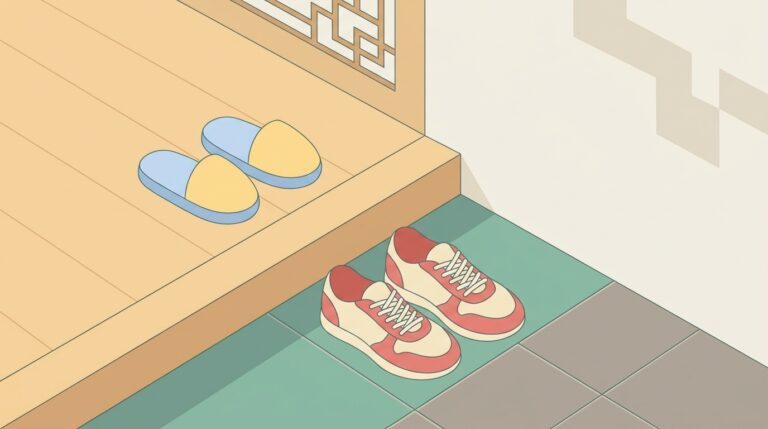
When you enter a Korean home, you will step onto a lowered entryway tile called the 현관 (Hyeon-gwan).
* The Golden Rule: Your outdoor shoes must never touch the upper wooden or laminated floor.
* The Gesture: Step out of your shoes on the lower tile, and step directly onto the raised indoor floor. Once your feet are on the indoor floor, turn around and neatly arrange your shoes so they face toward the exit. This makes leaving much easier!
4-2. The Sock Savior: Why Socks Matter
In Korea, going completely barefoot in someone else’s home can be seen as slightly impolite because your bare feet touch the clean floor where people sit.
* Pro-Tip: Always wear clean, hole-free socks. If you are wearing sandals, keep a small pair of “emergency socks” in your bag to slip on before entering a home or traditional restaurant!
Phase 5: Real-Life Roleplay Scenario
Meet Minho (민호), your friendly Korean host, and Yumi (유미), his grandmother. You are visiting Minho’s house for a delicious home-cooked meal.
- Scene: The entryway (현관) of Minho’s cozy apartment.
- Minho: “어서 오세요! 우리 집에 온 것을 환영해요!”
(Eo-seo o-se-yo! U-ri jib-e on geos-eul hwan-yeong-hae-yo! / Welcome! Welcome to our home!) - You: 🎭 (Smiling warmly, standing on the hyeon-gwan tile) “안녕하세요!”
(An-nyeong-ha-se-yo! / Hello!) - You: 🎭 (Pointing to your shoes) “신발 벗어요?”
(Sin-bal beot-eo-yo? / Should I take off my shoes?) - Minho: “네, 신발 벗고 들어오세요.”
(Ne, sin-bal beot-go deu-reo-o-se-yo. / Yes, please take off your shoes and come in.) - Yumi (Grandmother): 🎭 (Handing you a pair of fluffy yellow slippers) “슬리퍼 신으세요.”
(Seul-li-peo sin-eu-se-yo. / Wear these slippers.) - You: 🎭 (Taking the slippers with both hands and bowing slightly) “감사합니다!”
(Gam-sa-ham-ni-da! / Thank you!) - Minho: “양말이 아주 귀엽네요!”
(Yang-mal-i a-ju gwi-yeop-nae-yo! / Your socks are so cute!) - You: “아, 고마워요!”
(A, go-ma-wo-yo! / Oh, thank you!)
🔀 Interactive Choice Points
What do you do with your dirty outdoor shoes on the tile?
* A) Leave them scattered randomly.
* Feedback: 🚫 Bad. It looks messy and blocks the entryway.
* B) Pick them up and put them in your bag.
* Feedback: ⚠️ Risk. Too extreme! Your bag will get dirty.
* C) Turn them around so they point toward the door, neatly aligned.
* Feedback: 💖 Best! This shows amazing manners and preparation to leave.
Phase 6: 10-Second Emotional Shadowing Drill
Let’s practice speaking naturally with emotional cues! The / represents a tiny pause.
- [😊 Asking with polite curiosity]
“신발 / 벗어요?”
(Sin-bal / beot-eo-yo?) - [💖 Giving a warm, welcoming invitation]
“슬리퍼 / 신으세요!”
(Seul-li-peo / sin-eu-se-yo!) - [😮 Waving off with relief and speed]
“그냥 / 들어오세요!”
(Geu-nyang / deu-reo-o-se-yo!)
Phase 7: K-Culture Mini Dictionary
- 현관 (Hyeon-gwan) | Entryway | The small, sunken tiled area just inside the front door where you transition from outdoors to indoors.
- 실내화 (Sil-nae-hwa) | Indoor Shoes/Slippers | Shoes specifically designed for clean indoor floors, widely used in schools, offices, and homes.
- 온돌 (Ondol) | Underfloor Heating | Korea’s traditional floor-heating system. Because the floor is cozy and warm, Koreans love to sit and sleep directly on it!
- 양말 (Yang-mal) | Socks | An essential fashion and etiquette item in Korea. Having cute, clean socks is a major plus!
Phase 8: Traveler’s Survival Kit
Survival Expressions TOP 3
- 신발 주머니 있어요? (Sin-bal ju-meo-ni is-seo-yo?) | “Do you have a shoe bag?” | Pro-Tip: Use this at traditional temples or crowded restaurants where you must carry your shoes.
- 양말 있어요? (Yang-mal is-seo-yo?) | “Do you have socks?” | Pro-Tip: Ask this at a convenience store if you realize your sock has a hole!
- 여기 신발 벗나요? (Yeo-gi sin-bal beon-na-yo?) | “Do we take off shoes here?” | Pro-Tip: A slightly softer, highly natural way to ask at restaurants.
Editor’s Travel Note
When traveling around Seoul, you will walk a lot. Keep a reliable map app ready to locate nearest convenience stores to buy quick emergency socks. We highly recommend downloading the Naver Map App before your trip for the most accurate local walking routes.
Phase 9: “One Step Deeper” (Cultural Insight)
In many Western cultures, the home is divided by rooms, and shoes are often worn throughout the house. In Korea, the threshold of the 현관 (hyeon-gwan) represents a deep psychological boundary. Once you step past it without your shoes, you are leaving the chaotic, dirty outside world behind and entering a clean, sacred sanctuary of peace and family. This transition is deeply rooted in the historical Ondol (온돌) heating system, which turns the floor into the center of daily life.
💬 Your Turn: How does your home country handle shoes inside the house? Let us know in the comments below!
Phase 10: FAQ & Avoiding Mistakes (FAQ Schema)
Q: Can I wear indoor slippers outside onto the balcony or to take out the trash?
A: No! Indoor slippers are strictly for the indoor floor. Going outside with them defeats the entire purpose of keeping the house clean.
Q: What should I do if my socks are wet from the rain?
A: Always carry an extra dry pair of socks. Stepping onto a dry wooden floor with wet socks is considered quite impolite as it ruins the wooden texture.
Q: Are there restaurants where I have to take off my shoes?
A: Yes! Traditional restaurants with low tables (좌식 – jwa-sik) require you to remove your shoes. Look at the entryway: if you see rows of slippers or shoe cubbies, take them off!
🚨 Common Mistakes Board
- Mistake 1: Stepping onto the raised indoor floor with one shoe still on while trying to balance.
- Correct Action: Keep both feet on the lower hyeon-gwan tile until both shoes are completely off.
- Mistake 2: Wearing bathroom slippers out into the living room.
- Correct Action: In Korea, bathroom slippers are wet and stay inside the bathroom door. Swap them back to your indoor slippers when leaving the bathroom!
- Mistake 3: Not wearing socks at a formal home visit.
- Correct Action: Wear clean socks, even in summer!
Phase 11: Action Mission & Engagement
- 🥉 Bronze Mission: Practice saying “신발 벗어요?” out loud 5 times in front of your mirror.
- 🥈 Silver Mission: Share a picture of your favorite, cutest socks on Instagram and tag us with
#DailyHangulSocks! - 🥇 Gold Mission: The next time you visit a Korean restaurant or house, proactively align your shoes pointing toward the door before stepping inside.
- 🎮 K-Culture Mission: Watch a K-drama and count how many times characters change into slippers as soon as they get home!
Phase 12: Interactive Quiz Challenge
Test your knowledge with these quick questions!
1. You arrive at a traditional Korean restaurant. What should you ask the staff?
- A) 슬리퍼 있어요? (Seul-li-peo is-seo-yo?)
- B) 신발 벗어요? (Sin-bal beot-eo-yo?)
- C) 그냥 들어오세요! (Geu-nyang deu-reo-o-se-yo!)
👉 Click to see the answer!
Correct Answer: B
Explanation: “신발 벗어요?” (Should I take off my shoes?) is the perfect polite question to ask upon entry!</n
2. True or False: It is perfectly fine to walk barefoot in someone’s home during hot summer days.
👉 Click to see the answer!
Correct Answer: False
Explanation: Even in the summer, wearing clean socks is a sign of respect to keep the host’s floor clean of sweat and oils.






