

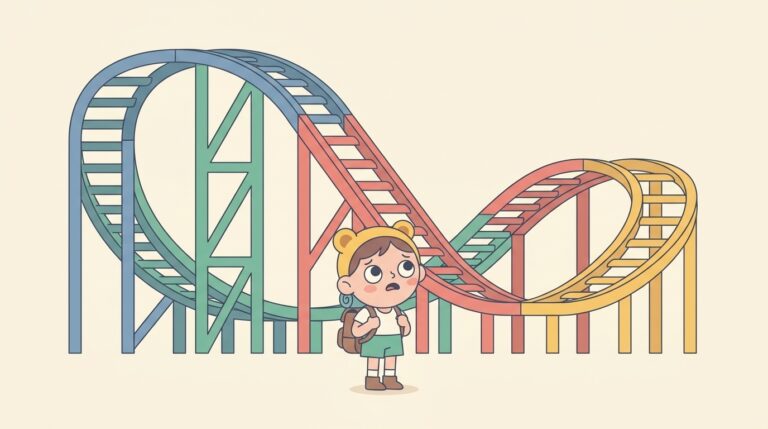
Survived the T-Express! How to Express Fear and Excitement on Korean Roller Coasters
Phase 1: Empathy (Welcome to the Thrill Zone!)
안녕하세요! (Annyeonghaseyo!) Welcome back to Daily Hangul, your ultimate Korean culture navigator. I’m your editor and K-buddy, and today, we are going to talk about something that makes my heart race just thinking about it: 무서운 놀이기구 (museoun norigigu – scary amusement park rides)!
Imagine this: You are standing in line at Everland, staring up at the legendary wood-structured roller coaster, the T-Express. Your Korean friends are super excited, dragging you to the front of the queue. Your palms are sweaty, and your heart is beating like a K-pop drum solo. You want to say “I’m so scared!” or “No way, I can’t ride this!” in Korean, but your mind goes completely blank.
Don’t worry! We’ve all been there. Today, we’ll learn three super-simple, high-impact Korean expressions that will help you express your fear, excitement, and survival instincts at any Korean theme park. This guide is built based on real feedback from A1 learners who survived Lotte World and Everland with flying colors. Let’s dive in!
Phase 2: Deep-Dive into Top 3 Key Expressions
1. 무서워요! (Museoweoyo!)
- Pronunciation: [mu-seo-weo-yo] (Sounds like “moo-suh-war-yo”)
- Meaning: I’m scared! / It’s scary!
- K-Culture Moment: You’ll hear this constantly in Korean variety shows like Run BTS! or Running Man when members are forced to do a bungee jump or ride a steep roller coaster.
- Editor’s Insight: This is the most standard, polite way to express fear. If you want to say it to close friends casually, just drop the “yo” and scream: “무서워! (Museoweo!)”
- Situation Spectrum: Casual: ✅ | Semi-formal: ✅ | Formal: ⚠️
- 🤔 Think About It: In English, we often say “I am scared” (focusing on ‘me’). In Korean, “무서워요” can mean both “I am scared” and “This ride is scary.” How does focusing on the situation rather than just your personal state change how you view fear?
2. 진짜 못 타요. (Jinjja mot tayeo.)
- Pronunciation: [jin-jja mot ta-yo] (Sounds like “jin-jah mote tah-yo”)
- Meaning: I really can’t ride [this].
- K-Culture Moment: In K-dramas, when a character is absolutely terrified of heights, they wave their hands frantically and say this to escape the ride.
- Editor’s Insight: “진짜 (jinjja)” means “really,” “못 (mot)” means “cannot,” and “타요 (tayeo)” means “ride.” Use this when you want to set a firm boundary!
- Situation Spectrum: Casual: ✅ | Semi-formal: ✅ | Formal: 🚫
- 🤔 Think About It: Koreans value group harmony, but saying “못 타요” clearly and politely is respected when it comes to extreme rides.
3. 살려 주세요! (Sallyeo juseyo!)
- Pronunciation: [sal-lyeo ju-se-yo] (Sounds like “sal-lyuh joo-seh-yo”)
- Meaning: Save me! / Help me!
- K-Culture Moment: This is the ultimate dramatic scream heard at the highest peak of a drop. It’s used both seriously (in emergencies) and playfully (on scary rides).
- Editor’s Insight: While it literally means “Please save my life,” screaming this on a roller coaster is a fun, dramatic way to show you are thrilled and terrified at the same time.
- Situation Spectrum: Casual: ✅ | Semi-formal: ✅ | Formal: 🚫
- 🤔 Think About It: Why do you think screaming “Save me!” is so universally funny and bonding on roller coasters in Korea?
Phase 3: Textbook Korean vs. Real-Life Korean
Situation 1: Expressing that a ride looks scary
- 📖 Textbook: “저 놀이기구는 매우 무섭습니다.” (Jeo norigiguneun maeu museopsnida. – That ride is very scary.)
- 🗣️ Real Life: “우와, 저거 진짜 무섭겠다!” (Uwa, jeogeo jinjja museopgetda! – Wow, that one looks really scary!)
- 💡 Why the difference? Textbook Korean is too formal and stiff for an amusement park. Real-life Korean uses “-겠다 (-getda)” to express a guess or feeling based on what you are looking at right now.
Situation 2: Begging not to go on a ride
- 📖 Textbook: “저는 그것을 타고 싶지 않습니다.” (Jeoneun geogeoseul tago sipji anhseumnida. – I do not wish to ride that.)
- 🗣️ Real Life: “나 이거 안 탈래!” (Na igeo an tallae! – I’m not riding this! / I don’t wanna ride this!)
- 💡 Why the difference? When hanging out with friends, using “~안 탈래 (~an tallae)” sounds natural, friendly, and expresses your soft refusal perfectly.
Phase 4: K-Culture Deep-Dive & Non-Verbal Manners
4-1. Nunchi (눈치) & Gestures
When saying “진짜 못 타요” (I really can’t ride), cross your arms in an “X” shape in front of your chest. This universal body language, combined with a polite smile, helps your Korean friends instantly read your Nunchi (tact/vibe) and stop teasing you to get on the ride.
4-2. The K-Amusement Park Culture Code
Did you know that in Korea, wearing cute animal headbands (머리띠 – meoritti) is a must for everyone, regardless of age or gender? Before going on any scary ride, you’ll visit the gift shop to buy matching headbands. Also, Korean couples love wearing “couple looks” (matching outfits) to amusement parks like Lotte World or Everland!
Phase 5: Real-Life Roleplay Scenario
Setting: Standing in line for the Gyro Drop at Lotte World.
Characters:
* Minho (민호): Your thrill-seeking Korean friend.
* You (유): A brave but currently terrified A1 learner.
- Minho: 우와! 저거 봐요. 진짜 빠르다!
(Uwa! Jeogeo bwayo. Jinjja ppareuda!)
(Wow! Look at that. It’s so fast!) - You: 🎭 [Looking up with wide eyes] 저거… 진짜 무서워요?
(Jeogeo… jinjja museoweoyo?)
(Is that… really scary?) - Minho: 조금요? 근데 진짜 재밌어요! 같이 타요!
(Jogeumyo? Geunde jinjja jaemisseoyo! Gachi tayo!)
(A little? But it’s really fun! Let’s ride together!) - You: 🎭 [Shaking head and making an ‘X’ with your arms] 저는 진짜 못 타요.
(Jeoneun jinjja mot tayeo.)
(I really can’t ride it.) - Minho: 에이, 한 번만요! 저 믿고 타요!
(Ei, han beonmanyo! Jeo mitgo tayo!)
(Oh come on, just once! Trust me and ride!) - You: 🎭 [Sighing playfully] 정말요? 그럼 같이 가요.
(Jeongmallyo? Geureom gachi gayo.)
(Really? Then let’s go together.) - [The ride starts to drop]
- You & Minho: 🎭 [Screaming at the top of your lungs] 살려 주세요!!!
(Sallyeo juseyo!!!)
(Save me!!!) - Minho: 🎭 [Laughing] 아, 진짜 재밌다!
(Ah, jinjja jaemitta!)
(Ah, that was so fun!)
🔀 Interactive Choice Points
How would you respond to Minho when he says “Let’s ride together! (같이 타요!)”?
- Option A: “무서워요! 안 탈래요!” (I’m scared! I won’t ride!)
- Feedback (Best): Perfect! It clearly expresses your fear while politely refusing.
- Option B: “살려 주세요!” (Save me!)
- Feedback (Bad): Saying this before you even get on the ride might sound a bit too dramatic or confusing to your friend. Keep it for the drop!
- Option C: “진짜 못 타요.” (I really can’t ride.)
- Feedback (Risk): Good, but make sure to say it with a friendly smile so your friend knows you are not genuinely angry!
Phase 6: 10-Second Emotion Shadowing Drill
Practice these with real emotions! Pay attention to the pauses (/).
- [🥺 Trembling with fear]
무서워요… / 진짜 / 무서워요…
(Museoweoyo… / jinjja / museoweoyo…)
(I’m scared… really… I’m scared…) -
[😱 Screaming on the drop]
엄마!!! / 살려 주세요!!!
(Eomma!!! / Sallyeo juseyo!!!)
(Mom!!! / Save me!!!)
Phase 7: K-Culture Mini-Dictionary
- 놀이기구 (Norigigu) | Amusement Park Ride | Used for any ride like roller coasters, carousel, etc.
- 머리띠 (Meoritti) | Headband | The ultimate fashion accessory at Korean theme parks.
- 줄 (Jul) | Line/Queue | Often used as “줄이 길어요” (The line is long).
- 티켓 (Tiket) | Ticket | Used for entry or ride passes.
Phase 8: Traveler’s Survival Kit
Top 3 Survival Phrases
- 화장실 어디예요? (Hwajangsil eodiyeyo? – Where is the restroom?) | Pro Tip: Ask this before entering a 120-minute queue!
- 기다려 주세요. (Gidaryeo juseyo. – Please wait.) | Pro Tip: Use this if your friend is walking too fast toward a scary ride.
- 사진 찍어 주세요. (Sajin jjigeo juseyo. – Please take a picture.) | Pro Tip: Hand your phone to a friendly local near the photo zone.
Editor’s Travel Note
Before heading out, make sure to download the official Everland App or Lotte World App to check real-time wait times for rides. You can easily find them on the Google Play Store or Apple App Store. Also, note that most snack carts inside accept standard international credit cards, so you don’t need to carry too much cash!
Phase 9: “One Step Deeper” (Cultural Reflection)
In Korea, going to an amusement park is a highly social bonding ritual. Screaming together on a scary ride like the T-Express creates an instant sense of shared vulnerability and trust, known as “정 (Jeong)” (deep connection). Next time you are scared, don’t hide it—share it!
💬 Your Turn: What is the scariest roller coaster you have ever ridden? Would you dare to ride a Korean roller coaster while shouting “살려 주세요!”? Let me know in the comments below!
Phase 10: FAQ & Common Mistakes
Q: Can I use “무서워요” to describe a scary movie?
A: Yes! You can say “이 영화 진짜 무서워요” (I yeonghwa jinjja museoweoyo – This movie is really scary).
Q: What is the difference between “못 타요” and “안 타요”?
A: “못 타요” means “I cannot ride” (due to fear, physical limitations, etc.), while “안 타요” means “I will not ride” (a personal choice). “못 타요” sounds softer and more polite!
Q: How do I ask how long the wait is?
A: You can ask the staff: “얼마나 기다려야 해요?” (Eolmana gidaryeoya haeyo? – How long do I have to wait?).
🚨 Common Mistakes Warning Board
- Mistake: Saying “나는 무서워요” (Naneun museoweoyo).
- Correct Action: Koreans rarely use “나 (I)” in daily conversations because it’s already obvious. Just say “무서워요” directly!
Phase 11: Action Mission
- 🥉 Bronze: Say “무서워요!” out loud 3 times with a dramatic expression in front of your mirror.
- 🥈 Silver: Share this post on your social media and tag a friend you want to challenge to ride a Korean roller coaster with.
- 🥇 Gold: Next time you see a scary scene in a K-drama, point at the screen and shout “진짜 무서워요!”.
🎮 K-Culture Mission: Watch an episode of your favorite Korean variety show (like Run BTS or Going Seventeen at an amusement park) and try to spot how many times the members scream “무서워!” or “살려줘!”.
Phase 12: Interactive Quiz Challenge
Test your knowledge below!
Q1. How do you say “I really can’t ride this” politely?
▶ Click to reveal the Answer & Explanation
Answer: 진짜 못 타요. (Jinjja mot tayeo.)
Explanation: “진짜” means really, “못” means cannot, and “타요” means ride. This is the perfect polite way to decline a ride!
Q2. True or False: Screaming “살려 주세요!” on a roller coaster is considered rude in Korea.
▶ Click to reveal the Answer & Explanation
Answer: False!
Explanation: It is a very common, fun, and dramatic way to express excitement and thrill among friends on a ride.






