

How to Safely Dispose of Broken Glass in Korea: Step-by-Step Recycling Guide
Phase 1: Empathy (안녕하세요! Welcome to Daily Hangul!)
Have you ever had one of those moments? You’re dancing in your cozy Seoul officetel to your favorite K-Pop track, and bam! You accidentally knock over your favorite glass cup. As it shatters on the floor, your heart sinks. Not just because of the mess, but because of that looming question: “Wait, how on earth do I safely and legally throw away broken glass in Korea?”
If you’ve been living in Korea or just arrived, you probably already know that Korea’s recycling system (분리수거 – Bunrisugeo) is incredibly organized, but it can be super intimidating! Back home, you might just wrap it in a paper bag and toss it. But in Korea, throwing away broken glass improperly can lead to heavy fines—or worse, injure the hard-working sanitation heroes who keep our neighborhoods clean.
Don’t panic! Your Korean bestie is here to help. Today, we’re going to master the exact words and steps you need to handle this situation like a local. This guide is based on real-life questions from our global learners, so you’re in safe hands. Let’s sweep up that glass and learn some practical Korean!
Phase 2: Deep Dive into 3 Key Expressions
When dealing with broken glass, these are the three most essential expressions you will need. Let’s break them down!
1. 유리 깨졌어요 (Yuri kkae-jyeot-seo-yo)
- Pronunciation: Yoo-ree kkae-jyut-suh-yo (Think of “yoo-ree” like “jury” without the ‘j’, and “kkae” as a sharp double ‘k’ sound like the ‘ca’ in “cat”).
- Meaning: “The glass is broken.”
- K-Culture Moment: You will hear this dramatic line in almost every K-Drama when a character drops a glass of water after hearing shocking news.
- Editor’s Insight: “유리” (yuri) means glass, and “깨졌어요” (kkae-jyeot-seo-yo) is the polite past tense of “깨지다” (to break). Use this to explain the situation clearly to your roommate or landlord.
- Situation Spectrum: Casual (유리 깨졌어 ⚠️) / Semi-formal (유리 깨졌어요 ✅) / Formal (유리가 깨졌습니다 ✅)
- 🤔 Think About It: In Korea, saying “유리 깨졌어요” immediately signals a hazard. Why do you think Korean culture places such a strong emphasis on warning others about broken objects immediately?
2. 다쳐요, 조심하세요 (Dachyeo-yo, jo-sim-ha-se-yo)
- Pronunciation: Dah-chyuh-yo, jo-seem-hah-seh-yo (“Dachyeo” sounds a bit like “touch-yo”).
- Meaning: “You’ll get hurt, please be careful.”
- K-Culture Moment: This is what a caring Korean friend or a kind convenience store owner will warmly say to you if they see you picking up something sharp.
- Editor’s Insight: Korean society highly values community safety. Saying “조심하세요” (Be careful) shows you care about the person cleaning up or walking past.
- Situation Spectrum: Casual (다쳐, 조심해 ⚠️) / Semi-formal (다쳐요, 조심하세요 ✅) / Formal (다치실 수 있으니 주의해 주세요 ✅)
- 🤔 Think About It: How does expressing concern for others’ safety with “조심하세요” reflect the communal nature of Korean society compared to your home country?
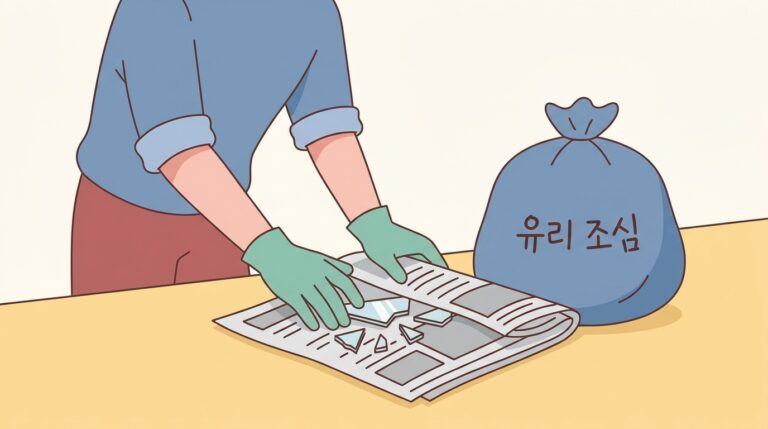
3. 신문지에 싸서 버려요 (Sin-mun-ji-e ssa-seo beo-ryeo-yo)
- Pronunciation: Seen-moon-jee-eh ssah-suh buh-ryuh-yo (Make a sharp ‘ss’ sound in “ssa”, like the hiss of a snake).
- Meaning: “Wrap it in newspaper and throw it away.”
- K-Culture Moment: This is the ultimate “K-Mom” life hack. If you ask any Korean mother how to throw away broken glass, this is the exact phrase she will use.
- Editor’s Insight: “신문지” (sinmunji) is newspaper, “싸다” (ssada) means to wrap, and “버리다” (beorida) means to throw away. This is the correct legal and safe way to discard small broken glass in Korea!
- Situation Spectrum: Casual (신문지에 싸서 버려 ⚠️) / Semi-formal (신문지에 싸서 버려요 ✅) / Formal (신문지에 싸서 배출해 주세요 ✅)
- 🤔 Think About It: Why is wrapping glass in newspaper so universally understood in Korea? It shows how practical daily habits are shared across generations.
Phase 3: Textbook Korean vs. Real-Life Korean
Let’s compare what textbooks teach you versus how Koreans actually talk in this situation!
Situation 1: Telling someone a glass cup is broken
- 📖 Textbook Korean: “유리컵이 파손되었습니다.” (Yuri-keobi pason-doe-eot-seumnida. – “The glass cup has been damaged.”)
- 🗣️ Real-Life Korean: “유리컵 깨졌어요!” (Yuri-keop kkae-jyeot-seo-yo! – “The glass cup broke!”)
- 💡 Why is it different? The textbook version uses “파손” (damage/destruction), which sounds like an official police report or a dry insurance document. Real humans just say “깨졌어요” (broke) in daily life!
Situation 2: Asking where to throw it away
- 📖 Textbook Korean: “쓰레기를 어디에 방출합니까?” (Sseuregireul eodie bangchulhamnikka? – “Where does one discharge the refuse?”)
- 🗣️ Real-Life Korean: “이거 어디에 버려요?” (Igeo eodie beoryeoyo? – “Where do I throw this away?”)
- 💡 Why is it different? “방출” (discharge/release) is way too technical. Real Koreans simply use the easy verb “버려요” (throw away) for everything recycle-related.
Phase 4: K-Culture Deep Dive & Non-Verbal Manners
4-1. “Nunchi” (눈치) & Safety Manners
In Korea, “눈치” (Nunchi – situational quick-wittedness) is key. If you break glass in a shared space (like an Airbnb or a shared kitchen), don’t just leave it.
* The Gesture: Wave your hands gently with palms facing down and say “잠시만요!” (Jam-si-man-yo – “Hold on a second!”) to stop people from walking near the shards.
* The Labeling Manner: When you wrap the broken glass in newspaper or a thick box, it is highly appreciated to write “유리 조심” (Yuri Josim – “Caution: Glass”) on the outside with a black marker. This simple gesture protects the sanitation workers and shows incredible community respect.
4-2. The Korean Recycling Law (쓰레기 종량제)
Korea introduced the Volume-rate Waste System (종량제 – Jongryangje) in 1995. You cannot use normal plastic bags; you must buy official regional trash bags (종량제 봉투) from local convenience stores. Small broken glass, wrapped safely in newspaper, can go into the general waste bag (일반 쓰레기). However, large broken glass items require a special non-combustible bag called 불연성 쓰레기 봉투 (often called “마대 자루” – sack bags).
Phase 5: Real-Life Roleplay Scenario
Meet Minho (민호), your friendly neighborhood Korean roommate. You just dropped a glass jar in the kitchen, and Minho runs in to check on you.
Minho: 앗! 무슨 소리예요? 괜찮아요?
       (At! Museun sori-yeo-yo? Gwaen-chan-ha-yo?)
       "Ah! What was that sound? Are you okay?"

You: 🎭 [Anxious & apologetic] 어떡하죠... 유리 깨졌어요.
     (Eo-tteok-ha-jo... yuri kkae-jyeot-seo-yo.)
     "What should I do... the glass broke."

Minho: 아, 다치니까 만지지 마세요! 제가 치울게요.
       (Ah, dachi-ni-kka man-ji-ji ma-se-yo! Je-ga chi-ul-ge-yo.)
       "Ah, you'll get hurt, don't touch it! I'll clean it up."

You: 🎭 [Helpful & cautious] 아니에요, 같이 해요. 이거 어디에 버려요?
     (Ani-e-yo, gat-i hae-yo. Igeo eodie beoryeoyo?)
     "No, let's do it together. Where do we throw this away?"

Minho: 신문지에 싸서 일반 쓰레기 봉투에 넣어야 해요.
       (Sin-mun-ji-e ssa-seo il-ban sseuregi bong-tu-e neo-eo-ya hae-yo.)
       "We need to wrap it in newspaper and put it in the general trash bag."

You: 🎭 [Relieved] 아, 다행이다. 신문지 여기 있어요!
     (Ah, da-haeng-i-da. Sin-mun-ji yeogi isseo-yo!)
     "Oh, thank goodness. Here is some newspaper!"

Minho: 고마워요. 봉투 겉에 '유리 조심'이라고 적어둘게요.
       (Go-ma-wo-yo. Bong-tu geot-e 'yuri jo-sim'-i-ra-go jeog-eo-dul-ge-yo.)
       "Thanks. I'll write 'Caution: Glass' on the outside of the bag."

You: 🎭 [Grateful] 정말 친절하시네요. 조심해서 치워요.
     (Jeong-mal chin-jeol-ha-si-ne-yo. Jo-sim-hae-seo chi-wo-yo.)
     "You are so kind. Let's clean it up carefully."
🔀 Interactive Choice Points
How would you respond if you broke a glass cup at a Korean friend’s house?
- Option A: “그냥 쓰레기통에 넣을게요!” (I will just throw it in the trash can!)
- 🔴 Feedback (Risk): Oh no! Putting raw broken glass straight into the trash can without wrapping it can cut the bag open and injure your friend or the garbage collector. Avoid this!
- Option B: “유리 깨졌어요. 신문지 있어요?” (The glass broke. Do you have newspaper?)
- 🟢 Feedback (Best): Perfect! This shows you know the safe way to dispose of glass in Korea and asks for the right materials politely.
- Option C: “죄송합니다. 제가 다 살게요.” (I am sorry. I will buy everything.)
- 🟡 Feedback (Bad): Too dramatic! While polite, breaking a glass cup is a small accident. You don’t need to offer to buy a whole new set; just cleaning it safely is enough!
Phase 6: 10-Second Emotion Shadowing Drill
Practice speaking with real Korean emotion! Pay attention to the pauses (/) and tone.
- [🥺 Worried & Apologetic]
- “어떡하죠… / 유리 / 깨졌어요.”
- Eo-tteok-ha-jo… / yuri / kkae-jyeot-seo-yo.
- (What should I do… the glass is broken.)
- [🚨 Caring & Urgent]
- “다쳐요! / 조심하세요!”
- Da-chyeo-yo! / Jo-sim-ha-se-yo!
- (You’ll get hurt! Please be careful!)
- [💡 Helpful & Proactive]
- “신문지에 / 싸서 / 버릴게요.”
- Sin-mun-ji-e / ssa-seo / beo-ril-ge-yo.
- (I will wrap it in newspaper and throw it away.)
Phase 7: K-Culture Mini Dictionary
- 분리수거 (Bunrisugeo) | Recycling / Waste Sorting | The daily ritual in Korea of sorting trash into plastic, paper, cans, glass, and food waste.
- 종량제 봉투 (Jongryangje Bongtu) | Official Garbage Bag | Government-regulated plastic bags required for general household trash. You must buy the ones specific to your district.
- 일반 쓰레기 (Ilban Sseuregi) | General Waste | Trash that cannot be recycled (like dirty tissues, wraps, or safely wrapped broken glass shards).
- 유리 조심 (Yuri Josim) | Caution: Glass | A safety warning phrase written on wrapped packages to warn garbage collectors.
Phase 8: Survival Kit for Travelers
Survival Expressions TOP 3
- “빗자루 있어요?” (Bit-ja-ru isseo-yo?)
- Pro Tip: “Do you have a broom?” Use this to ask your host or hotel staff for cleaning tools.
- “종량제 봉투 어디서 사요?” (Jong-ryang-je bong-tu eo-di-seo sa-yo?)
- Pro Tip: “Where can I buy official trash bags?” Most convenience stores sell them at the counter.
- “다친 데 없어요?” (Da-chin de op-seo-yo?)
- Pro Tip: “Are you hurt anywhere?” Use this to check on your friends after an accident.
🗺️ Editor’s Travel Note
If you need to buy general trash bags or cleaning supplies immediately, open the Naver Map App on your phone and search for nearby convenience stores (편의점) like GS25, CU, or 7-Eleven. Simply walk up to the counter and ask: “종량제 봉투 주세요” (Jongryangje bongtu juseyo – Please give me trash bags).
(Note: Local waste disposal regulations and bag prices are subject to change by district authorities.)
Phase 9: One Step Deeper (Thinking Question)
In Korea, waste separation isn’t just a legal duty; it’s a social contract. Because Korea has limited landfill space, the community works together to recycle over 60% of its waste! When you write “유리 조심” (Caution: Glass) on a trash bag, it shows that you care about the unseen workers in society. This is the beauty of “정” (Jeong)—the warm feeling of connection and care for fellow community members.
💬 Your Turn: How does recycling in Korea compare to your home country? Have you ever had a funny or confusing recycling moment in Korea? Let us know in the comments below!
Phase 10: FAQ & Common Mistakes
Q: Can I put unbroken glass bottles in the general trash bag?
A: No! Unbroken glass bottles (like beer, soju, or soda bottles) should be recycled in the designated “Glass Recycle” (유리) bin. You can even return them to local supermarkets to get a small cash deposit back!
Q: What should I do with giant broken mirrors or windows?
A: Large glass items cannot go into normal plastic trash bags. You must purchase a special non-combustible waste bag (불연성 종량제 마대) or contact your local district office (구청) for a bulky waste sticker.
Q: Can I use a Seoul trash bag in Busan?
A: No, trash bags are regional. You must use bags issued by the specific district (구) you currently reside in.
🚨 Common Mistakes Warning Board
- Mistake 1: Throwing broken glass straight into the recycle bin.
- Correct Action: No! Broken glass cannot be recycled because it dangerous to sort. Wrap it in newspaper and throw it in the general waste bag (일반 쓰레기).
- Mistake 2: Using regular shopping bags for general waste.
- Correct Action: Always use official 종량제 봉투 (Volume-rate bags) purchased from local stores.
- Mistake 3: Touching broken glass shards with bare hands.
- Correct Action: Use gloves, a broom, or thick tape to pick up tiny pieces safely.
Phase 11: Action Mission
- 🥉 Bronze Mission: Practice saying “유리 깨졌어요” out loud 3 times in front of the mirror!
- 🥈 Silver Mission: Write the words “유리 조심” (Caution: Glass) on a piece of paper to practice your Korean handwriting.
- 🥇 Gold Mission: Next time you go to a convenience store, spot where the 종량제 봉투 are kept behind the counter!
Phase 12: Interactive Quiz Challenge
Try these quick questions to test your skills!
1. What is the correct way to dispose of small broken glass shards in Korea?
- A) Throw them directly into the glass recycle bin.
- B) Wrap them in newspaper and put them in the general trash bag (일반 쓰레기 봉투).
- C) Toss them in the food waste bin.
2. Fill in the blank: “Be careful, you’ll get hurt” in Korean is “________, 조심하세요.”
- A) 배고파요 (Baegopayo)
- B) 다쳐요 (Dachyeoyo)
- C) 예뻐요 (Yeoppeoyo)
🎉 Click here to see the answers & explanations!
- Answer 1: B
- Explanation: Broken glass is hazardous and cannot be recycled. It must be wrapped in newspaper and placed in the general trash bag.
- Answer 2: B
- Explanation: “다쳐요” means “you’ll get hurt”. (“배고파요” means hungry, and “예뻐요” means pretty!)
- Explanation: “다쳐요” means “you’ll get hurt”. (“배고파요” means hungry, and “예뻐요” means pretty!)







