

Clear the Air: How to Resolve Misunderstandings and Make Up in Korean Like a Pro
Phase 1: Empathy (The Story of “Why Did She Look at Me Like That?”)
안녕하세요! (An-nyeong-ha-se-yo!) Your favorite Daily Hangul editor and cultural navigator is back!
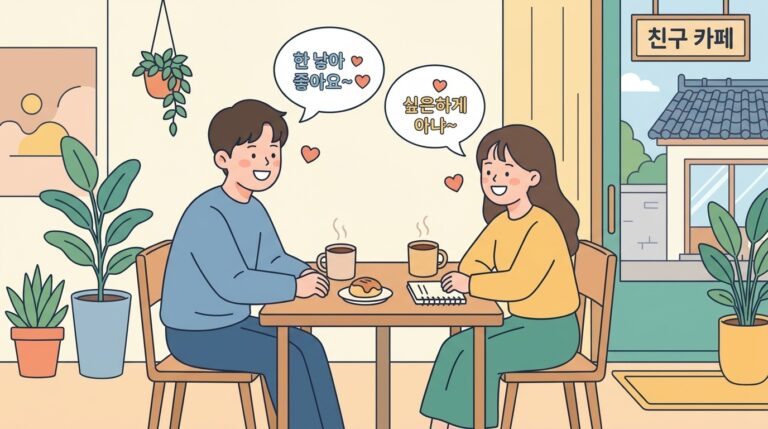
Imagine this: You’re grabbing coffee with your close Korean friend, Min-ji. You make a lighthearted joke about her being late, saying “역시 민지 씨는 바쁜 사람이네요!” (Yeok-si Min-ji ssi-neun ba-ppeun sa-ram-i-ne-yo! / “As expected, Min-ji is a busy person!”). You meant it as a playful tease, but suddenly, Min-ji’s smile fades. She goes quiet, sips her iced americano, and the air turns icy cold. Did I say something wrong?
In Korean culture, where 눈치 (Nunchi – situational reading) and subtle undertones shape relationships, verbal slips and misunderstandings (오해 – Oh-hae) happen easily. But don’t panic! Making a mistake is human; knowing how to warm up the room again is where the magic happens.
Today, we are going beyond the robotic “죄송합니다” (Mian-ham-ni-da) and exploring how to genuinely clear the air, explain your intent, and strengthen your friendship. This guide is built from real-world student cases who turned awkward silences into deeper bonds. Let’s dive in!
Phase 2: Deep Dive into 3 Essential Expressions
1. 오해하지 말고 들으세요 (Oh-hae-ha-ji mal-go deu-reu-se-yo)
- Pronunciation: Oh-heh-hah-jee mahl-goh deul-euh-seh-yoh (Sounds like “Oh-hare” + “hadji” + “malgo” + “deur-uh-seh-yo”)
- Meaning: Please don’t misunderstand, but hear me out.
- K-Culture Moment: You’ve definitely seen this in K-Dramas! Right before a character delivers a piece of news that might sound harsh or suspicious, they look into the other person’s eyes and say this to soften the blow.
- Editor’s Insight: This is a crucial pre-emptive strike. It signals to the listener that your upcoming words might sound bad on the surface, but your underlying intention is pure. It begs them to suspend judgment.
- Situation Spectrum: Casual (⚠️ 오해하지 말고 들어), Semi-formal (✅), Formal (✅ 오해 없이 들으시길 바랍니다)
- 🤔 Think About It: In your culture, do you apologize before saying something difficult, or do you just say it and explain later?
2. 그럴 뜻은 아니었어요 (Geu-reol tteut-eun a-ni-eot-seo-yo)
- Pronunciation: Geu-reol tteut-eun ah-nee-eot-suh-yoh (Sounds like “Girl” + “t-eun” + “ah-nee-ut-suh-yo”)
- Meaning: I didn’t mean it that way. / That wasn’t my intention.
- K-Culture Moment: In K-Pop behind-the-scenes content, members often tease each other. If one takes it a bit too seriously, the teaser immediately holds up their hands, saying “그럴 뜻은 아니었어!” to restore peace.
- Editor’s Insight: The word ‘뜻’ (tteut) means ‘meaning’ or ‘intent’. By saying this, you are actively separating your action from your motive. It reassures the other person that you do not hold bad feelings toward them.
- Situation Spectrum: Casual (✅ 그럴 뜻은 아니었어), Semi-formal (✅), Formal (✅ 그러려던 의도는 아니었습니다)
- 🤔 Think About It: Why is distinguishing between ‘intent’ and ‘impact’ so important in keeping harmony in close-knit communities?
3. 마음 풀어요 (Ma-eum pu-reo-yo)
- Pronunciation: Mah-eum pool-uh-yoh (Sounds like “Mah-um” + “pool-uh-yo”)
- Meaning: Please don’t be mad anymore. / Let’s melt the frozen heart.
- K-Culture Moment: After a couple’s fight in a romance drama, the male or female lead brings a warm bowl of soup or sweet snack, nudging the other gently while saying “마음 풀어~” (Ma-eum pool-uh~).
- Editor’s Insight: The verb ‘풀다’ (pul-da) means ‘to untie’, ‘to unpack’, or ‘to melt’. Korean culture views anger as a knot in the heart. Saying ‘마음 풀어요’ is a sweet, warm request to untie that knot together.
- Situation Spectrum: Casual (✅ 마음 풀어), Semi-formal (✅), Formal (🚫 too informal for high-level business setups; use 마음을 가라앉히시기 바랍니다 instead)
- 🤔 Think About It: In Korean, anger is ‘tied’ or ‘frozen’ and must be ‘untied’ or ‘melted’. What metaphors does your language use for anger?
Phase 3: Textbook Korean vs. Real-Life Korean
Let’s compare how textbooks teach reconciliation versus how real Koreans actually resolve things over dinner!
Situation A: When you accidentally missed your friend’s call
- 📖 Textbook Korean: “전화를 받지 못해 대단히 죄송합니다.” (Jeon-hwa-reul bat-ji mot-hae dae-dan-hi joe-song-ham-ni-da.)
- Why it’s stiff: This sounds like a corporate customer service center apologizing for server downtime. Too cold for friends!
- 🗣️ Real Korean: “아까 정신이 없어서 연락 못 받았어. 미안해!” (A-kka jeong-sin-i eop-seo-seo yeol-rak mot bad-as-seo. Mi-an-hae!)
- 💡 Why it works: “정신이 없다” (To have no mind / to be hectic) is the ultimate, universally accepted excuse in Korea. It instantly explains why you couldn’t reply without sounding like you were ignoring them.
Situation B: Softening an accidental rude remark
- 📖 Textbook Korean: “제 무례한 언행을 용서해 주십시오.” (Je mu-rye-han eon-haeng-eul yong-seo-hae ju-sip-si-o.)
- Why it’s stiff: Unless you are in a historical drama (사극) apologizing to the King, this is way too dramatic.
- 🗣️ Real Korean: “내가 말을 좀 서투르게 했네. 기분 나빴다면 미안해.” (Nae-ga mal-eul jom seo-tu-reu-ge haet-ne. Gi-bun na-ppat-da-myeon mi-an-hae.)
- 💡 Why it works: Acknowledging that your phrasing was clumsy (말이 서투르다) while validating their feelings (기분 나빴다면) shows high emotional intelligence (눈치).
Phase 4: K-Culture Deep Dive & Non-Verbal Manners
4-1. The Body Language of Apology
In Korea, words are only half the battle. How you present yourself physically says everything:
1. The Eye Contact Dilemma: While apologizing, staring directly and intensely into someone’s eyes can feel aggressive. Soften your gaze, look slightly downward, and raise your eyes occasionally to show sincerity.
2. Hand Gestures: When saying “그럴 뜻은 아니었어요” (I didn’t mean it that way), lightly wave both hands in front of your chest with palms facing outward. This physically demonstrates “wiping away” the misunderstanding.
4-2. The “Sul-Gari” (술자리) Culture of Making Up
Did you know that in Korea, most misunderstandings are cleared over food and drinks? If you have an awkward vibe with a Korean friend, inviting them for 치맥 (Chi-maek – Chicken & Beer) or 삼겹살 (Sam-gyeop-sal) is a silent code for: “I want to make things right.” Pouring a drink for your friend with two hands and saying “우리의 오해를 풀어야죠!” (We must clear our misunderstanding!) instantly melts the ice.
Phase 5: Real-Life Roleplay Scenario
Scene: A Cozy Cafe in Hongdae
Characters:
* You: A B1-level student who accidentally forgot to invite Min-woo (민우) to a group gathering.
* Min-woo (민우): Your close Korean friend who is acting slightly cold (쌀쌀맞은) and distant.
- [Turn 1] You:
민우 씨, 혹시 지난주 모임 때문에 화났어요?
(Min-woo ssi, hok-si ji-nan-ju mo-im ttae-mun-e hwa-nat-seo-yo?)
“Min-woo, by any chance, are you mad because of last week’s gathering?” -
[Turn 2] Min-woo:
🎭 (Sipping coffee, looking away)
아니요, 화난 건 아닌데요… 그냥 다 같이 만나는 줄 몰랐어요.
(A-ni-yo, hwa-nan geon a-nin-de-yo… geu-nyang da gat-i man-na-neun jul mol-rat-seo-yo.)
“No, it’s not that I’m mad… I just didn’t know everyone was meeting up together.” -
[Turn 3] You:
🎭 (Putting your hands together in a pleading gesture)
정말 미안해요! 오해하지 말고 들으세요. 원래 번개로 만난 거였어요.
(Jeong-mal mi-an-hae-yo! Oh-hae-ha-ji mal-go deu-reu-se-yo. Won-rae beon-gae-ro man-nan geo-yeot-seo-yo.)
“I’m so sorry! Please don’t misunderstand. Originally, it was just a sudden last-minute meet-up.” -
[Turn 4] Min-woo:
그래요? 그래도 나한테만 연락이 없길래 일부러 안 부른 줄 알았죠.
(Geu-rae-yo? Geu-rae-do na-han-te-man yeol-rak-i eop-gil-rae il-bu-reo an bu-reun jul a-rat-jyo.)
“Really? Still, since only I didn’t get a call, I thought you excluded me on purpose.” -
[Turn 5] You:
절대 아니에요! 제가 깜빡하고 단톡방에 초대를 안 한 거예요. 진짜 그럴 뜻은 아니었어요.
(Jeol-dae a-ni-e-yo! Jae-ga kkam-ppak-ha-go dan-tok-bang-e cho-dae-reul an han geo-ye-yo. Jin-jja geu-reol tteut-eun a-ni-eot-seo-yo.)
“Absolutely not! I slipped up and forgot to invite you to the group chat. I really didn’t mean it that way.” -
[Turn 6] Min-woo:
🎭 (Expression softening a bit)
아, 진짜요? 전 또 저만 소외당한 줄 알고 혼자 삐졌었네요.
(Ah, jin-jja-yo? Jeon tto jeo-man so-oe-dang-han jul al-go hon-ja ppi-jyeot-seon-ne-yo.)
“Oh, seriously? I thought I was being left out and was pouting on my own.” -
[Turn 7] You:
🎭 (Smiling warmly, offering a snack)
에이, 제가 민우 씨를 얼마나 좋아하는데요! 이제 마음 풀어요, 네?
(E-i, je-ga Min-woo ssi-reul ol-ma-na jo-a-ha-neun-de-yo! I-je ma-eum pul-eo-yo, ne?)
“Ay, you know how much I like you! Come on, untie your heart now, okay?” -
[Turn 8] Min-woo:
🎭 (Laughs)
알았어요. 대신 오늘 커피는 씨가 사는 거예요!
(A-rat-seo-yo. Dae-sin o-neul keo-pi-neun ssi-ga sa-neun geo-ye-yo!)
“Alright. But in return, the coffee today is on you!”
—
🔀 Choose Your Next Move!
What do you do to seal the deal and make up?
* A. “당연하죠! 맛있는 거 사줄게요.” (Of course! I’ll buy you something delicious.)
* 🌟 Best! Perfect. Offering food is the ultimate Korean bonding experience. It shows you’re invested in keeping the friendship sweet.
* B. “돈이 없는데… 그냥 더치페이 해요.” (I don’t have money… let’s just split it.)
* ❌ Bad! Ruined the mood instantly! In Korea, when you make a mistake, buying the next coffee/meal is a standard silent token of apology.
* C. “내가 산다고 했으니까 비싼 것만 고르지 마요.” (Since I said I’m buying, don’t pick expensive things.)
* ⚠️ Risk! Sounds slightly stingy and passive-aggressive. Even as a joke, it might recreate the tension you just resolved.
Phase 6: 10-Second Emotional Shadowing Drill
Practice the rhythm and emotion of these phrases! Pause at the / marks.
[🥺 Desperately apologizing]
진짜 / 그럴 뜻은 / 아니었어요!
(Jin-jja / geu-reol tteut-eun / a-ni-eot-seo-yo!)-
[🤗 Warmly coaxing, with a cute smile]
에이~ / 이제 / 마음 풀어요! / 네?
(E-i~ / i-je / ma-eum pul-eo-yo! / ne?) -
[🙏 Earnest and polite]
오해하지 말고 / 들어주세요.
(Oh-hae-ha-ji mal-go / deu-reo-ju-se-yo.)
Phase 7: K-Culture Mini-Dictionary
- 삐지다 (Ppi-ji-da) | To pout / To be sulky | Used when someone is quietly upset or giving you the silent treatment because their feelings are hurt.
- 번개 (Beon-gae) | Lightning meetup / Flash mob | A spontaneous, unscheduled plan to meet up immediately.
- 단톡방 (Dan-tok-bang) | Group Chatroom | Portmanteau of 단체 (Group) + 카카오톡 (KakaoTalk) + 방 (Room). Essential for Korean social life!
- 서운하다 (Seo-un-ha-da) | To feel sad/neglected | A unique Korean emotion where you feel disappointed because someone you care about didn’t treat you with as much care as you expected.
Phase 8: Traveler’s Survival Kit
Survival Expressions for Misunderstandings
- 혹시 기분 나쁘셨다면 미안해요. (Hok-si gi-bun na-ppeu-syeot-da-myeon mi-an-hae-yo.)
- Pro Tip: Use this when you aren’t sure if you crossed a line, but feel a change in the room’s energy.
- 제가 한국어가 아직 서툴러서요. (Je-ga han-gug-eo-ga a-jik seo-tul-reo-seo-yo.)
- Pro Tip: “My Korean is still clumsy.” This magical phrase instantly disarms any locals and gains you 200% forgiveness.
- 화해의 의미로 맛있는 거 먹으러 가요! (Hwa-hae-ui ui-mi-ro mas-it-neun geo meog-eu-reo ga-yo!)
- Pro Tip: “Let’s go eat something tasty as a sign of making up!”
📌 Editor’s Travel Note:
If you ever need to find a sweet dessert cafe or high-rated 삼겹살 restaurant to treat your friend, avoid using global map apps which often lack local accuracy in Korea. Instead, look up options on the Naver Map App for the most updated local reviews and directions.
Phase 9: “One Step Deeper” (Cultural Insight)
In Western cultures, direct verbal communication is often the primary tool to resolve conflict. People sit down, analyze the problem, and say “I apologize for doing X, Y, and Z.”
In Korea, however, maintaining 정 (Jeong – deep relational affection) is more important than defining who was legally “right” or “wrong.” Acknowledging the other person’s 서운함 (feeling of neglect) and proposing to share a meal together is often far more effective than a logical, step-by-step debate. By eating together, you are signaling: “Our relationship is bigger than this small misunderstanding.”
💬 Your Turn: Have you ever experienced a misunderstanding because of a language or cultural barrier? How did you solve it? Let me know in the comments below!
Phase 10: FAQ & Avoiding Mistakes
Q: What is the difference between 미안해요 (Mian-hae-yo) and 죄죄송해요 (Joe-song-hae-yo)?
A: Both mean “I’m sorry.” However, 미안해요 is used with friends, peers, or people younger than you (semi-formal/casual). 죄송해요 is formal and should be used with superiors, older people, or in public settings where you must show high respect.
Q: Can I use “미안” (Mian) to my boss or teacher if I say it with a very sad face?
A: Absolutely NOT! “미안” is purely casual (반말) and using it with superiors—no matter how sad your face is—will be considered highly rude and disrespectful.
Q: My Korean friend suddenly stopped replying to my KakaoTalk messages. Are they mad?
A: Not necessarily, but they might be feeling 서운하다 (slightly hurt/neglected). Before jumping to conclusions, send a gentle message like, “혹시 제가 실수한 게 있다면 편하게 말해주세요!” (If I made a mistake, please tell me comfortably!).
🚨 Common Mistakes Alert!
- Saying “네가 오해했어” (You misunderstood me):
- Why it’s bad: This sounds like you are blaming them for being overly sensitive.
- Correct Action: Say “내 표현이 부족했어” (My expression was lacking) or “내가 말을 잘못했어” (I spoke incorrectly).
- Ignoring the silence (눈치 없이 행동하기):
- Why it’s bad: Hoping the awkwardness will disappear without acknowledgment.
- Correct Action: Buy a sweet beverage or a warm drink, hand it to them, and say “기분 풀어요~” (Cheer up / melt your feelings).
Phase 11: Action Mission & Engagement
Ready to put this into practice? Try our 3-step challenge!
- 🥉 Bronze Mission: Write the phrase “그럴 뜻은 아니었어요!” in your notebook three times while mimicking the hand-waving gesture.
- 🥈 Silver Mission: Share this post on your social media with the hashtag
#DailyHanguland tag a friend you want to thank for always understanding you. - 🥇 Gold Mission: Next time you feel a slight awkwardness with a Korean speaker, courageously say, “제 말이 기분 나쁘셨다면 미안해요.” and see how quickly they smile!
🎮 K-Culture Mission: Watch your favorite K-Drama today and count how many times characters use the word “오해” (misunderstanding). Write down the episode number and drama name in the comments below!
Phase 12: Interactive Quiz Challenge
Let’s test your skills! Click the details toggle below to check the correct answers.
1. Which expression is best to use BEFORE you say something that might sound bad?
- A) 마음 풀어요
- B) 오해하지 말고 들으세요
- C) 진짜 미안해요
2. Fill in the blank: “그럴 ___은 아니었어요.” (I didn’t mean it that way.)
- A) 기분 (Gi-bun)
- B) 연락 (Yeol-rak)
- C) 뜻 (Tteut)
3. True or False: In Korea, buying a meal or coffee for someone is a common non-verbal way of apologizing and rebuilding trust.
- A) True
- B) False
🔍 Click here to reveal the Answers & Explanations!
- Correct Answer: B
- Explanation: “오해하지 말고 들으세요” is perfect for preparing the listener so they don’t jump to conclusions.
- Correct Answer: C
- Explanation: “뜻” (tteut) means intent/meaning. “그럴 뜻은 아니었어요” translates to “That was not my intention.”
- Correct Answer: A (True)
- Explanation: Food brings hearts together! Buying a meal is a highly valued gesture of apology and care in Korea.
- Explanation: Food brings hearts together! Buying a meal is a highly valued gesture of apology and care in Korea.







