

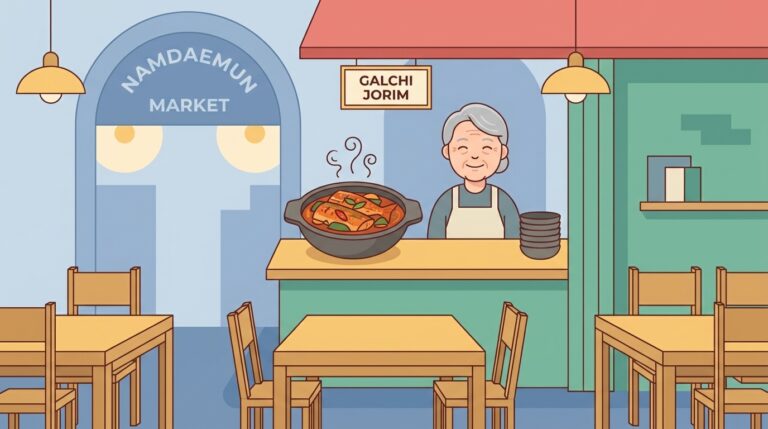
Master the Bustling Namdaemun Market: Ordering Braised Cutlassfish Like a True Local!
Phase 1: Empathy (An Immersive Story-Driven Opening)
안녕하세요! (Annyeonghaseyo!) Welcome back to Daily Hangul, your trusted cultural guide and Korean bestie.
Imagine this: You are weaving through the chaotic, colorful, and sensory-overloading alleys of Namdaemun Market (남대문시장). The aroma of toasted sesame oil, steaming dumplings, and sizzling griddles fills the air. You are on a mission to find the legendary Galchi Jorim Alley (갈치조림 골목)—a hidden maze dedicated entirely to spicy, savory, braised cutlassfish served in bubbling black earthen pots.
Finally, you step into a tiny, legendary diner. The steam is thick, the energy is high, and the “Imo” (이모, auntie/shop owner) looks at you with a sharp but warm gaze. Suddenly, the textbook phrases you memorized like “메뉴판을 주시겠습니까?” (Would you please give me the menu?) feel incredibly out of place and stiff. You want to blend in, show respect, and customize your level of spiciness without sounding like a robot.
Don’t worry! This guide is built based on real-world feedback from intermediate (B2) learners who felt overwhelmed by the fast-paced traditional market vibe. Today, we will transition you from a passive tourist to a confident local insider who knows how to navigate the heat, the noise, and the deliciousness of Namdaemun!
Phase 2: In-Depth Analysis of 3 Key Expressions
1. 이모, 여기 갈치조림 2인분 주세요! (Imo, yeogi galchi-jorim i-inbun juseyo!)
- Pronunciation Analogy: “Ee-mo, yuh-gi gal-chee jo-rim ee-een-boon joo-seh-yo!” (Imagine saying “Ee-mo” like the first part of “emotion”, and “yeogi” like “yogi” bear but with a soft ‘uh’ sound).
- Meaning: “Auntie, two servings of braised cutlassfish here, please!”
- K-Culture Moment: In K-Dramas featuring traditional market scenes or cozy neighborhood joints, you’ll rarely hear people call servers “Jeogiyo” (저기요). They yell “Imo!” (Auntie) to instantly establish a friendly, warm connection that often leads to extra side dishes (service, 서비스).
- Editor’s Insight: While “Jeogiyo” is polite and safe, “Imo” is the golden key in traditional markets. It breaks the ice instantly. Use “2인분” (i-inbun – 2 servings) instead of “두 개” (du gae – two items) to sound highly natural in dining contexts.
- Situation Spectrum: Casual (✅) / Semi-formal (⚠️ – Use only in informal diners/markets) / Formal (🚫 – Do not use in upscale restaurants)
- 🤔 Think About It: Why does Korean culture use familial terms like “Auntie” (이모) or “Uncle” (삼촌) for strangers? How does this reflect the communal, family-oriented mindset (Jeong, 정) of Korean society?
2. 조금 덜 맵게 해 주실 수 있나요? (Jogeum deol maepge hae jusil su innayo?)
- Pronunciation Analogy: “Jo-geum deol maep-geh hae joo-sheel soo een-nah-yo?” (Pronounce “deol” like the English word “dull”).
- Meaning: “Could you make it a little less spicy?”
- K-Culture Moment: You’ll see K-Food vloggers sweating over the bright red Galchi Jorim. It is notoriously spicy! If your tongue is sensitive, this phrase is your shield.
- Editor’s Insight: Intermediate learners often say “안 맵게 해주세요” (Make it not spicy). However, Galchi Jorim inherently requires red pepper flakes to mask the fishy odor. Asking for “덜 맵게” (less spicy) is much more culturally realistic and culinarily respectful than asking for zero spice.
- Situation Spectrum: Casual (✅) / Semi-formal (✅) / Formal (✅)
- 🤔 Think About It: How does your native language politely soften requests compared to the Korean use of “조금” (a little) and “-ㄹ 수 있나요?” (is it possible)?
3. 양념에 밥 비벼 먹으면 맛있겠어요! (Yangnyeome bap bibyeo meogeumyeon masitgesseoyo!)
- Pronunciation Analogy: “Yahng-nyuh-meh bap bee-byuh muh-geu-myun mah-sheet-get-suh-yo!” (Pronounce “bibyeo” like “bee-byuh” as in bibimbap).
- Meaning: “It would be delicious to mix rice with the sauce!”
- K-Culture Moment: In Korean food shows (like Tasty Guys), the ultimate climax of eating braised fish is drizzling the thick, fiery radish-infused sauce over white rice and folding in seasoned seaweed sheets (Gim).
- Editor’s Insight: Using “~겠어요” expresses your anticipation or deduction based on sight. Saying this to the owner shows you truly understand the soul of K-Food culture!
- Situation Spectrum: Casual (✅) / Semi-formal (✅) / Formal (⚠️)
- 🤔 Think About It: In Korea, the sauce is often considered the highlight of the dish, not just an accompaniment. How does this compare to food cultures where sauces are served strictly on the side?
Phase 3: Textbook Korean vs. Real-Life Korean
Situation 1: Ordering Food
- 📖 Textbook Korean: “갈치조림 두 개를 주문하고 싶습니다.” (I would like to order two braised cutlassfish.)
- 🗣️ Real-Life Korean: “이모님, 저희 갈치조림 둘이요!” (Auntie, two braised cutlassfish for us!)
- 💡 Why the difference? Textbook phrases are grammatically perfect but sound like a written essay. In busy market alleys, speed, warmth, and brevity rule. Saying “둘이요” (two of us/two portions) is punchy and natural.
Situation 2: Asking for More Side Dishes
- 📖 Textbook Korean: “반찬을 더 많이 제공해 주시겠습니까?” (Would you provide more side dishes?)
- 🗣️ Real-Life Korean: “이모, 여기 반찬 좀 더 주실 수 있어요?” (Auntie, can we get some more side dishes here?)
- 💡 Why the difference? “제공하다” (to provide) is an industrial, corporate term. In a cozy diner, “좀 더 주실 수 있어요?” (could you give us a bit more?) sounds polite yet intimate.
Phase 4: K-Culture Deep Dive & Non-Verbal Manners
4-1. Nunchi (눈치) & Traditional Market Etiquette
- Space is Premium: Namdaemun’s Galchi diners are tiny. You will likely sit close to strangers. Keep your bags tucked under your stool or in your lap.
- The “Imo” Eye Contact: When calling for the bill or ordering, raise your hand slightly, catch the owner’s eye with a warm smile, and say “여기요~” (Yeogiyo~) or “이모님~” (Imonim~). Yelling across the room when they are busy frying fish is bad form.
- Sharing side dishes: Banchan in traditional markets are communal but often served in small portions to prevent waste. Don’t hesitate to ask for refills, but always finish what you take!
4-2. The Cultural Code of
Frequently Asked Questions (FAQ)
Q: What does "이모, 여기 갈치조림 2인분 주세요! (Imo, yeogi galchi-jorim i-inbun juseyo!)" mean in Korean and how do you pronounce it?
A: In Korean, "이모, 여기 갈치조림 2인분 주세요! (Imo, yeogi galchi-jorim i-inbun juseyo!)" is pronounced [Analogy: "Ee-mo, yuh-gi gal-chee jo-rim ee-een-boon joo-seh-yo!" (Imagine saying "Ee-mo" like the first part of "emotion", and "yeogi" like "yogi" bear but with a soft 'uh' sound] and means: "Auntie, two servings of braised cutlassfish here, please!"
Q: What does "조금 덜 맵게 해 주실 수 있나요? (Jogeum deol maepge hae jusil su innayo?)" mean in Korean and how do you pronounce it?
A: In Korean, "조금 덜 맵게 해 주실 수 있나요? (Jogeum deol maepge hae jusil su innayo?)" is pronounced [Analogy: "Jo-geum deol maep-geh hae joo-sheel soo een-nah-yo?" (Pronounce "deol" like the English word "dull"] and means: "Could you make it a little less spicy?"
Q: What does "양념에 밥 비벼 먹으면 맛있겠어요! (Yangnyeome bap bibyeo meogeumyeon masitgesseoyo!)" mean in Korean and how do you pronounce it?
A: In Korean, "양념에 밥 비벼 먹으면 맛있겠어요! (Yangnyeome bap bibyeo meogeumyeon masitgesseoyo!)" is pronounced [Analogy: "Yahng-nyuh-meh bap bee-byuh muh-geu-myun mah-sheet-get-suh-yo!" (Pronounce "bibyeo" like "bee-byuh" as in bibimbap] and means: "It would be delicious to mix rice with the sauce!"







