

Blushing in K-Dramas and Real Life: How to Express Embarrassment in Korean
Phase 1: Empathy (스토리 몰입형 오프닝)
안녕하세요! (An-nyeong-ha-se-yo!) Your trusty Korean culture navigator and editor from Daily Hangul is here!
Imagine this: You are at a trendy cafe in Hongdae. You order a delicious strawberry latte, turn around to find a table, and bam! You lock eyes with someone who looks exactly like your favorite K-drama lead. They smile at you. Your heart does a little backflip, and suddenly, you feel a wave of heat rushing up your neck. You just know your face is as bright red as the strawberry puree in your cup.
In English, you might say, “Oh my god, I’m blushing so hard!” But how do you say this in Korean without sounding like a stiff, outdated textbook? Many of my B1-level students struggle here—they know the word for “red” (빨갛다 – ppal-gat-da) and “face” (얼굴 – eol-gul), but translating “I am blushing because I am embarrassed” literally often sounds unnatural to native speakers.
Today, we are going to master the art of expressing that cute, heart-fluttering, or downright awkward embarrassment. By the end of this post, you’ll be able to laugh off your blushing moments just like a character in a rom-com!
Phase 2: Deep Dive into 3 Essential Expressions (핵심 표현 3선 심층 분석)
Let’s look at the three most natural ways to say “I’m blushing” or “My face turned red” depending on who you are talking to.
1. 얼굴이 빨개지다 (Eol-gul-i ppal-gae-ji-da)
- Pronunciation: Eol-gool-ee ppal-gae-jee-dah (Sounds like “all-ghool-ee” followed by a sharp “ppal” like the ‘p’ in ‘spit’, and “gae-jee-dah”)
- Meaning: To have one’s face turn red (Direct) vs. To blush out of shyness or embarrassment (Nuance)
- K-Culture Moment: This is the ultimate K-drama classic. Think of the female lead when the male lead suddenly leans in close to help her buckle her seatbelt.
- Editor’s Insight: The verb ending -어/아지다 (-eo/a-ji-da) means “to become.” So you are literally saying your face “became red.” It is the most versatile and objective way to describe the physical reaction.
- Situation Spectrum: Casual ✅ | Semi-formal ✅ | Formal ✅
- 🤔 Think About It: In Korea, showing a bit of shyness (수줍음 – su-jub-eum) is often seen as charming and polite rather than awkward. Why do you think K-dramas emphasize blushing faces so much?
2. 쪽팔려서 쥐구멍에 들어가고 싶다 (Jjok-pal-lyeo-seo jwi-gu-myeong-e deol-eo-ga-go sip-da)
- Pronunciation: Jjok-pahl-ryuh-suh jwee-goo-myung-eh deul-uh-gah-go sheep-dah
- Meaning: I’m so embarrassed I want to crawl into a mouse hole.
- K-Culture Moment: You accidentally walk into the wrong restroom, or your phone blasts a loud K-pop song during a quiet university lecture.
- Editor’s Insight: 쪽팔리다 (jjok-pal-li-da) is a very common casual slang for “to be embarrassed.” Pairing it with 쥐구멍에 들어가고 싶다 (wanting to hide in a mouse hole) is the Korean equivalent of “I want the ground to swallow me up.” Use this only with close friends!
- Situation Spectrum: Casual ✅ | Semi-formal ⚠️ | Formal 🚫
- 🤔 Think About It: Does your native language have a funny animal-related metaphor for feeling embarrassed? How does a “mouse hole” compare to it?
3. 부끄러워서 고개를 못 들겠어 (Bu-kkeu-reo-wo-seo go-gae-reul mot deul-get-seo)
- Pronunciation: Boo-kkeu-ruh-wuh-suh go-gae-reul moht deul-ghet-suh
- Meaning: I’m too shy/embarrassed to lift my head.
- K-Culture Moment: A colleague praises your work in front of the whole department, or you receive an unexpected, sweet compliment from your crush.
- Editor’s Insight: This expression shows modesty. 부끄럽다 (bu-kkeu-reop-da) can mean both “shy” and “embarrassed.” Refusing to “lift your head” (고개를 못 들다) shows that you are feeling overwhelmed by the attention.
- Situation Spectrum: Casual ✅ | Semi-formal ✅ | Formal ⚠️
- 🤔 Think About It: Why is keeping your head down considered a sign of politeness in Korea when receiving praise, compared to western cultures where eye contact is expected?
Phase 3: Textbook Korean vs. Real Korean (교과서 한국어 vs. 진짜 한국어)
Let’s compare the rigid sentences from old grammar books with what young Koreans actually say when they are blushing!
Scenario A: Your friend points out that your face is red because of your crush.
- 📖 Textbook: “제 얼굴이 붉어졌습니까?” (Je eol-gul-i buk-eo-jyeot-seub-ni-ka? – Has my face become crimson?)
- 🗣️ Real Korean: “아, 진짜? 나 지금 얼굴 엄청 빨개?” (Ah, jin-jja? Na ji-geum eol-gul eom-cheong ppal-gae? – Oh, really? Is my face super red right now?)
- 💡 Why the difference? “붉다” (crimson/red) is highly literary and sounds like you are reading a poem. In real life, “빨갛다” combined with the casual intensifier “엄청” (super/hugely) is the natural way to go.
Scenario B: Tripping slightly on the street and hoping nobody saw.
- 📖 Textbook: “저는 부끄러움을 느낍니다.” (Jeo-neun bu-kkeu-reoum-eul neu-kkim-ni-da. – I feel shyness/embarrassment.)
- 🗣️ Real Korean: “아, 완전 이불킥 각이다.” (Ah, wan-jeon i-bul-kik gak-i-da. – Ah, this is definitely an ‘blanket-kick’ moment.)
- 💡 Why the difference? Koreans rarely say “I feel embarrassment” directly. Instead, they use slang like 이불킥 (i-bul-kik – blanket kick), which describes kicking your blankets in bed later tonight because you are cringing so hard at what you did today!
Phase 4: K-Culture Deep Dive & Non-Verbal Manners
4-1. The Art of “Nunchi” & Blushing Gestures
When Koreans blush or feel embarrassed, they rarely just stand there. There are specific non-verbal cues that go along with it:
1. The Hand Fan: Fanning your face with your hand while saying “아, 더워!” (Ah, deow-eo! – Oh, it’s hot!) is the universal defense mechanism to pretend your red face is just from the temperature, not because of your crush.
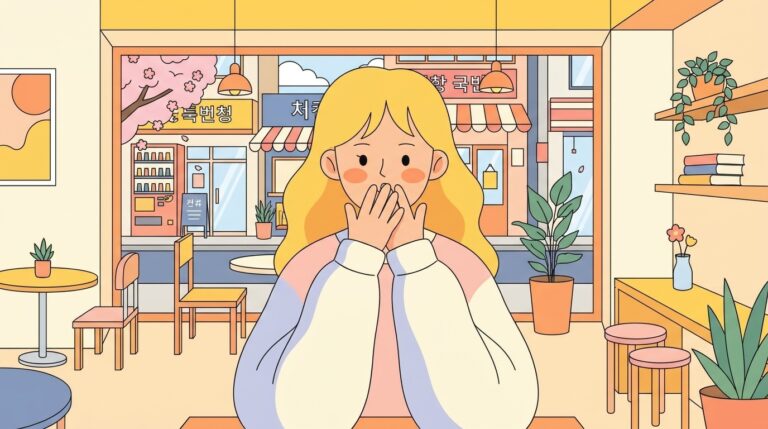
2. The Hand Shield: Covering your cheeks with both hands (often called the 꽃받침 – kkot-bat-chim or “flower cup” pose) to physically hide the blush.
4-2. The Romantic “Blush” in K-Beauty
Did you know that in Korea, blushing is so romanticized that there is a makeup trend called 숙취 메이크업 (suk-chwi me-i-keu-eop) or “hangover makeup”? It mimics the cute, flushed look you get when you’ve had a sip of alcohol or when you are flustered. Koreans use blush high on the cheekbones, right under the eyes, to create that adorable, easily-embarrassed anime-character vibe!
Phase 5: Real-Life Roleplay Scenario (실전 롤플레이)
Setting: A cozy Noraebang (karaoke room) in Sinchon. You are with your Korean friend, Minjun, and his friends. It’s your turn to sing, but you completely crack your voice on the high note!
Characters:
- Minjun (민준): Your supportive, teasing Korean friend.
- You (유): An exchange student trying their best.
- 민준: 와! 이번 곡 고음 대박인데? 너 할 수 있어?
(Wow! The high note in this song is crazy. Can you do it?) - 유: 🎭 (gulping nervously) 어… 노력해 볼게! 아자!
(Uh… I’ll try! Let’s go!) - 유: 🎭 (reaches the chorus and makes a loud, squeaky voice crack) 삑-!
(Squeak-!) - 민준: 🎭 (bursts into laughter but claps) 아하하! 귀여워! 괜찮아, 괜찮아!
(Ahaha! Cute! It’s okay, it’s okay!) - 유: 🎭 (covering face with hands) 아, 어떡해… 나 지금 얼굴 엄청 빨개졌지?
(Oh, what should I do… Is my face super red right now?) - 민준: 응, 완전 토마토 같아! 귀를 대봐, 열나는 것 같아.
(Yeah, completely like a tomato! Touch your ears, I think they are radiating heat.) - 유: 진짜 쪽팔려서 쥐구멍에 들어가고 싶다…
(Seriously, I’m so embarrassed I want to crawl into a mouse hole…) - 민준: 에이, 노래방에서는 원래 다 이러고 노는 거야! 다음 사람 고고!
(Hey, that’s how everyone plays at Noraebang! Next person, go go!)
🔀 Interactive Choice Points
How do you want to respond to Minjun’s teasing about your tomato face?
- Choice A: “아니야, 더워서 그래! 에어컨 좀 켜줘.” (No, it’s because it’s hot! Turn on the AC.)
- Feedback (Best! 🌟): Super natural! Using temperature as an excuse is a classic Korean defense mechanism. It keeps the conversation playful and light.
- Choice B: “나 이제 집에 갈래.” (I want to go home now.)
- Feedback (Bad 🚫): Too serious! It might make Minjun feel guilty for laughing, ruining the fun Noraebang atmosphere.
- Choice C: “이불킥 예약이다, 진짜.” (Definitely reserving a blanket-kick tonight, seriously.)
- Feedback (Great! 💖): Excellent use of modern slang. Minjun will be highly impressed by your natural vocabulary!
Phase 6: 10-Second Emotion Shadowing Drill (10초 감정 섀도잉)
Practice these sentences out loud. Pay attention to the pauses (/) and the emotional cues in the brackets!
-
[🥺 Whiny and embarrassed]
아, 어떡해… / 나 지금 / 얼굴 엄청 빨개졌지?
(Ah, eo-tteok-hae… / na ji-geum / eol-gul eom-cheong ppal-gae-jyeot-ji?) -
[😂 Laughing at yourself]
진짜 / 쪽팔려서 / 쥐구멍에 / 들어가고 싶다!
(Jin-jja / jjok-pal-lyeo-seo / jwi-gu-myeong-e / deol-eo-ga-go sip-da!) -
[🫣 Shy but happy]
칭찬해 주시니까 / 너무 부끄러워서 / 고개를 못 들겠어요.
(Ching-chan-hae ju-si-ni-kka / neo-mu bu-kkeu-reo-wo-seo / go-gae-reul mot deul-get-seo-yo.)
Phase 7: K-Culture Mini Dictionary (K-Culture 미니 사전)
- 이불킥 (I-bul-kik): “Blanket kick.” The act of kicking your blankets in bed when you suddenly remember an embarrassing moment from the past.
- 홍익인간 (Hong-ik-in-gan): Literally Korea’s founding philosophy (“To broadly benefit the human world”), but young people use it as slang for someone whose face turns extremely red after drinking even a tiny bit of alcohol.
- 부끄러움 (Bu-kkeu-reoum): Shyness or embarrassment. It is a noun form of 부끄럽다.
- 현타 (Hyeon-ta): Short for “현실 자각 타임” (Reality hit time). The moment of sudden clarity and embarrassment after doing something silly or passionate.
Phase 8: Survivor Kit for Travelers (여행자를 위한 생존 키트)
Survival Expressions TOP 3
Frequently Asked Questions (FAQ)
Q: What does "얼굴이 빨개지다 (Eol-gul-i ppal-gae-ji-da)" mean in Korean and how do you pronounce it?
A: In Korean, "얼굴이 빨개지다 (Eol-gul-i ppal-gae-ji-da)" is pronounced [Eol-gool-ee ppal-gae-jee-dah (Sounds like "all-ghool-ee" followed by a sharp "ppal" like the 'p' in 'spit', and "gae-jee-dah"] and means: To have one's face turn red (Direct) vs. To blush out of shyness or embarrassment (Nuance)
Q: What does "쪽팔려서 쥐구멍에 들어가고 싶다 (Jjok-pal-lyeo-seo jwi-gu-myeong-e deol-eo-ga-go sip-da)" mean in Korean and how do you pronounce it?
A: In Korean, "쪽팔려서 쥐구멍에 들어가고 싶다 (Jjok-pal-lyeo-seo jwi-gu-myeong-e deol-eo-ga-go sip-da)" is pronounced [Jjok-pahl-ryuh-suh jwee-goo-myung-eh deul-uh-gah-go sheep-dah] and means: I'm so embarrassed I want to crawl into a mouse hole.
Q: What does "부끄러워서 고개를 못 들겠어 (Bu-kkeu-reo-wo-seo go-gae-reul mot deul-get-seo)" mean in Korean and how do you pronounce it?
A: In Korean, "부끄러워서 고개를 못 들겠어 (Bu-kkeu-reo-wo-seo go-gae-reul mot deul-get-seo)" is pronounced [Boo-kkeu-ruh-wuh-suh go-gae-reul moht deul-ghet-suh] and means: I'm too shy/embarrassed to lift my head.







