

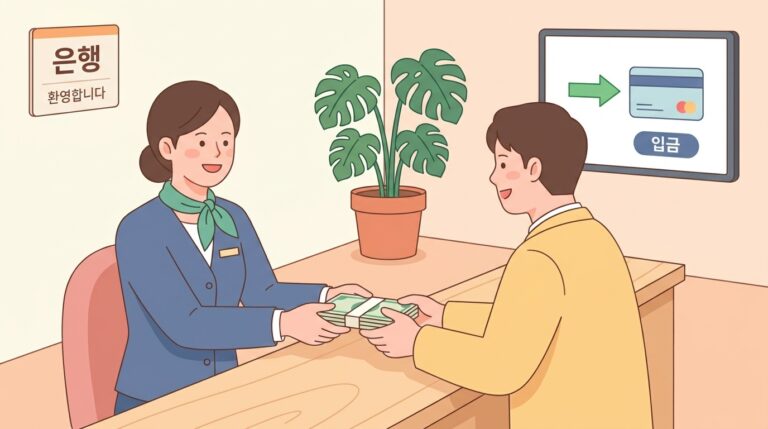
Handling Money Like a Local: Master Making Deposits in Korea
Phase 1: Empathy (Welcome to the Friendly Neighborhood Bank!)
안녕하세요! (Annyeonghaseyo!) I’m your Daily Hangul editor, your personal guide to navigating life and language in Korea.
Imagine this: You’ve just arrived in Seoul. You’re holding a handful of cash from a recent gig, or maybe a friend split the bill for some delicious K-BBQ and handed you physical bills. You walk into a sleek, modern Korean bank or stand in front of a shiny ATM. The screen is flashing, the security guard greets you politely, and suddenly—brain freeze. How do you say “I want to deposit this money” without sounding like a robot or resorting to wild hand gestures?
Don’t worry! Many of our learners have shared how intimidating their first Korean banking experience felt. In fact, one of our regular readers, Sarah, told us she walked in and out of a bank three times before building up the courage to make a simple deposit. Today, we are going to break that barrier. By the end of this guide, you’ll be walking into any Korean bank with the confidence of a true local! Ready? Let’s dive in.
Phase 2: Top 3 Core Expressions Deep Dive
1. 입금해 주세요 (Ip-geum-hae ju-se-yo)
- Pronunciation: Ip-geum-hae ju-se-yo (Sounds like: “Ip-goom-hay joo-say-yo”). Think of “ip” as in ipad, and “geum” like the first syllable of gom.
- Meaning: Please make a deposit. / Please deposit this.
- K-Culture Moment: You will hear this constantly in modern K-Dramas whenever characters are handling business, sending allowance to their parents, or receiving their hard-earned part-time job (알바 – alba) pay.
- Editor’s Insight: “입금” (ip-geum) literally translates to “entering money.” Adding “해 주세요” (hae ju-se-yo) makes it a polite request. It’s simple, direct, and universally understood by any bank teller.
- Situation Spectrum: Casual: 🚫 | Semi-formal: ✅ | Formal: ✅
- 🤔 Think About It: In English, we say “deposit.” In Korean, the characters mean “entering gold/money.” Isn’t it fascinating how languages visualize the movement of money differently?
2. 통장에 넣어 주세요 (Tong-jang-e neo-eo ju-se-yo)
- Pronunciation: Tong-jang-e neo-eo ju-se-yo (Sounds like: “Tong-jahng-eh nuh-uh joo-say-yo”). “Neo-eo” sounds like “nuh” followed by a soft breathy “uh”.
- Meaning: Please put it in my bankbook/account.
- K-Culture Moment: If you watch classic family dramas, you’ll often see parents holding a physical paper bankbook (통장 – tong-jang) with pride. Even in our digital age, physical bankbooks are still widely used and loved in Korea!
- Editor’s Insight: Use this expression if you are handing over both cash and your physical bankbook or debit card to the teller. It shows a warmer, highly natural command of everyday Korean.
- Situation Spectrum: Casual: ⚠️ | Semi-formal: ✅ | Formal: ✅
- 🤔 Think About It: Does your home country still use physical paper bankbooks that print transaction histories right in front of you? In Korea, it’s a nostalgic yet highly active piece of financial life!
3. 현금으로 입금할게요 (Hyeon-geum-eu-ro ip-geum-hal-ge-yo)
- Pronunciation: Hyeon-geum-eu-ro ip-geum-hal-ge-yo (Sounds like: “Hyun-goom-oo-ro ip-goom-hal-kay-yo”).
- Meaning: I will deposit this in cash.
- K-Culture Moment: Perfect for when you have leftover cash from a trip or a cash-heavy market shopping spree at Mangwon Market.
- Editor’s Insight: “현금” (hyeon-geum) means cash, and “~으로” (eu-ro) means “by means of / using.” It clarifies exactly how you want to perform the transaction before the teller even asks.
- Situation Spectrum: Casual: 🚫 | Semi-formal: ✅ | Formal: ✅
- 🤔 Think About It: Why do you think Korea is moving so fast toward a cashless society, yet banks remain incredibly accommodating to cash depositors?
Phase 3: Textbook Korean vs. Real-Life Korean
Let’s compare what textbooks teach you versus how real Koreans actually talk at the counter.
Scenario 1: Presenting your cash at the desk
- 📖 Textbook Korean: 저의 예금을 입금하기를 원합니다. (Jeo-ui ye-geum-eul ip-geum-ha-gi-reul won-hap-ni-da.)
- Translation: I desire to deposit my deposit.
- 🗣️ Real-Life Korean: 이거 입금해 주세요. (I-geo ip-geum-hae ju-se-yo.)
- Translation: Please deposit this (pointing to the cash).
- 💡 Why the difference? Textbook Korean is often grammatically stiff and repetitive. Real-life Korean values brevity and uses demonstrative pronouns like “이거” (this) while pointing to save time.
Scenario 2: Specifying the destination account
- 📖 Textbook Korean: 이 돈을 제 계좌 번호에 입금해 주십시오. (I don-eul je gye-jwa beon-ho-e ip-geum-hae ju-sip-si-o.)
- Translation: Please deposit this money into my account number.
- 🗣️ Real-Life Korean: 여기(카드)에 넣어 주세요. (Yeo-gi ka-deu-e neo-eo ju-se-yo.)
- Translation: Please put it in here (handing over your card).
- 💡 Why the difference? Handing over the physical card or bankbook does the talking for you. Simply saying “put it in here” is polite, efficient, and sounds incredibly natural.
Phase 4: K-Culture Deep Dive & Non-Verbal Etiquette
4-1. Nunchi (눈치) & Hand Gestures at the Bank
- Two-Handed Respect: When handing over your cash, ID, or debit card to the teller, always use two hands. This is a foundational sign of respect in Korean culture. Using one hand can make you look dismissive or hurried.
- The Waiting Ticket: Before you do anything, look for the ticket machine (번호표 – beon-ho-pyo). Grab your number first, and sit down. Walking straight to an empty counter without a ticket is a major breach of local bank etiquette!
4-2. The Aesthetic of Korean Banks
Korean banks are designed to be highly comfortable. Don’t be surprised to find cozy waiting areas with free coffee mix, water dispensers, and sometimes even physical newspapers or massage chairs!
Phase 5: Real-Life Roleplay Scenario
Let’s put you in a real bank in Hongdae, Seoul. You are talking to Min-ji, a friendly and professional bank teller.
Characters:
- 민지 (Min-ji): The polite bank teller.
- You: A helpful customer wanting to deposit 50,000 KRW cash into your card account.
Dialogue:
- 민지: 🎭 (Smiling warmly) 어서 오세요, 고객님. 어떤 업무 도와드릴까요?
- Eo-seo o-se-yo, go-gaek-nim. Eo-tteon eop-mu do-wa-deu-ril-ka-yo?
- “Welcome, valued customer. How may I help you today?”
- You: 🎭 (Handing over your cash and debit card with two hands) 안녕하세요. 이거 입금해 주세요.
- An-nyeong-ha-se-yo. I-geo ip-geum-hae ju-se-yo.
- “Hello. Please deposit this.”
- 민지: 🎭 (Checking the card and cash) 네, 카드로 입금해 드릴게요. 총 오만 원 맞으신가요?
- Ne, ka-deu-ro ip-geum-hae deu-ril-ge-yo. Chong o-man won ma-jeu-sin-ga-yo?
- “Yes, I will deposit it into your card. Is it 50,000 won in total?”
- You: 🎭 (Nodding politely) 네, 맞아요.
- Ne, ma-ja-yo.
- “Yes, that’s correct.”
- 민지: 🎭 (Processing the transaction on her computer) 혹시 본인 명의 계좌가 맞으신가요?
- Hok-si bon-in myeong-ui gye-jwa-ga ma-jeu-sin-ga-yo?
- “By any chance, is this account under your own name?”
- You: 🎭 (Answering confidently) 네, 제 계좌예요.
- Ne, je gye-jwa-yeo-yo.
- “Yes, it’s my account.”
- 민지: 🎭 (Handing back the card and a receipt) 네, 처리 완료되었습니다. 여기 카드와 영수증입니다.
- Ne, cheo-ri wan-ryo-doe-eot-seup-ni-da. Yeo-gi ka-deu-wa yeong-su-jeung-im-ni-da.
- “Yes, the transaction is complete. Here is your card and receipt.”
- You: 🎭 (Receiving them with both hands) 감사합니다. 수고하세요!
- Gam-sa-ham-ni-da. Su-go-ha-se-yo!
- “Thank you. Have a nice day!” (Literally: Keep up the good work!)
🔀 Interactive Choice Point
Min-ji asks: “혹시 본인 명의 계좌가 맞으신가요?” (Is this account under your name?)
- Choice A: “아니요, 친구 계좌예요.” (A-ni-yo, chin-gu gye-jwa-yeo-yo.) -> “No, it’s my friend’s account.”
- Choice B: “네, 제 거예요.” (Ne, je geo-yeo-yo.) -> “Yes, it’s mine.”
- Choice C: “몰라요.” (Mol-la-yo.) -> “I don’t know.”
Feedback:
- Best Choice (B): Perfect! It’s polite, short, and directly answers her security check.
- Risk Choice (A): Honesty is great! However, depositing cash into someone else’s account might require you to fill out an extra form with their name and phone number for anti-fraud purposes. Be prepared!
- Bad Choice (C): Saying “I don’t know” might cause the teller to freeze the transaction for safety reasons. Always know whose card you are using!
Phase 6: 10-Second Emotion Shadowing Drill
Practice speaking like a native by adjusting your pacing and showing real emotions. The slash / represents a tiny pause.
- [😊 Politely & Confidently]
- 이거 / 입금해 / 주세요.
- I-geo / ip-geum-hae / ju-se-yo.
- “Please / deposit / this.”
- [✨ Brightly & Gratefully]
- 네, / 맞아요. / 감사합니다!
- Ne, / ma-ja-yo. / Gam-sa-ham-ni-da!
- “Yes, / that’s right. / Thank you!”
- [🤝 Softly & Respectfully]
- 제 카드에 / 넣어 주세요.
- Je ka-deu-e / neo-eo ju-se-yo.
- “Into my card, / please put it in.”
Phase 7: K-Culture Mini-Dictionary
- 현금 (Hyeon-geum) | Cash
- Usage: Essential to carry if you are visiting traditional markets or buying delicious street snacks like hotteok (호떡).
- 통장 (Tong-jang) | Bankbook
- Usage: A physical booklet used to record all transaction details. It’s highly prized by older generations for budgeting.
- 번호표 (Beon-ho-pyo) | Waiting Ticket
- Usage: The paper slip you print out from a kiosk when you first enter a bank or a busy public office.
- 영수증 (Yeong-su-jeung) | Receipt
- Usage: Tellers will always ask if you need one. You can say “버려 주세요” (beo-ryeo ju-se-yo – “Please throw it away”) if you don’t need it!
Phase 8: Survivor Kit for Travelers
Survival Phrases TOP 3
- ATM 어디 있어요? (ATM eo-di it-seo-yo?)
- Meaning: Where is the ATM?
- Pro Tip: Keep this handy when you need to make a quick deposit or withdrawal outside bank hours!
- 수수료 얼마예요? (Su-su-ryo eol-ma-yeo-yo?)
- Meaning: How much is the transaction fee?
- Pro Tip: Great for weekends or late-night ATM transactions when additional fees apply.
- 도와주세요. (Do-wa-ju-se-yo.)
- Meaning: Please help me.
- Pro Tip: Use this if the automated ATM machine eats your card or throws an error code.
Editor’s Travel Note
Before visiting a branch, we highly recommend checking local navigation apps. Google Maps isn’t always fully optimized for Korea, so search for nearby branches using the KakaoMap App or Naver Map App.
Disclaimer: Bank branch hours in Korea are generally 09:00 to 16:00, but these hours can change based on local regulations and specific branch policies.
Phase 9:
Frequently Asked Questions (FAQ)
Q: What does "입금해 주세요 (Ip-geum-hae ju-se-yo)" mean in Korean and how do you pronounce it?
A: In Korean, "입금해 주세요 (Ip-geum-hae ju-se-yo)" is pronounced [Ip-geum-hae ju-se-yo (Sounds like: "Ip-goom-hay joo-say-yo"] and means: Please make a deposit. / Please deposit this.
Q: What does "통장에 넣어 주세요 (Tong-jang-e neo-eo ju-se-yo)" mean in Korean and how do you pronounce it?
A: In Korean, "통장에 넣어 주세요 (Tong-jang-e neo-eo ju-se-yo)" is pronounced [Tong-jang-e neo-eo ju-se-yo (Sounds like: "Tong-jahng-eh nuh-uh joo-say-yo"] and means: Please put it in my bankbook/account.
Q: What does "현금으로 입금할게요 (Hyeon-geum-eu-ro ip-geum-hal-ge-yo)" mean in Korean and how do you pronounce it?
A: In Korean, "현금으로 입금할게요 (Hyeon-geum-eu-ro ip-geum-hal-ge-yo)" is pronounced [Hyeon-geum-eu-ro ip-geum-hal-ge-yo (Sounds like: "Hyun-goom-oo-ro ip-goom-hal-kay-yo"] and means: I will deposit this in cash.







