

Phase 1: Empathy & K-Drama Beginnings
안녕하세요! (An-nyeong-ha-se-yo!) Hello! Your favorite Daily Hangul editor is here to hold your hand through another exciting Korean journey. 👋
Imagine this: You are exploring the neon-lit, beautiful streets of Seoul. Suddenly, a minor headache strikes, or maybe that spicy tteokbokki you had for lunch is making your stomach rumble. You need a pharmacy, and fast! In K-Dramas, this is the classic moment where the charming main lead runs through the rain to buy medicine for their partner.
But in real life, you don’t have a personal K-Drama star to help you. You need to find a pharmacy yourself. Many of our students at Daily Hangul told us they felt terrified of asking for directions in Korean, fearing they wouldn’t understand the reply. Don’t worry! Today, you will learn the absolute easiest, most natural way to find a pharmacy in Korea like a local.
Phase 2: Core Expressions Deep-Dive
Let’s learn the three magical sentences that will save your day.
1. 약국 어디예요? (Yag-guk eo-di-yeo-yo?)
- Pronunciation: Yahg-gook uh-dee-yeh-yo? (Sounds like “Yahg-gook” + “uh-di” + “ye-yo?”)
- Meaning: Where is the pharmacy? (Literally: Pharmacy / where / is?)
- K-Culture Moment: You will hear this in almost every family-themed K-Drama when a character suddenly catches a cold.
- Editor’s Insight: “약국” (yag-guk) means pharmacy, and “어디예요?” (eo-di-yeo-yo?) means “where is it?”. This is the gold standard of polite, simple Korean.
- Situation Spectrum: Casual (⚠️ 약국 어디야? – for close friends) | Semi-formal (✅ 약국 어디예요? – Best for strangers) | Formal (✅ 약국이 어디에 있습니까? – Too stiff for daily life)
- 🤔 Think About It: In Korean, we omit the subject “it” or “you” very often. We just say “Pharmacy where is?” Why do you think Korean communication values brevity in urgent situations?
2. 머리 아파요. (Meo-ri a-pa-yo.)
- Pronunciation: Muh-ree ah-pah-yo. (Sounds like “Muh-ree” + “ah-pah-yo”)
- Meaning: I have a headache. (Literally: Head / hurts.)
- K-Culture Moment: Usually accompanied by a dramatic hand-on-forehead gesture in dramas.
- Editor’s Insight: “머리” (meo-ri) means head (or hair), and “아파요” (a-pa-yo) means it hurts or I’m sick. You can use this to explain why you are looking for a pharmacy.
- Situation Spectrum: Casual (⚠️ 머리 아파) | Semi-formal (✅ 머리 아파요) | Formal (✅ 머리가 아픕니다)
3. 타이레놀 있어요? (Ta-i-re-nol is-seo-yo?)
- Pronunciation: Tie-reh-nol ees-suh-yo?
- Meaning: Do you have Tylenol?
- K-Culture Moment: Walking into a brightly lit neighborhood pharmacy and speaking directly to the pharmacist.
- Editor’s Insight: Tylenol is highly recognizable in Korea. “있어요?” (is-seo-yo?) means “Do you have…?” or “Is there…?” This is a survival pattern for shopping!
- Situation Spectrum: Casual (⚠️ 타이레놀 있어?) | Semi-formal (✅ 타이레놀 있어요?) | Formal (✅ 타이레놀이 있습니까?)
Phase 3: Textbook Korean vs. Real Korean
Let’s compare what boring old textbooks teach you versus how Koreans actually talk!
Situation 1: Asking where the pharmacy is
- 📖 Textbook Korean: 약국이 어디에 위치하고 있습니까? (Yag-gug-i eo-di-e wi-chi-ha-go is-seub-ni-ka? – “In which location is the pharmacy situated?”)
- 🗣️ Real Korean: 약국 어디예요? (Yag-guk eo-di-yeo-yo? – “Where is the pharmacy?”)
- 💡 Why the difference? Nobody uses passive, heavy words like “located” in a casual street conversation. Keep it short!
Situation 2: Explaining your pain
- 📖 Textbook Korean: 저는 두통을 겪고 있습니다. (Jeo-neun du-tong-eul gyeok-go is-seub-ni-da. – “I am experiencing a headache.”)
- 🗣️ Real Korean: 머리 아파요. (Meo-ri a-pa-yo. – “My head hurts.”)
- 💡 Why the difference? “두통” (du-tong) is a medical term for headache. In daily conversations, Koreans prefer the simple, physical description “머리 아파요”.
Phase 4: K-Culture Deep-Dive & Non-Verbal Manners
4-1. The Body Language of Pain and Respect
When asking for directions in Korea, always start by slightly bowing your head (about 15 degrees) and saying “저기요…” (Jeo-gi-yo… / Excuse me). If you are in pain, gently putting your hand to your temple (for headaches) or stomach while asking “약국 어디예요?” immediately signals to the local that you need help. Koreans are incredibly kind to travelers in distress and might even walk you to the pharmacy!
4-2. The “Yakguk” Culture
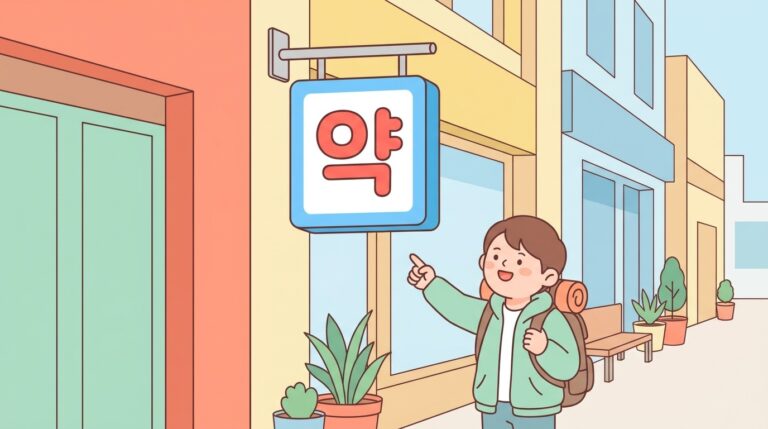
Unlike in western countries where pharmacies are hidden inside giant supermarkets, Korean pharmacies (약국) are everywhere, marked by a big red or blue sign that simply says 약 (Yak – Medicine). You can buy basic painkillers, digestive aids, and hangover cures directly from the pharmacist over the counter without a prescription.
Phase 5: Interactive Roleplay Scenario
Meet Min-ji, a friendly local college student drinking an iced Americano near Hongdae Station. You have a sudden headache. Let’s ask her for help!
- You: 저기요… (Jeo-gi-yo… / 🎭 Bowing slightly, holding your head)
- Min-ji: 네? 무슨 일 있으세요? (Ne? Mu-seun il is-seo-se-yo? / Yes? Is something wrong?)
- You: 머리 아파요. 약국 어디예요? (Meo-ri a-pa-yo. Yag-guk eo-di-yeo-yo? / My head hurts. Where is the pharmacy?)
- Min-ji: 아, 두통이 있으시구나. 저기 편의점 옆에 있어요! (Ah, du-tong-i is-seu-si-gu-na. Jeo-gi pyeon-ui-jeom yeop-e is-seo-yo! / Ah, you have a headache. It’s right there, next to the convenience store!)
- You: 저기요? 편의점 옆이요? (Jeo-gi-yo? Pyeon-ui-jeom yeop-i-yo? / Over there? Next to the convenience store?)
- Min-ji: 네, 맞아요! 저 초록색 간판이에요. (Ne, ma-ja-yo! Jeo cho-rok-saek gan-pan-i-e-yo. / Yes, correct! That green sign over there.)
- You: 아! 감사합니다! (Ah! Gam-sa-ham-ni-da! / Ah! Thank you!)
- Min-ji: 조심해서 가세요! (Jo-sim-hae-seo ga-se-yo! / Go safely!)
🔀 Choose Your Path!
What do you say next to Min-ji to show your gratitude?
* A) “고마워” (Go-ma-wo)
* B) “감사합니다” (Gam-sa-ham-ni-da)
* C) “대박!” (Dae-bak!)
Click to see the feedback on your choice!
- A (Go-ma-wo) – Bad: This is casual language (Banmal). Since Min-ji is a stranger, using this might sound too rude!
- B (Gam-sa-ham-ni-da) – BEST!: Polite, respectful, and perfectly natural. Min-ji will smile warmly.
- C (Dae-bak!) – Risk: This means “Awesome!” or “Jackpot!”. Saying this after receiving help is a bit too silly and informal.
Phase 6: 10-Second Emotion Shadowing
Let’s practice speaking with real Korean emotions. Pay attention to the pauses (/) and the feelings!
- [🥺 Painful & Tired]
머리 / 아파요… (Muh-ree / ah-pah-yo…) -
[🙏 Polite & Desperate]
약국 / 어디예요? (Yahg-gook / uh-dee-yeh-yo?) -
[😊 Bright & Relieved]
아! / 감사합니다! (Ah! / gam-sa-ham-ni-da!)
Phase 7: K-Culture Mini Dictionary
- 약 (Yak) | Medicine | The magical single syllable you need to look for on street signs.
- 편의점 (Pyeon-ui-jeom) | Convenience Store | In Korea, you can buy basic medicine (like Tylenol) here late at night if pharmacies are closed!
- 처방전 (Cheo-bang-jeon) | Prescription | Needed for stronger medications, but not for basic painkillers.
- 약사님 (Yak-sa-nim) | Pharmacist | The polite way to address the pharmacist when you walk in.
Phase 8: Travel Survival Kit
Survival Phrases TOP 3
- 소화제 주세요. (So-hwa-je ju-se-yo.)
- Meaning: Please give me digestive medicine. (Great after eating too much Korean BBQ!)
- 밴드 주세요. (Baen-deu ju-se-yo.)
- Meaning: Please give me band-aids. (For those blisters from walking around Seoul!)
- 감기약 주세요. (Gam-gi-yak ju-se-yo.)
- Meaning: Please give me cold medicine.
💡 Editor’s Travel Note:
Google Maps does not work well for walking directions in Korea! Before you fly, make sure to download the Naver Map App or KakaoMap App. Simply type “약국” (yag-guk) into these apps to find the nearest open pharmacy instantly.
Phase 9: A Step Deeper (Reflection)
In western countries, people often self-diagnose and grab medicine from open shelves. In Korea, even for over-the-counter medicine, you usually talk directly to the pharmacist at the counter. This reflects Korea’s caring culture; pharmacists want to make sure you take the right medicine and often ask, “밥 먹었어요?” (Have you eaten?) before telling you to take the pill. It’s a small, warm connection in a busy city.
💬 Your Turn: Have you ever had to find a pharmacy in a foreign country? Let us know your survival stories in the comments below!
Phase 10: FAQ & Common Mistakes
Q: Can I buy painkillers like Ibuprofen at Korean convenience stores?
A: Yes! Basic medicines like Tylenol and Ibuprofen are available at most major convenience stores (CU, GS25, Seven-Eleven) 24/7. Look for the “안전상비의약품” (Safe Medicine) shelf near the cashier.
Q: Are Korean pharmacies open on Sundays?
A: Many are closed, but there are designated “late-night/holiday pharmacies” (휴일지킴이약국). You can check their locations using the Naver Map app.
Q: How do I ask the pharmacist for English-speaking help?
A: You can politely ask, “영어 가능하세요?” (Yeong-eo ga-neung-ha-se-yo? / Is English possible?).
🚨 Common Mistakes Alert!
- Mistake 1: Saying “약국 어디야?” (Yag-guk eo-di-ya?) to a stranger.
- Correct Action: Always add “-요” at the end to make it polite: “약국 어디예요?”
- Mistake 2: Searching for “pharmacy” on Google Maps in Korea.
- Correct Action: Search “약국” on Naver Maps.
- Mistake 3: Pronouncing “약국” as “Ya-guk”.
- Correct Action: Make sure to pronounce the bottom ‘k’ sound clearly: Yahg-gook.
Phase 11: Action Missions
- 🥉 Bronze Mission: Pronounce “약국 어디예요?” out loud 3 times in front of your mirror.
- 🥈 Silver Mission: Write “머리 아파요” in the comments of this post!
- 🥇 Gold Mission: Next time you watch a K-Drama, try to spot the word “약” (Yak) on a street sign or listen for “아파요” (A-pa-yo) when a character gets sick!
Phase 12: Interactive Quiz Challenge
1. What does “약국” (yag-guk) mean?
- A) Hospital
- B) Pharmacy
- C) Convenience store
See Answer & Explanation
Correct Answer: B) Pharmacy
* Explanation: “약국” (yag-guk) is pharmacy. Hospital is “병원” (byeong-won).
2. Fill in the blank: “머리 ________.” (My head hurts.)
- A) 예뻐요 (yeo-ppeo-yo)
- B) 아파요 (a-pa-yo)
See Answer & Explanation
Correct Answer: B) 아파요 (a-pa-yo)
* Explanation: “아파요” means hurts. “예뻐요” means pretty (My head is pretty?! No! 😉).
3. True or False: You can buy basic Tylenol at Korean convenience stores.
- A) True
- B) False
See Answer & Explanation
Correct Answer: A) True
* Explanation: Yes, 24-hour convenience stores carry basic over-the-counter medications in Korea.







