

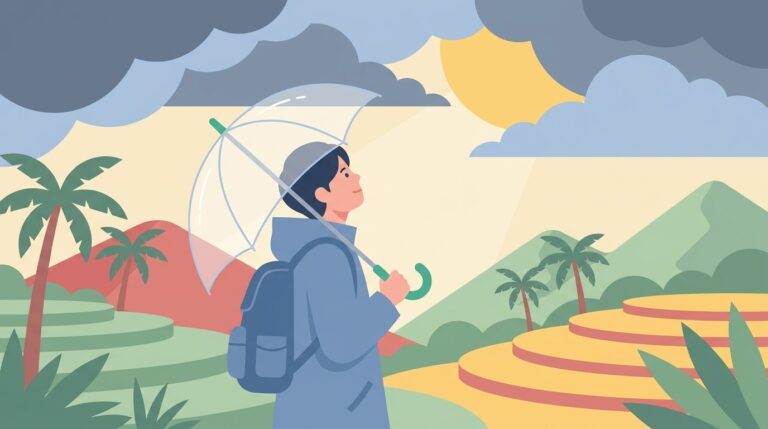
Chasing Clear Skies: Navigating Southeast Asia’s Monsoon and Typhoon Seasons Like a Pro
Phase 1: Empathy (Journey into the Wet Season Dilemma)
안녕하세요! Daily Hangul‘s Chief Editor and your trusty local culture navigator here!
Imagine this: You’ve meticulously planned your dream getaway to Southeast Asia. You’ve packed your trendiest linen shirts, booked a gorgeous beachfront villa, and envisioned yourself sipping fresh coconut water under a flawless azure sky. But as soon as you step out of the airport, you’re greeted not by a warm tropical breeze, but by a wall of relentless, heavy rain and the ominous howling of a typhoon.
Many of our advanced C2 learners tell us that while they can easily read weather forecasts in Korean, they struggle to grasp the actual nuances of how locals discuss, prepare for, and cleverly circumvent the unpredictable monsoon seasons (우기 – ugi) and typhoon seasons (태풍 시즌 – taepung sijeon). Today, we’re moving beyond textbook definitions to dive into the rich, highly nuanced vocabulary and cultural insights that will help you plan your travels, talk like a seasoned globetrotter, and discuss complex climate patterns with native Korean speakers with absolute confidence. Let’s get started!
Phase 2: Deep-Dive into 3 Essential Advanced Expressions
1. 삼고초려 끝에 날짜를 잡다 (Sam-go-cho-ryeo kkeut-e nal-jja-reul jap-da)
- Pronunciation: Sahm-go-cho-ryeo kkeut-e nal-jja-reul jahp-dah (Rhymes with “calm-go-cho-leo”)
- Meaning: Lit. “To set a date after making three humble visits to a cottage” / Fig. “To decide on a travel date after immense deliberation, careful planning, and consulting multiple sources.”
- K-Culture Moment: Often heard in travel variety shows like Traveler or Battle Trip when the cast members finally coordinate their hectic schedules and research the perfect weather window to avoid natural disruptions.
- Editor’s Insight: Derived from the classic idiomatic idiom (사자성어) Samgocheoryo (三顧草廬), this expression emphasizes that choosing your travel window to avoid Southeast Asia’s erratic monsoon season was not a casual decision, but a result of meticulous calculation.
- Situation Spectrum: Casual ⚠️ | Semi-formal ✅ | Formal ✅
- 🤔 Think About It: How does your native culture express the act of over-analyzing and putting immense effort into choosing the perfect timing for an event?
2. 눈치싸움에서 승리하다 (Nunchi-ssau-me-seo seung-ri-ha-da)
- Pronunciation: Noon-chee-ssah-oom-eh-suh seung-ree-hah-dah
- Meaning: Lit. “To win the tactical wits/intuition game” / Fig. “To successfully book a trip during the shoulder season (right before or after the monsoon) when prices are low and the weather surprisingly holds up.”
- K-Culture Moment: Vloggers on YouTube post videos titled “How I won the ‘Nunchi-ssauem’ in Thailand during late October and got 5-star luxury resorts for pennies!”
- Editor’s Insight: Nunchi (tactful intuition) is the ultimate Korean social skill. When applied to travel, “Nunchi-ssauem” refers to predicting what other tourists will do and outsmarting the typical weather patterns or booking trends.
- Situation Spectrum: Casual ✅ | Semi-formal ✅ | Formal 🚫
- 🤔 Think About It: Koreans heavily rely on collective intuition (Nunchi) to make strategic decisions. Do you use social intuition when booking flights during risky weather seasons?
3. 직격탄을 피하다 (Jik-gyeok-tan-eul pi-ha-da)
- Pronunciation: Jeek-gyuhk-tahn-eul pee-hah-dah
- Meaning: Lit. “To avoid a direct hit (from a missile/bullet)” / Fig. “To successfully dodge the peak of a typhoon or severe monsoon season during travel.”
- K-Culture Moment: Used in news broadcasts and premium travel documentaries discussing global warming and its unpredictable shift in Southeast Asian weather corridors.
- Editor’s Insight: This is a highly sophisticated, vivid metaphor. When you say you avoided the peak wet season, saying you “avoided a direct hit” makes you sound incredibly fluent and expressive.
- Situation Spectrum: Casual ✅ | Semi-formal ✅ | Formal ✅
- 🤔 Think About It: Why do you think Korean uses such intense, militaristic terms like Jikgyeoktan (direct hit) to describe escaping bad weather or economic crises?
Phase 3: Textbook Korean vs. Real-Life Korean
Situation 1: Explaining why you are delaying your trip to Vietnam
- 📖 Textbook Korean: “베트남의 우기가 심해서 여행을 연기했습니다.” (Because the wet season in Vietnam is severe, I postponed my trip.)
- 🗣️ 진짜 한국어 (Real-Life): “태풍 직격탄 맞을까 봐, 눈치싸움 하다가 아예 우기 비껴가는 일정으로 미뤘어요.” (I was worried about getting hit directly by a typhoon, so after playing the waiting game, I pushed my schedule to completely bypass the wet season.)
- 💡 Why the Difference? While the textbook version is grammatically correct, it sounds robotic. Real-life Korean utilizes active metaphors like “getting hit directly” (직격탄 맞다) and “bypassing/skirting around” (비껴가다) to convey savvy travel planning.
Situation 2: Asking if the current weather in Bali is manageable
- 📖 Textbook Korean: “지금 발리는 비가 많이 옵니까?” (Is it raining a lot in Bali right now?)
- 🗣️ 진짜 한국어 (Real-Life): “요즘 발리 스콜성 폭우 심한가요? 아니면 여행 다닐 만한 수준인가요?” (Are the sudden squalls in Bali terrible lately? Or is it still decent enough to travel around?)
- 💡 Why the Difference? Advanced speakers specify the type of rain (e.g., “squalls” / 스콜성 폭우) rather than just “rain” (비), and use the highly natural idiomatic ending “~할 만하다” (worth doing/manageable).
Phase 4: K-Culture Deep-Dive & Non-Verbal Manners
4-1. The Art of “Weather Etiquette” in Travel Discourse
When discussing weather disruptions or cancelled trips with Korean friends, always show empathy before sharing your technical advice. Instead of flatly saying “You shouldn’t go then,” use a soft head tilt, a slight sigh (아휴…), and offer a comforting phrase like “안타깝네요” (What a shame) or “속상하시겠어요” (You must be so upset).
4-2. The “Nunchi” of Shoulder-Season Travel in K-Travel Culture
In Korean pop-culture, traveling during the transition months (such as May or October in Southeast Asia) is highly romanticized. Koreans refer to this as the “Goldilocks zone” of travel. Shows like Spiteful Travel highlight how Koreans use real-time weather apps and community forums to play “Nunchi-ssauem”—navigating the razor-thin margin between cheap off-season hotel rates and glorious, unexpected sunny days.
Phase 5: Real-Life Roleplay Scenario
The Setting
Ji-won (지원), a seasoned travel planner, is advising Mark (마크), who is planning a premium honeymoon to the Philippines but is stressed about the shifting typhoon patterns.
지원: (걱정스러운 눈빛으로 마크를 바라보며) 마크 씨, 필리핀 신혼여행 일정 잡으셨어요? 9월이면 한창 태풍 시즌일 텐데요.
      (Mark, have you finalized your Philippines honeymoon schedule? September is usually right in the middle of typhoon season.)

마크: (한숨을 쉬며 머리를 긁적인다) 맞아요, 지원 씨. 그래서 지금 머리가 너무 아파요. 일정을 미뤄야 하나 고민 중이에요.
      (Exactly, Ji-won. That's why I have such a headache right now. I'm contemplating whether I should push the dates back.)

지원: (고개를 끄덕이며) 탁월한 선택이세요. 평생 한 번뿐인 신혼여행인데 태풍 직격탄이라도 맞으면 어떡해요. 눈치싸움을 좀 하셔야겠어요.
      (Wise choice. It's a once-in-a-lifetime honeymoon; what if you get hit directly by a typhoon? You need to play a bit of a tactical waiting game.)

마크: (눈이 반짝이며) 눈치싸움이요? 혹시 추천하시는 시기가 따로 있으신가요?
      (A tactical waiting game? Do you happen to have a specific period you'd recommend?)

지원: (미소를 지으며 태블릿을 보여준다) 제 생각에는 우기가 거의 끝나가는 11월 중순이 딱이에요. 강수량도 확 줄고 리조트 가격도 아직 성수기 전이라 합리적이거든요.
      (I think mid-November, when the wet season is almost wrapping up, is the sweet spot. Rainfall drops sharply, and resort prices are still reasonable before peak season kicks in.)

마크: (안도의 한숨을 내쉬며) 아! 삼고초려 끝에 보라카이로 정한 건데, 날씨 때문에 망칠 순 없죠. 지원 씨 말대로 11월로 조율해 봐야겠어요.
      (Ah! I chose Boracay after so much deliberation, I can't let the weather ruin it. I should coordinate to move it to November as you suggested.)

지원: (엄지손가락을 치켜세우며) 잘 생각하셨어요! 그때 가시면 날씨도 선선하고 최고의 휴양이 될 거예요.
      (Great decision! If you go then, the weather will be cool and it'll be the ultimate relaxing vacation.)

마크: (고마워하며) 진짜 은인이세요! 당장 항공권 변경 수수료부터 알아봐야겠네요.
      (You are a lifesaver! I need to check the flight change fees right away.)
🔀 Interactive Decision Points
If you were Mark, how would you respond to Ji-won suggesting the change to November?
* A) “수수료 아까운데 그냥 하늘에 기도하고 9월에 갈래요.” (Flight change fees are a waste of money, I’ll just pray to the heavens and go in September.)
* Feedback: 🚫 Risk! Beautiful honeymoon ruined by storm clouds. High risk of resort confinement!
* B) “지원 씨 조언대로 11월로 변경해서 안전하고 완벽한 여행을 만들겠어요!” (I’ll change it to November as you advised and make it a safe, perfect trip!)
* Feedback: Best! Displays wise decision-making and utilizes premium travel logic.
* C) “그럼 동남아 말고 아예 우기가 없는 다른 대륙으로 갈까요?” (Then, instead of Southeast Asia, should we go to another continent with no wet season at all?)
* Feedback: ⚠️ Mediocre. Safe, but you miss out on the gorgeous Southeast Asian resorts and your original dream destination.
Phase 6: 10-Second Emotional Shadowing Drill
Practice speaking with real emotional cadence. Pay attention to the pauses (/) and emotional cues.
- [🥺 Worried & Frustrated]
태풍 직격탄 맞을까 봐 / 매일 날씨 앱만 / 들여다보고 있어요.
(Taepung jikgyeoktan majeulkka bwa / maeil nalssi aepman / deuryeodabogo isseoyo.)
“Terrified of getting hit directly by a typhoon, I do nothing but stare at my weather app every single day.” -
[😎 Relieved & Proud]
치열한 눈치싸움 끝에 / 우기를 딱 피해서 / 다녀왔죠!
(Chiyeolhan nunchissauem kkeute / ugireul ttak pihaeseo / danyeowatjyo!)
“After an intense tactical waiting game, I traveled and perfectly avoided the wet season!”
Phase 7: K-Culture Mini-Dictionary
- 스콜성 폭우 (Seukol-seong pogu) | Sudden Tropical Squalls | Refers to short-lived, violent downpours typical of Southeast Asian wet seasons. Used by Koreans to describe unpredictable summer rain in Seoul too!
- 비수기 (Bi-su-gi) | Off-Peak Season | The period when travel demand is low due to poor weather. Perfect for budget travelers who don’t mind a bit of rain.
- 성수기 (Seong-su-gi) | Peak Season | The high-demand travel window, characterized by perfect weather and sky-high prices.
- 어깨 시즌 (Eokkae Sijeon) | Shoulder Season | Lit. “Shoulder Season.” The transition period between wet and dry seasons where brave travelers find the best deals.
Phase 8: The Ultimate Traveler’s Survival Kit
Survival Expressions for Rainy Season Travel
- 혹시 우천 시 대체 프로그램이 있나요? (Hoksi ucheon si daeche peurogeuraemi innayo?)
- Pro Tip: Ask this to resort managers: “Is there an alternative indoor program in case of rain?”
- 기상 악화로 인한 환불 규정이 어떻게 되나요? (Gisang akhwa-ro inhan hwanbul gyujeongi eotteoke doenayo?)
- Pro Tip: Crucial when booking boat tours: “What is the refund policy due to severe weather conditions?”
- 비가 그칠 기미가 안 보이네요. (Biga geuchil gimiga an boineyo.)
- Pro Tip: Use this with local taxi drivers to start a friendly conversation: “It doesn’t look like the rain is going to stop anytime soon.”
Editor’s Travel Note
Before heading to Southeast Asia during shoulder seasons, download the 윈디 (Windy) 날씨 앱 to track real-time wind and typhoon paths. In Korea, travelers heavily rely on community reviews on platforms like Naver Café to get real-time weather updates from travelers currently on the ground. Note: Weather predictions can change rapidly due to global climate shifts.
Phase 9: “Going Deeper” (A Cultural Reflection)
In Korea, weather is not just a topic of small talk; it is intimately linked with emotional empathy and community care. When someone says, “비가 오는데 조심히 가세요” (Go home safely in the rain), they are showing deep consideration for your well-being. This communal mindset extends to travel culture. Koreans will often actively share detailed real-time weather warnings on travel forums to protect complete strangers from having their vacations ruined by sudden typhoons.
💬 Your Turn: Have you ever experienced a sudden weather emergency while traveling abroad? How did you handle it? Let us know in the comments below!
Phase 10: FAQ & Common Mistakes
Q: Can I use “우기” (ugi) to describe a rainy summer week in Korea?
A: Not quite. “우기” specifically refers to the distinct, prolonged tropical wet seasons (like in Vietnam or Thailand). For Korea’s summer rainy window, the term 장마 (jangma) is used.
Q: What is the difference between 태풍 (taepung), 허리케인 (heorikein), and 사이클론 (saikeullon)?
A: They are scientifically the same phenomenon! Koreans use 태풍 (Typhoon) for storms originating in the Northwest Pacific, 허리케인 for the Atlantic, and 사이클론 for the Indian Ocean.
Q: Is “눈치싸움” considered a negative or manipulative term?
A: Not at all! In travel and shopping contexts, it is a highly positive term that praises someone’s cleverness and resourcefulness in dodging crowds or high prices.







