

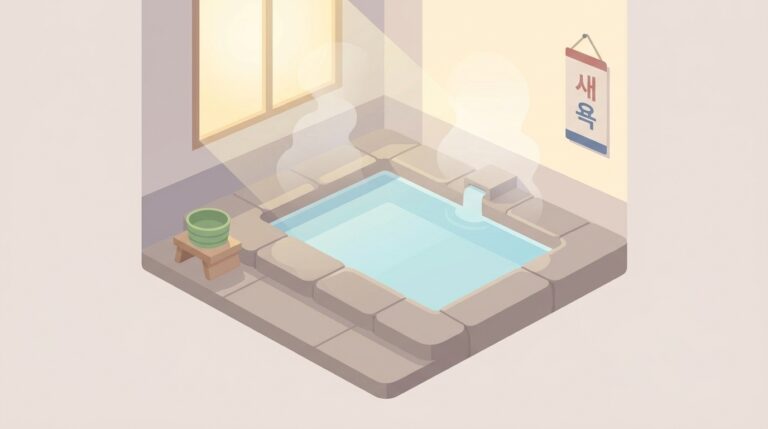
Survived the Hot Tub? Now Braving the Cold Pool (냉탕) Like a True Korean!
Phase 1: Empathy – “Brrr! It’s Cold!” But You Can Do It!
안녕하세요! (An-nyeong-ha-se-yo!) Hello there! I’m your Korean bestie and Daily Hangul’s senior editor.
If you have ever stepped foot inside a Korean Jjimjilbang (찜질방 – Korean sauna) or public bathhouse (Mogyoktang – 목욕탕), you have probably seen a mysterious sight: people peacefully soaking in a steaming hot tub, only to jump directly into an icy-cold pool (냉탕 – Naeng-tang) like it is absolutely nothing!
When I first brought my foreign friends to a bathhouse, they stood near the cold pool, dipped a single toe in, shivered, and ran away. “It’s too cold! How do Koreans look so relaxed in there?” they gasped.
Don’t worry! Today, we are going to learn how to brave the 냉탕 (Naeng-tang) with confidence, using simple, real-life Korean expressions that will make the locals look at you with deep respect. Let’s dive in!
Phase 2: Top 3 Essential Expressions for the Cold Pool
1. 와, 진짜 차갑다! (Wa, jin-jja cha-gap-da!)
- Pronunciation: Wah, jeen-jjah chah-gahp-dah! (Sounds like “Wow!” + “Gin-ja” + “Chah-gahp-dah”)
- Meaning: Wow, it’s really cold!
- K-Culture Moment: You will hear this in almost every Korean reality travel show. Celebrities dip their feet in cold mountain valley water or a bathhouse cold pool and scream this exact phrase.
- Editor’s Insight: 차갑다 (cha-gap-da) is used for objects or liquids you touch (like ice water). Do not confuse it with 춥다 (chup-da), which is only used for weather or feeling cold overall.
- Situation Spectrum: Casual (✅) | Semi-formal (⚠️ – 진짜 차가워요!) | Formal (🚫)
- 🤔 Think About It: In your culture, do people verbalize their physical sensations out loud as much as Koreans do? In Korea, sharing the feeling of “coldness” builds instant camaraderie!
2. 시원하다! (Si-won-ha-da!)
- Pronunciation: Shee-won-hah-dah! (Sounds like “She” + “one” + “hah-dah”)
- Meaning: It’s so refreshing! (Literally: It’s cool/cold)
- K-Culture Moment: An old grandfather enters an incredibly hot tub or a freezing cold pool and sighs, “Ah~ Si-won-ha-da!” leaving young children confused as to why a hot bath is “cool.”
- Editor’s Insight: In Korean culture, 시원하다 doesn’t just mean temperature. It describes a feeling of relief, relaxation, or clearing your congested mind. When you enter the cold pool, saying this makes you sound like a 100% local.
- Situation Spectrum: Casual (✅) | Semi-formal (✅ – 시원해요!) | Formal (🚫)
- 🤔 Think About It: Why do you think Koreans connect “cold” or “hot” physical sensations with emotional “refreshment”?
3. 심장이 떨려요. (Sim-jang-i tteol-ryeo-yo.)
- Pronunciation: Sheem-jahng-ee tteol-ryuh-yo. (Sounds like “Seam” + “jang-ee” + “thul-ryuh-yo”)
- Meaning: My heart is trembling/racing.
- K-Culture Moment: Often used in K-Dramas when someone is about to confess their love, but in a sauna, it is a fun, dramatic way to say the cold water is giving you a huge adrenaline rush!
- Editor’s Insight: Use this with a playful smile before stepping into the cold water to show you are nervous but excited.
- Situation Spectrum: Casual (✅ – 심장 떨려) | Semi-formal (✅) | Formal (⚠️ – 심장이 떨립니다)
- 🤔 Think About It: How does your language express physical excitement or nervousness compared to using the word “heart” (심장)?
Phase 3: Textbook Korean vs. Real-Life Korean
Situation 1: Expressing that the water is freezing
- 📖 Textbook Korean: 수온이 매우 낮습니다. (Su-on-i mae-u nat-seub-ni-da.) = “The water temperature is very low.”
- 🗣️ Real-Life Korean: 물이 완전 얼음장이에요! (Mul-i wan-jeon eo-reum-jang-i-e-yo!) = “The water is literally a sheet of ice!”
- 💡 Why the difference? Textbook Korean is grammatically correct but sounds like a weather report. Real Koreans use vivid metaphors like 얼음장 (eo-reum-jang – ice sheet) to emphasize the cold playfully.
Situation 2: Encouraging your friend to get in
- 📖 Textbook Korean: 안으로 들어오십시오. (An-eu-ro deu-reo-o-sip-si-o.) = “Please enter inside.”
- 🗣️ Real-Life Korean: 에이, 안 추워요. 들어와 봐요! (E-i, an chu-wo-yo. Deu-reo-wa bwa-yo!) = “Oh come on, it’s not cold. Just try coming in!”
- 💡 Why the difference? The real-life version is friendly, inviting, and uses ~봐요 (try doing something) which sounds much more encouraging and natural.
Phase 4: K-Culture Deep Dive & Non-Verbal Manners
4-1. Nunchi (눈치) & Bathhouse Etiquette
Before you even put your toe in the 냉탕 (Naeng-tang), remember these non-verbal rules of Nunchi (tact/social awareness):
1. Shower First: You must wash your body thoroughly before entering any tub or pool.
2. No Splashing: The cold pool is not a swimming pool! Don’t dive, splash, or swim laps unless you are a small child (and even then, parents will scold them).
3. The Slow Dip: Gently splash some cold water on your chest and arms first to prep your heart before submerging. This is a vital safety tip and shows bathhouse respect.
4-2. The “Hot-Cold-Hot” Cycle
Koreans love the On-Naeng-tang (온냉탕) routine—alternating between the hot tub (온탕) and the cold pool (냉탕). It is believed to boost blood circulation, tighten skin, and relieve fatigue. Try it once, and you’ll feel like a brand new person!
Phase 5: Real-Life Roleplay Scenario
Setting: A popular traditional Jjimjilbang in Seoul. You (an enthusiastic learner) are standing at the edge of the cold pool (냉탕). Min-woo (민우), a friendly regular bathhouse-goer, is already floating peacefully in the icy water.
- 민우 (Min-woo): 🎭 (Smiling, splashing water gently)
어서 오세요! 물 진짜 시원해요. 들어와 봐요!
Eo-seo o-se-yo! Mul jin-jja si-won-hae-yo. Deu-reo-wa bwa-yo!
(Welcome! The water is so refreshing. Try coming in!) -
You: 🎭 (Shivering slightly, pointing at the water)
와, 진짜 차가워 보여요! 심장이 너무 떨려요.
Wa, jin-jja cha-ga-wo bo-yeo-yo! Sim-jang-i neo-mu tteol-ryeo-yo.
(Wow, it looks really cold! My heart is racing so much.) -
민우 (Min-woo): 🎭 (Laughs, gesturing to sit on the ledge)
처음에는 그래요. 발부터 조금씩 넣어 보세요.
Cheo-eum-e-neun geu-rae-yo. Bal-bu-teo jo-geum-ssik neo-eo bo-se-yo.
(It is like that at first. Try putting your feet in first, little by little.) -
You: 🎭 (Dipping your feet in)
앗! 차가워! 물이 완전 얼음장이에요!
At! Cha-ga-wo! Mul-i wan-jeon eo-reum-jang-i-e-yo!
(Ah! Cold! The water is literally a sheet of ice!) -
민우 (Min-woo): 🎭 (Nodding encouragingly)
조금만 참으면 괜찮아져요. 셋 하면 들어오세요. 하나, 둘, 셋!
Jo-geum-man cha-meu-myeon gwen-chan-ah-jyeo-yo. Set ha-myeon deu-reo-o-se-yo. Ha-na, dul, set!
(If you endure just a little bit, it gets okay. Come in on three. One, two, three!) -
You: 🎭 (Submerging up to your shoulders, taking a deep breath)
흐읍… 어? 어라…? 진짜 시원하다!
Heu-eup… Eo? Eo-ra…? Jin-jja si-won-ha-da!
(Inhale… Oh? Huh…? It really is refreshing!) -
민우 (Min-woo): 🎭 (Thumbs up, grinning)
거봐요! 이제 한국 사우나 다 배우셨네요. 최고예요!
Geo-bwa-yo! I-je han-guk sa-u-na da bae-u-syeot-nae-yo. Choe-go-yeo-yo!
(See! You’ve learned everything about Korean saunas now. You’re the best!) -
You: 🎭 (Smiling widely, floating)
감사합니다! 온탕이랑 냉탕 왔다 갔다 하니까 진짜 좋아요.
Gam-sa-ham-ni-da! On-tang-i-rang naeng-tang wat-da gat-da ha-ni-ka jin-jja jo-a-yo.
(Thank you! Going back and forth between the hot and cold tub is so great.)
🔀 Interactive Choice Point
What will you say next to Min-woo?
* Option A: “저 먼저 나갈게요. 너무 추워요!” (Jeo meon-jeo na-gal-ge-yo. Neo-mu chu-wo-yo! – I’ll go out first. It’s too cold!)
* Option B: “여기서 수영해도 돼요?” (Yeo-gi-seo su-yeong-hae-do dwae-yo? – Can I swim here?)
* Option C: “식혜 마시러 가요!” (Sik-hye ma-si-reo ga-yo! – Let’s go drink sweet rice punch!)
Feedback:
- Option A (Safe but Quick): Good! It is totally fine to step out when it gets too cold. Just remember to say it politely.
- Option B (BATHHOUSE CRIME!): Oh no! Doing this will get you scolded by the local grandmas (Ajummis). Avoid swimming or splashing!
- Option C (BEST CHOICE!): Perfect! Drinking ice-cold Sweet Rice Punch (Sik-hye) after a bath is the ultimate Jjimjilbang tradition. Min-woo will gladly show you the snack bar!
Phase 6: 10-Second Emotion Shadowing Drill
Practice speaking with real feeling! Pause at the / marks.
- [🥶 Shivering and shocked]
앗! / 진짜 / 차갑다! (At! / Jin-jja / cha-gap-da!) - [😌 Relieved and sighing in relaxation]
아~ / 진짜 / 시원하다! (Ah~ / jin-jja / si-won-ha-da!) - [🤩 Proud and excited]
저 / 냉탕 / 들어갔어요! (Jeo / naeng-tang / deu-reo-gat-seo-yo!)
Phase 7: K-Culture Mini Dictionary
- 냉탕 (Naeng-tang) | Cold pool/cold tub in a Korean bathhouse.
- 온탕 (On-tang) | Hot tub/warm pool.
- 목욕탕 (Mogyoktang) | Traditional public bathhouse where people wash naked.
- 식혜 (Sik-hye) | Sweet, traditional Korean rice beverage served ice cold.
Phase 8: Traveler’s Survival Kit
Survival Phrases TOP 3
- 수건 하나 더 주세요. (Su-geon ha-na deo ju-se-yo.) | Can I have one more towel, please? (Pro Tip: At most bathhouses, women get a limited number of towels while men get unlimited, so you might need this!)
- 뜨거워요! (Tteu-geo-wo-yo!) | It’s hot! (Useful if you accidentally step into the 열탕—the boiling hot tub next to the cold pool).
- 여탕 어디예요? / 남탕 어디예요? (Yeo-tang eo-di-yeo-yo? / Nam-tang eo-di-yeo-yo?) | Where is the women’s section? / Where is the men’s section? (Crucial so you don’t enter the wrong locker room!)
Editor’s Travel Note
Before heading to a famous bathhouse like Aquafield or Cimer, use 네이버 지도 Naver Map App to check their operating hours and reviews. Also, note that most traditional bathhouses only accept credit cards or cash at the front counter, but inside, you will pay for snacks and scrubs by scanning your locker key wristband.
Phase 9: “One Step Deeper” – The Bathhouse Equality
In Korea, going to the bathhouse is a communal bonding experience. When you enter the tubs, there are no expensive clothes, fancy jewelry, or social hierarchies—everyone is completely naked and equal. Entering the 냉탕 together, laughing, and enduring the cold builds a unique sense of closeness.
💬 Your Turn: Would you dare to go completely naked and jump into the cold pool with your Korean friends? Let us know in the comments below!
Phase 10: FAQ & Common Mistakes
Q: Can I wear a swimsuit in the cold pool (냉탕)?
A: Absolutely not! In traditional Korean bathhouses (Mogyoktang), you must be completely naked. Wearing any clothing inside the wet bath area is considered unhygienic and forbidden. (Note: In large unisex Jjimjilbang lounging areas, you wear the provided t-shirt and shorts, but not inside the bathing tubs).
Q: How long should I stay in the cold pool?
A: Usually, 1 to 2 minutes is perfect. Staying in too long might drop your body temperature too much. Listen to your body!
Q: What should I do if my heart feels too tight when entering?
A: Splash water on your chest first and enter slowly. If it feels too shocking, step out immediately.
🚨 Common Mistakes Board
- Mistake 1: Entering the tub without washing your body first. -> Correct Action: Always take a seated shower to scrub yourself clean before stepping into any water.
- Mistake 2: Running around the wet floors. -> Correct Action: Bathhouse floors are extremely slippery. Walk slowly to avoid accidents!
- Mistake 3: Dipping your long hair into the water. -> Correct Action: Tie your hair up in a bun or wear a shower cap so your hair doesn’t touch the communal tub water.
Phase 11: Action Mission
- Bronze Medal: Say “시원하다!” out loud when you wash your hands or face with cold water at home.
- Silver Medal: Share this post on your Instagram and tag a friend you want to brave the Korean Jjimjilbang with!
- Gold Medal: Visit a Korean bathhouse, step into the cold pool up to your neck, and say “와, 진짜 시원해요!” to a local regular!
Phase 12: Interactive Quiz Challenge
1. What does “시원하다” mean in a bathhouse context?
- A) The water is dirty
- B) It is refreshing and relaxing (even if the water is hot/cold)
- C) It is dangerous
2. Fill in the blank: “This cold water is literally a sheet of ice!” = “물이 완전 _______이에요!”
- A) 얼음장 (eo-reum-jang)
- B) 아이스크림 (a-i-seu-keu-rim)
- C) 따뜻한 (tta-tteut-han)
3. True or False: It is completely okay to swim and splash in the 냉탕.
- A) True
- B) False
Click here to reveal the Answers & Explanations!
- Answer: B. “시원하다” is the magic word for relaxation and physical relief in Korea!
- Answer: A. “얼음장” (eo-reum-jang) means a thin layer of ice. Perfect for emphasizing freezing cold water.
- Answer: B (False). Splashing or swimming is rude and will get you scolded. Keep it peaceful!






