

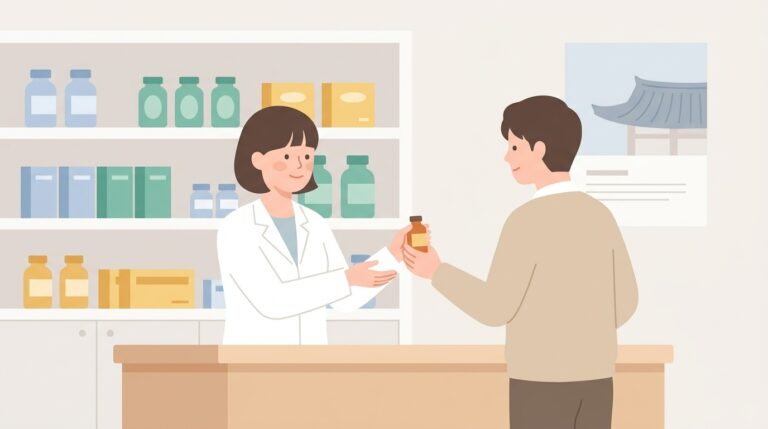
Navigating Korean Pharmacies: How to Get the Right Medicine Without a Prescription
안녕하세요! Welcome back to Daily Hangul, your trusted cultural navigator and Korean bestie. I’m your Senior Editor, and today we are going to tackle a situation that can feel incredibly daunting when you’re living in or visiting Korea: getting sick and navigating the pharmacy (약국 – yakguk).
Imagine this: You wake up in your cozy Seoul Airbnb with a splitting headache and a scratchy throat. You walk into a brightly lit pharmacy, but as you look at the shelves, everything is in Hangul. The pharmacist looks at you, and suddenly all your Korean vocabulary vanishes. Do you need to see a doctor first? Can you just buy pain relievers over the counter?
In Korea, the division between Over-the-Counter (OTC) drugs (일반 의약품 – ilban uiyakpum) and Prescription drugs (전문 의약품 – jeonmun uiyakpum) is very strict. Today, we’ll make sure you know exactly how to ask for what you need, understand the pharmacist’s instructions, and confidently get back on your feet! Let’s dive in.
Phase 2: Key Expressions Deep Dive
1. 처방전 없이 살 수 있는 약이 있어요? (Is there medicine I can buy without a prescription?)
- Pronunciation: Cheobangjeon eopsi sal su inneun yagi issoyo? (Sounds like: chuh-bang-jun up-shee sal soo een-noon yak-ee eet-suh-yo?)
- Meaning: “Do you have medicine I can buy without a prescription?”
- K-Culture Moment: In K-Dramas, you often see characters running to a 24-hour convenience store (pyeon-ui-jeom) or a pharmacy late at night to buy basic cold medicine or digestive pills for a friend. This line is your golden ticket to finding OTC drugs directly.
- Editor’s Insight: Cheobangjeon (처방전) means prescription. Adding eopsi (없이) means “without”. If you are looking for simple painkillers, cold medicine, or digestive aids, this is the perfect, polite phrase to use.
- Situation Spectrum: Casual (⚠️ 처방전 없이 살 수 있는 약 있어?) | Semi-formal (✅ 처방전 없이 살 수 있는 약 있어요?) | Formal (✅ 처방전 없이 구입 가능한 의약품이 있습니까?)
- 🤔 Think About It: In your home country, can you buy stronger painkillers or allergy meds right off the shelf, or do you always need to talk to a pharmacist first? Korea’s separation of prescribing and dispensing is highly regulated!
2. 처방전 있어야 돼요? (Do I need a prescription?)
- Pronunciation: Cheobangjeon isseoya doeyo? (Sounds like: chuh-bang-jun eet-suh-ya dweh-yo?)
- Meaning: “Do I need to have a prescription for this?”
- K-Culture Moment: You might find a specific skin ointment or a stronger anti-inflammatory drug online, but when you show the photo to the pharmacist, they might shake their head and ask for a document.
- Editor’s Insight: If you ask for a specific medication (like high-dose migraine relief or certain antibiotics) and the pharmacist says “안 돼요” (an doeyo – cannot), use this phrase to clarify if you must visit a clinic (uiwon/byeongwon) first.
- Situation Spectrum: Casual (⚠️ 처방전 있어야 돼?) | Semi-formal (✅ 처방전 있어야 돼요?) | Formal (✅ 처방전을 제출해야 합니까?)
- 🤔 Think About It: Koreans tend to visit local clinics very frequently because medical consultation fees are relatively affordable compared to many Western countries.
3. 증상이 어떠세요? / 몸이 어떻게 안 좋으세요? (What are your symptoms? / Where does it feel bad?)
- Pronunciation: Jeungsangi eotteoseyo? / Momi eotteoke an joeuseyo? (Sounds like: joong-sang-ee uh-ttuh-seh-yo? / mohm-ee uh-ttuh-keh an jo-oo-seh-yo?)
- Meaning: “What are your symptoms?” / “How are you feeling unwell?”
- K-Culture Moment: The moment you walk up to the pharmacy counter, the warm, maternal/paternal pharmacist (약사님 – yaksanit) will lean forward and ask you this with a caring look.
- Editor’s Insight: This is what you will hear. Instead of trying to translate complex medical terms, you can respond with simple symptoms like “머리가 아파요” (meoriga apayo – my head hurts) or “감기약 주세요” (gamgiyak juseyo – please give me cold medicine).
- Situation Spectrum: Casual (🚫 – used by pharmacists to customers) | Semi-formal (✅ 증상이 어떠세요?) | Formal (✅ 어디가 불편하십니까?)
- 🤔 Think About It: Korean pharmacists often recommend a combination of herbal drinkable ampoules and pills for a faster recovery. Be ready for a multi-step routine!
Phase 3: Textbook Korean vs. Real-Life Korean
Let’s compare the rigid sentences from classroom books with how Koreans actually speak at the pharmacy counter.
Scenario 1: Requesting a painkiller
- 📖 Textbook: “진통제를 판매하십니까?” (Jintongjereul panmaehasimnikka? – Do you sell analgesics?)
- 🗣️ Real-Life: “타이레놀 하나 주세요.” (Tairenol hana juseyo. – One Tylenol, please.) or “진통제 하나 주세요.” (Jintongje hana juseyo. – One painkiller, please.)
- 💡 Why the difference? Brand names like Tylenol (타이레놀) or Advil (애드빌) are universally understood in Korean pharmacies. Using the active ingredient name or the brand name is much faster and more natural than formal vocabulary.
Scenario 2: Asking if you can buy it immediately
- 📖 Textbook: “이 약은 의사의 처방전 없이 구매가 가능합니까?” (I yageun uisaui cheobangjeon eopsi gumaga ganeunghamnikka? – Is this medicine purchasable without a doctor’s prescription?)
- 🗣️ Real-Life: “이거 그냥 살 수 있어요?” (Igeo geunyang sal su issoyo? – Can I just buy this?)
- 💡 Why the difference? “그냥” (geunyang) literally means “just” or “as is.” In a pharmacy context, it naturally implies “directly over-the-counter without any extra paperwork or prescription.”
Phase 4: K-Culture Deep Dive & Non-Verbal Manners
4-1. Nunchi & Gestures at the Pharmacy
When entering a Korean pharmacy, you don’t typically browse shelves for pills yourself. Most medications, even OTC ones, are kept behind the counter.
* The Gesture: Point to where it hurts (your head, your stomach, your throat) while explaining your symptoms. This universal body language is highly appreciated and helps the pharmacist select the exact targeted medicine.
* The Bow: When receiving your medicine, accept it with both hands as a sign of respect, and give a polite nod while saying “감사합니다” (gamsahamnida).
4-2. The “S쌍화탕” (Ssanghwa-tang) Phenomenon
If you go to a pharmacy complaining of a cold, the pharmacist will likely hand you a small, warm glass bottle of traditional herbal medicine alongside your blister pack of cold pills. This is Ssanghwa-tang (쌍화탕).
* How to take it: You are supposed to drink the warm liquid first, and then swallow the pills with water. This herbal remedy boosts your body heat and immunity, and is a staple of Korean recovery culture!
Phase 5: Real-Life Roleplay Scenario
Setting: A local neighborhood pharmacy (Suri Pharmacy) in Mapo, Seoul.
Characters:
* 유진 (Yujin): An exchange student with a severe sore throat and headache.
* 약사님 (Pharmacist): A kind middle-aged pharmacist wearing a white coat.
약사님: 어서 오세요. 어디가 불편하세요?
        (Eoseo oseyo. Eodiga bulpyeonhaseyo?)
        [🎭 Welcomes you warmly, leaning over the counter]
        "Welcome. Where does it feel uncomfortable?"

유진: 목이 너무 아프고 열이 나는 것 같아요.
      (Mogi neomu apeugo yeori naneun geot gatayo.)
      [🎭 Touches throat with a grimace]
      "My throat hurts so much, and I think I have a fever."

약사님: 아, 목감기 증상이 있으시네요. 혹시 기침도 많이 하세요?
        (A, mokgamgi jeungsangi isseusineyo. Hoksi gichimdo mani haseyo?)
        [🎭 Nods sympathetically and retrieves two boxes of medicine]
        "Ah, you have sore throat cold symptoms. By any chance, do you cough a lot too?"

유진: 기침은 별로 안 하는데, 머리가 좀 아파요. 처방전 없이 살 수 있는 약 있어요?
      (Gichimeun byeollo an haneunde, meoriga jom apayo. Cheobangjeon eopsi sal su inneun yagi issoyo?)
      [🎭 Rubs temples gently]
      "I don't cough much, but my head hurts a bit. Do you have medicine I can buy without a prescription?"

약사님: 네, 이거 처방전 없이 바로 드실 수 있는 종합감기약하고 해열진통제예요.
        (Ne, igeo cheobangjeon eopsi baro deosil su inneun jonghapgamgiyakhago haeyeoljintongjeyeyo.)
        [🎭 Places a box of pills and a warm bottle of Ssanghwa-tang on the counter]
        "Yes, these are general cold medicine and fever reducers you can take right away without a prescription."

유진: 어떻게 먹어야 돼요?
      (Eotteoke meogeoya doeyo?)
      [🎭 Looks closely at the boxes]
      "How should I take them?"

약사님: 하루에 세 번, 식사하고 30분 뒤에 드세요. 이 따뜻한 쌍화탕이랑 같이 드시면 더 좋아요.
        (Harue se beon, siksarago samsipbun dwie deuseyo. I ttatteutan ssanghwatang-irang gachi deusmyeon deo joayo.)
        [🎭 Points to the warm bottle and gestures drinking]
        "Take them three times a day, 30 minutes after meals. It's even better if you take them with this warm Ssanghwa-tang."

유진: 아, 네! 감사합니다. 얼마예요?
      (A, ne! Gamsahamnida. Olmayeyo?)
      [🎭 Takes out a bank card with both hands]
      "Ah, yes! Thank you. How much is it?"
🔀 Interactive Choice Points
Now it’s your turn! The pharmacist asks: “혹시 알레르기나 다른 약 드시는 거 있으세요?” (Do you have any allergies or other medications you are taking?)
- Choice A: “아니요, 없어요. 그냥 주세요.” (Aniyo, eopseyo. Geunyang juseyo. – No, I don’t. Just give it to me.)
- Feedback: Best! Clear, direct, and lets the pharmacist know you are safe to take standard medication.
- Choice B: “몰라요. 그냥 아무거나 주세요.” (Mollayo. Geunyang amugeona juseyo. – I don’t know. Just give me anything.)
- Feedback: Risk! Saying “just give me anything” can make the pharmacist nervous about drug interactions or allergies. Try to use “없어요” (eopseyo) if you have no allergies.
- Choice C: “약 안 먹을래요.” (Yak an meogeullaeyo. – I won’t take the medicine.)
- Feedback: Bad. If you walked all the way to the pharmacy to get medicine, refusing it right at the end defeats the purpose!
Phase 6: 10-Second Emotion Shadowing Drill
Practice speaking like a native by mimicking these breath and emotional cues! / represents a short pause.
- [🥺 Painfully and tiredly]
- “목이 / 너무 아파서 / 잠을 못 잤어요.”
- Mogi / neomu apaseo / jameul mot jasseoyo.
- (My throat / hurt so much / I couldn’t sleep.)
- [😊 Politely and hopefully]
- “처방전 없이 / 바로 살 수 있는 / 약이 있을까요?”
- Cheobangjeon eopsi / baro sal su inneun / yagi isseulkkayo?
- (Without a prescription / that I can buy immediately / would there be any medicine?)
Phase 7: K-Culture Mini Dictionary
- 처방전 (Cheobangjeon) | Prescription
- The official slip of paper given by a doctor at a clinic that you must present to the pharmacist to get prescription-grade drugs.
- 일반 의약품 (Ilban Uiyakpum) | Over-the-Counter (OTC) Drug
- Standard medicines like mild painkillers, digestive tablets, and band-aids that you can purchase directly at the pharmacy counter.
- 전문 의약품 (Jeonmun Uiyakpum) | Prescription-Only Drug
- Stronger medications, including antibiotics and specific hormonal treatments, which legally require a doctor’s diagnosis and prescription.
- 식후 30분 (Sik-hu Samsip-bun) | 30 Minutes After a Meal
- The golden rule of Korean medication schedules. Pharmacists almost always write this on your bag to protect your stomach lining.
Phase 8: Survivor Kit for Travelers
Survival Phrases TOP 3
- 머리 아플 때 먹는 약 주세요. (Meori apeul ttae meongneun yak juseyo.)
- Pro Tip: “Please give me medicine for when my head hurts.” Perfect for securing quick headache relief!
- 소화제 있어요? (Sohwaje issoyo?)
- Pro Tip: “Do you have digestive medicine?” Crucial after eating too much delicious, spicy Korean BBQ!
- 이거 약국에서만 팔아요? (Igeo yakgugeseoman parayo?)
- Pro Tip: “Is this only sold in pharmacies?” Some basic items like Tylenol and gas relief liquid can be bought at 24-hour convenience stores, but others require a pharmacy.
Editor’s Travel Note 🗺️
If you need emergency OTC medications late at night when pharmacies are closed, head to the nearest convenience store (CU, GS25, or Seven-Eleven). They carry a small section of “Safe OTC Medicines” (안전상비의약품) like basic Tylenol, pediatric cold medicines, and digestive aids. To find the nearest open pharmacy, you can check the Kakao Map App and search for “연중무휴 약국” (365-day open pharmacy).
Phase 9:
Frequently Asked Questions (FAQ)
Q: What does "처방전 없이 살 수 있는 약이 있어요? (Is there medicine I can buy without a prescription?)" mean in Korean and how do you pronounce it?
A: In Korean, "처방전 없이 살 수 있는 약이 있어요? (Is there medicine I can buy without a prescription?)" is pronounced [Cheobangjeon eopsi sal su inneun yagi issoyo? (Sounds like: chuh-bang-jun up-shee sal soo een-noon yak-ee eet-suh-yo?] and means: "Do you have medicine I can buy without a prescription?"
Q: What does "처방전 있어야 돼요? (Do I need a prescription?)" mean in Korean and how do you pronounce it?
A: In Korean, "처방전 있어야 돼요? (Do I need a prescription?)" is pronounced [Cheobangjeon isseoya doeyo? (Sounds like: chuh-bang-jun eet-suh-ya dweh-yo?] and means: "Do I need to have a prescription for this?"
Q: What does "증상이 어떠세요? / 몸이 어떻게 안 좋으세요? (What are your symptoms? / Where does it feel bad?)" mean in Korean and how do you pronounce it?
A: In Korean, "증상이 어떠세요? / 몸이 어떻게 안 좋으세요? (What are your symptoms? / Where does it feel bad?)" is pronounced [Jeungsangi eotteoseyo? / Momi eotteoke an joeuseyo? (Sounds like: joong-sang-ee uh-ttuh-seh-yo? / mohm-ee uh-ttuh-keh an jo-oo-seh-yo?] and means: "What are your symptoms?" / "How are you feeling unwell?"







