

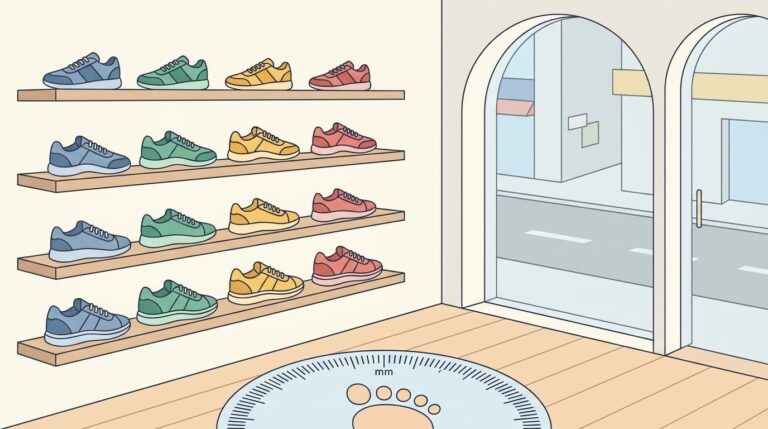
Finding Your Perfect Fit: The Ultimate Guide to Korean Shoe Sizes (mm)
안녕하세요! Welcome back to Daily Hangul! It’s your favorite Korean culture navigator and editor.
Have you ever walked into a trendy shoe store in Hongdae or Seongsu-dong, spotted the most gorgeous pair of sneakers, and suddenly froze when the friendly staff asked, “몇 신으세요?” (What size do you wear?)? You try to convert your US size 7 or UK 5 in your head, but all you see are three-digit numbers like 240 or 270.
In Korea, shoe sizes are measured in millimeters (mm). Today, we’ll not only master how to convert your shoe size effortlessly but also learn the exact phrases to sound like a local shopper. Let’s dive in!
Phase 2: Core Expressions for Shoe Shopping
1. 몇 신으세요? (myeot sin-eu-se-yo?)
- Pronunciation: Myut shin-eu-se-yo? (Sounds like “Mute” + “she” + “new” + “say” + “yo”)
- Meaning: What size do you wear? (Directly: “How much do you wear [on your feet]?”)
- K-Culture Moment: You will hear this the second you lay your eyes on a pair of shoes in department stores in Myeongdong or cozy boutiques in Hannam-dong.
- Editor’s Insight: The verb 신다 (sin-da) is exclusively used for wearing things on your feet (shoes, socks, stockings). Asking “몇 신으세요?” is the most polite, standard way retail staff address customers.
- Situation Spectrum: Casual ⚠️ | Semi-formal ✅ | Formal ✅
- 🤔 Think About It: In English, we ask “What size are you?”, focusing on the noun. Why do you think Korean focuses on the action verb of “wearing” (신다)?
2. 사이즈가 크게 나왔어요 / 작게 나왔어요 (sa-i-jeu-ga keu-ge na-wat-eo-yo / jak-ge na-wat-eo-yo)
- Pronunciation: Sigh-jee-ga keu-ge nah-wat-uh-yo / jahk-ge nah-wat-uh-yo
- Meaning: These run big / These run small.
- K-Culture Moment: Friendly staff in K-beauty and fashion districts will whisper this to you as a secret tip so you don’t buy the wrong fit.
- Editor’s Insight: 나오다 means “to come out” or “to be released.” When a shoe “came out big” (크게 나왔다), it means the actual fit is slightly larger than the official millimeter tag.
- Situation Spectrum: Casual ✅ | Semi-formal ✅ | Formal 🚫
3. 발볼이 넓은 편이에요 (bal-bol-i neol-beun pyeon-i-e-yo)
- Pronunciation: Bal-bol-ee nuhl-beun pyun-ee-eh-yo
- Meaning: I have somewhat wide feet (Directly: “My foot-width is on the wide side”).
- K-Culture Moment: Essential when trying on sleek Korean loafers or boots which tend to be designed narrower than Western brands.
- Editor’s Insight: 발볼 (bal-bol) refers to the width of your foot. Adding ~ㄴ/은 편이다 (on the side of / relatively) softens your statement, making it sound natural and polite.
- Situation Spectrum: Casual ✅ | Semi-formal ✅ | Formal ✅
Phase 3: Textbook Korean vs. Real-Life Korean
Situation 1: Asking to try on a different size
- 📖 Textbook Korean: “다른 치수로 보여주세요.” (da-reun chi-su-ro bo-yeo-ju-se-yo – Please show me another measurement.)
- 🗣️ Real-Life Korean: “이거 240(이백사십)으로 신어볼 수 있을까요?” (i-geo i-baek-sa-sip-eu-ro sin-eo-bol su is-seul-kka-yo? – Can I try this on in a 240?)
- 💡 Why the difference? Koreans rarely use the word “치수” (dimension/measurement) in casual retail. Instead, they state the exact millimeter number using Sino-Korean numbers and ask to try it on (신어보다).
Situation 2: Expressing that the shoe is tight
- 📖 Textbook Korean: “이 구두는 저에게 너무 작습니다.” (i gu-du-neun jeo-e-ge neo-mu jak-seup-ni-da – These dress shoes are too small for me.)
- 🗣️ Real-Life Korean: “발이 좀 끼는데, 한 사이즈 큰 거 있어요?” (bal-i jom kkin-eun-de, han sa-i-jeu keun geo is-seo-yo? – It pinches/squeezes my feet a bit, do you have one size larger?)
- 💡 Why the difference? 끼다 (kki-da) vividly describes the sensation of your feet being tightly squeezed inside a shoe. “한 사이즈 큰 거” (one size bigger) is much more natural than requesting a specific numeric dimension.
Phase 4: K-Culture Deep Dive & Non-Verbal Manners
4-1. The “Shoe Shoe” Etiquette (눈치 & Gestures)
- The Finger Space Test: When checking if a shoe fits, Koreans often slide their index finger behind their heel and look at the salesperson. If you look up and say “손가락 하나 들어가요” (One finger fits in), the clerk will immediately know it’s a perfect fit!
- Do Not Step on the Backs: When trying on sneakers, never step on the heel counter (꺾어 신다). It’s considered bad manners to damage shoes before purchasing.
4-2. Quick Millimeter Conversion Secrets
Korean sizes are simple once you know the formula!
* Women: US 5 = 220mm, US 6 = 230mm, US 7 = 240mm, US 8 = 250mm (Add a zero to the centimeter length of your foot!)
* Men: US 7 = 250mm, US 8 = 260mm, US 9 = 270mm, US 10 = 280mm
Phase 5: Live Roleplay Scenario
Setting: A trendy multi-brand shoe shop in Hongdae. You are talking to Min-su, a passionate 20-something store clerk wearing stylish oversized clothes.
- 민수: 어서 오세요! 마음에 드시는 신발 있으시면 말씀해 주세요.
(Welcome! If there are any shoes you like, please let me know.) - Customer (You): 저기, 이 운동화 너무 예쁜데… 몇 신어야 될지 모르겠어요.
(Excuse me, these sneakers are so pretty… but I don’t know what size I should wear.) - 민수: 아, 보통 몇 사이즈 신으세요? 미국 사이즈나 유럽 사이즈로 말씀해 주셔도 돼요!
(Ah, what size do you usually wear? You can tell me your US or European size!) - Customer (You): 미국 사이즈로 7(일곱) 신어요. 한국 사이즈로는 몇이에요?
(I wear a US size 7. What is that in Korean size?) - 민수: US 7이시면 보통 240(이백사십) 신으시면 딱 맞아요. 한번 신어보실래요?
(If you are a US 7, wearing 240 usually fits perfectly. Would you like to try them on?) - Customer (You): 🎭 (Slipping the shoe on) 음… 발볼이 조금 끼는 것 같아요.
(Hmm… the foot-width feels a bit tight.) - 민수: 이 모델이 발볼이 조금 작게 나왔거든요. 245(이백사십오)로 가져다 드릴까요?
(This model runs a bit narrow. Shall I bring you a 245?) - Customer (You): 네, 한 사이즈 큰 걸로 신어볼게요!
(Yes, I’ll try them on in one size larger!) - 민수: 잠시만 기다려 주세요! 바로 새 상품으로 가져오겠습니다.
(Please wait a moment! I’ll bring a brand new pair right away.)
🔀 Interactive Choice:
- A. “그냥 이걸로 살게요.” (I’ll just buy this one.)
- B. “혹시 245 신어보고 안 맞으면 다시 240으로 바꿀 수 있죠?” (If I try 245 and it doesn’t fit, I can switch back to 240, right?)
- C. “네, 부탁드립니다! 혹시 다른 색상도 있나요?” (Yes, please! By the way, are there other colors too?)
Feedback:
- Choice A (Bad): Buying tight shoes will give you blisters on your Seoul trip! Always try the recommended size up.
- Choice B (Risk): Perfectly logical, but phrasing it this way before trying might sound a bit too anxious to the clerk.
- Choice C (Best): Friendly, natural, and keeps the conversation flowing while exploring your fashion options!
Phase 6: 10-Second Emotion Shadowing Drill
Practice these with the designated emotional cues to sound incredibly natural!
[😊 Excited & Hopeful]
이거 / 240(이백사십)으로 / 신어볼 수 있을까요?
(i-geo / i-baek-sa-sip-eu-ro / sin-eo-bol su is-seul-kka-yo?)[🥺 Slightly Disappointed & Worried]
예쁜데 / 발볼이 / 조금 껴요.
(ye-ppeun-de / bal-bol-i / jo-geum kkeo-yo.)[😎 Confident & Satisfied]
이걸로 / 할게요! 감사합니다!
(i-geol-ro / hal-ge-yo! gam-sa-hap-ni-da!)
Phase 7: K-Culture Mini-Dictionary
- 칼발 (Kal-bal) | Razor Feet
- Refers to narrow, slender feet with no prominent bones. If you have kal-bal, you can wear pointed Korean boots easily.
- 정사이즈 (Jeong-sa-i-jeu) | True to Size
- “이 신발 정사이즈예요” means the shoe fits exactly as measured. No need to size up or down.
- 깔창 (Kkal-chang) | Shoe Insole (often height-increasing)
- A famous culture in Korea where people put thick insoles inside high-tops to look taller.
- 착화감 (Chak-hwa-gam) | How the shoe feels when worn
- Combines “wear shoe” (착화) and “feeling” (감). You’ll see K-fashion bloggers talk extensively about chak-hwa-gam.
Phase 8: Survival Kit for Travelers
Survival Phrases TOP 3
- 이거 새 상품 있어요? (i-geo sae sang-pum is-seo-yo?)
- Pro Tip: Use this to ask for a fresh, unopened box instead of the display shoe.
- 더 큰 사이즈 있어요? (deo keun sa-i-jeu is-seo-yo?)
- Pro Tip: Perfect when you need to go up a size quickly.
- 텍스 프리 되나요? (teks-peu-ri doe-na-yo?)
- Pro Tip: Essential in tourist hotspots like Myeongdong to get your tax refund slip.
Editor’s Travel Note
Before heading out to shop, make sure to download the Naver Map App to find hidden local shoe designers in Seongsu-dong. Note: Store operating hours and tax-refund thresholds may change, so always verify at the cash counter.
Phase 9:
Frequently Asked Questions (FAQ)
Q: What does "몇 신으세요? (myeot sin-eu-se-yo?)" mean in Korean and how do you pronounce it?
A: In Korean, "몇 신으세요? (myeot sin-eu-se-yo?)" is pronounced [Myut shin-eu-se-yo? (Sounds like "Mute" + "she" + "new" + "say" + "yo"] and means: What size do you wear? (Directly: "How much do you wear [on your feet]?")
Q: What does "사이즈가 크게 나왔어요 / 작게 나왔어요 (sa-i-jeu-ga keu-ge na-wat-eo-yo / jak-ge na-wat-eo-yo)" mean in Korean and how do you pronounce it?
A: In Korean, "사이즈가 크게 나왔어요 / 작게 나왔어요 (sa-i-jeu-ga keu-ge na-wat-eo-yo / jak-ge na-wat-eo-yo)" is pronounced [Sigh-jee-ga keu-ge nah-wat-uh-yo / jahk-ge nah-wat-uh-yo] and means: These run big / These run small.
Q: What does "발볼이 넓은 편이에요 (bal-bol-i neol-beun pyeon-i-e-yo)" mean in Korean and how do you pronounce it?
A: In Korean, "발볼이 넓은 편이에요 (bal-bol-i neol-beun pyeon-i-e-yo)" is pronounced [Bal-bol-ee nuhl-beun pyun-ee-eh-yo] and means: I have somewhat wide feet (Directly: "My foot-width is on the wide side").







