

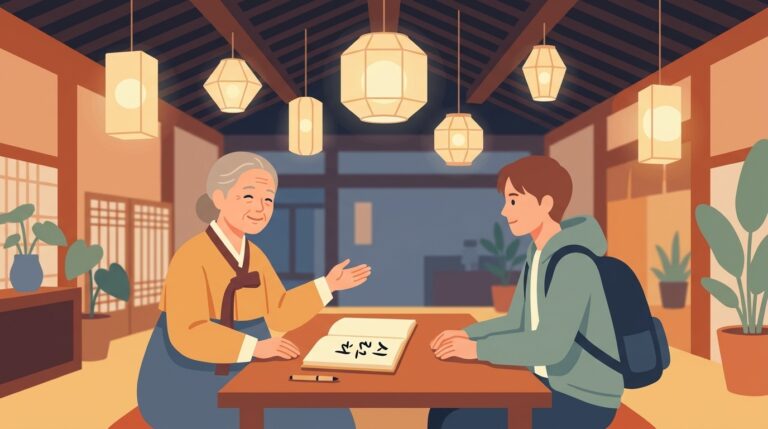
Unlocking Your Destiny: The Ultimate Guide to Experiencing Korean Saju (사주)
Phase 1: Empathy (스토리 몰입형 오프닝)
안녕하세요! (An-nyeong-ha-se-yo!) Your trusty Korean culture navigator and Daily Hangul editor is back!
Have you ever been watching a K-Drama and noticed the characters suddenly heading to a dim, mysterious tent or a cozy, modern cafe to meet with a fortune teller? They hand over four distinct pieces of information—their birth year, month, day, and exact birth hour—and suddenly, the reader starts nodding and saying, “Ah, you have too much ‘Fire’ in your energy, that’s why you are so impatient!”
Welcome to the fascinating world of Saju-palja (사주팔자), or simply Saju (사주)!
For many Koreans, Saju isn’t necessarily a strict religious belief. Instead, it is a deeply rooted cultural tradition, a form of spiritual counseling, and a fun way to navigate life’s big decisions—like finding a job, dating, or getting married.
If you have ever wanted to visit a Saju cafe in Hongdae or Gangnam but felt too intimidated by the complex vocabulary, you are not alone! Many of our intermediate learners have shared their anxiety: “What if I don’t understand my fortune? How do I ask about my future career? What if I accidentally say something rude?”
Don’t worry! Today, we are going to master the exact phrases, cultural nuances, and etiquette you need to confidently step into a Saju tent and unlock the secrets of your destiny. Let’s dive in!
Phase 2: Core Expressions Deep Dive (핵심 표현 3선 심층 분석)
To have a meaningful Saju experience, you need to know how to ask the right questions. Here are three essential expressions that will make you sound like a local!
1. 사주 좀 보고 싶어서 왔어요. (사주 좀 보고 싶어서 왔어요.)
- Pronunciation: Saju jom bogo sipeoseo wasseoyo. (Sounds like: sah-joo johm boh-go sheep-uh-suh wah-ssuh-yo)
- Meaning: I came here because I wanted to get my Saju (fortune) read.
- K-Culture Moment: This is the universal “opening line” when you enter a Saju cafe or tent. It immediately tells the master (Yeokhakga or Saju Master) why you are there.
- Editor’s Insight: The word 좀 (jom) literally means “a little,” but here, it softens the sentence, making your request sound polite, natural, and less demanding.
- Situation Spectrum:
- Casual: 사주 좀 보러 왔어. (⚠️ Only to friends/very young readers)
- Semi-formal: 사주 좀 보고 싶어서 왔어요. (✅ Perfect for standard visits)
- Formal: 사주를 보러 왔습니다. (🚫 Too stiff and clinical for a cozy Saju cafe)
- 🤔 Think About It: In your home country, how do people usually introduce their desire to get their fortune or tarot read? Is there a polite way to ease into it like using “좀” in Korean?
2. 제 사주에 어떤 기운이 많나요? (제 사주에 어떤 기운이 많나요?)
- Pronunciation: Je saju-e eotteon giun-i mannayo? (Sounds like: jeh sah-joo-eh uh-tteon ghee-oon-ee mahn-nah-yo?)
- Meaning: Which elemental energy is dominant in my Saju?
- K-Culture Moment: Saju is based on the five elemental energies (Ohaeng): Wood (목), Fire (화), Earth (토), Metal (금), and Water (수). A reader might tell you, “You have a lot of Water energy, which makes you creative but easily adaptable.”
- Editor’s Insight: 기운 (giun) refers to energy, vibe, or force. Understanding your dominant energy helps you understand the “why” behind the Saju master’s lifestyle or career recommendations.
- Situation Spectrum:
- Casual: 내 사주에 무슨 기운이 많아? (⚠️)
- Semi-formal: 제 사주에 어떤 기운이 많나요? / 많아요? (✅ Highly recommended)
- Formal: 본인의 사주에 어떤 기운이 강합니까? (🚫 Used by the master to you, not vice versa)
- 🤔 Think About It: Western astrology focuses on star signs (sun, moon, rising). How does the Korean concept of “five elements” (Water, Fire, etc.) change the way you view your personality?
3. 연애운이랑 직업운이 궁금해요. (연애운이랑 직업운이 궁금해요.)
- Pronunciation: Yeonae-un-ilang jigeob-un-i gunggeumhaeyo. (Sounds like: yuhn-ae-oon-ee-lahng jee-guhb-oon-ee goong-geum-hae-yo)
- Meaning: I’m curious about my love luck and career luck.
- K-Culture Moment: In Korean Saju, different aspects of life are categorized into various types of 운 (un – luck/fortune). The most popular are Yeonae-un (love luck) and Jigeob-un (career/job luck).
- Editor’s Insight: Instead of asking a vague “How is my future?”, specifying which un (운) you want to focus on helps the reader give you incredibly detailed and targeted advice.
- Situation Spectrum:
- Casual: 연애운이랑 직업운 궁금해. (⚠️)
- Semi-formal: 연애운이랑 직업운이 궁금해요. (✅ Perfect)
- Formal: 연애운과 직업운에 대해 알고 싶습니다. (🚫 A bit too formal, like an interview)
Phase 3: Textbook Korean vs. Real-Life Korean (교과서 한국어 vs 진짜 한국어)
Let’s compare what traditional textbooks teach with how real Koreans actually talk when visiting a Saju cafe.
Situation 1: Asking about your overall future
- 📖 Textbook Style: 저의 미래는 어떻습니까? (Jeo-ui mirae-neun eotteoseumnikka? – “How is my future?”)
- Why it’s unnatural: It sounds like a character in a historical drama or someone talking to a robot. It’s too grand and stiff.
- 🗣️ Real Korean: 올해 제 총운이 어떻게 돼요? (Olhae je chong-un-i eotteoke dwaeyo? – “How is my overall luck for this year?”)
- 💡 Why it’s better: Koreans prefer to ask about 총운 (chong-un – overall luck) and usually focus on a specific timeframe, like 올해 (olhae – this year) or 내년 (naenyeon – next year).
Situation 2: Asking if you will find a partner
- 📖 Textbook Style: 저는 언제 배우자를 만날 것입니까? (Jeoneun eonje baeuja-reul mannal geosimnikka? – “When will I meet my spouse?”)
- Why it’s unnatural: Unless you are strictly looking to get married in the next few months, using “배우자” (spouse/marriage partner) sounds incredibly heavy and formal.
- 🗣️ Real Korean: 저 언제쯤 남친/여친 생겨요? (Jeo eonje-jjeum namchin/yeochin saeng-gyeoyo? – “Around when will I get a boyfriend/girlfriend?”)
- 💡 Why it’s better: It uses the friendly contractions 남친 (namchin) and 여친 (yeochin), which keeps the mood light, fun, and conversational.
Phase 4: K-Culture Deep Dive & Non-Verbal Etiquette (비언어적 매너)
4-1. Saju Etiquette & Gestures
- Respecting the Notepad: When you sit down, the Saju master will pull out a notebook or an iPad and write down complex Chinese characters (Hanja). Avoid leaning over aggressively to look at it. Instead, sit back politely, clasp your hands together on your lap, and show that you are waiting expectantly.
- Nodding & “Aha” Responses: Saju is highly conversational. When the master makes a point, it’s polite to react with a warm “아~ 진짜요?” (Ah~ jin-jja-yo? – Oh, really?) or by nodding. It builds a good rapport and encourages the reader to share more insights.
4-2. The Cultural Meaning of Saju in Modern Korea
Saju isn’t seen as “black magic” or a taboo religious practice. In fact, during Seollal (Lunar New Year) or when starting a new venture, millions of young Koreans visit Saju cafes or download specialized Saju apps. It serves as a psychological buffer—if the reading is good, it boosts confidence; if it’s bad, it warns them to be careful and mindful. It is a form of collective therapy!
Phase 5: Interactive Roleplay Scenario (실전 롤플레이 시나리오)
Imagine you are visiting a cozy, atmospheric Saju cafe in Hongdae on a rainy afternoon. The master, a kind-looking elder with warm eyes named Mr. Kim, invites you to sit.
Characters:
- Mr. Kim (Saju Master): Intuitive, speaks with a gentle but authoritative tone.
- You (The Learner): Curious, polite, and eager to know about your future in Korea.
Dialogue:
- Mr. Kim: 어서 오세요. 편하게 앉으세요. 사주 보러 오셨나요?
(Eoseo oseyo. Pyeonhage anjeuseyo. Saju boreo osyeonnayo?)
[Translation]: Welcome. Please sit comfortably. Are you here to see your Saju? -
You: 네, 맞아요. 사주 좀 보고 싶어서 왔어요.
(Ne, majayo. Saju jom bogo sipeoseo wasseoyo.)
[Translation]: Yes, that’s right. I came because I’d like to get my Saju read. -
Mr. Kim: 🎭 [Smiles and opens a thick notebook] 네, 먼저 생년월일이랑 태어난 시간을 알려주세요.
(Ne, meonjeo saeng-nyeon-wol-il-ilang tae-eonan sigan-eul allyeojuseyo.)
[Translation]: [Smiles and opens a thick notebook] Great, first please tell me your birthdate (year/month/day) and birth time. -
You: 1995년 10월 15일 오전 9시 반이에요.
(Cheon-gubaek-gusib-o-nyeon sib-wol sib-o-il ojeon ahop-si ban-ieyo.)
[Translation]: It’s October 15th, 1995, at 9:30 AM. -
Mr. Kim: 🎭 [Writes down characters and calculates] 오, 사주에 ‘나무(木)’와 ‘물(水)’의 기운이 아주 조화롭네요. 성격이 따뜻하고 창의적인 분이에요.
(O, saju-e ‘namu’wa ‘mul’-ui giun-i aju johwalopneyo. Seonggyeoki ttatteuthago chang-uijeogin bun-ieyo.)
[Translation]: [Writes down characters and calculates] Oh, the energies of ‘Wood’ and ‘Water’ are very harmonious in your Saju. You are a warm and creative person. -
You: 우와, 맞아요! 신기하네요. 혹시 제 사주에 어떤 기운이 또 많나요?
(Uwa, majayo! Singihaneyo. Hoksi je saju-e eotteon giun-i tto mannayo?)
[Translation]: Wow, that’s true! Fascinating. By any chance, what other energy is abundant in my Saju? -
Mr. Kim: 금(金)의 기운도 조금 있어서 결단력도 있습니다. 어떤 부분이 가장 궁금하신가요?
(Geum-ui giundo jogeum isseoseo gyeoldan-ryeokdo isseumnida. Eotteon bubun-i gajeong gunggeumhasin-gayo?)
[Translation]: You also have a bit of ‘Metal’ energy, so you have good decisiveness. What aspect are you most curious about? -
You: 음… 연애운이랑 직업운이 궁금해요.
(Eum… Yeonae-un-ilang jigeob-un-i gunggeumhaeyo.)
[Translation]: Hmm… I’m curious about my love luck and career luck.
🔀 Interactive Choice Point
Now it’s your turn to choose your next question! How will you respond to Mr. Kim?
- Option A: “돈 많이 벌 수 있나요?” (Don manhi beol su innayo? – Can I make a lot of money?)
- Option B: “내년 제 연애운은 어때요?” (Naenyeon je yeonae-un-eun eotteoyo? – How is my love luck for next year?)
- Option C: “조심해야 할 것도 알려주세요.” (Josimhaeya hal geosdo allyeojuseyo. – Please also tell me what I should be careful of.)
Feedback on Your Choices:
- Option A (Risk): While money is important, asking “Can I make a lot of money?” so directly is considered slightly childish or materialistic in a Saju session. It’s better to ask about Jaemul-un (재물운 – wealth luck).
- Option B (Best): Fantastic! Asking about next year’s love luck (Naenyeon yeonae-un) is highly relevant and allows the master to give you specific timing on relationships.
- Option C (Best/Insightful): Excellent! Saju is not just about wishing for good things; asking for warnings (josimhaeya hal geot) shows wisdom and helps you prepare for life’s challenges.
Phase 6: 10-Second Emotion Shadowing Drill (10초 감정 섀도잉 드릴)
Practice speaking like a native! Pay attention to the pauses (/) and the emotional cues in the brackets.
[😊 Excited & Curious]
사주 좀 / 보고 싶어서 / 왔어요!
(Saju jom / bogo sipeoseo / wasseoyo!)-
[😮 Impressed & Amazed]
우와, / 진짜 신기해요! / 제 사주에 / 다른 기운도 있나요?
(Uwa, / jin-jja sin-gi-hae-yo! / Je saju-e / dareun giun-do innayo?) -
[🥺 Hopeful & Slightly Shy]
혹시… / 내년 연애운은 / 어떻게 돼요?
(Hoksi… / naenyeon yeonae-un-eun / eotteoke dwaeyo?)
Phase 7: K-Culture Mini Dictionary (K-Culture 미니 사전)
- 사주팔자 (Saju-palja) | Four Pillars of Destiny | Based on your birth year, month, day, and hour. It translates to “Four Pillars and Eight Characters.”
- 궁합 (Gunghap) | Marital Compatibility | A highly popular Saju reading to check if two romantic partners are spiritually compatible before marriage.
- 재물운 (Jaemul-un) | Wealth/Financial Luck | The flow of money and wealth in your life.
- 역학가 (Yeokhakga) | Saju Master/Scholar | A practitioner who studies the ancient Eastern philosophy of changes (Yeokhak) to read fortunes.
Phase 8: Survival Kit for Travelers (여행자를 위한 생존 키트)
Survival Phrases
- 태어난 시간을 잘 몰라요. (Tae-eonan sigan-eul jal mollayo.)
- Pro Tip: “I don’t know my exact birth time.” Don’t worry! Saju can still be read without the hour, though it is slightly less precise.
- 종이에 적어주실 수 있나요? (Jong-i-e jeogeojusil su innayo?)
- Pro Tip: “Could you write this down on paper?” This is great so you can translate or review your Saju notes later!
- 녹음해도 괜찮을까요? (Nokeumhaedo gwaenchanheulkkayo?)
- Pro Tip: “Is it okay if I record this?” Saju masters talk fast. Recording is widely accepted if you ask politely first!
Editor’s Travel Note
Ready to go? Open the Naver Map App on your phone and search for “사주 카페” (Saju Cafe) or “철학관” (Cheolhakgwan) near major university areas like Hongdae or Ewha. Note: Prices generally range from 20,000 KRW to 50,000 KRW, and cash or bank transfer is often preferred.
Phase 9: “A Step Deeper” (한 발 더 깊이)
In Western societies, destiny is often viewed as something fixed, or conversely, entirely created by individual free will. Saju teaches a beautiful middle ground. It suggests that while we are born with a certain set of natural parameters (our “car” and “road”), how we drive that car is entirely up to us. Saju is not about passive prediction; it’s a guide to living in harmony with your natural elements.
💬 Your Turn: Do you believe our birth times can influence our personalities, or do you view it purely as a fun psychological game? Let me know in the comments below!
Phase 10: FAQ & Common Mistakes (FAQ & 오해 방지)
Q: Is Saju related to Buddhism or Shamanism?
A: No, Saju is actually based on astronomical calculations and the ancient Chinese philosophy of Yin-Yang and the Five Elements (Myeongrihak). It is closer to academic statistics than religious spiritualism.
Q: Can I get my Saju read if I don’t speak perfect Korean?
A: Absolutely! Many cafes in tourist spots like Myeongdong have translators or masters who speak basic English or Japanese. Just ask, “영어 통역 가능한가요?” (Yeongeo tong-yeok ganeunghangayo? – Is English interpretation available?).
Q: Is Saju the same as Tarot?
A: No. Tarot uses card selection to read immediate, short-term vibes. Saju uses your fixed birth data to read long-term life patterns and seasonal trends.
🚨 Common Mistakes Alert!
- Mixing up solar and lunar calendars: If you use a lunar birthday, specify it by saying “음력이에요” (um-ryeok-i-eyo). Otherwise, they assume it’s the solar calendar (“양력이에요” / yang-ryeok-i-eyo).
- Reacting negatively to a bad prediction: Saju masters will sometimes tell you about “unlucky” years. Don’t panic! It is simply a reminder to exercise caution, not a death sentence.
- Over-relying on Saju for decisions: Treat it as advice, not an absolute law.
Phase 11: Action Mission & Engagement (액션 미션)
- 🥉 Bronze Mission: Write down your birthday and exact birth time in Korean format (e.g., 1995년 5월 12일 오후 2시).
- 🥈 Silver Mission: Share this post on your social media with the hashtag #DailyHangul and write down which of the 5 elements you think you possess most.
- 🥇 Gold Mission: Use our dialogue template to practice shadowing out loud three times so you are ready for your next trip to Seoul!
Phase 12: Interactive Quiz Challenge (인터랙티브 퀴즈 챌린지)
1. Which of the following is the most natural way to say “I’m curious about my career luck”?
* A) 저의 직업은 어떻게 됩니까?
* B) 직업운이 궁금해요.
* C) 사주 좀 봐주세요.
Reveal Answer & Explanation
Correct Answer: B
Asking “직업운이 궁금해요” (I’m curious about my career luck) is polite, natural, and specifically directs the Saju master to focus on your professional path. A is too formal, and C is too broad.
2. True or False: Saju is a religious shamanistic ritual.
* True
* False
Reveal Answer & Explanation
Correct Answer: False
Saju is based on philosophical and mathematical calculations (Yin-Yang, Five Elements) rather than religious deities or shamanistic spirits.







