

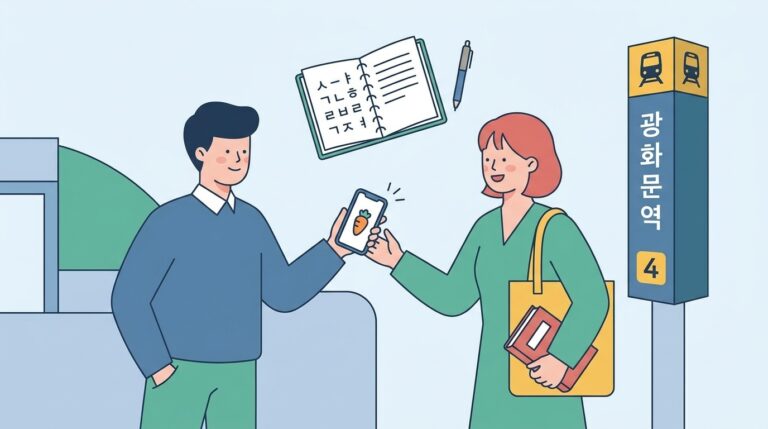
Hold on, It’s Mine! How to Say ‘Reserved’ on Korean Second-hand Apps
안녕하세요! (An-nyeong-ha-se-yo!) Your favorite Daily Hangul editor and cultural navigator is back! 🇰🇷✨
Have you ever scrolled through Karrot Market (당근마켓 – Dang-geun-ma-ket) or Joonggonara (중고나라), found the perfect K-beauty organizer or limited-edition K-pop album, only to realize someone else got to it first? Or maybe you are selling your own pre-loved items and need to let other buyers know that a deal is already in progress.
In Korea’s bustling second-hand market, things move lightning-fast. To save your time and energy, you need to know how to spot and use the word for “Reserved”. Today, we’ll master this essential concept so you can trade like a true Seoulite!
Phase 2: Top 3 Essential Expressions for “Reserved”
Here are the three magic words you will see and use constantly during second-hand trades.
1. 예약중 (Ye-yak-jung)
- Pronunciation: Yeh-yak-joong (Sounds like “Yeah, yak” + “jung” as in jungle)
- Meaning: Under Reservation / Pending / On Hold
- K-Culture Moment: In K-Dramas, when characters are hunting for rare vintage items on neighborhood apps, you’ll often see them sighing deeply while staring at a screen that says 예약중.
- Editor’s Insight: This is the most official and common tag. The character 예약 (ye-yak) means reservation, and 중 (jung) means “in the middle of” or “currently.”
- Situation Spectrum: Casual ✅ | Semi-formal ✅ | Formal ✅
- 🤔 Think About It: In your country, do people say “on hold” or “pending sale”? How does seeing “예약중” change your level of urgency?
2. 예약해 주세요 (Ye-yak-hae ju-se-yo)
- Pronunciation: Yeh-yak-hae joo-seh-yo (Sounds like “Yeah-yak-heh” + “ju-say-yo”)
- Meaning: Please hold it for me / Please mark it as reserved.
- K-Culture Moment: When you find a seller who agrees to meet you tomorrow, you politely send this message to ensure they don’t sell it to someone else tonight.
- Editor’s Insight: This combines the verb “to reserve” with the polite request form -해 주세요 (hae ju-se-yo). It’s friendly yet clear.
- Situation Spectrum: Casual ⚠️ | Semi-formal ✅ | Formal ✅
- 🤔 Think About It: Why is it important to ask for a reservation politely in a peer-to-peer app?
3. 예약 완료 (Ye-yak wan-ryo)
- Pronunciation: Yeh-yak wan-ryo (Sounds like “Yeah-yak” + “wan-ryoh”)
- Meaning: Reservation Completed
- K-Culture Moment: The sweet relief of seeing this tag on an item you just agreed to buy!
- Editor’s Insight: 완료 (wan-ryo) means completion. Once you see this, the item is officially locked in for you.
- Situation Spectrum: Casual ✅ | Semi-formal ✅ | Formal ✅
- 🤔 Think About It: How does “예약 완료” build trust between buyers and sellers in a local community?
Phase 3: Textbook Korean vs. Real-Life Korean
Let’s look at how textbooks teach reservations versus how Koreans actually text on trading apps.
Situation 1: Asking the seller to hold the item
- 📖 Textbook Korean: “제가 살 테니 다른 사람에게 팔지 마세요.” (Je-ga sal te-ni da-reun sa-ram-e-ge pal-ji ma-se-yo. – I will buy it, so please do not sell it to others.)
- 🗣️ Real-Life Korean: “저 구매할게요! 예약 가능할까요?” (Jeo gu-mae-hal-ge-yo! Ye-yak ga-neung-hal-kka-yo? – I’ll buy it! Is reservation possible?)
- 💡 Why the difference? The textbook version sounds demanding and slightly aggressive. Real Koreans prefer softer, polite questions ending in “~ㄹ까요?” to check the seller’s condition first.
Situation 2: Confirming a hold
- 📖 Textbook Korean: “이 상품은 현재 예약 상태입니다.” (I sang-pum-eun hyeon-jae ye-yak sang-tae-im-ni-da. – This product is currently in a reserved state.)
- 🗣️ Real-Life Korean: “지금 예약중이에요!” (Ji-geum ye-yak-jung-i-e-yo! – It’s on hold right now!)
- 💡 Why the difference? Written text on apps is conversational. Using “~중이에요” makes the interaction feel warmer and more natural for neighborhood trades.
Phase 4: K-Culture Deep Dive & Non-Verbal Manners
4-1. The Art of “Nunchi” (눈치) in Second-hand Trading
In Korea, local trading apps like Karrot Market are based on trust and proximity. If a seller marks an item as 예약중 for you, it is a huge breach of etiquette (매너 – mae-neo) to cancel last minute. This is called 노쇼 (No-Show). If you must cancel, use your Nunchi (situational quick-wittedness) and message them immediately with a polite apology!
4-2. The “Karrot” Culture (당근 마켓)
Koreans don’t just say “I traded second-hand.” They say “당근했다” (Dang-geun-haet-da – I did Karrot). It’s a lifestyle! People meet near subway station exits (e.g., “Gangnam Station Exit 3”) to do quick, safe, face-to-face transactions.
Phase 5: Real-Life Roleplay Scenario
Meet Ji-won (지원), a friendly local seller selling a cute K-pop photo card holder, and Alex (알렉스), an exchange student.
- Setting: Chat room inside the Karrot Market app.
- 알렉스: 안녕하세요! 혹시 포토카드 홀더 아직 있나요?
(An-nyeong-ha-se-yo! Hok-si po-to-ka-deu hol-deo a-jik it-na-yo?)
🎭[Hopeful and polite]“Hello! By any chance, is the photo card holder still available?” - 지원: 네, 아직 있어요! 구매 원하시나요?
(Ne, a-jik it-eoy-yo! Gu-mae won-ha-si-na-yo?)
🎭[Friendly and quick]“Yes, it is still here! Do you want to buy it?” - 알렉스: 네! 제가 퇴근 후에 가야 해서 저녁 7시에 직거래 가능한가요?
(Ne! Je-ga toe-geun hu-e ga-ya hae-seo jeo-nyeok il-gop-si-e jik-geo-rae ga-neung-hal-kka-yo?)
🎭[Politely asking for a face-to-face trade]“Yes! I have to go after work, so is a direct trade at 7 PM possible?” - 지원: 아, 네! 저녁 7시 괜찮습니다. 어디서 만날까요?
(A, ne! Jeo-nyeok il-gop-si gwaen-chan-seup-ni-da. Eo-di-seo man-nal-kka-yo?)
🎭[Accommodating]“Ah, yes! 7 PM works. Where shall we meet?” - 알렉스: 홍대입구역 9번 출구 어때요? 그리고 혹시 예약중으로 변경해 주실 수 있나요?
(Hong-dae-ip-gu-yeok gup-beon chul-gu eo-ttae-yo? Geu-ri-go hok-si ye-yak-jung-eu-ro byeon-gyeong-hae ju-sil su it-na-yo?)
🎭[Carefully requesting a hold]“How about Hongdae Station Exit 9? And could you perhaps change the status to ‘Reserved’?” - 지원: 좋은 생각이네요! 지금 바로 예약중으로 바꿀게요.
(Jo-eun saeng-gak-i-ne-yo! Ji-geum ba-ro ye-yak-jung-eu-ro ba-kkul-ge-yo.)
🎭[Reassuring]“Good idea! I will change it to ‘Reserved’ right now.” - 알렉스: 감사합니다! 저녁에 뵐게요.
(Gam-sa-hap-ni-da! Jeo-nyeok-e boel-ge-yo.)
🎭[Happy and relieved]“Thank you! See you this evening.” - 지원: 네, 이따 뵙겠습니다! 😊
(Ne, i-tta boep-get-seup-ni-da!)
🎭[Warm closing]“Yes, see you later! 😊”
🔀 Interactive Choice Points
If Ji-won asks you for confirmation, how do you respond?
* A. “지금 예약해 주세요!” (Please reserve it for me now!)
* 💖 Best! Clear, polite, and secures your item instantly.
* B. “돈 없어요. 깎아주세요.” (I have no money. Give me a discount.)
* ❌ Bad! Very rude to ask for a discount abruptly after scheduling.
* C. “나중에 갈게요.” (I will go later.)
* ⚠️ Risk! Too vague. The seller might cancel and sell to someone else.
Phase 6: 10-Second Emotion Shadowing Drill
Practice speaking like a native! Mimic the pauses (/) and emotions.
[🥺 Desperately hoping for a hold]- 혹시 / 예약 / 가능할까요?
- Hok-si / ye-yak / ga-neung-hal-kka-yo?
- “Is reservation… by any chance… possible?”
[😊 Brightly confirming as a seller]- 네, / 예약중으로 / 변경해 드릴게요!
- Ne, / ye-yak-jung-eu-ro / byeon-gyeong-hae deu-ril-ge-yo!
- “Yes, / to ‘Reserved’ / I will change it for you!”
Phase 7: K-Culture Mini Dictionary
- 직거래 (Jik-geo-rae) | Direct/In-person Trade | Meeting physically to exchange goods and cash. Very safe and popular in Korea.
- 택포 (Taek-po) | Shipping Included | Short for 택배비 포함 (Taek-bae-bi po-ham). Means the price includes delivery.
- 쿨거래 (Kul-geo-rae) | Cool Trade | A quick, hassle-free transaction without unnecessary questions or bargaining.
- 네고 (Ne-go) | Negotiation | Bargaining for a lower price. (e.g., “네고 금지” = No bargaining).
Phase 8: Survivor Kit for Travelers
Survival Expressions TOP 3
- 이거 예약 가능한가요? (I-geo ye-yak ga-neung-hal-kka-yo?) – Is this reservable?
- Pro Tip: Use this to lock in popular vintage clothes.
- 예약 취소할게요. 죄송합니다. (Ye-yak chwi-so-hal-ge-yo. Joe-song-hap-ni-da.) – I’ll cancel the reservation. I’m sorry.
- Pro Tip: Always send this if your plans change!
- 예약중이라서 안 돼요. (Ye-yak-jung-i-ra-seo an dwae-yo.) – It’s reserved, so it’s not available.
- Pro Tip: Used when telling other buyers the item is taken.
Editor’s Travel Note
When trading in Korea, you will definitely need the Naver Map App to find the exact subway exits or convenience stores for your 직거래 (jik-geo-rae). Note: App interfaces and market rules may update over time.
Phase 9:
Frequently Asked Questions (FAQ)
Q: What does "예약중 (Ye-yak-jung)" mean in Korean and how do you pronounce it?
A: In Korean, "예약중 (Ye-yak-jung)" is pronounced [Yeh-yak-joong (Sounds like "Yeah, yak" + "jung" as in jungle] and means: Under Reservation / Pending / On Hold
Q: What does "예약해 주세요 (Ye-yak-hae ju-se-yo)" mean in Korean and how do you pronounce it?
A: In Korean, "예약해 주세요 (Ye-yak-hae ju-se-yo)" is pronounced [Yeh-yak-hae joo-seh-yo (Sounds like "Yeah-yak-heh" + "ju-say-yo"] and means: Please hold it for me / Please mark it as reserved.
Q: What does "예약 완료 (Ye-yak wan-ryo)" mean in Korean and how do you pronounce it?
A: In Korean, "예약 완료 (Ye-yak wan-ryo)" is pronounced [Yeh-yak wan-ryo (Sounds like "Yeah-yak" + "wan-ryoh"] and means: Reservation Completed







