

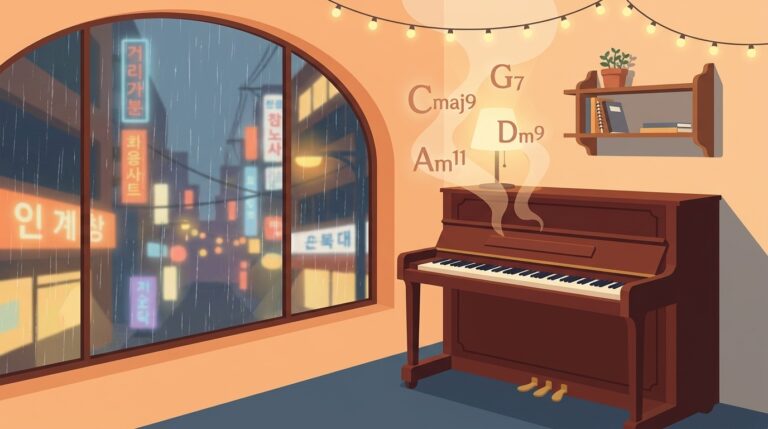
C1 Korean Masterclass: Mastering the Art of Korean Piano Accompaniment (피아노 코드 반주법)
Phase 1: Empathy (An Invitation to the Cozy Korean Piano Salon)
안녕하세요! It’s your K-culture navigator and Daily Hangul editor.
Imagine this: You’re stepping into a cozy eum-ak hag-won (음악 학원 – music academy) in the heart of Hongdae. Rain is tapping gently against the window, and from a nearby practice room, you hear the warm, rich chords of a K-ballad. You sit at a mahogany upright piano, wanting to play along to your favorite IU or Sung Si-kyung song. You know your major and minor triads, but when you look at the sheet music, the accompaniment feels stiff, mechanical, and—honestly—a bit textbook.
You want that fluid, emotional K-pop ballad style (popularly called gwan-ban ban-ju / 건반 반주), but you’re struggling to bridge the gap between playing dry chords and evoking true gam-seong (감성 – emotional vibe). If you’ve ever felt like your piano playing sounds too “rigid” when you want it to flow like a soundtrack, you are in the right place.
Today, we are diving deep into the vocabulary, nuances, and cultural aesthetics of Korean Piano Chord Accompaniment (피아노 코드 반주법). This guide is crafted based on real feedback from advanced learners who wanted to talk shop with Korean musicians without sounding like a dry dictionary. Let’s elevate your musical vocabulary to C1 fluency!
Phase 2: Deep Dive into 3 Essential Expressions
1. 쪼개다 (jjo-gae-da)
- Pronunciation: Jjo-gae-da (Sounds like “joh-gheh-dah” with a tense, doubled ‘jj’ sound)
- Meaning: Literally “to split” or “to break into pieces.” In a musical context, it means to subdivide beats or arpeggiate chords rather than playing them as block chords.
- K-Culture Moment: You’ll hear this constantly in behind-the-scenes recording videos on YouTube (like those by AKMU or MeloMance). A producer might say, “여기서는 코드를 좀 쪼개서 가볼까요?” (Shall we split/arpeggiate the chords a bit here?)
- Editor’s Insight: Instead of using the dry, academic term arpeggio-hada (아르페지오하다), Korean musicians casually use jjo-gae-da. It implies breaking a solid block chord into rhythmic patterns (like 8th or 16th notes) to create movement.
- Situation Spectrum: Casual (✅) / Semi-formal (✅) / Formal (⚠️ – use ‘분할하다’ or ‘아르페지오로 연주하다’ in academic papers)
- 🤔 Think About It: How does your native language describe “breaking down” a chord? Is it as physical and tactile as the Korean word “to split” (쪼개다)?
2. 건반을 누르다 vs. 얹다 (geon-ban-eul nu-reu-da vs. eon-da)
- Pronunciation: Geon-ban-eul nu-reu-da (“guhn-bahn-eul noo-reu-dah”) vs. eon-da (“uhn-dah” with a silent ‘j’ in 얹다)
- Meaning: Nu-reu-da means “to press/strike the keys,” while eon-da means “to lay/rest one’s hands lightly on the keys.”
- K-Culture Moment: In K-drama piano scenes (like Do Do Sol Sol La La Sol), a teacher often tells a tensed student to just “rest” their fingers on the keys to get a softer, warmer tone.
- Editor’s Insight: To achieve that soft, breathing K-ballad intro, you don’t press (누르다) the keys with force. You gently lay (얹다) your hands down, letting the weight of your wrists do the work. Mastering this linguistic distinction instantly makes you sound like a seasoned pro.
- Situation Spectrum: Casual (✅) / Semi-formal (✅) / Formal (✅)
- 🤔 Think About It: In Korean culture, softness and “empty space” (yeobaek-ui mi) are highly valued. How does shifting from “pressing” to “resting” reflect this cultural aesthetic?
3. 라인을 살리다 (ra-in-eul sal-li-da)
- Pronunciation: Ra-in-eul sal-li-da (“rah-een-eul sahl-lee-dah”)
- Meaning: Literally “to bring the line alive.” In piano accompaniment, it refers to voicing and highlighting the top melodic line within your chord inversions so the accompaniment sings.
- K-Culture Moment: Often used by vocalists directing their pianists: “제 보컬 뒤에서 탑라인 좀 살려주세요.” (Please bring out the top line behind my vocals.)
- Editor’s Insight: Sal-li-da (to save/revive) is a magical verb in Korean. When applied to music, it means making a specific voice or rhythm stand out so it doesn’t sound buried in the mud.
- Situation Spectrum: Casual (✅) / Semi-formal (✅) / Formal (🚫)
- 🤔 Think About It: Why does Korean use “to save/revive” (살리다) for musical lines? It views melody as a living organism!
Phase 3: Textbook Korean vs. Real-World Korean
Let’s look at how textbooks teach musical terms versus how real Korean pianists actually talk in a band room (합주실).
Situation 1: Explaining how to play chord progressions
- 📖 Textbook: “화음을 분산시켜서 연주해 보세요.” (Play the chords in a dispersed/arpeggiated manner.)
- 🗣️ Real-World: “코드를 좀 풀어서 쳐보세요.” (Try ‘untying’ or ‘loosening’ the chords.)
- 💡 Why the difference? Pureoda (to untie/unravel) is highly intuitive. Instead of the Sino-Korean academic word bunsan (dispersion), musicians prefer the image of “unraveling” a tightly bound chord.
Situation 2: Asking for a softer, more emotional tone
- 📖 Textbook: “약하게 그리고 감정적으로 연주해 주세요.” (Please play softly and emotionally.)
- 🗣️ Real-World: “건반에 힘 빼고 말랑하게 가볼게요.” (Let’s take the tension out of the keys and make it sound ‘squishy/soft’.)
- 💡 Why the difference? Mallang-hada (to be soft/chewy like jelly) is a sensory-mimetic word. Using it in music instantly conveys a warm, non-percussive touch that is hard to explain with scientific musical terms.
Phase 4: K-Culture Deep Dive & Non-Verbal Nuances
4-1. The Art of “Hyeop-eop” (협업 – Collaboration) and Body Language
When accompanying a singer in Korea, eye contact is everything. But it’s not just looking—it’s the slight head nod (목례) and the shared breath (호흡을 맞추다).
* Before starting the intro, the pianist will look at the singer, take a deep, visible breath (deul-sum 들숨), and drop their shoulders. This physical cue aligns the tempo without a loud count-in.
* The “Eye-Smile” (눈인사): If the singer hits a beautiful high note or shifts the dynamics, the pianist subtly smiles with their eyes to show they are locked in.
4-2. The “Gam-seong” (감성) of K-Ballad Accompaniment
K-ballads (like those of Toy/Yoo Hee-yeol) are built on extended chords (텐션 코드 – Tension Chords) like Add9, Major 9, and minor 11. In Korean music culture, these aren’t just “jazz chords”; they are the definition of gam-seong. Playing a simple triad sound is often jokingly called cho-ding ban-ju (초딩 반주 – elementary kid playing). To get that refined, late-night Seoul vibe, you must master the art of sliding from the 2nd to the 3rd (ke-seu-teon / 캐스턴-style suspensions).
Phase 5: Real-World Roleplay Scenario
Setting: A cozy music studio in Mapo-gu. You are practicing a piano cover of a famous K-drama OST with Ji-woo, an experienced indie singer-songwriter.
Character
- Ji-woo (지우): A passionate, warm, but highly detailed vocalist who loves rich piano voicings.
Ji-woo: "저기, 민우 씨! 아까 그 후렴구(chorus) 부분 말이에요. 거기서 코드를 그냥 쿵, 쿵 누르니까 곡 분위기가 살짝 무거운 것 같아요."
(Hey, Min-woo! About that chorus section earlier. Since you're just hitting the chords raw like 'boom, boom,' the vibe feels a bit heavy.)

You: "아, 그렇군요! 혹시 여기서는 8비트로 코드를 좀 쪼개서 가볼까요?"
(Ah, I see! Should we try splitting the chords into an 8-beat pattern here?)

Ji-woo: "(🎭 박수를 치며 기뻐하며) 오, 맞아요! 그렇게 쪼개서 리듬감을 주면 훨씬 세련되게 들릴 것 같아요. 탑라인도 좀 살려주실 수 있나요?"
(Oh, yes! Splitting it like that to give it rhythm will make it sound so much more sophisticated. Could you also bring out the top line?)

You: "네, 멜로디 라인이 보컬이랑 겹치지 않게 보이싱(voicing)을 잘 풀어서 얹어볼게요."
(Yes, I'll unravel the voicing nicely so the melody line doesn't clash with your vocals.)

Ji-woo: "좋아요. 그리고 인트로 부분에서는 건반에 힘을 완전히 빼고 '말랑하게' 흘러가듯이 치면 좋겠어요."
(Great. And for the intro, I'd love it if you completely took the tension out of your hands and played it softly, as if it's just flowing.)

You: "알겠습니다. 첫 코드 누를 때 손가락을 얹는 느낌으로 아주 살며시 들어갈게요."
(Got it. When I hit the first chord, I'll go in very gently, with the feeling of just resting my fingers on the keys.)

Ji-woo: "(🎭 기대에 찬 눈빛으로) 완벽해요! 그럼 우리 처음부터 다시 맞춰볼까요? 호흡 맞춰서 가요!"
(Perfect! Shall we try matching it from the beginning again? Let's sync our breath and go!)

You: "좋습니다! 제가 지우 씨 들숨 소리 듣고 리드할게요. 하나, 둘, 셋..."
(Great! I'll listen to your breath and lead. One, two, three...)
🔀 Interactive Choice Points
At the end of the first chorus, Ji-woo suddenly ad-libs a high note. How do you respond on the piano?
- Option A: “Keep the rigid 8-beat pattern going to maintain steady tempo.”
- 🔴 Feedback (Bad): Ji-woo feels restricted. K-ballad accompaniment needs to breathe (tempo rubato). Staying strictly on-grid makes it sound like a metronome.
- Option B: “Drop the volume instantly, spread the chord slowly (rolling/arpeggio), and leave space for her voice.”
- 🟢 Feedback (Best!): This is true gam-seong. By rolling the chord and letting the pedal carry the sustain, you “save” her vocal line (라인을 살리다).
- Option C: “Play a flashy, loud jazz lick to match her high note energy.”
- ⚠️ Feedback (Risk): You might steal her spotlight. In Korean accompaniment, the golden rule is ban-ju (accompaniment) should never overpower the jung-in-gong (protagonist/vocalist).
Phase 6: 10-Second Emotion Shadowing Drill
To speak like a native musician, your intonation needs the right flow. Practice these with the dynamic guides:
[😊 Excitedly, offering a solution]- “코드를 / 좀 / 쪼개서 / 가볼까요?”
- Ko-deu-reul / jom / jjo-gae-seo / ga-bol-kka-yo?
- (Shall we try… splitting up the chords a bit?)
[😌 Calmly, reassuring your partner]- “건반에 / 힘 완전히 빼고 / 말랑하게 / 칠게요.”
- Geon-ban-e / him wan-jeon-hi ppae-go / mal-lang-ha-ge / chil-ge-yo.
- (I’ll take all the tension out of the keys and play it super softly.)
Phase 7: K-Culture Mini Dictionary
- 건반 (Geon-ban): The piano keys. Literally “key board.” Used to describe touch and tone (e.g., “건반이 무겁다” – The action of the keys is heavy).
- 보이싱 (Boi-sing): Loan word for “Voicing.” How you arrange the notes of a chord. Essential for K-pop style to avoid muddy low-intervals.
- 합주 (Hap-ju): Ensemble playing / jamming. A holy word for hobbyist musicians in Korea who rent private practice rooms (hap-ju-sil).
- 물감성 (Mul-gam-seong): “Watery sentimentality.” A slang term for music that makes you feel incredibly nostalgic, rainy, or emotional.
Phase 8: Survivor Kit for Travelers
Survival Vocab TOP 3
- 페달이 잘 안 먹혀요. (Pe-dal-i jal an meok-hyeo-yo.)
- Pro Tip: “The sustain pedal isn’t working properly.” Use this when renting a piano practice room in Seoul.
- 코드 악보 있나요? (Ko-deu ak-bo in-na-yo?)
- Pro Tip: “Do you have chord-only sheet music?” Handy for quick jams.
- 키 좀 낮춰주실 수 있어요? (Ki jom nat-chwo-ju-sil su it-eo-yo?)
- Pro Tip: “Could you lower the key/transpose down?” Essential when accompanying singers.
📌 Editor’s Travel Note: When looking for high-quality, hourly-rated piano practice rooms in Seoul, download the SpaceCloud (스페이스클라우드) app. You can book beautiful grand piano rooms (often called yeonsup-sil 연습실) starting from 5,000 KRW ($4 USD) per hour!
Phase 9:
Frequently Asked Questions (FAQ)
Q: What does "쪼개다 (jjo-gae-da)" mean in Korean and how do you pronounce it?
A: In Korean, "쪼개다 (jjo-gae-da)" is pronounced [Jjo-gae-da (Sounds like "joh-gheh-dah" with a tense, doubled 'jj' sound] and means: Literally "to split" or "to break into pieces." In a musical context, it means to subdivide beats or arpeggiate chords rather than playing them as block chords.
Q: What does "건반을 누르다 vs. 얹다 (geon-ban-eul nu-reu-da vs. eon-da)" mean in Korean and how do you pronounce it?
A: In Korean, "건반을 누르다 vs. 얹다 (geon-ban-eul nu-reu-da vs. eon-da)" is pronounced [Geon-ban-eul nu-reu-da ("guhn-bahn-eul noo-reu-dah"] and means: Nu-reu-da means "to press/strike the keys," while eon-da means "to lay/rest one's hands lightly on the keys."
Q: What does "라인을 살리다 (ra-in-eul sal-li-da)" mean in Korean and how do you pronounce it?
A: In Korean, "라인을 살리다 (ra-in-eul sal-li-da)" is pronounced [Ra-in-eul sal-li-da ("rah-een-eul sahl-lee-dah"] and means: Literally "to bring the line alive." In piano accompaniment, it refers to voicing and highlighting the top melodic line within your chord inversions so the accompaniment sings.







