

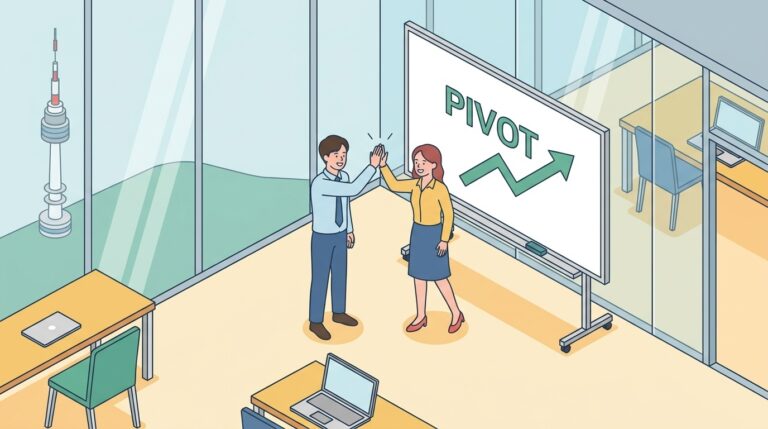
Failure is Just a Pivot: Master the Art of ‘Failing Forward’ in Korean Startups
Phase 1: Empathy (An Editor’s Welcome)
안녕하세요! Welcome back, my dear friend. It’s your favorite cultural navigator from 매일한글 (Daily Hangul) here!
Have you ever stood in a sleek, open-plan office in Gangnam, holding a cup of cold brew, feeling your heart drop to your stomach because a major project you led just fell through? In traditional Korean corporate environments (often called K-Company culture), failure was once a taboo—something associated with deep bows, formal apology letters (gamyeonsuh), and cold sweat.
But wait! If you are working in or with a modern Korean startup, things have changed dramatically. Enter the era of the “Fail-Fast, Pivot-Faster” mindset. Startups in Seoul’s “Teheran-ro” tech hub now actively encourage calculated risks. However, expressing this culturally shifted attitude in high-level Korean can be incredibly tricky. How do you admit a mistake, propose a pivot, and encourage your team to “fail forward” without sounding defensive or overly blunt?
Today, we are diving deep into C2-level professional Korean expressions that will make you sound like a visionary, resilient startup co-founder who knows how to embrace failures with style. Let’s get you equipped!
Phase 2: Deep-Dive into 3 Essential Expressions
1. 실패를 자산으로 삼다 (Sil-pae-reul ja-san-eu-ro sam-da)
- Pronunciation: Sil-pae-reul ja-san-eu-ro sam-da (Think “seal-pae” like a wax seal, then “ja-san” which sounds like “ja-son” but with an ‘a’ as in “father”).
- Meaning: To turn failure into an asset / To treat failure as a valuable resource.
- K-Culture Moment: You’ll often hear this in tech documentaries (like those featuring Kakao or Toss founders) when discussing early-stage pivots. It’s the ultimate “fail forward” mantra.
- Editor’s Insight: This isn’t just saying “it’s okay to fail.” By using the word 자산 (asset/property), you are framing the mistake as an investment that has already been paid for. It’s highly intellectual and strategic.
- Situation Spectrum: Casual (⚠️ – too heavy) | Semi-formal (✅) | Formal (✅)
- 🤔 Think About It: In your native language, is failure discussed as a “cost,” a “teacher,” or an “asset”? How does viewing failure as a tangible financial asset change your psychological approach to business risks?
2. 피벗(Pivot)은 빠를수록 좋습니다 (Pi-beot-eun ppa-reul-su-rok jop-seun-ni-da)
- Pronunciation: Pi-beot-eun ppa-reul-su-rok jop-seun-ni-da (Sounds like “Pivot-eun” + “pah-reul-soo-rok” + “chote-seum-nee-da”).
- Meaning: The faster we pivot, the better.
- K-Culture Moment: Frequently used in popular K-Dramas like Start-Up (스타트업) when Sandbox mentors advise struggling founders to change their business model before running out of runway.
- Editor’s Insight: The English word “Pivot” has been fully adopted into Korean startup jargon as 피벗. Combining it with the grammar pattern -을수록 좋다 (the more… the better) shows that you value agility over stubborn persistence.
- Situation Spectrum: Casual (✅ – as 피벗은 빠를수록 좋지) | Semi-formal (✅) | Formal (✅)
- 🤔 Think About It: Why do you think the Korean tech ecosystem adopted the English word “pivot” instead of using native Korean words like ‘방향 전환’ (change of direction)?
3. 리스크를 감수하지 않는 것이 가장 큰 리스크입니다 (Ri-seu-keu-reul gam-su-ha-ji an-neun geo-si ga-jang keun ri-seu-keu-im-ni-da)
- Pronunciation: Ri-seu-keu-reul gam-su-ha-ji an-neun geo-si ga-jang keun ri-seu-keu-im-ni-da.
- Meaning: Not taking a risk is the biggest risk of all.
- K-Culture Moment: This is a quote you might find on the neon sign of a trendy zero-to-one incubator in Seongsu-dong.
- Editor’s Insight: 감수하다 (to bear/endure/take on) is a high-level verb. Using this double-negation rhetorical structure immediately elevates your authority during executive meetings or board presentations.
- Situation Spectrum: Casual (🚫) | Semi-formal (✅) | Formal (✅)
- 🤔 Think About It: Does your workplace culture truly live up to this quote, or is it just a motivational slogan on the wall?
Phase 3: Textbook Korean vs. Real-world Startup Korean
Let’s compare textbook phrases with what actual Korean startup operators say to foster a psychological safety net.
Situation A: Encouraging a teammate after a failed feature launch
- 📖 Textbook: “실패해도 괜찮으니 낙담하지 마세요.” (It is okay even if you fail, so do not be discouraged.)
- 🗣️ Real-world: “이번 실패는 좋은 예방주사를 맞은 셈 치죠.” (Let’s consider this failure as getting a good preventive vaccine.)
- 💡 Why the difference? The textbook version can sound patronizing. The real-world phrase uses the metaphor of 예방주사 (vaccine/vaccination), implying this minor failure builds immunity against catastrophic future market failures.
Situation B: Proposing a radical shift during a retrospective (Retros)
- 📖 Textbook: “계획이 잘못되었으니 바꾸어야 합니다.” (The plan was wrong, so we must change it.)
- 🗣️ Real-world: “가설 검증이 끝났으니, 이제 빠르게 피드백을 반영해 가설을 고도화할 때입니다.” (Our hypothesis testing is complete; now is the time to rapidly incorporate feedback and sophisticatedly refine our hypothesis.)
- 💡 Why the difference? Instead of admitting “we were wrong” (which damages morale), C2-level Korean uses scientific startup terminology like 가설 검증 (hypothesis verification) and 고도화하다 (to make highly sophisticated/upgrade). It reframes a mistake as a completed science experiment.
Phase 4: K-Culture Deep-Dive & Non-Verbal Manners
4-1. The “Post-Mortem” Eye Contact and Posture
In traditional Korean culture, when you fail, you bow your head, avoid eye contact, and look apologetic. However, in a psychologically safe startup culture, this passive body language can backfire. It makes you look defeated.
* The Non-Verbal Hack: Maintain soft but direct eye contact during post-mortems. Sit up straight, nod slightly when receiving feedback, and use open-hand gestures. When stating what went wrong, use the passive voice for the system (e.g., “시스템에 공백이 있었습니다” – There was a gap in the system) but active voice for your personal accountability.
4-2. Cultural Code: The ‘K-Startup’ Ecosystem
If you watch the K-Drama Start-Up (starring Suzy and Nam Joo-hyuk), you’ll notice that the incubator ‘Sandbox’ was inspired by a child’s sandbox—where children can fall without getting hurt. In Seoul’s actual startup hubs like TIPS Town in Yeoksam or D.CAMP in Mapo, founders actively participate in “Fuckup Nights” (실패 공유회), where they share their bankruptcy and pivot stories over craft beer. Sharing failure is now seen as a badge of honor and maturity.
Phase 5: Real-Life Roleplay Scenario
Setting: A modern glass-walled meeting room at a fintech startup in Pangyo Techno Valley.
Characters:
* Min-jun (민준): The Head of Product. Empathetic, data-driven, and highly supportive of agile methodologies.
* You (Foreign PM): Lead Product Manager. You just launched a feature that had a 70% drop-off rate.
- 민준: (아이패드를 보며 씁쓸한 미소를 지으며) 이번 신기능 이탈률이 생각보다 너무 높네요. 거의 70%에 가깝습니다.
- You: (차분하게 고개를 끄덕이며) 네, 민준 님. 기대했던 지표가 나오지 않아 아쉽지만, 이번 실패는 더 큰 시장 리스크를 줄이기 위한 좋은 예방주사를 맞은 셈입니다.
- 민준: (흥미롭다는 듯 바라보며) 아, 그렇게 보시는군요. 구체적으로 어떤 데이터를 얻으셨나요?
- You: 유저 인터뷰를 해보니 우리의 핵심 가설이 실제 타겟층의 니즈와 달랐습니다. 즉, 가설 검증이 끝난 것이죠.
- 민준: 그렇다면 다음 스텝은 어떻게 되나요? 혹시 프로젝트 전체를 드랍(Drop)해야 할까요?
- You: 아닙니다. 실패를 자산으로 삼아, 원래 가설을 고도화하는 방향으로 빠르게 피벗하는 것이 좋겠습니다.
- 민준: 좋습니다. 리스크를 두려워해서 아무것도 안 하는 것보다는, 이렇게 배우는 게 맞죠.
- You: 맞습니다. 리스크를 감수하지 않는 것이 가장 큰 리스크니까요. 내일 백로그 회의 때 수정안을 공유하겠습니다.
🔀 Interactive Choice Point
Min-jun asks: “이번 실패에 대해 대표님 보고는 어떻게 하실 건가요?” (How are you going to report this failure to the CEO?)
- [Choice A] “제 잘못이라고 솔직하게 말씀드리고 시말서를 쓰겠습니다.” (I will honestly say it’s my fault and write a letter of apology.)
- [Choice B] “데이터 분석 결과를 바탕으로, 이번 실패를 어떻게 자산화하여 피벗할지 향후 로드맵 위주로 보고드리겠습니다.” (Based on the data analysis, I will report focusing on how to assetize this failure and pivot in our future roadmap.)
- [Choice C] “마케팅 부서의 타겟팅 에러였다고 보고해서 책임을 나누겠습니다.” (I will report that it was the marketing department’s targeting error to share the responsibility.)
💡 Feedback:
- Best Choice: [Choice B] (Perfect C2 approach. It shows executive presence, takes analytical ownership, and shifts the conversation to future value creation.)
- Bad Choice: [Choice A] (Too traditional and passive. Modern startups do not want self-flagellation; they want solutions.)
- Risk Choice: [Choice C] (Toxic behavior. Shifting blame to other departments will instantly destroy cross-functional trust, which is fatal in a startup.)
Phase 6: 10-Second Emotional Shadowing Drill
Practice saying these with the exact emotional undertone. Pause at the slashes /.
- [💪 Confident and Reassuring – During a tense post-mortem]
“이번 실패는 / 더 큰 리스크를 막기 위한 / 좋은 예방주사입니다!”
(I-beon sil-pae-neun / deo keun ri-seu-keu-reul mak-gi wi-han / jo-eun ye-bang-ju-sa-im-ni-da!) -
[🎯 Sharp and Visionary – During a board meeting]
“실패를 / 자산으로 삼아 / 빠르게 피벗해야 합니다!”
(Sil-pae-reul / ja-san-eu-ro sam-a / ppa-reu-ge pi-beot-hae-ya ham-ni-da!)
Phase 7: K-Startup Mini-Dictionary
- 포스트모템 (Post-mortem) | Retrospective
- Analysis conducted after a project fails to learn from mistakes, avoiding finger-pointing.
- 스프린트 (Sprint) | Sprint
- A set period (usually 1-2 weeks) during which specific work must be completed and made ready for review.
- 린하다 (Lean-ha-da) | Being Lean
- Operating efficiently, building MVPs (Minimum Viable Products), and avoiding unnecessary administrative bloat.
- 얼라인 (Align) | Alignment
- Getting everyone on the same page regarding goals and vision (e.g., “팀원들과 얼라인이 필요해요”).
Phase 8: The Ultimate Survival Kit for Startup Expats
Survival Phrases TOP 3
- “오히려 좋아!” (Oh-ryeo jo-ah!)
- Meaning: “Actually, this is even better!” (The ultimate positive reframe used when things go wrong but open up new opportunities.)
- “싱크해 봅시다.” (Sing-keu-hae bop-si-da.)
- Meaning: “Let’s sync up on this.”
- “우선순위를 조정하죠.” (U-seon-sun-wi-reul jo-jeong-ha-jo.)
- Meaning: “Let’s adjust our priorities.”
Editor’s Travel & Life Note
When visiting or working in Seoul’s startup clusters, networking is everything. Skip the formal business cards if you are in a casual meetup; instead, use Remember (리멤버) to manage your professional network or simply exchange KakaoTalk IDs. If you need a premium coworking space to experience this vibe first-hand, check out Fastfive or Sparkplus locations across Gangnam. (Note: Co-working space operating hours and hot-desk pass prices may vary, so always check their official apps before visiting!)
Phase 9:
Frequently Asked Questions (FAQ)
Q: What does "실패를 자산으로 삼다 (Sil-pae-reul ja-san-eu-ro sam-da)" mean in Korean and how do you pronounce it?
A: In Korean, "실패를 자산으로 삼다 (Sil-pae-reul ja-san-eu-ro sam-da)" is pronounced [Sil-pae-reul ja-san-eu-ro sam-da (Think "seal-pae" like a wax seal, then "ja-san" which sounds like "ja-son" but with an 'a' as in "father"] and means: To turn failure into an asset / To treat failure as a valuable resource.
Q: What does "피벗(Pivot)은 빠를수록 좋습니다 (Pi-beot-eun ppa-reul-su-rok jop-seun-ni-da)" mean in Korean and how do you pronounce it?
A: In Korean, "피벗(Pivot)은 빠를수록 좋습니다 (Pi-beot-eun ppa-reul-su-rok jop-seun-ni-da)" is pronounced [Pi-beot-eun ppa-reul-su-rok jop-seun-ni-da (Sounds like "Pivot-eun" + "pah-reul-soo-rok" + "chote-seum-nee-da"] and means: The faster we pivot, the better.







