

Master the Dry Cleaners in Korea: How to Confidently Ask for Your Receipt
Phase 1: Empathy (Your Laundry Day Survival Guide)
Annyeonghaseyo! (안녕하세요!) I’m your senior editor and local culture navigator at Daily Hangul.
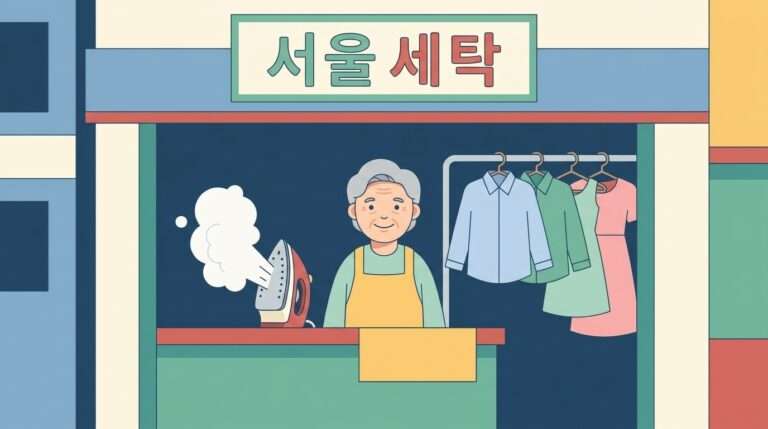
Imagine this: You’ve just dropped off your favorite trench coat at a cozy neighborhood dry cleaner (se-tak-so, 세탁소) in Seoul. The sweet, elderly owner (often warmly called Imo, 이모, or Sajangnim, 사장님) takes your coat, scribbles something down, and smiles. You realize you need a receipt for your company expense or just for your peace of mind to claim your coat later. Suddenly, your mind goes blank. How do you say “Receipt, please” without sounding like a robot or accidentally asking for the menu?
If you’ve ever felt a splash of panic in everyday Korean situations, don’t worry! This is a classic “A1-level bump” that almost every expat and traveler experiences. Today, we are going to unlock the exact, natural words to get your receipt with confidence, direct from real-life survival scenarios. Let’s make your laundry day stress-free!
Phase 2: Deep Dive into 3 Key Expressions
Here are the top three expressions you need at a Korean dry cleaner. Let’s break them down step-by-step.
1. 영수증 주세요 (Yeong-su-jeung ju-se-yo)
- Pronunciation: Yung-soo-jung joo-seh-yo (Sounds like: “Young-sue-jung” + “Juice-eh-yo”)
- Meaning: “Receipt, please.”
- K-Culture Moment: You’ve probably seen this in countless K-Dramas! Think of a slice-of-life drama where the main character picks up their dry-cleaned suit for an interview. They politely extend their hand and say this exact phrase.
- Editor’s Insight: Yeong-su-jeung means receipt, and ju-se-yo is the magic Korean word for “please give me.” It is incredibly polite, clear, and universally understood.
- Situation Spectrum: Casual ⚠️ | Semi-formal ✅ | Formal ✅
- 🤔 Think About It: In your home country, do people always ask for paper receipts, or is everything digital now? In Korea, paper receipts are still highly valued at neighborhood shops for tracking items!
2. 영수증 받을 수 있을까요? (Yeong-su-jeung ba-deul su is-seul-kka-yo?)
- Pronunciation: Yung-soo-jung bah-deul soo ees-seul-kka-yo?
- Meaning: “Could I get a receipt?” (Literally: “Is it possible to receive a receipt?”)
- K-Culture Moment: Used when you want to sound extra gentle and polite, especially to elderly shop owners who appreciate soft language.
- Editor’s Insight: This uses the “-eul su is-seul-kka-yo” grammar which translates to “Could I…?” It shows ultimate respect and soft mannerisms.
- Situation Spectrum: Casual 🚫 | Semi-formal ✅ | Formal ✅
3. 이거 표 주세요 (I-geo pyo ju-se-yo)
- Pronunciation: Ee-guh pyo joo-seh-yo
- Meaning: “Give me the ticket/tag, please.”
- K-Culture Moment: In traditional neighborhood dry cleaners, owners often call the receipt/claim tag a pyo (표 – ticket/tag).
- Editor’s Insight: If the owner is a bit older, saying pyo instead of yeong-su-jeung makes you sound like a seasoned local!
- Situation Spectrum: Casual ✅ | Semi-formal ✅ | Formal ⚠️
Phase 3: Textbook Korean vs. Real Korean
Let’s compare what textbooks teach you versus how Koreans actually talk at the dry cleaners.
Situation 1: Asking for a receipt
- 📖 Textbook style: “저에게 영수증을 주시겠습니까?” (Jeo-e-ge yeong-su-jeung-eul ju-si-get-seub-ni-ka? – “Would you bestow a receipt upon me?”)
- 🗣️ Real Korean: “영수증 주세요~” (Yeong-su-jeung ju-se-yo~ – “Receipt, please!”)
- 💡 Why the difference? Textbook phrases are often overly formal and grammatically heavy. Real-life Korean prefers short, friendly, and efficient phrases, especially in retail.
Situation 2: Asking when to pick up clothes
- 📖 Textbook style: “언제 제가 옷을 찾으러 와야 합니까?” (Eon-je je-ga ot-eul cha-jeu-reo wa-ya hab-ni-ka? – “When must I come to retrieve my garments?”)
- 🗣️ Real Korean: “언제 찾으러 와요?” (Eon-je cha-jeu-reo wa-yo? – “When should I come pick them up?”)
- 💡 Why the difference? Dropping unnecessary pronouns (like “I” or “my garments”) makes your Korean sound smooth and natural.
Phase 4: K-Culture Deep Dive & Non-Verbal Manners
4-1. Nunchi & Gestures
When asking for a receipt or handing over your credit card in Korea, always use two hands. Handing over an item with one hand can be perceived as slightly dismissive, especially when interacting with someone older than you. Place your credit card or cash between both hands and bow your head slightly. This non-verbal cue shows great respect!
4-2. The Cozy “Neighborhood Dry Cleaner” (세탁소)
Unlike big automated factory cleaners in some western countries, traditional Korean neighborhood dry cleaners (se-tak-so) are deeply personal spaces. The owner often knows all the neighbors by name. Don’t be surprised if the shop smells of warm steam, fresh laundry detergent, and a hint of home-cooked lunch! Showing polite manners here instantly warms up the community atmosphere.
Phase 5: Real-Life Roleplay Scenario
Let’s step into a neighborhood dry cleaner called “Haengbok Se-tak-so” (행복 세탁소 – Happy Dry Cleaners). You are talking to Kim Sajangnim (the friendly neighborhood owner).
- Setting: A warm, steam-filled shop in Mapo-gu, Seoul. Cozy and bustling.
[1] Sajangnim (smiling): 어서 오세요! (Eo-seo o-se-yo!)
    🎭 (Greeting you warmly as you walk in)
    "Welcome!"

[2] You: 안녕하세요. 옷 세탁하고 싶어요. (An-nyeong-ha-se-yo. Ot se-tak-ha-go sip-eo-yo.)
    🎭 (Holding out your winter coat politely)
    "Hello. I want to dry clean my clothes."

[3] Sajangnim: 네, 패딩 하나네요. 수요일에 오세요. (Ne, pae-ding ha-na-ne-yo. Su-yo-il-e o-se-yo.)
    🎭 (Checking the padded coat and writing it down)
    "Okay, one padded jacket. Come back on Wednesday."

[4] You: 저... 영수증 주세요. (Jeo... yeong-su-jeung ju-se-yo.)
    🎭 (Looking polite and making eye contact)
    "Um... receipt, please."

[5] Sajangnim: 아, 영수증이요? 여기요. (A, yeong-su-jeung-i-yo? Yeo-gi-yo.)
    🎭 (Printing a paper receipt and handing it over with both hands)
    "Ah, a receipt? Here you go."

[6] You: 감사합니다. 카드 돼요? (Gam-sa-ham-ni-da. Ka-deu dwae-yo?)
    🎭 (Taking the receipt and pulling out your bank card)
    "Thank you. Do you accept credit cards?"

[7] Sajangnim: 그럼요, 됩니다. 결제 끝났어요. (Geu-reom-yo, doem-ni-da. Gyeol-je kkeut-nas-seo-yo.)
    🎭 (Tapping your card on the terminal)
    "Of course we do. Payment is done!"

[8] You: 감사합니다. 안녕히 계세요! (Gam-sa-ham-ni-da. An-nyeong-hi gye-se-yo!)
    🎭 (Bowing slightly as you walk towards the door)
    "Thank you. Goodbye!"
🔀 Interactive Path Selection
What do you say if you want to ask when to pick up your clothes?
* Choice A: 언제 와요? (Eon-je wa-yo? – When do I come?)
* Choice B: 내일 주세요. (Nae-il ju-se-yo. – Give it to me tomorrow.)
* Choice C: 언제 끝나요? (Eon-je kkeut-na-yo? – When does it finish?)
💡 Feedback on Your Choice:
- Choice A (Best): Perfect! It’s short, natural, and friendly.
- Choice B (Risk): A bit too demanding for an A1 learner. Demanding tomorrow might sound slightly pushy unless discussed!
- Choice C (Bad): While grammatically correct, it sounds like you are rushing them excessively. Stick to “언제 와요?” (When should I come?).
Phase 6: 10-Second Emotion Shadowing Drill
Try speaking these lines with the correct emotional tone. Look at the pause marks (/) to control your rhythm!
- [😊 Softly and Politely]
- 저… / 영수증 / 주세요.
- Jeo… / yeong-su-jeung / ju-se-yo.
- (Pause slightly after ‘Jeo…’ to sound natural and friendly!)
- [🙌 Gratefully and Cheerfully]
- 감사합니다! / 안녕히 계세요!
- Gam-sa-ham-ni-da! / An-nyeong-hi gye-se-yo!
Phase 7: K-Culture Mini Dictionary
- 세탁소 (Se-tak-so) | Dry Cleaners
- Essential neighborhood hub in Korea for cleaning, tailoring, and mending clothes.
- 영수증 (Yeong-su-jeung) | Receipt
- Crucial for confirming payments or retrieving clothes if you lose your phone number records.
- 이모 (Imo) | Aunt/Warm term for older women
- Literally means “maternal aunt,” but used affectionately to address friendly middle-aged female shop owners.
- 카드 (Ka-deu) | Card (Credit/Debit)
- Korea is virtually cash-free. Even tiny neighborhood dry cleaners accept credit cards with zero issues.
Phase 8: Travel Survival Kit
Survival Expressions TOP 3
- 이거 세탁해 주세요 (I-geo se-tak-hae ju-se-yo)
- Meaning: “Please wash/dry clean this.”
- 금요일까지 돼요? (Geum-yo-il-kka-ji dwae-yo?)
- Meaning: “Is it possible by Friday?”
- 이거 지워주세요 (I-geo ji-wo-ju-se-yo)
- Meaning: “Please remove this stain.”
Editor’s Travel Note
Need to find a dry cleaner near your Airbnb? Open Naver Map App (the ultimate navigation tool in Korea) and type in 세탁소 (Se-tak-so). It will show you all the closest local shops along with ratings and operating hours. Note: Local hours can vary on holidays, so checking the app beforehand is always smart!
Phase 9: “Going One Step Deeper”
In Korea, asking for things politely often begins with the filler word 저… (Jeo…). It acts as a gentle clearing of the throat that prepares the listener for a request. Rather than flatly saying “영수증 주세요,” starting with “저… 영수증 주세요” immediately softens your tone. This small linguistic cushion represents the high value placed on interpersonal harmony in Korean society. It’s not just about the words; it’s about the emotional atmosphere you create!
💬 Your Turn: How do you politely get someone’s attention in your own language before asking for a receipt? Let us know in the comments below!
Phase 10: FAQ & Avoiding Common Mistakes
Q: What if I lose my paper receipt? Can I still get my clothes back?
A: Yes! Don’t worry. Most Korean dry cleaners use your phone number to register your clothes. You can just say your phone number to pick them up.
Q: Can I pay with foreign credit cards at local dry cleaners?
A: Generally, yes! Visa and Mastercard are widely accepted in almost every Korean shop, though having some backup cash or a local card (like T-money for minor items) is always a safe bet.
Q: Do they do alterations (mending) at the dry cleaners?
A: Yes! Look for the word 수선 (Su-seon) on the sign. Most dry cleaners can shorten your pants or fix zippers for a very low fee.
🚨 Common Mistakes Alert
- Mistake 1: Saying “영수증 주라” (Yeong-su-jeung ju-ra). This is informal and impolite to elders.
- Correct Action: Always use 주세요 (ju-se-yo)!
- Mistake 2: Handing your card over with one hand while looking away.
- Correct Action: Use two hands and make warm eye contact!
Phase 11: Action Mission & Engagement
- Bronze Mission: Read “영수증 주세요” aloud 5 times in front of the mirror using both hands to pretend to hold a card.
- Silver Mission: Write a comment below telling us: “What is your favorite Korean clothing item you want to keep clean?”
- Gold Mission (K-Culture Mission): Next time you watch a K-Drama set in a neighborhood, listen closely when characters pay for items. Can you spot them saying “주세요” (ju-se-yo)?
Phase 12: Interactive Quiz Challenge
Test your knowledge! Tap the drop-down sections below to see if you got the right answers.
🔎 Question 1: How do you say ‘Receipt, please’ in polite Korean?
Answer: 영수증 주세요 (Yeong-su-jeung ju-se-yo).
Explanation: This is the standard, polite way to ask for a receipt anywhere in Korea!
🔎 Question 2: Which gesture is most respectful when paying in Korea?
Answer: Handing over your payment card with both hands while bowing slightly.
Explanation: Using two hands shows respect and high manners in Korean culture.
🔎 Question 3: True or False: Traditional Korean dry cleaners only accept cash.
Answer: False!
Explanation: Almost all dry cleaners in Korea happily accept credit cards (카드).







