

Master the Art of Korean Business Dining: Navigating Etiquette, Taboos, and Subtle Linguistic Nuances at the Table
Phase 1: Empathy (An Immersive Opening)
안녕하세요! (Annyeonghaseyo!) I’m your lead editor at Daily Hangul.
Imagine this: You are at a high-end Hanjeongsik (Korean full-course dinner) in Seoul with your top-tier corporate clients. The atmosphere is tense but promising. The Soju is flowing, and the exquisite dishes are arriving. Suddenly, a senior executive lifts their glass, and you politely clink yours, looking them straight in the eye while holding your glass with one hand. Instantly, you notice a brief, microscopic freeze in their expression. What went wrong?
You might have spoken flawless C2-level Korean all evening, but at the Korean dining table, actions, gestures, and the linguistic etiquette accompanying them speak louder than words. Dining in Korea isn’t just about nourishing the body; it is a highly ritualized dance of respect, hierarchy, and mutual trust. Today, we are diving deep into the sophisticated world of Korean business dining etiquette and the crucial taboos you must master to seal those multi-million dollar deals with grace.
Phase 2: Deep Dive into 3 Core Expressions
To navigate a formal business dinner smoothly, you need more than just vocabulary; you need the exact socio-linguistic tools that show you truly understand Korean culture.
1. 맛있게 드십시오 (Mas-it-ge deu-sip-si-o)
- Pronunciation: Mahsh-eet-geu deu-sheep-shee-oh (Think of “mash-it-gate” combined with a soft “do-sheep-she-oh”)
- Meaning: “Please enjoy your meal” (Literally: “Eat deliciously”)
- K-Culture Moment: In corporate K-Dramas like Misaeng (Incomplete Life), you will often see junior employees waiting for the department head to say this or saying it themselves with a deep bow before touching their utensils.
- Editor’s Insight: While beginners learn “맛있게 드세요” (deu-se-yo), in a high-stakes C2 business environment, you must use the deferential 하십시오체 (hap-si-o-che) ending: 맛있게 드십시오. It signals absolute respect for your clients or superiors.
- Situation Spectrum: Casual: 🚫 | Semi-formal: ⚠️ | Formal: ✅
- 🤔 Think About It: In your culture, is there a phrase that carries the same weight of hierarchy and permission as “맛있게 드십시오”? Or is dining a more egalitarian affair?
2. 제가 한잔 올리겠습니다 (Je-ga han-jan ol-li-get-seup-ni-da)
- Pronunciation: Che-gah han-jan ohl-lee-get-seump-nee-dah (Rhymes with “Che-guevara” + “ol-lee” + “get-sub-nee-dah”)
- Meaning: “Allow me to pour you a drink” (Literally: “I will offer you a glass”)
- K-Culture Moment: During celebratory dinners after a successful merger, the junior partner will stand up or lean in slightly to pour drinks for the VIPs using this exact humble phrasing.
- Editor’s Insight: The verb 올리다 (ol-li-da, to offer/lift up) is the honorific replacement for 주다 (ju-da, to give). Using this word elevates your interlocutor to the highest status.
- Situation Spectrum: Casual: 🚫 | Semi-formal: ⚠️ | Formal: ✅
- 🤔 Think About It: How does the act of pouring drinks for others, rather than serving oneself, change the dynamic of a business meeting?
3. 먼저 수저를 드신 후에 시작하겠습니다 (Meon-jeo su-jeo-reul deu-sin hu-e si-jak-ha-get-seup-ni-da)
- Pronunciation: Mohn-joh soo-juh-reul deu-sheen hoo-eh she-jahk-hah-get-seump-nee-dah
- Meaning: “I will begin eating after you lift your utensils first.”
- K-Culture Moment: A classic scene in family or corporate dramas where the ambitious protagonist waits patiently for the patriarch or chairperson to pick up their spoon before even touching their napkin.
- Editor’s Insight: 수저 (su-jeo) is a portmanteau of 숟가락 (spoon) and 젓가락 (chopsticks). Under no circumstances should you lift yours before the highest-ranking person at the table does so.
- Situation Spectrum: Casual: 🚫 | Semi-formal: ⚠️ | Formal: ✅
- 🤔 Think About It: How does this linguistic subordination of one’s physical hunger reflect Confucian values of patience and societal hierarchy?
Phase 3: Textbook Korean vs. Real-World Korean
Let’s look at how textbooks sanitize dining expressions versus how C2 professionals actually articulate them in real corporate environments.
Scenario 1: Accepting a drink from a superior
- 📖 Textbook Korean: 감사합니다, 잘 마시겠습니다. (Gam-sa-ham-ni-da, jal ma-si-get-seup-ni-da. – “Thank you, I will drink well.”)
- 🗣️ Real-World Korean: 배려해 주셔서 감사합니다. 귀한 말씀 새겨듣겠습니다. (Bae-ryeo-hae ju-syeo-seo gam-sa-ham-ni-da. Gwi-han mal-sseum sae-gyeotech-get-seup-ni-da. – “Thank you for your consideration. I will engrave your valuable words in my heart.”)
- 💡 Why the difference? In a highly formal setting, accepting a drink is not just about alcohol; it is about accepting mentorship. The real-world phrase acknowledges the relationship, not just the liquid.
Scenario 2: Expressing satisfaction with the food
- 📖 Textbook Korean: 음식이 아주 맛있습니다. (Eum-si-gi a-ju mas-it-seup-ni-da. – “The food is very delicious.”)
- 🗣️ Real-World Korean: 귀한 자리에 이토록 정갈하고 깊은 맛을 내는 음식을 대접해 주셔서 영광입니다. (Gwi-han ja-ri-e i-to-rok jeong-gal-ha-go gi-peun ma-seul nae-neun eum-si-geul dae-jeop-hae ju-syeo-seo yeong-gwang-im-ni-da. – “It is an honor to be treated to food with such refined and deep flavors at this prestigious gathering.”)
- 💡 Why the difference? Calling food merely “delicious” is basic. Using descriptors like 정갈하다 (jeong-gal-ha-da, neat/refined) and 깊은 맛 (gi-peun mat, deep/complex flavor) demonstrates high education and refined taste.
Phase 4: K-Culture Deep Dive & Non-Verbal Manners
4-1. Nunchi (눈치) & Gesture Magic
When dining with Korean business partners, your non-verbal cues must be flawlessly calibrated:
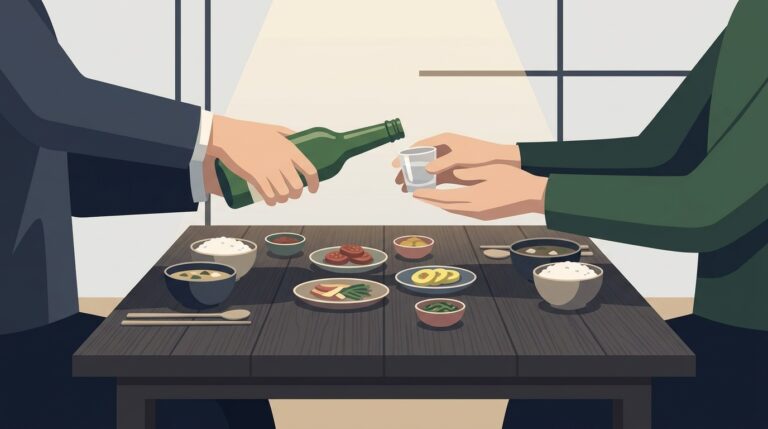
* The Two-Hand Rule: When pouring or receiving a drink, or passing a dish, always use two hands. Hold the bottle/glass with your right hand, and lightly support your right forearm or wrist with your left hand. This historical gesture stems from holding back the wide sleeves of traditional Hanbok.
* The Angle of the Glass: When drinking with someone of higher status, turn your head slightly away from them and cover your mouth and glass with your hand as you sip. Drinking directly in front of an elder or superior is considered confrontational.
* Table Taboos: Never stick your chopsticks vertically into a bowl of rice. This mimics incense burned at ancestral funerals (Jesa) and is considered extremely bad luck.
4-2. The “Hoe-sik” (회식) Culture
Hoesik (company dining/drinking sessions) is where the real business happens in Korea. It is the crucible where trust is forged outside the sterile walls of the office. Understanding that Hoesik is an extension of work, rather than a leisure activity, is the ultimate mark of a C2-level global professional.
Phase 5: Real-World Roleplay Scenario
Setting: Private dining room at a premium Korean beef (Han-u) restaurant in Gangnam.
Characters:
* You (C2 Global Liaison)
* Director Park (박 부장님) – Senior Director of a major Korean tech conglomerate.
- Turn 1 (Director Park): (Grabbing the bottle of Premium Soju) 자, 오늘 우리 글로벌 파트너십을 위해 한잔합시다. 잔을 주시지요.
- Turn 2 (You): 🎭 [Receiving the glass with both hands, supporting your right wrist with your left hand] 네, 부장님. 영광입니다. 제가 한잔 올리겠습니다.
- Turn 3 (Director Park): (Pouring the drink carefully) 우리 회사와 일하게 된 소감이 어떻습니까?
- Turn 4 (You): 🎭 [Turning your head slightly to the left, taking a polite sip, and turning back] 귀사와 함께하게 되어 매우 기쁩니다. 부장님의 혜안과 지도력 아래 많은 것을 배우고 싶습니다.
- Turn 5 (Director Park): (Smiling warmly, picking up his chopsticks) 좋습니다. 자, 고기가 아주 잘 익었네요. 맛있게 드십시오.
- Turn 6 (You): 🎭 [Waiting until Director Park puts the first piece of meat in his mouth, then picking up your chopsticks] 감사합니다. 부장님께서 먼저 드신 후에 맛있게 먹겠습니다.
- Turn 7 (Director Park): 허허, 역시 예의가 바르시군요. 오늘 계약 건은 아주 잘 진행될 것 같습니다.
- Turn 8 (You): 🎭 [Lowering your chopsticks slightly to show respect] 좋게 봐주셔서 진심으로 감사드립니다. 실망시켜 드리지 않도록 최선을 다하겠습니다.
🔀 Interactive Choice Point
At the end of the meal, Director Park offers you a second round of strong alcohol, but you have hit your physical limit. What do you do?
* A. “아니요, 저는 이제 못 마십니다.” (No, I cannot drink anymore.)
* B. “마음은 굴뚝같지만, 내일 아침 일찍 중요한 보고가 있어 더 받지 못함을 널리 양해해 주시기 바랍니다.” (My heart wishes to, but I beg your broad understanding as I have an important morning report tomorrow.)
* C. Accept the drink but silently pour it away into a water cup when he is not looking.
💡 Feedback on Choices:
- Choice A (Bad): Extremely blunt. It breaks the harmony (Hwa) of the table and could be perceived as rude.
- Choice B (Best): Polite, uses highly professional honorifics, and provides a logical, work-related excuse that a Korean boss will deeply respect.
- Choice C (Risk): High risk. If caught, this is seen as a severe breach of trust and deception. Avoid this.
Phase 6: 10-Second Emotional Shadowing Drill
Practice these sentences focusing on pitch, pauses (/), and emotional delivery to sound like a native executive.
- [😊 Expressing deep respect & humility]
먼저 수저를 / 드신 후에 / 시작하겠습니다.
(Meon-jeo su-jeo-reul / deu-sin hu-e / si-jak-ha-get-seup-ni-da.) -
[🤝 Sincere and polite refusal]
마음은 / 굴뚝같지만, / 양해를 / 부탁드립니다.
(Mae-eum-eun / gul-ttuk-gat-ji-man, / yang-hae-reul / bu-tak-deu-rim-ni-da.)
Phase 7: K-Culture Mini-Dictionary
- 수저 (Su-jeo): Spoon and chopsticks set. Never hold both in one hand simultaneously.
- 아랫사람 (A-raet-sa-ram): Subordinate or younger person. In dining, they are responsible for grilling meat and keeping cups filled.
- 상석 (Sang-seok): The seat of honor. Usually the seat furthest from the entrance, facing the door.
- 주도 (Ju-do): Drinking etiquette. The philosophy and rules governing how alcohol is served and consumed in Korea.
Phase 8: Traveler’s Survival Kit
Survival Phrases
- 앞접시 하나만 주시겠습니까? (Ap-jeop-si ha-na-man ju-si-get-seup-ni-ca? – “Could I please have an extra small side plate?”)
- 물수건 좀 더 주십시오. (Mul-su-geon jom deo ju-sip-si-o. – “Please bring me some wet wipes/towels.”)
- 이것은 어떻게 먹는 것입니까? (I-geo-seun eo-tteo-ke meok-neun geo-sim-ni-ka? – “How do you eat this dish?”)
💡 Editor’s Travel Note: When navigating high-end restaurants in Seoul, booking is essential. Do not rely on general global search engines. Download the Catch Table App (캐치테이블) to reserve exclusive private dining rooms directly, ensuring a smooth corporate hosting experience.
Phase 9: “Going Deeper” (Reflective Thought)
Korean dining etiquette is a living map of Confucianism. The linguistic shifts (from Banmal to Hap-si-o-che) and physical adjustments (two hands, turning the head) reflect a deep-rooted belief that individual comfort must yield to collective harmony. When you master these behaviors, you are not merely copying gestures; you are communicating that you value their societal order and respect their worldview.
💬 Your Turn: Have you ever experienced a business dinner where a non-verbal cultural misunderstanding occurred? How did you handle it? Let us know in the comments below!
Phase 10: FAQ & Avoiding Common Mistakes
Q: Can I pour my own drink if no one is offering?
A: Generally, no. Pouring your own drink (Mat-jan) is seen as lonely or unsocial. If your glass is empty, pour a drink for someone else first, and they will naturally return the favor.
Q: What if I have dietary restrictions? How do I say it politely?
A: Say it in advance using honorifics: “체질상/종교적인 이유로 특정 음식을 삼가고 있습니다. 양해 부탁드립니다.” (Due to physical/religious reasons, I refrain from certain foods. I request your understanding.)
Q: Is it okay to lift my bowl while eating rice?
A: Unlike in Japan or China, lifting your rice bowl (Bap-gong-gi) off the table in Korea is traditionally considered unrefined. Leave the bowl on the table and use your spoon to eat.
🚨 Common Mistakes Alert!
- Chopstick Drumming: Tapping your bowl with chopsticks or spoons. (Correct Action: Rest them quietly on the utensil holder or napkin.)
- Blowing Your Nose: Blowing your nose loudly at the table. (Correct Action: Excuse yourself to the restroom if you need to blow your nose.)
- Utensil Speeding: Eating faster than the host. (Correct Action: Match the pacing of the highest-ranking person at the table.)
Phase 11: Action Mission & Engagement
- Bronze Medal: Say “맛있게 드십시오” out loud with correct head turning gestures in front of your mirror.
- Silver Medal: Watch a Korean business drama (e.g., Queen of Tears or Misaeng) and spot 3 table etiquettes mentioned in this article.
- Gold Medal: The next time you visit a Korean restaurant, use the two-hand rule for all exchanges and order using “정갈하다” to describe the side dishes.
Phase 12: Interactive Quiz Challenge
Test your executive table manners!
1. Where should the highest-ranking executive (VIP) sit?
- A) Closest to the entrance
- B) In the middle of the table
- C) Furthest from the door, facing it
Click to reveal the Answer
Correct Answer: C
Explanation: The seat furthest from the entrance, offering a clear view of the room and maximum privacy, is the traditional ‘Sang-seok’ (seat of honor).
2. True or False: You should hold both your spoon and chopsticks in one hand when eating soup and rice quickly.
- A) True
- B) False
Click to reveal the Answer
Correct Answer: B (False)
Explanation: You should use only one utensil at a time. Hold either the spoon or the chopsticks, never both in the same hand together, as it looks rushed and ill-mannered.







