

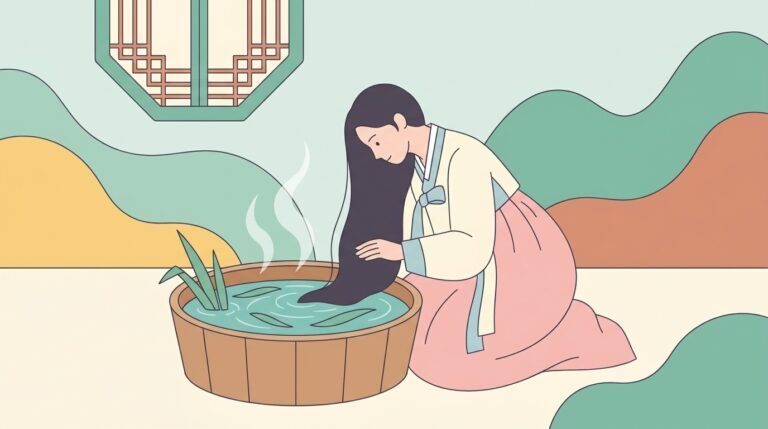
Head Out to Dano: Wash Your Hair the Traditional Way with Changpo!
Phase 1: Empathy (An Immersive Opening)
안녕하세요! (Annyeonghaseyo!) I’m your Daily Hangul Senior Editor and cultural navigator.
Imagine walking into a lush, green valley in early summer. The air is thick with the scent of wild irises, and you see people laughing, splashing water, and washing their long, dark hair in a steaming brew of fresh herbs. This isn’t a scene from a historical K-Drama; it’s Dano (단오), one of Korea’s most vibrant traditional holidays!
Historically celebrated on the 5th day of the 5th lunar month, Dano marks the beginning of summer. Its most iconic ritual? Changpomul meori gamgi (창포물 머리 감기)—washing your hair in water boiled with sweet flag (iris) roots.
When C1-level learners first read about this in historical texts, they often struggle with the sophisticated, poetic vocabulary used to describe these customs. You might wonder: How do I discuss these deep cultural traditions in natural, high-level Korean without sounding like a dusty history textbook? Today, we’ll bridge that gap! Let’s master the elegant vocabulary of Korean seasonal customs (세시 풍속 – sesi pungsok) so you can confidently converse with locals about heritage, beauty rituals, and the poetic flow of Korean seasons.
Phase 2: In-Depth Analysis of 3 Key Expressions
1. 창포물에 머리를 감다 (Changpomure meorireul gamda)
- Pronunciation: Chang-po-mool-ae muh-ree-reul gahm-da (Sounds like “Chang-po” + “mool” [water] + “ae” [at/in] + “muh-ree” [head/hair] + “gam-da” [to wash hair])
- Meaning: To wash one’s hair in iris-infused water.
- K-Culture Moment: You will see this expression featured in historical K-Dramas (Sageuk) during festive market scenes, where characters prepare for the summer solstice to ward off evil spirits.
- Editor’s Insight: While ‘씻다’ (ssitda) is a general term for washing, 감다 (gamda) is used exclusively for hair. Saying “머리를 씻다” sounds highly unnatural to a native ear.
- Situation Spectrum: Casual (✅) | Semi-formal (✅) | Formal (✅)
- 🤔 Think About It: Why does Korean have a specific verb just for washing hair (감다), while English uses “wash” for almost everything? How does this reflect the detailed attention Korean culture pays to personal grooming?
2. 무병장수를 기원하다 (Mubyeongjangsureul giwonhada)
- Pronunciation: Moo-byung-jang-soo-reul gee-won-ha-da (Think of “Moo” [without] + “byung” [disease] + “jang-soo” [long life])
- Meaning: To pray for good health and longevity.
- K-Culture Moment: Often uttered by elders during traditional holidays or when giving gifts like the embroidered Dano fans (단오선).
- Editor’s Insight: This is an elegant Four-Character Idiom compound (사자성어 – sa-ja-seong-eo). Utilizing this in conversations about holidays instantly elevates your Korean to a sophisticated, educated C1 level.
- Situation Spectrum: Casual (⚠️ – sounds too dramatic) | Semi-formal (✅) | Formal (✅)
- 🤔 Think About It: What symbols of longevity exist in your culture, and how do you verbally express wishes for someone’s long and healthy life?
3. 액운을 물리치다 (Aeguneul mullichida)
- Pronunciation: Aeg-oon-eul mool-ree-chi-da (Sounds like “Aeg-oon” [bad luck/misfortune] + “mullichida” [to repel/ward off])
- Meaning: To ward off bad luck or evil spirits.
- K-Culture Moment: Seen in cultural documentaries and fantasy K-Dramas where shamans or traditional rituals are performed to protect a village.
- Editor’s Insight: ‘액운’ (aegun) refers specifically to misfortune destined by fate. ‘물리치다’ carries a dynamic, active force of pushing away or defeating an enemy.
- Situation Spectrum: Casual (⚠️) | Semi-formal (✅) | Formal (✅)
- 🤔 Think About It: Dano occurs when yang energy (양기) is at its peak. Why do you think people felt the need to ward off evil spirits right before the heavy summer rains?
Phase 3: Textbook Korean vs. Real-Life Korean
Let’s compare stiff, textbook explanations with how native Koreans actually talk about these traditions today.
Situation 1: Explaining the benefits of Changpo water
- 📖 Textbook Korean: “창포물로 머리를 감으면 머리카락에 윤기가 나고 빠지지 않습니다.”
(If you wash your hair with Changpo water, your hair becomes glossy and does not fall out.) - 🗣️ Real-Life Korean: “창포물로 감으면 머릿결이 찰랑찰랑해지고 탈모 예방에도 직방이래요.”
(They say washing with Changpo water makes your hair super silky and works wonders for preventing hair loss.) - 💡 Why the difference? C1 speakers use onomatopoeia like 찰랑찰랑 (cheallang-cheallang – fluttering/silky hair) and slang like 직방 (jik-bang – highly/instantly effective) to make their speech sound alive and natural.
Situation 2: Expressing skepticism or curiosity about old customs
- 📖 Textbook Korean: “저는 현대 과학 시대에 그 풍습이 효과가 있는지 의문이 듭니다.”
(I doubt whether that custom is effective in the era of modern science.) - 🗣️ Real-Life Korean: “에이, 요즘 세상에 밑져야 본전인데 재미 삼아 한번 해보는 거죠, 뭐!”
(Oh come on, in this day and age, there’s nothing to lose, so why not just do it for fun!) - 💡 Why the difference? 밑져야 본전 (mit-jyeo-ya bon-jeon) is an incredibly common idiomatic expression meaning “nothing to lose” or “worth a shot anyway.”
Phase 4: K-Culture Deep Dive & Non-Verbal Manners
4-1. Nunchi & Physical Manners during Traditional Festivals
When participating in a Dano reenactment festival (like the famous Gangneung Danoje Festival):
* The Gentle Rinse: When washing your hair or dipping your hands in Changpo water, do not splash wildly. Keep your movements graceful. Gently cup the water and let it pour over your hair.
* Respectful Curiosity: If elders are explaining the custom, tilt your head slightly forward (a sign of active listening) and make soft exclamations of agreement like “아~ 그렇군요!” (Ah~ I see!).
4-2. Cultural Code Analysis: The Beauty Science of Ancestors
Koreans have always valued rich, thick, black hair as a sign of vitality and beauty. Historically, Dano was a rare day of freedom in a highly restricted Confucian society where women could gather outdoors, swing on giant swings (그네뛰기), and wash their hair in the valley. Modern scientific research has actually proven that sweet flag (Changpo) contains asarone and oils that moisturize the scalp and give hair a natural sheen—showing that traditional 세시 풍속 was not just superstition, but an ancestor’s brilliant bio-science!
Phase 5: Real-Life Roleplay Scenario
The Setting
You are visiting the Namsangol Hanok Village during the Dano Festival. You meet Ji-min (지민), a passionate local cultural guide who is showing visitors the giant steaming pots of boiled Changpo water.
지민: 🎭 (환하게 웃으며) 안녕하세요! 오늘 단오 맞이 창포물 머리 감기 체험 한 번 해보시겠어요?
      (Annyeonghaseyo! Today, to celebrate Dano, would you like to try our Changpo water hair-washing experience?)

유저: 🎭 (관심을 보이며) 아, 이게 그 말로만 듣던 창포물이군요! 향이 정말 독특하네요.
      (Ah, so this is the famous Changpo water I've only heard about! The scent is really unique.)

지민: 🎭 (고개를 끄덕이며) 맞아요. 옛날에는 단옷날 이 물로 머리를 감으면 액운을 물리치고 머릿결이 고와진다고 믿었대요.
      (Exactly. In the old days, they believed that washing your hair with this water on Dano would ward off bad luck and make your hair beautiful.)

유저: 🎭 (미소를 지으며) 안 그래도 요즘 스트레스 때문에 머리가 많이 빠지는데, 탈모 예방에도 효과가 있을까요?
      (Actually, I've been losing a lot of hair lately due to stress. Would it be effective for hair loss prevention too?)

지민: 🎭 (엄지를 치켜세우며) 그럼요! 창포가 두피 진정에 엄청 좋아서 탈모 예방에 직방이에요. 한 번 적셔보실래요?
      (Of course! Changpo is amazing for soothing the scalp, so it works wonders for hair loss prevention. Want to wet your hair with it?)

유저: 🎭 (소매를 걷어붙이며) 밑져야 본전인데, 올여름 무병장수를 기원하면서 제대로 한번 감아볼게요!
      (Nothing to lose! Praying for good health and longevity this summer, let's give it a proper wash!)

지민: 🎭 (대야와 수건을 건네며) 좋습니다! 머리를 적실 때 이 향긋한 풀 내음을 온전히 느껴보세요.
      (Great! When you wet your hair, fully feel this fragrant grassy scent.)

유저: 🎭 (머리에 물을 적시며) 와, 머리가 맑아지는 기분이에요. 전통 방식을 이렇게 직접 체험하니 정말 뜻깊네요.
      (Wow, I feel my mind clearing up. Experiencing the traditional way like this is truly meaningful.)
🔀 Interactive Choice Points
Now, how would you respond to Ji-min’s final comment? Choose your path:
- Option A: “네, 조상들의 지혜가 담긴 문화니까 보존해야 해요.”
- Option B: “진짜 그래요! 머리가 시원해지면서 스트레스가 싹 날아가는 느낌이에요. 친구들한테도 소문내야겠어요!”
- Option C: “그런데 이 물은 매일 끓여야 하나요? 너무 귀찮겠어요.”
📊 Feedback on Your Choice:
- Option A (Safe but Stiff – Bad): Grammatically perfect, but sounds like a dry textbook. It stops the lively flow of the friendly conversation.
- Option B (The Ultimate Conversationalist – Best): Excellent! You used high-level expressive vocabulary (싹 날아가다 – to completely fly away/disappear) and showed natural enthusiasm, matching the cultural vibe.
- Option C (Cultural Buzzkill – Risk): While practical, bringing up “laziness” (귀찮다) during a beautiful traditional experience might dampen the celebratory mood.
Phase 6: 10-Second Emotion Shadowing Drill
Let’s practice speaking with the exact rhythmic pauses (/) and emotional tone of a native speaker.
- [😊 Expressing delightful surprise & curiosity]
- 아, / 이게 그 말로만 듣던 / 창포물이군요! / 향이 정말 / 독특하네요.
- Ah, / i-ge geu mal-lo-man deut-deon / chang-po-mul-i-gun-yo! / hyang-i jeong-mal / dok-teuk-ha-ne-yo.
- [🔥 Energetic & Confident determination]
- 밑져야 본전인데, / 올여름 무병장수를 기원하면서 / 제대로 한번 / 감아볼게요!
- Mit-jyeo-ya bon-jeon-in-de, / ol-yeo-reum mu-byeong-jang-su-reul gi-won-ha-meon-seo / je-dae-ro han-beon / gah-mah-bol-ge-yo!
Phase 7: K-Culture Mini-Dictionary
- 단오 (Dano) | The 5th day of the 5th lunar month; a major traditional holiday celebrating spring’s end and welcoming energetic summer light.
- 창포 (Changpo) | Sweet flag (Acorus calamus). A wild wetland plant with aromatic leaves and roots historically used for cleansing and medical purposes.
- 무병장수 (Mubyeong-jangsu) | No sickness, long life. A core traditional value of wishing healthy longevity to friends and family.
- 세시 풍속 (Sesi pungsok) | Seasonal customs. Traditional Korean practices, rituals, and games associated with specific times of the lunar calendar.
Phase 8: Survivor’s Kit for Travelers
Survival Expressions TOP 3
- 체험비는 얼마인가요? (Che-heom-bi-neun eol-ma-in-ga-yo?) | How much is the experience/participation fee?
- Pro Tip: Many cultural events at Hanok villages are actually free, but always ask this first to show respect.
- 수건은 따로 준비해야 하나요? (Su-geon-eun tta-ro jun-bi-hae-ya ha-na-yo?) | Do I need to bring my own towel?
- 머리를 완전히 안 감고 손만 적셔도 되나요? (Meo-ri-reul wan-jeon-hi an gam-go son-man jeok-shyeo-do doe-na-yo?) | Can I just dip my hands instead of washing my entire head of hair?
Editor’s Travel Note
If you want to experience authentic Dano celebrations, look up the Gangneung Danoje Festival Official Site or search for “Namsangol Hanok Village” on your Naver Map App. These festivals typically happen in early-to-mid June (depending on the lunar calendar). Note: Event details and schedules change annually, so check official schedules prior to visiting.
Phase 9: “Going One Step Deeper” (Cultural Insight)
Traditional Korean holidays are deeply rooted in the concept of coexistence with nature. Rather than trying to conquer the scorching heat of the upcoming summer, our ancestors prepared their bodies and minds using natural herbs like Changpo and mugwort (쑥). It was a communal event designed to clean up, play together, and wish each other well before the grueling farming season began.
💬 Your Turn: Does your culture have a traditional day or a specific natural ingredient used to welcome summer or wash away bad luck? Let us know in the comments below!
Phase 10: FAQ & Common Mistakes
Q: Can I buy real Changpo shampoo in Korean supermarkets?
A: Yes! Many modern Korean beauty brands utilize “창포” extract in their premium scalp-care lines. Look for bottles containing the characters 창포 on the label.
Q: Is Dano a national public holiday in Korea today?
A: No, Dano is not an official day off from work, unlike Chuseok or Seollal. However, it is celebrated widely through regional folk festivals and municipal cultural centers.
Q: Is “Changpo” the exact same thing as the Western yellow iris?
A: While often translated as “iris” in general English, Korean Changpo (Acorus calamus) is scientifically a “sweet flag” plant, which belongs to a different family than the standard ornamental iris.
🚨 Common Mistakes Alert!
- Mistake 1: Saying “머리를 씻다” (meo-ri-reul ssit-da).
- Correct Action: Always use 머리를 감다 (meo-ri-reul gam-da) when talking about washing hair.
- Mistake 2: Confusing “단오” (Dano) with “단오선” (Danoseon).
- Correct Action: Dano is the holiday; Danoseon refers specifically to the cooling fans gifted on that day.
- Mistake 3: Pronouncing ‘창포물’ as chang-po-mool with a hard ‘p’.
- Correct Action: Soften the ‘p’ slightly so it glides smoothly into ‘mool’.
Phase 11: Action Mission
- 🥉 Bronze Mission: Read the two shadowing sentences in Phase 6 aloud 3 times with the correct pauses.
- 🥈 Silver Mission: Share this post on your social media with the hashtag
#DailyHanguland write one thing you do to ward off bad luck before summer. - 🥇 Gold Mission: Next time you wash your hair, look in the mirror and say out loud in Korean: “오늘 창포물은 아니지만, 머리 감고 액운을 싹 물리치자!” (Today isn’t Changpo water, but let’s wash my hair and sweep away all bad luck!)
Phase 12: Interactive Quiz Challenge
Test your knowledge of Dano and high-level Korean terms!
1. Which of the following is the correct verb for washing hair?
a) 머리를 씻다
b) 머리를 빨다
c) 머리를 감다
2. True or False: “밑져야 본전” means that you will lose all your money anyway.
👉 Click here for the Answers & Explanations!
-
Answer: c) 머리를 감다.
Explanation: ‘씻다’ is for hands/body, ‘빨다’ is for laundry, and 감다 is exclusively for hair. -
Answer: False.
Explanation: 밑져야 본전 means “nothing to lose” (even if things go wrong, you end up where you started, i.e., at break-even). It encourages taking a low-risk shot!







