

Phase 1: Empathy (Welcome, History Explorers!)
안녕하세요! (An-nyeong-ha-se-yo!) Hello, my lovely K-culture family! It’s your favorite Korean bestie and Daily Hangul’s Senior Editor here.
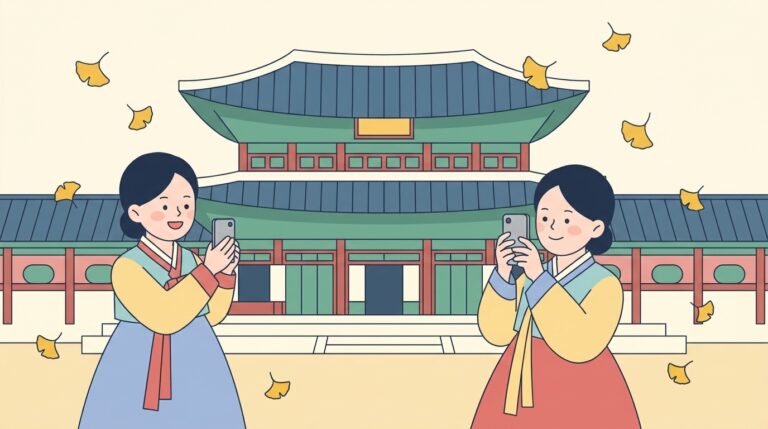
Imagine this: You are standing in the middle of Gyeongbokgung Palace (경복궁). The autumn leaves are a brilliant gold, and you’re wearing a beautiful, flowing Hanbok (한복). You want to ask the guide about the kings who walked these very stones, or maybe you want to chat with a local friend about how cool Korean history is. But suddenly… you freeze. “How do I say ‘dynasty’?” “Is ‘history’ yeok-sa or something else?”
Learning history in a new language can feel like climbing a mountain. You want to sound respectful but natural, not like a dry, dusty textbook from the 1980s! Today, we are going to unlock the most beautiful, practical, and easy Korean words and phrases for studying and discussing history (역사 공부 – yeok-sa gong-bu).
This guide is tailor-made for our A2-level beginners who want to explore palaces, temples, and K-dramas with confidence. Let’s dive in! 🌸
Phase 2: Deep Dive into Top 3 Essential Historical Phrases
1. 여기가 어떤 곳이에요? (Yeo-gi-ga eo-tteon gos-i-e-yo?)
- Pronunciation: Yuh-gee-gah uh-ttuhn goht-ee-ae-yo? (Sounds like “Yo-gee-gah” + “uh-ttuhn” + “goh-see-eh-yo”)
- Meaning: “What kind of place is this?” (Literal: “Here is what kind of place?”)
- K-Culture Moment: You will hear this constantly in travel variety shows like 2 Days & 1 Night or Battle Trip when the cast arrives at a mysterious historical monument.
- Editor’s Insight: Instead of asking “What is this?” (이게 뭐예요?), asking “What kind of place is this?” makes you sound much more polite and genuinely curious about the cultural background.
- Situation Spectrum:
- Casual (with friends): 여기가 어떤 곳이야? (Yeo-gi-ga eo-tteon gos-i-ya?) ⚠️
- Semi-formal (to guides/strangers): 여기가 어떤 곳이에요? (Yeo-gi-ga eo-tteon gos-i-e-yo?) ✅
- Formal (very polite): 이곳은 어떤 곳입니까? (I-gos-eun eo-tteon gos-im-ni-ka?) 🚫 (Too stiff for a casual tour)
- 🤔 Think About It: In Korean culture, space and place carry deep emotional memories. Asking “what kind of place” shows you care about the story of the land, not just the physical object.
2. 역사 공부가 재미있어요. (Yeok-sa gong-bu-ga jae-mi-is-seo-yo.)
- Pronunciation: Yuhk-sah gong-boo-gah jae-mee-eet-suh-yo.
- Meaning: “Studying history is fun!”
- K-Culture Moment: If you watch historical K-dramas (사극 – Sa-geuk) like The King’s Affection or Under the Queen’s Umbrella, you might see scholars studying hard. This phrase is perfect for expressing your new passion!
- Editor’s Insight: ‘역사’ (yeok-sa) means history. Many beginners confuse it with ‘약사’ (yak-sa), which actually means pharmacist! Be careful with that ‘yeo’ (여) sound!
- Situation Spectrum:
- Casual: 역사 공부 진짜 재밌어! (Yeok-sa gong-bu jin-jja jae-mit-eo!) ✅
- Semi-formal: 역사 공부가 재미있어요. (Yeok-sa gong-bu-ga jae-mi-is-seo-yo.) ✅
- Formal: 역사 공부가 흥미롭습니다. (Yeok-sa gong-bu-ga heung-mi-rop-seum-ni-da.) ⚠️ (A bit too formal for casual chatting)
3. 여기는 조선 시대 건물이에요. (Yeo-gi-neun Jo-seon si-dae geon-mul-i-e-yo.)
- Pronunciation: Yuh-gee-nuhn Jo-suhn she-dae guhn-mool-ee-ae-yo.
- Meaning: “This is a building from the Joseon Dynasty.”
- K-Culture Moment: Think of almost every historical K-drama set in a palace—that’s the Joseon Dynasty (조선 시대), which lasted for over 500 years!
- Editor’s Insight: ‘시대’ (si-dae) means era or period. You can pair it with many words. For example, Girls’ Generation is ‘소녀시대’ (So-nyeo-si-dae) – literally “Girls’ Era”!
- Situation Spectrum:
- Casual: 여기 조선 시대 건물이야. (Yeo-gi Jo-seon si-dae geon-mul-i-ya.) ⚠️
- Semi-formal: 여기는 조선 시대 건물이에요. (Yeo-gi-neun Jo-seon si-dae geon-mul-i-e-yo.) ✅
- Formal: 이곳은 조선 시대 건축물입니다. (I-gos-eun Jo-seon si-dae geon-chung-mul-im-ni-da.) ⚠️ (Very textbook-like)
Phase 3: Textbook Korean vs. Real-Life Korean
Let’s look at how textbooks teach history talk versus how real Koreans actually say it!
Situation 1: Expressing admiration for a historical site
- 📖 Textbook Korean: 이 유적지는 매우 아름답습니다. (I yu-jeok-ji-neun mae-u a-reum-dap-seum-ni-da.)
- “This historical site is very beautiful.” (Very formal and stiff)
- 🗣️ Real-Life Korean: 우와, 여기 분위기 진짜 대박이에요! (U-wa, yeo-gi bun-wi-gi jin-jja dae-bak-i-e-yo!)
- “Wow, the vibe here is absolutely amazing!”
- 💡 Why the difference? Modern Koreans love using the word 분위기 (bun-wi-gi – vibe/atmosphere) and 대박 (dae-bak – awesome/great) to express genuine awe in a warm, friendly way.
Situation 2: Asking if a drama is based on real history
- 📖 Textbook Korean: 이 드라마는 실제 역사와 일치합니까? (I de-ra-ma-neun sil-je yeok-sa-wa il-chi-ham-ni-ka?)
- “Does this drama coincide with real history?” (Sounds like a university thesis!)
- 🗣️ Real-Life Korean: 이 드라마, 진짜 역사 이야기예요? (I de-ra-ma, jin-jja yeok-sa i-ya-gi-yeo-yo?)
- “Is this drama a true history story?”
- 💡 Why the difference? Using simple words like 진짜 이야기 (jin-jja i-ya-gi – true story) is much more natural for A2 learners and native speakers alike in daily conversations.
Phase 4: K-Culture Deep Dive & Non-Verbal Manners
4-1. Palace Manners & Gestures
When visiting historical sites in Korea, showing respect to the heritage is highly valued. Here are two quick tips:
1. The ‘Two-Hand’ Rule: When someone hands you a brochure or a ticket at a historical site, receive it with both hands (or put your left hand gently under your right forearm). This shows deep respect!
2. Hanbok Power: If you wear a Hanbok (traditional Korean dress) to Gyeongbokgung or Changdeokgung Palace, entry is completely free! It’s a wonderful cultural exchange gesture that locals love to see.
4-2. The King of History: King Sejong (세종대왕)
You cannot study Korean history without mentioning King Sejong the Great. He is the absolute MVP of Korean history because he created Hangeul (한글), the Korean alphabet, in 1443! When you visit Gwanghwamun Plaza in Seoul, you will see his massive golden statue. Knowing even a little bit about him instantly warms the hearts of Korean locals.
Phase 5: Real-Life Roleplay Scenario
Setting: Gyeongbokgung Palace on a sunny afternoon. You are talking with Ji-hoo (지후), a friendly volunteer student guide who loves history.
Ji-hoo: 🎭 (Smiling warmly, bowing slightly)
        안녕하세요! 경복궁에 오신 것을 환영합니다.
        An-nyeong-ha-se-yo! Gyeong-bok-gung-e o-sin geos-eul hwan-yeong-ham-ni-da.
        (Hello! Welcome to Gyeongbokgung Palace.)

You:    🎭 (Bowing back with a smile)
        안녕하세요! 여기가 어떤 곳이에요?
        An-nyeong-ha-se-yo! Yeo-gi-ga eo-tteon gos-i-e-yo?
        (Hello! What kind of place is this?)

Ji-hoo: 🎭 (Pointing gently to the main hall)
        여기는 조선 시대의 가장 큰 궁궐이에요. 역사 공부 좋아하세요?
        Yeo-gi-neun Jo-seon si-dae-ui ga-jang keun gung-gwol-i-e-yo. Yeok-sa gong-bu jo-a-ha-se-yo?
        (This is the largest palace of the Joseon Dynasty. Do you like studying history?)

You:    🎭 (Nodding enthusiastically)
        네! 역사 공부가 재미있어요. 드라마도 많이 봐요.
        Ne! Yeok-sa gong-bu-ga jae-mi-is-seo-yo. De-ra-ma-do ma-ni bwa-yo.
        (Yes! Studying history is fun. I also watch a lot of dramas.)

Ji-hoo: 🎭 (Delighted)
        우와, 정말요? 어떤 한국 드라마를 좋아해요?
        U-wa, jeong-mal-yo? Eo-tteon Han-guk de-ra-ma-reul jo-a-hae-yo?
        (Wow, really? What kind of Korean dramas do you like?)

You:    🎭 (Thinking for a second)
        사극 드라마 다 좋아해요. 특히 한복이 너무 예뻐요.
        Sa-geuk de-ra-ma da jo-a-hae-yo. Teuk-hi han-bok-i neo-mu yeop-peo-yo.
        (I like all historical dramas. Especially, Hanbok is so beautiful.)

Ji-hoo: 🎭 (Thumbing up)
        맞아요! 오늘 한복 입은 모습도 정말 잘 어울려요!
        Ma-ja-yo! O-neul han-bok ib-eun mo-seup-do jeong-mal jal eo-ul-lyeo-yo!
        (That's right! You look really great in your Hanbok today, too!)

You:    🎭 (Blushing slightly, bowing)
        감사합니다! 더 많이 배우고 싶어요.
        Gam-sa-ham-ni-da! Deo ma-ni bae-u-go sip-eo-yo.
        (Thank you! I want to learn more.)
🔀 Interactive Choice Point
How do you want to respond to Ji-hoo next?
* Option A: “궁궐이 진짜 커요!” (The palace is really big!) ➔ [Best] Perfect, natural reaction showing your awe.
* Option B: “공부하기 싫어요.” (I don’t want to study.) ➔ [Bad] Oh no, too negative after saying you love history!
* Option C: “세종대왕님 사랑해요!” (I love King Sejong!) ➔ [Risk] Cute and funny, but might catch Ji-hoo off guard!
Phase 6: 10-Second Emotion Shadowing Drill
Let’s practice speaking with real Korean emotions! Pause at the / and speak with the emotion in the brackets.
[😊 Excited & Happy]
우와, / 여기 분위기 / 진짜 대박이에요!
(U-wa, / yeo-gi bun-wi-gi / jin-jja dae-bak-i-e-yo!)-
[🤔 Curious & Soft]
실례지만, / 여기가 / 어떤 곳이에요?
(Sil-rye-ji-man, / yeo-gi-ga / eo-tteon gos-i-e-yo?) -
[💖 Proud & Passionate]
저는 / 한국 역사 공부가 / 정말 재미있어요!
(Jeo-neun / Han-guk yeok-sa gong-bu-ga / jeong-mal jae-mi-is-seo-yo!)
Phase 7: K-Culture Mini Dictionary
- 사극 (Sa-geuk) | Historical Drama/Movie
- Everyday Use: “너 그 사극 봤어?” (Did you watch that historical drama?) Used to describe any media set in past Dynasties.
- 문화재 (Mun-hwa-jae) | Cultural Property / Heritage
- Everyday Use: Used when referring to protected historical buildings, treasures, or traditional arts.
- 가이드 (Ga-i-deu) | Tour Guide
- Everyday Use: Loans from English, widely used for museum, city, or palace tour guides.
- 박물관 (Bang-mul-gwan) | Museum
- Everyday Use: A must-know word if you love history! “국립중앙박물관” is the National Museum of Korea.
Phase 8: Survivor’s Travel Kit
Survival Phrases Top 3
- 여기 한국어 안내 책자 있어요? (Yeo-gi Han-gug-eo an-nae chaek-ja is-seo-yo?)
- Meaning: Do you have a Korean (or English) brochure here? (Pro-tip: Swap “Han-gug-eo” with “Yeong-eo” for English!)
- 사진 찍어도 돼요? (Sa-jin jjik-eo-do dwae-yo?)
- Meaning: May I take a picture? (Essential inside temples or museums!)
- 화장실이 어디예요? (Hwa-jang-sil-i eo-di-yeo-yo?)
- Meaning: Where is the restroom? (The absolute ultimate survival phrase!)
Editor’s Travel Note
Before heading out, make sure to download the Naver Map App—it is far more accurate for finding historical alleyways in Seoul than Google Maps!
Please note: Entrance fees for palaces are subject to change, so check official palace websites before visiting! Free entry always applies if you are wearing a Hanbok.
Phase 9: “Going Deeper” (A Touch of Korean Mindset)
In Korea, history is not just about the past; it is a living part of the present. Koreans deeply respect their ancestors’ resilience and artistic spirit. When you learn terms like 조선 시대 (Joseon Dynasty) or talk about 세종대왕 (King Sejong), you are showing locals that you respect the roots of their modern culture. Language is the ultimate bridge of respect!
💬 Your Turn: Which Korean historical site do you want to visit first? Gyeongbokgung? Gyeongju? Let me know in the comments below!
Phase 10: FAQ & Common Mistakes
Q: Can I use informal Korean (Banmal) with tour guides if they look younger than me?
A: No, always use polite style (요-style/해요체) with tour guides and strangers, regardless of their age. It shows great manners!
Q: What is the difference between 궁 (Gung) and 궁궐 (Gung-gwol)?
A: ‘궁’ is a shorter, casual way to say palace (like Gyeongbok-gung). ‘궁궐’ is the formal, collective word for the palace complex.
Q: I want to say “I like history,” but I keep saying “I like story.” Help!
A: Remember, ‘역사’ (yeok-sa) is history. ‘이야기’ (i-ya-gi) is story. Keep practicing the difference!
🚨 Common Mistakes Alert!
- Wrong: “여기 뭐예요?” (Yeo-gi mwo-yeo-yo?) – What is here? (Sounds a bit blunt/rude)
- Correct Action: Use “여기가 어떤 곳이에요?” (What kind of place is this?) to sound polite and elegant.
Phase 11: Action Mission for Today
- Bronze Medal 🥉: Speak “역사 공부가 재미있어요” out loud 3 times in front of a mirror!
- Silver Medal 🥈: Go to Instagram or TikTok, find a video of Gyeongbokgung Palace, and comment: “여기 진짜 예뻐요!” (Here is really pretty!)
- Gold Medal 🥇 / K-Culture Mission: Watch one episode of a historical K-drama and try to spot the word “왕” (Wang – King) or “세자” (Se-ja – Crown Prince)!
Phase 12: Interactive Quiz Challenge
Test your new skills!
- How do you politely ask a guide, “What kind of place is this?”
- A) 여기 뭐야?
- B) 여기가 어떤 곳이에요?
- C) 역사 공부 재미있어요.
- True or False: Wearing a traditional Hanbok gets you free admission to Seoul’s main palaces.
- A) True
- B) False
🎉 Click here to see the answers!
1. Correct Answer: B (Option A is informal/rude, Option C means “studying history is fun”)
2. Correct Answer: A (True!) It is a wonderful way to experience Korean culture!







