

안녕하세요! Welcome to Daily Hangul!
Hello, my lovely language learners! I’m your lead editor and your personal K-Culture navigator. Have you ever stepped off a long-lasting flight at Incheon International Airport, with your favorite K-Pop playlist still buzzing in your ears, only to realize you don’t have a single South Korean Won (KRW) in your pocket? Your phone battery is low, and you need physical cash to buy a transit card. Your eyes scan the massive airport terminal, feeling a bit lost.
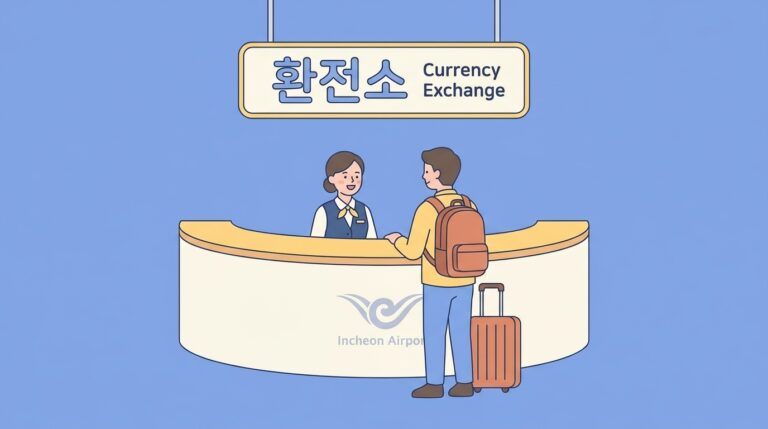
Don’t panic! Today, we are going to learn the ultimate magic phrase that will save your day at the airport: “환전소 어디예요?” (Where is the currency exchange?). Based on hundreds of real stories from our absolute beginner (A1) students, this guide will make sure you get your cash smoothly and confidently like a real Seoulite! Let’s dive in!
Phase 2: Top 3 Survival Phrases
1. 환전소 어디예요? (Hwan-jeon-so eo-di-yeo-yo?)
- Pronunciation: Hwan-jeon-so (sounds like “Juan-john-so”) + eo-di-yeo-yo (sounds like “uh-dee-yuh-yo?”)
- Meaning: “Where is the currency exchange booth?”
- K-Culture Moment: You will see this phrase in almost every travel vlog when creators land at Incheon Airport. It’s the very first step of any K-Travel adventure!
- Editor’s Insight: “환전소” means currency exchange booth, and “어디예요?” means “Where is it?”. It is polite, simple, and direct.
- Situation Spectrum: Casual: 🚫 | Semi-formal: ✅ | Formal: ⚠️
- 🤔 Think About It: In Korean, we often drop the subject (“I” or “You”) because the context makes it obvious. How does this compare to your native language?
2. 이거 환전해 주세요. (I-geo hwan-jeon-hae ju-se-yo.)
- Pronunciation: I-geo (“ee-guh”) + hwan-jeon-hae (“hwan-john-hae”) + ju-se-yo (“ju-seh-yo”)
- Meaning: “Please exchange this (money) for me.”
- K-Culture Moment: Handing over your foreign bills to the friendly bank clerk with a polite smile.
- Editor’s Insight: “이거” means “this” and “~해 주세요” is the magic polite formula for “Please do this for me.”
- Situation Spectrum: Casual: 🚫 | Semi-formal: ✅ | Formal: ⚠️
- 🤔 Think About It: Why is “주세요” (give me/please do) used so frequently in Korean daily life? What does it say about Korean politeness?
3. 감사합니다! (Gam-sa-ham-ni-da!)
- Pronunciation: Gam-sa-ham-ni-da (“gahm-sah-hahm-nee-dah”)
- Meaning: “Thank you!”
- K-Culture Moment: Bowing slightly when receiving your freshly printed Korean Won bills.
- Editor’s Insight: This is the universal polite “thank you” in Korea. Remember that the ‘b’ in “합” is pronounced like an ‘m’ sound (ham-ni-da), not hap-ni-da!
- Situation Spectrum: Casual: 🚫 | Semi-formal: ✅ | Formal: ✅
- 🤔 Think About It: Why does saying “thank you” with a small bow feel so warm and respectful in East Asian cultures?
Phase 3: Textbook Korean vs. Real Korean
Let’s compare the stiff textbook language with what you will actually hear and use at Incheon Airport!
Situation 1: Asking for directions
- 📖 Textbook: “환전소가 어디에 있습니까?” (Hwan-jeon-so-ga eo-di-e in-neup-ni-ka? – Highly formal, feels like a military manual!)
- 🗣️ Real Korean: “환전소 어디예요?” (Hwan-jeon-so eo-di-yeo-yo? – Natural, friendly, and perfectly polite for daily interactions.)
- 💡 Why the difference? Modern Koreans prefer short, efficient, and friendly “~요” endings over the stiff “~습니까” endings in public settings unless it is an ultra-formal corporate briefing.
Situation 2: Handing over your cash
- 📖 Textbook: “미국 달러를 한국 원화로 바꾸고 싶습니다.” (Mi-guk dal-reo-reul Han-guk won-hwa-ro ba-kku-go sip-seup-ni-da. – Too long!)
- 🗣️ Real Korean: “이거 원화로 바꿔 주세요.” (I-geo won-hwa-ro ba-kkwor ju-se-yo. – “Please change this to Won.”)
- 💡 Why the difference? At a busy airport booth, pointing at your cash and saying “this to Won, please” is faster and sounds much more natural to native speakers.
Phase 4: K-Culture Deep Dive & Non-verbal Manners
4-1. Nunchi & Body Language
When asking for directions in Korea, Nunchi (눈치 – situational quick-wittedness) is key!
1. The Polite Nod: When approaching an information desk or a currency clerk, start with a slight head tilt/nod. It shows instant respect.
2. Two-Hand Rule: When handing your passport and cash to the teller, always use both hands. Using one hand can seem impatient or rude. This small gesture instantly marks you as a cultured traveler!
4-2. The Airport K-Drama Scene
Think of your favorite K-Drama airport arrival scene. The characters look sleek, they hold their travel documents with care, and they navigate the terminal with calm confidence. By using these short phrases and the two-hand gesture, you are stepping right into your own cinematic Korean journey!
Phase 5: Real-Life Roleplay Scenario
Imagine you are at Incheon Airport Terminal 1. You walk up to an Airport Information Desk. The staff member, Min-ji (민지), is smiling warmly.
- You: 🎭 (Approaching with a warm smile) “저기요…” (Jeo-gi-yo… / Excuse me…)
- Min-ji: “네, 안녕하세요! 무엇을 도와드릴까요?” (Ne, an-nyeong-ha-se-yo! Mu-eot-eul do-wa-deu-ril-kka-yo? / Yes, hello! How can I help you?)
- You: 🎭 (Pointing gently towards your wallet) “환전소 어디예요?” (Hwan-jeon-so eo-di-yeo-yo? / Where is the currency exchange?)
- Min-ji: “아, 환전소요? 저기 오른쪽으로 가세요.” (A, hwan-jeon-so-yo? Jeo-gi o-reun-jjok-eu-ro ga-se-yo. / Ah, the currency exchange? Go to the right over there.)
- You: 🎭 (Nodding your head in understanding) “오른쪽이요?” (O-reun-jjok-i-yo? / To the right?)
- Min-ji: “네, 맞아요. 은행 바로 옆에 있어요.” (Ne, ma-ja-yo. Eun-haeng ba-ro yeop-e is-seo-yo. / Yes, correct. It’s right next to the bank.)
- You: 🎭 (Bowing slightly with a bright expression) “아, 감사합니다!” (A, gam-sa-ham-ni-da! / Ah, thank you!)
- Min-ji: “네, 즐거운 여행 되세요!” (Ne, jeul-geo-un yeo-haeng doe-se-yo! / Yes, have a great trip!)
🔀 Interactive Choice Point
Now you must walk to the booth. How will you ask the clerk to change your $100 bill?
* Choice A: “돈 주세요.” (Don ju-se-yo. – Give me money.)
* Choice B: “이거 원화로 바꿔 주세요.” (I-geo won-hwa-ro ba-kkwor ju-se-yo. – Please change this to Won.)
* Choice C: “환전!” (Hwan-jeon! – Currency exchange!)
Feedback:
- Choice A (Risk): Too blunt! It sounds like a robbery demand (“Give me money”). Avoid this!
- Choice B (Best): Perfect! It is polite, uses natural phrasing, and clearly indicates your request with “주세요”.
- Choice C (Bad): Just yelling the noun sounds rude and impatient. Always use a full polite ending like “~요”.
Phase 6: 10-Second Emotional Shadowing Drill
Practice speaking like a native actor! Follow the pauses (/) and emotional cues below:
-
[🥺 Hesitant & Polite]
“저기요… / 환전소 / 어디예요?”
(Jeo-gi-yo… / hwan-jeon-so / eo-di-yeo-yo?) -
[😊 Relieved & Happy]
“아! / 오른쪽이요? / 감사합니다!”
(Ah! / o-reun-jjok-i-yo? / gam-sa-ham-ni-da!)
Phase 7: K-Culture Mini-Dictionary
- 환전소 (Hwan-jeon-so): Currency exchange booth. Found at airports, tourist hotspots (like Myeongdong), and major banks.
- 원화 (Won-hwa): Korean Won (KRW). The official currency of South Korea, represented by the symbol ₩.
- 오른쪽 (O-reun-jjok): Right side. (Left side is 왼쪽 / Oen-jjok).
- 은행 (Eun-haeng): Bank. Great to know if you need an ATM (기기 – gi-gi) or more complex financial services.
Phase 8: Traveler’s Survival Kit
Survival Phrases TOP 3
- 여권 여기 있습니다. (Yeo-gwon yeo-gi is-seup-ni-da. / Here is my passport. – Hand it over with both hands!)
- 화장실 어디예요? (Hwa-jang-sil eo-di-yeo-yo? / Where is the restroom? – A must-know after a long flight!)
- 와이파이 돼요? (Wa-i-pa-i dway-yo? / Is Wi-Fi working? / Can I use Wi-Fi?)
Editor’s Travel Note
- Essential App Tip: Before leaving the airport, make sure to download the Naver Map App to find your way around Seoul seamlessly, as Google Maps does not work perfectly in Korea due to security regulations.
- Disclaimer: Exchange rates and airport booth operating hours may vary. Please check current rates online before traveling.
Phase 9:
Frequently Asked Questions (FAQ)
Q: What does "환전소 어디예요? (Hwan-jeon-so eo-di-yeo-yo?)" mean in Korean and how do you pronounce it?
A: In Korean, "환전소 어디예요? (Hwan-jeon-so eo-di-yeo-yo?)" is pronounced [Hwan-jeon-so (sounds like "Juan-john-so"] and means: "Where is the currency exchange booth?"
Q: What does "이거 환전해 주세요. (I-geo hwan-jeon-hae ju-se-yo.)" mean in Korean and how do you pronounce it?
A: In Korean, "이거 환전해 주세요. (I-geo hwan-jeon-hae ju-se-yo.)" is pronounced [I-geo ("ee-guh"] and means: "Please exchange this (money) for me."
Q: What does "감사합니다! (Gam-sa-ham-ni-da!)" mean in Korean and how do you pronounce it?
A: In Korean, "감사합니다! (Gam-sa-ham-ni-da!)" is pronounced [Gam-sa-ham-ni-da ("gahm-sah-hahm-nee-dah"] and means: "Thank you!"







