

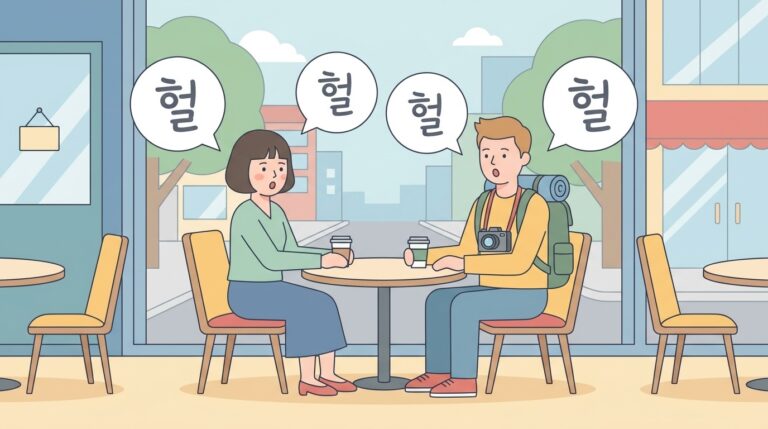
OMG! Did You Hear That? Master the Magic Word ‘Heol’ (헐) in 5 Minutes
Phase 1: Empathy (Your Korean Bestie’s Welcome)
Annyeonghaseyo! (안녕하세요!) Your Korean bestie and Daily Hangul editor here!
Imagine this: You are watching a K-drama. The lead actor suddenly drops his ice cream. He gasps and lets out a short, deflated sound: “Heol…” Or maybe you are texting your Korean friend about a shocking plot twist, and they reply with just: “헐.”
If you have ever felt left out of these moments, don’t worry! Today, we are mastering “Heol” (헐)—the ultimate Korean slang word for “OMG,” “No way,” or “What the…” It is the Swiss Army knife of Korean reactions. Learning this single word will instantly make you sound like a local and help you connect with your Korean friends on a whole new level. Let’s dive in!
Phase 2: Core Expression Deep Dive
1. 헐 (Heol)
- Pronunciation: “Hul” (rhymes with the “u” in “gull” or “dull”. Think of a quick sigh of disbelief: h-u-hl)
- Meaning: OMG / No way / What! / Oh my gosh
- K-Culture Moment: You see this written in giant colorful subtitles on Korean variety shows like Running Man whenever a member gets betrayed, or in webtoons when a character is absolutely speechless.
- Editor’s Insight: “Heol” is born from pure disbelief. It is used when you are shocked, disappointed, or just amazed. Note: It is strictly for casual conversations!
- Situation Spectrum: Casual ✅ | Semi-formal ⚠️ | Formal 🚫
- 🤔 Think About It: In English, “OMG” often sounds high-energy. But “Heol” can be whispered as a low-energy, deflated sigh. Why do you think Koreans use low-energy sighs to express shock? Let us know in the comments!
Phase 3: Textbook Korean vs. Real Korean
Let’s compare what dusty grammar books teach you versus how cool Koreans actually talk!
Situation 1: Hearing shocking news
- 📖 Textbook Korean: 정말입니까? 너무 놀랍습니다. (Jeong-mal-im-ni-ka? Neo-mu nol-rap-seum-ni-da.) – “Is that true? I am very surprised.”
- 🗣️ 진짜 (Real) Korean: 헐, 대박! (Heol, dae-bak!) – “Heol! No way, that’s crazy!”
- 💡 Why it’s different: Textbook Korean is too stiff for daily gossip. Real friends react instantly with short, punchy slang to show genuine excitement.
Situation 2: Dropping your phone on your face in bed
- 📖 Textbook Korean: 아이고, 아픕니다. (Ai-go, a-peum-ni-da.) – “Oh dear, it hurts.”
- 🗣️ 진짜 (Real) Korean: 헐… (Heol…) – “…Omg (speechless pain and embarrassment)”
- 💡 Why it’s different: When you are embarrassed or shocked by your own silliness, a simple “Heol…” represents your speechless state perfectly.
Phase 4: K-Culture Deep Dive & Non-verbal Manners
4-1. The “Heol” Gesture
To sound 100% Korean, you need the right body language:
1. The Hand-to-Mouth: Slightly cover your mouth with one hand while letting out a short “Heol” when hearing juicy gossip.
2. The Deflated Shoulders: Drop your shoulders slightly and tilt your head down when saying a sad “Heol…” (e.g., when your favorite cafe is closed).
4-2. Culture Code: The Webtoon Subtitle
In Korean digital culture, “헐” is the king of texting. If you want to show mild shock, text 헐. If you are deeply shocked, text 헐헐헐 (Heol-heol-heol) or combine it with ㅠㅠ (crying eyes): 헐ㅠㅠ.
Phase 5: Real-Life Roleplay Scenario
Meet Ji-a (지아), your energetic Korean friend who loves K-pop and talking about delicious food.
- Scenario: You and Ji-a are planning to eat Spicy Rice Cakes (Tteokbokki) at a famous restaurant, but there’s a huge line.
-
Ji-a: 저기 봐! 대기 줄 진짜 길어! (Jeo-gi bwa! Dae-gi jul jin-cha gil-eo!)
(Look over there! The waiting line is so long!) - You: 🎭 (Shocked) 헐! 진짜네! (Heol! Jin-cha-ne!)
(Heol! You’re right!) - Ji-a: 우리 1시간은 기다려야 할 것 같아. (U-ri han-si-gan-eun gi-da-ryeo-ya hal geot gat-ah.)
(I think we have to wait for an hour.) - You: 🎭 (Disappointed sigh) 헐… 1시간요? (Heol… han-si-gan-yo?)
(Heol… an hour?) - Ji-a: 다른 가게 갈까? (Da-reun ga-ge gal-kka?)
(Shall we go to another shop?) - You: 아니요, 기다려요! 여기 진짜 맛있잖아요. (An-i-yo, gi-da-ryeo-yo! Yeo-gi jin-cha ma-sit-jan-ah-yo.)
(No, let’s wait! The food here is so delicious.) - Ji-a: 오, 좋아! 그럼 우리 수다 떨자! (Oh, jo-ah! Geu-reom u-ri su-da tteol-ja!)
(Oh, great! Let’s chat then!) - You: 🎭 (Happy) 좋아요! (Jo-ah-yo!)
(Sounds good!)
🔀 Interactive Choice Point
How do you respond when Ji-a says the wait is actually two hours?
* A) Say “네” (Yes) calmly. (Feedback: Too boring! You miss the chance to practice your slang.)
* B) Say “헐, 대박! 진짜요?” (Heol, daebak! Jin-cha-yo?) (Feedback: BEST! Shows perfect level of friendly shock while staying polite with ‘요’.)
* C) Say “헐! 야!” (Heol! Ya!) (Feedback: RISK! “Ya” means “Hey” in a very casual way. Don’t use it unless you are super close friends, or it might sound rude.)
Phase 6: 10-Second Emotion Shadowing Drill
Train your vocal muscles! Say these out loud with the right emotion:
- [😱 Shocked & Gasping]
헐!/진짜요?
(Heol! / Jin-cha-yo?)
“OMG! Really?” -
[🥺 Disappointed & Pouting]
헐.../안 돼요...
(Heol… / an-dwae-yo…)
“Heol… no way…” -
[🤯 Mind-Blown]
헐/대박!
(Heol / Dae-bak!)
“Heol… awesome!”
Phase 7: K-Culture Mini Dictionary
- 대박 (Dae-bak) | Awesome / Jackpot | Used together with Heol to show massive shock or excitement.
- 진짜 (Jin-cha) | Really / Seriously | Perfect for confirming rumors or shocking facts.
- 우와 (U-wa) | Wow | A pure, positive exclamation of amazement.
- 헐랭 (Heol-raeng) | Oh boy / Well then | A cute, playful variation of Heol popular among teens.
Phase 8: Survivor’s Kit for Travelers
Survival Phrases TOP 3
- 헐, 진짜요? (Heol, jin-cha-yo?) – “OMG, really?” (Keep the polite ‘yo’ at the end!)
- 헐, 대박! (Heol, dae-bak!) – “OMG, awesome!”
- 헐, 귀여워요! (Heol, gwi-yeo-wo-yo!) – “OMG, it’s so cute!”
Editor’s Travel Note
When traveling in Seoul, you’ll want to share your shocking food portions or cute cafe finds instantly on social media. Use the Naver Map App to find hidden local spots, and when you get there, let out a soft “Heol, daebak!” to show your appreciation to the shop owner!
Phase 9: “One Step Deeper” (Cultural Insight)
In Korean society, showing active reactions (called 리액션 – ri-aek-syeon) is considered a key polite social skill. It proves you are actively listening and empathizing with the speaker. Saying a simple “Heol” isn’t just slang; it’s a warm signal that says, “I am fully listening to your story and sharing your feelings.”
💬 Your Turn: Have you ever used a reaction word in your language that behaves just like “Heol”? Tell us your language’s version in the comments below!
Phase 10: FAQ & Avoiding Mistakes
Q: Can I say “Heol” to my boss or teacher?
A: Absolutely not! “Heol” is very casual slang. Saying it to a boss or elder might make you look unprofessional or disrespectful. Use “정말요?” (Jeong-mal-yo? / Really?) instead.
Q: Is “Heol” a bad swear word?
A: No, it is highly common and safe slang. Children, teenagers, and young adults use it daily without any bad intentions.
Q: Can I use it in writing?
A: Yes, but only in informal texting, social media comments, or webtoons. Never use it in academic essays or business emails!
🚨 Common Mistakes Alert!
- Mistake 1: Saying “Heol” to older strangers.
Correct Action: Use “아, 정말인가요?” (Ah, jeong-mal-in-ga-yo? – Oh, is that so?) - Mistake 2: Pronouncing it like “Hole”.
Correct Action: Keep your lips relaxed. It’s “Hul” like “dull”. - Mistake 3: Saying “Heol” with a completely flat, angry face.
Correct Action: Match it with facial expressions—wide eyes or a sad pout!
Phase 11: Action Mission
- 🥉 Bronze Medal: Say “Heol” out loud 3 times in front of your mirror with different emotions.
- 🥈 Silver Medal: Text a Korean friend or comment on a K-pop idol’s Instagram post using
헐!. - 🥇 Gold Medal: The next time something surprising happens in a K-drama, point at the screen and shout “헐!”
Phase 12: Interactive Quiz Challenge
Q1. Which situation is NOT appropriate for using “헐” (Heol)?
- A) You dropped your freshly bought ice cream.
- B) Your Korean boss tells you that your business proposal was approved.
- C) Your friend tells you they met a famous K-pop star on the street.
Click for the Answer & Explanation!
- Correct Answer: B
- Explanation: You should never use casual slang like “Heol” with your boss or in formal business settings. It’s polite to say “정말 감사합니다” (Jeong-mal gam-sa-hap-ni-da – Thank you very much) instead!
Q2. Fill in the blank: “OMG, that’s awesome!” = “헐, ____!”
- A) 안녕 (An-nyeong)
- B) 대박 (Dae-bak)
- C) 감사 (Gam-sa)
Click for the Answer & Explanation!
- Correct Answer: B
- Explanation: “대박” (Dae-bak) means awesome/cool. Together, “헐, 대박!” is the ultimate reaction combo!







