

Master Online Hangouts: Essential Korean Phrases for Video Calls (화상 통화하기)
안녕하세요! (Annyeonghaseyo!) Welcome back to Daily Hangul, your premium Korean tutoring guide and friendly neighborhood cultural navigator!
We’ve all been there: you click the Zoom or Google Meet link, your screen loads, and suddenly… silence. Or worse, your screen freezes mid-smile! Whether you are calling a Korean friend to catch up, joining a casual study group, or setting up a virtual hangout with your online language exchange partner, video calls can be intimidating. At the A2 (beginner-intermediate) level, the fear of technical glitches combined with speaking a new language can make your hands sweat!
Don’t worry! Today, we’re going to arm you with the ultimate ‘virtual survival kit’ so you can handle any video call like a native Korean. Let’s dive in!
Phase 2: Deep Dive into 3 Core Expressions
Here are the top three expressions you absolutely need to know for any Korean video call.
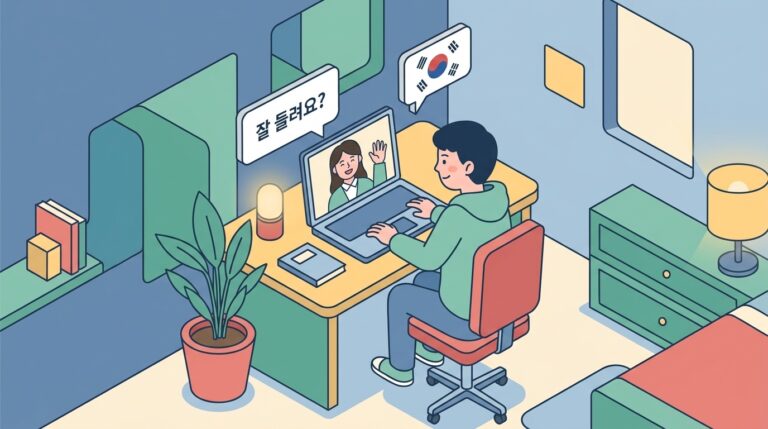
1. 잘 들려요? (Jal deullyeoyo?)
- Pronunciation: Jahl deul-lyuh-yo? (Sounds like “Jal” + “dool-yo-yo” with a soft ‘l’)
- Meaning: Can you hear me well?
- K-Culture Moment: In K-Dramas, you often see characters starting a video call by waving furiously at their phones, squinting, and asking, “잘 들려?” (casual) to make sure the connection is good before sharing exciting gossip.
- Editor’s Insight: This uses the passive verb 들리다 (to be heard). Instead of asking “Are you listening?”, Koreans ask “Is my voice being heard well?” which sounds much softer and politer.
- Situation Spectrum: Casual (잘 들려? ✅) | Semi-formal (잘 들려요? ✅) | Formal (잘 들리십니까? ⚠️)
- 🤔 Think About It: Why do you think Korean uses passive expressions (like “is it heard?”) more often than direct active ones (“do you hear me?”) during polite conversations?
2. 화면이 멈췄어요 (Hwamyeoni meomchwosseoyo)
- Pronunciation: Hwa-myeon-ee mum-chwuss-uh-yo
- Meaning: The screen is frozen / has stopped.
- K-Culture Moment: Imagine watching a live broadcast of your favorite K-Pop idol on Weverse, and suddenly their handsome face freezes! Fans immediately spam the chat with “화면 멈췄어요!” or “랙 걸렸어요” (It’s lagging!).
- Editor’s Insight: 화면 (hwamyeon) means ‘screen’ and 멈추다 (meomchuda) means ‘to stop’. It’s much more natural than saying “비디오가 죽었어요” (The video is dead – which sounds very weird in Korean!).
- Situation Spectrum: Casual (화면 멈췄어 ✅) | Semi-formal (화면이 멈췄어요 ✅) | Formal (화면이 정지되었습니다 ⚠️)
- 🤔 Think About It: How does your culture react when a screen freezes? Do you wait patiently, or do you point it out immediately like Koreans do?
3. 마이크 켜 주세요 (Maikeu kyeo juseyo)
- Pronunciation: My-keu kyuh joo-seh-yo
- Meaning: Please turn on your microphone / Unmute yourself.
- K-Culture Moment: During online university lectures or virtual team meetings in Korea, you’ll constantly hear professors or leaders saying, “OO 씨, 마이크 켜 주세요!” (Please turn on your mic, OO!).
- Editor’s Insight: 마이크 (maikeu) is the English loanword ‘mic’. 켜다 (kyeoda) means ‘to turn on’. To ask someone to mute, you say “마이크 꺼 주세요” (maikeu kkeo juseyo – turn off).
- Situation Spectrum: Casual (마이크 켜 줘 ✅) | Semi-formal (마이크 켜 주세요 ✅) | Formal (마이크를 켜 주시기 바랍니다 ⚠️)
- 🤔 Think About It: Loanwords are highly common in Korean tech terms. Can you think of other tech words that sound similar to English?
Phase 3: Textbook Korean vs. Real-Life Korean
Let’s compare what dry textbooks teach you versus what actual Koreans say on video calls.
Situation 1: When the connection is bad
- 📖 Textbook: 연결 상태가 좋지 않습니다. (Yeongyeol sangtaega jochi ansumnida. – “The connection state is not good.”)
- 🗣️ Real-Life: 인터넷이 좀 끊겨요. (Inteonesi jom kkeun-kyeo-yo. – “The internet is cutting out a bit.”)
- 💡 Why the difference? The textbook phrase is too formal and robotic, like an automated system voice. Real humans use ‘끊기다’ (to be cut off/disconnected) to describe unstable Wi-Fi.
Situation 2: When you want to say goodbye
- 📖 Textbook: 화상 통화를 종료하겠습니다. (Hwasang tonghwareul jongryohagesseumnida. – “I will terminate the video call.”)
- 🗣️ Real-Life: 이제 끌게요! 다음에 또 봐요! (Ije kkeul-ge-yo! Da-eume tto bwa-yo! – “I’m hanging up now! See you next time!”)
- 💡 Why the difference? ‘끄다’ means to turn off/disconnect. Saying you will ‘terminate the call’ makes you sound like a sci-fi villain. Keep it warm and friendly!
Phase 4: K-Culture Deep Dive & Non-Verbal Manners
4-1. The “K-Video Call” Etiquette
- The Double Hand Wave: When starting or ending a video call, Koreans rarely do a single-hand casual wave. It is almost always a double-handed enthusiastic wave near the face accompanied by a wide smile. It conveys warmth and energy over the screen!
- V-Sign (브이): If you take a screenshot of your video call together, make sure to do the classic Korean “V” sign next to your cheek. It’s the ultimate virtual photo pose!
4-2. Cultural Code: 랜선 모임 (Lanseon Moim – LAN-line Gatherings)
In Korea, virtual gatherings became highly popularized as “랜선 모임” (LAN cable gatherings). People have 랜선 회식 (virtual company dinners where everyone drinks beer in front of their own cameras) and 랜선 여행 (virtual travel live streams). Sharing a drink or snacks over a video call is a huge part of modern Korean social culture!
Phase 5: Real-Life Roleplay Scenario
Meet Ji-woo (지우), your friendly Korean language exchange partner from Seoul. You are meeting her on Zoom for the first time!
- Ji-woo: 😊 안녕하세요! 제 목소리 잘 들려요?
(Annyeonghaseyo! Je moksori jal deullyeoyo?)
(Hello! Can you hear my voice well?) - You: 🎭 (Nodding happily) 네! 잘 들려요. 지우 씨도 제 말 잘 들려요?
(Ne! Jal deullyeoyo. Ji-woo ssido je mal jal deullyeoyo?)
(Yes! I can hear you well. Can you hear me well too, Ji-woo?) - Ji-woo: 네, 잘 들려요! 어? 그런데 갑자기 화면이 좀 끊기네요.
(Ne, jal deullyeoyo! Eo? Geureonde gapjagi hwamyeoni jom kkeun-kyi-ne-yo.)
(Yes, loud and clear! Oh? But suddenly the screen is lagging a bit.) - You: 🎭 (Checking your Wi-Fi router) 아, 정말요? 제 인터넷이 좀 불안정해요.
(Ah, jeongmal-yo? Je inteonesi jom buranjeong-haeyo.)
(Ah, really? My internet is a bit unstable.) - Ji-woo: 아! 이제 괜찮아요. 잘 보여요. 마이크 볼륨도 괜찮네요.
(Ah! Ije gwaenchannayo. Jal boyeoyo. Maikeu bollyumdo gwaenchannyeoyo.)
(Ah! It’s okay now. I can see you well. Your microphone volume is good too.) - You: 🎭 (Relieved smile) 다행이네요! 오늘 만나서 반가워요.
(Dahaeng-ineyo! Oneul mannaseo bangawoyo.)
(Thank goodness! Nice to meet you today.) - Ji-woo: 저도요! 우리 같이 재미있게 한국어 공부해 봐요!
(Jeodoyo! Uri gachi jaemi-itge Hangugeo gongbuhae bwayo!)
(Me too! Let’s have fun studying Korean together!) - You: 네! 열심히 할게요.
(Ne! Yeolsimhi halgeyo.)
(Yes! I will do my best.)
🔀 Interactive Choice Point
At the end of the call, Ji-woo asks: “다음에 또 언제 만날까요?” (When shall we meet next?)
- A) “내일 통화해요!” (Nae-il tongwha-haeyo! – Let’s call tomorrow!)
- B) “시간 있을 때 문자 주세요.” (Sigan isseul ttae munja juseyo. – Text me when you have time.)
- C) “다음에요.” (Da-eum-eyo. – Next time.)
Feedback:
- Selection A (Best): Super friendly and shows great enthusiasm! Ji-woo will love your eagerness to practice.
- Selection B (Risk): Safe and polite, but might sound a little passive. Good for keeping boundaries.
- Selection C (Bad): Too short and blunt! It might sound like you didn’t enjoy the call.
Phase 6: 10-Second Emotion Shadowing Drill
Practice speaking with the right emotion and rhythm! / indicates a slight pause.
- [😊 Bright & Friendly]
제 목소리 / 잘 들려요?
(Je moksori / jal deullyeoyo?)
Is my voice / heard well? -
[🥺 Slightly Worried & Apologetic]
죄송해요, / 화면이 / 멈췄어요.
(Joesong-haeyo, / hwamyeoni / meomchwosseoyo.)
Sorry, / the screen / froze. -
[🎉 Excited & Energetic]
다음에 / 또 / 통화해요!
(Da-eume / tto / tongwha-haeyo!)
Let’s video call / again / next time!
Phase 7: K-Culture Mini Dictionary
- 화통 (Hwa-Tong) | Short for 화상 통화 (Video Call)
- Usage: Mainly used by Gen-Z as a quick text slang when asking to video call: “오늘 밤에 화통 고?” (Video call tonight?)
- 캠방 (Kaem-Bang) | Camera Broadcast
- Usage: Used to describe streams where creators show their faces on camera, as opposed to voice-only streams.
- 음소거 (Eum-so-geo) | Mute
- Usage: “음소거 해제해 주세요” (Eum-so-geo haeje-hae juseyo – Please unmute yourself).
- 링크 (Ring-keu) | Link (URL)
- Usage: “줌 링크 보내 주세요” (Zum ring-keu bonae juseyo – Please send me the Zoom link).
Phase 8: Survivor’s Travel Kit
Are you in Korea and needing to hop on a quick virtual meeting? Here is your survival kit!
Survival Phrases TOP 3
- 여기 와이파이 비밀번호가 뭐예요? (Yeogi wa-i-pa-i bimilbeonhoga mwo-yeo-yo?)
- Pro Tip: Use this at any Korean cafe to get high-speed internet for your video call.
- 조용한 자리 있어요? (Joyong-han jari isseoyo?)
- Pro Tip: Ask the staff if they have a quiet seat or zone if you have an important call.
- 이어폰 빌릴 수 있을까요? (Ieopon billil su isseulkkayo?)
- Pro Tip: If you forgot your earphones, some study cafes or hotels might lend you a pair!
💡 Editor’s Travel Note:
If you need a reliable, quiet space for a video call in Korea, search for “스터디카페” (Study Cafe) or “공유오피스” (Shared Office) on Naver Map App. They offer private rental booths with high-speed internet perfect for online meetings.
Phase 9: “One Step Deeper” (Cultural Reflection)
In Western cultures, turning off your video camera during a casual meeting is often acceptable. However, in Korean virtual meetings—especially in business or academic settings—keeping your camera on (캠 켜기) is considered basic respect and politeness (예의). It shows that you are fully present and actively listening to the other person. If you absolutely must turn your camera off, it is polite to type a quick message in the chat explaining why (e.g., “화면이 안 좋아서 잠깐 끄겠습니다” – My connection is bad so I will turn it off for a moment).
💬 Your Turn: How does camera etiquette differ in your country? Let us know in the comments below!
Phase 10: FAQ & Common Mistakes
Q: Can I use ‘전화해요’ (jeonhwa-haeyo) for video calls?
A: ‘전화’ refers to general phone calls. While people will understand, it is much more precise to say ‘화상 통화’ (video call) or use social media slang like ‘페타’ (FaceTime – Pe-Ta) or ‘보톡’ (VoiceTalk – Bo-Tok on KakaoTalk).
Q: How do I tell someone they are muted politely?
A: Simply say, “마이크가 꺼져 있어요” (Maikeuga kkeojyeo isseoyo – Your mic is turned off) or politely ask, “마이크 켜 주세요” (Maikeu kyeo juseyo).
Q: Is ‘인터넷이 나빠요’ correct to say “the internet connection is bad”?
A: Grammatically yes, but naturally no. Saying “나빠요” (is bad) sounds like the internet is being mean or evil! Instead, use “인터넷 연결이 안 좋아요” (The internet connection is not good) or “인터넷이 느려요” (The internet is slow).
🚨 Common Mistakes Alert!
- Mistake 1: Saying “비디오 켜세요” (Turn on video) aggressively.
- Correct Action: Use the softer “화면 좀 보여주세요” (Please show me your screen/face) or “카메라 켜 주세요” (Please turn on your camera).
- Mistake 2: Confusing ‘켜다’ (turn on) and ‘끄다’ (turn off).
- Correct Action: Remember: 켜다 (Kyuh – On like light) / 끄다 (Kkeu – Off like clicking off).
Phase 11: Action Mission
- 🥉 Bronze: Say “잘 들려요?” out loud 5 times in front of your mirror with a big smile!
- 🥈 Silver: Take a screenshot of your next virtual meeting, do the Korean ‘V-sign’, and post it on Instagram tagging
#DailyHangul! - 🥇 Gold: In your next online exchange session, start the conversation completely in Korean using: “안녕하세요! 제 목소리 잘 들려요?”
Phase 12: Interactive Quiz Challenge
Test your skills! Can you pass the virtual call test?
1. Match the Phrase
What should you say when the other person’s screen stops moving?
* A) 마이크 꺼 주세요.
* B) 화면이 멈췄어요.
* C) 잘 들려요.
👉 Click to see the answer!
Correct Answer: B
Explanation: 화면이 멈췄어요 means ‘The screen has frozen’.
2. True or False?
In Korea, it is considered perfectly normal and polite to keep your camera turned off during your first language exchange meeting without saying anything.
👉 Click to see the answer!
Correct Answer: False
Explanation: Keeping your camera on (캠 켜기) is seen as respectful. If you must turn it off, always give a quick polite reason first!
Wrap-Up
You are now fully prepared to rock your next online Korean meetup! Don’t let tech glitches hold you back. Bookmark this page, practice the phrases, and keep communicating! 다음에 또 만나요! (See you next time!)







