

Master Korea’s Cafe Buzz: What to Do When the Pager Rings (진동벨)
Phase 1: Empathy (공감)
안녕하세요! (An-nyeong-ha-se-yo!) Hello! It’s your Daily Hangul editor and your personal K-Culture Navigator.
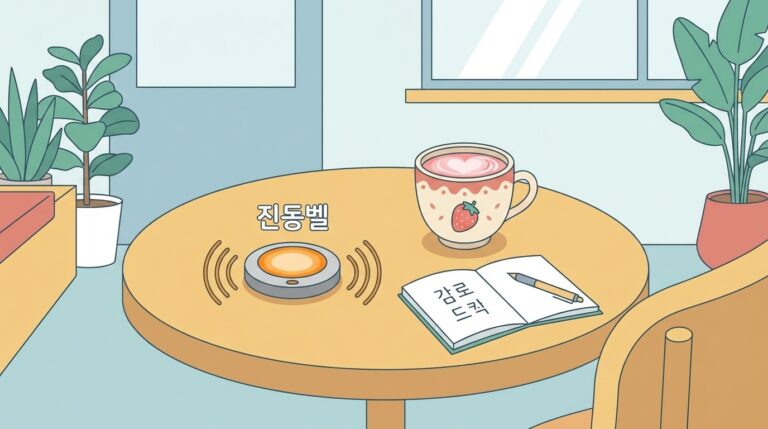
Picture this: You are in a beautiful, minimalist cafe in Hongdae. You order a delicious strawberry latte, pay, and the barista hands you a small, plastic, circular device that looks like a mini UFO. You sit down, but your heart starts racing. What is this? What if it makes a loud noise? What do I say when I go back to the counter?
If you’ve felt this way, you are not alone! Many of my students at the A2 level have shared how this tiny “buzzing pager”—called a 진동벨 (jin-dong-bel)—made them super anxious during their first trip to Seoul.
Don’t worry! Today, we are going to master this exact situation. By the end of this post, you’ll know exactly what to do and say when your pager starts buzzing like a happy bee. Let’s dive in! ☕
Phase 2: Key Expressions (핵심 표현 3선)
Let’s learn the 3 magic sentences you need when the pager rings.
1. 벨이 울리면 가져올게요 (Bel-i ul-ri-myeon ga-jyeo-ol-gae-yo)
- Pronunciation: Bell-ee wool-ree-myeon gah-jyeo-ol-geh-yo (Sounds like “Bell” + “wool” + “myeon”…)
- Meaning: “I will bring it over when the bell rings/vibrates.”
- K-Culture Moment: You will hear staff say something similar, or you can say this to your friend to show you are a helpful cafe buddy.
- Editor’s Insight: Even though it is a buzzer, Koreans call it a “bell” (벨). 울리면 (ul-ri-myeon) means “if it rings/vibrates.”
- Situation Spectrum: Casual: ⚠️ | Semi-formal: ✅ | Formal: ✅
- 🤔 Think About It: In many Western countries, baristas call your name. Why do you think Korean cafes prefer using silent, vibrating pagers instead?
2. 진동벨 주세요 (Jin-dong-bel ju-se-yo)
- Pronunciation: Jin-dong-bell joo-seh-yo (Rhymes with “Jean-dong-bell”)
- Meaning: “Please give me the vibrating bell (pager).”
- K-Culture Moment: If the barista forgets to hand you the pager, or if you need to ask for one directly.
- Editor’s Insight: 진동 (jin-dong) means vibration, and 벨 (bel) is bell. Adding 주세요 (ju-se-yo) makes it polite and easy for A2 learners!
- Situation Spectrum: Casual: 🚫 | Semi-formal: ✅ | Formal: ⚠️
- 🤔 Think About It: How does adding “ju-se-yo” instantly make any Korean request polite?
3. 음료 나왔습니다 (Eum-ryo na-wat-seub-ni-da)
- Pronunciation: Oom-ryo nah-wat-seub-nee-dah (Quickly: Um-ryo)
- Meaning: “Your drinks are out / ready.”
- K-Culture Moment: The magic words written on the pickup counter screen or spoken by the barista when you return the pager.
- Editor’s Insight: 음료 (eum-ryo) means beverage/drink. When you hear this, it’s time to exchange your vibrating buddy for your sweet drink!
- Situation Spectrum: Casual: 🚫 | Semi-formal: ⚠️ | Formal: ✅ (Used by staff to customers)
- 🤔 Think About It: Notice how the staff uses very polite formal language (-습니다) even for a simple drink pickup. This shows Korean customer service respect.
Phase 3: Textbook vs. Real Korean (교과서 vs. 진짜 한국어)
Situation 1: Asking if the drink is ready
- 📖 Textbook Korean: “제 커피가 완성되었습니까?” (Je keo-pi-ga wan-seong-doe-eot-seub-ni-ka? – Is my coffee completed?)
- 🗣️ Real Korean: “제 꺼 나왔어요?” (Je kkeo na-wat-eo-yo? – Is mine out?)
- 💡 Why the difference?: The textbook version is too robotic. Real Koreans simply ask “Is mine out?” using the friendly -요 style.
Situation 2: When returning the pager
- 📖 Textbook Korean: “여기 진동 수신기가 있습니다.” (Yeo-gi jin-dong su-sin-gi-ga it-seub-ni-da. – Here is the vibration receiver.)
- 🗣️ Real Korean: “여기요~” (Yeo-gi-yo~ – Here it is / Over here~)
- 💡 Why the difference?: Nobody says “vibration receiver” in real life! Just say “Yeo-gi-yo” (Here you go) with a warm smile as you hand over the pager.
Phase 4: K-Culture Deep Dive & Non-Verbal Manners
4-1. The
Frequently Asked Questions (FAQ)
Q: What does "벨이 울리면 가져올게요 (Bel-i ul-ri-myeon ga-jyeo-ol-gae-yo)" mean in Korean and how do you pronounce it?
A: In Korean, "벨이 울리면 가져올게요 (Bel-i ul-ri-myeon ga-jyeo-ol-gae-yo)" is pronounced [Bell-ee wool-ree-myeon gah-jyeo-ol-geh-yo (Sounds like "Bell" + "wool" + "myeon"...] and means: "I will bring it over when the bell rings/vibrates."
Q: What does "진동벨 주세요 (Jin-dong-bel ju-se-yo)" mean in Korean and how do you pronounce it?
A: In Korean, "진동벨 주세요 (Jin-dong-bel ju-se-yo)" is pronounced [Jin-dong-bell joo-seh-yo (Rhymes with "Jean-dong-bell"] and means: "Please give me the vibrating bell (pager)."
Q: What does "음료 나왔습니다 (Eum-ryo na-wat-seub-ni-da)" mean in Korean and how do you pronounce it?
A: In Korean, "음료 나왔습니다 (Eum-ryo na-wat-seub-ni-da)" is pronounced [Oom-ryo nah-wat-seub-nee-dah (Quickly: Um-ryo] and means: "Your drinks are out / ready."






