

Speak Like a Local: Your No-Stress Guide to Friendly Korean Honorifics (Jondetmal)
Phase 1: Empathy (Welcome, My Friend!)
안녕하세요! (An-nyeong-ha-se-yo!) I’m your Daily Hangul editor, and I’m so excited to welcome you to our cozy learning space today.
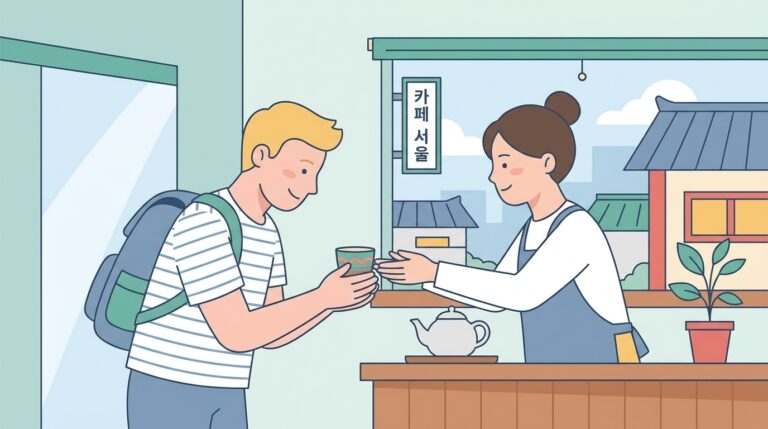
Imagine this: You are in a beautiful, sunlit cafe in Seoul. You order a delicious strawberry latte, and when the barista hands it to you, you want to say a warm “Thank you.” You remember the word Gomawo (고마워) from your favorite K-drama. You say it with a bright smile, but the barista looks slightly startled for a split second before smiling back.
What happened? Oh no, did you make a mistake? 🤭
Don’t worry! You didn’t ruin anyone’s day, but you just used Banmal (casual language) instead of Jondetmal (polite/honorific language) to someone you don’t know yet. In Korea, showing respect through your words is like giving someone a warm, polite hug. It builds instant trust and shows that you care about their feelings. Today, we are going to learn how to master basic Jondetmal so you can feel 100% confident, polite, and welcome anywhere in Korea!
Phase 2: Top 3 Essential Polite Expressions
Let’s learn three super-easy, magic expressions that will instantly make you sound incredibly polite and lovely.
1. 안녕하세요 (An-nyeong-ha-se-yo)
- Pronunciation: “Ah-nyeong-hah-seh-yo” (Think of saying “On-young-ha-say-yo” with a gentle melody)
- Meaning: Hello / Hi (Polite)
- K-Culture Moment: In K-dramas, you will see characters slightly bow their heads while saying this when they enter a convenience store, meet an older colleague, or greet a taxi driver.
- Editor’s Insight: This is the ultimate icebreaker. If you remember only one word from this guide, make it this one! It works in 99% of daily situations.
- Situation Spectrum: Casual (🚫) / Semi-formal (✅) / Formal (✅)
- 🤔 Think About It: In English, we use “Hello” for almost everyone. Why do you think Korean culture separates “Hi” (An-nyeong) from “Hello” (An-nyeong-ha-se-yo) based on respect?
2. 감사합니다 (Gam-sa-ham-ni-da)
- Pronunciation: “Gahm-sah-hahm-nee-dah” (Rhymes with “calm-saw-hum-knee-da”)
- Meaning: Thank you (Polite)
- K-Culture Moment: When K-Pop idols win an award on music shows, they always scream “감사합니다!” to their fans and staff.
- Editor’s Insight: While Gomawo is fine for close friends of the same age, Gamsahamnida is the safe, gold standard for showing gratitude to servers, clerks, and strangers.
- Situation Spectrum: Casual (🚫) / Semi-formal (✅) / Formal (✅)
- 🤔 Think About It: How does saying a formal “Thank you” change the vibe between you and a shopkeeper?
3. 죄송합니다 (Joe-song-ham-ni-da)
- Pronunciation: “Jweh-song-hahm-nee-dah” (Sounds like “Chweh-song-hum-knee-da”)
- Meaning: I am sorry (Polite)
- K-Culture Moment: Used when accidentally bumping into someone on the busy Seoul subway or when squeezing past people to get off the bus.
- Editor’s Insight: If you step on someone’s foot, don’t say Mianhae (casual sorry) unless they are your kid brother. Joesonghamnida shows genuine, polite regret.
- Situation Spectrum: Casual (🚫) / Semi-formal (✅) / Formal (✅)
- 🤔 Think About It: Why is a polite apology so powerful in a crowded city like Seoul?
Phase 3: Textbook Korean vs. Real-Life Korean
Let’s compare what dusty grammar books teach you versus how cool, real Koreans actually speak!
Situation A: Greeting a shop clerk
- 📖 Textbook Korean: 안녕하십니까? (An-nyeong-ha-sim-ni-ka? – “Are you in peace?” – Extremely formal, sounds like a news anchor or military officer)
- 🗣️ Real-Life Korean: 안녕하세요! (An-nyeong-ha-se-yo! – Soft, friendly, and perfectly polite)
- 💡 Why the difference? Unless you are interviewing the President or entering a corporate boardroom, the everyday polite “요 (-yo)” ending is much warmer and more natural!
Situation B: Expressing thanks
- 📖 Textbook Korean: 고맙습니다 (Go-map-seum-ni-da – Polite thank you, but a bit stiff)
- 🗣️ 감사합니다! (Gam-sa-ham-ni-da! – More common, bright, and universally loved in modern daily life)
- 💡 Why the difference? Gamsahamnida has a slightly more active, appreciative ring to it in urban Seoul today!
Phase 4: K-Culture Deep Dive & Non-Verbal Manners
4-1. The Magic Bow & Two-Hand Rule
Politeness in Korea isn’t just about what you say; it’s about what you do!
* The Head Bow: When saying An-nyeong-ha-se-yo, do a mini-bow. You don’t need to bend 90 degrees! A gentle 15-to-30-degree nod of your upper body is perfect.
* The Two-Hand Hand-off: When paying at a convenience store or receiving a business card, always hand over and receive items with both hands (or place your left hand gently under your right forearm to support it). It looks incredibly respectful!
4-2. The K-Drama Truth
Have you noticed in dramas how characters sometimes ask, “우리 말 놓을까요?” (Uri mal noeul-kka-yo? – “Shall we lower our language/speak casually?”)? Even if people are dating or close friends, they often start with polite Jondetmal to show respect. Speaking politely is a sign of treating the other person as someone precious!
Phase 5: Real-Life Roleplay Scenario
Let’s practice! You are at a beautiful traditional tea house in Insadong, Seoul. Your friendly server, Minji (민지), is ready to take your order.
The Conversation (8 Turns)
- Minji (NPC): “어서 오세요! (Eo-seo o-se-yo!) Welcome!” (🎭 Bowing slightly with a warm smile)
- You: “안녕하세요! (An-nyeong-ha-se-yo!) Hello!” (🎭 Bowing back gently)
- Minji (NPC): “메뉴판 여기 있습니다. (Me-nyu-pan yeo-gi is-seum-ni-da.) Here is the menu.” (🎭 Handing the menu with both hands)
- You: “감사합니다. (Gam-sa-ham-ni-da.) Thank you.” (🎭 Receiving the menu with both hands)
- Minji (NPC): “주문하시겠어요? (Ju-mun-ha-si-ges-seo-yo?) Would you like to order?”
- You: “녹차 주세요. (Nok-cha ju-se-yo.) Green tea, please.” (🎭 Pointing gently to the menu)
- Minji (NPC): “네, 알겠습니다. 잠시만 기다려 주세요. (Ne, al-get-seum-ni-da. Jam-si-man gi-da-ryeo ju-se-yo.) Yes, understood. Please wait a moment.”
- You: “감사합니다! (Gam-sa-ham-ni-da!) Thank you!” (🎭 Smiling warmly)
🔀 Interactive Choice Point!
What do you do if you accidentally drop your fork?
* Choice A: Scream “야! 포크!” (Ya! Pokeu! – “Hey! Fork!”)
* Choice B: Raise your hand politely and say, “죄송합니다, 포크 주세요.” (Joe-song-ham-ni-da, pokeu ju-se-yo. – “Excuse me/Sorry, fork please.”)
* Choice C: Pick it up quietly and say nothing.
Feedback:
- Choice A (Bad/Risk): 🚫 Oh dear! “Ya” is super rude to a stranger. Minji might feel very shocked!
- Choice B (Best): ✅ Perfect! You acknowledged the small trouble with a polite Joesonghamnida and asked nicely. Minji will happily bring you a new fork with a smile!
- Choice C (Okay but sad): ⚠️ You don’t get your fork, and you miss a chance to practice your Korean! Let’s be brave!
Phase 6: 10-Second Emotional Shadowing Drill
Let’s practice speaking with real Korean emotion! Read these out loud, pausing at the / marks.
[😊 Warm and friendly greeting]- 안녕 / 하세요! (An-nyeong / ha-se-yo!)
[💖 Deeply grateful and appreciative]- 감사 / 합니다! (Gam-sa / ham-ni-da!)
[🥺 Apologetic and polite]- 죄송 / 합니다. (Joe-song / ham-ni-da.)
Phase 7: K-Culture Mini Dictionary
- 존댓말 (Jondetmal): Polite/honorific language. Used for strangers, elders, and colleagues.
- 반말 (Banmal): Casual/informal language. Used strictly for close friends of the same age or younger people.
- 눈치 (Nunchi): The art of reading the room and sensing others’ feelings. Essential for knowing when to bow or use polite words!
- 주세요 (Ju-se-yo): “Please give me…” The magical word to attach to any noun when ordering or asking for something.
Phase 8: Survival Kit for Travelers
Survival Expressions TOP 3
- 이거 주세요 (I-geo ju-se-yo): “This one, please.” (Point at anything on a menu and say this!)
- 화장실 어디예요? (Hwa-jang-sil eo-di-yeo-yo?): “Where is the restroom?” (Polite and absolutely life-saving.)
- 저기요 (Jeo-gi-yo): “Excuse me!” (Perfect for calling a waiter in a restaurant.)
💡 Editor’s Travel Note: Before you travel, make sure to download the Naver Map App for navigating Seoul’s subway and bus systems like a local, as global map apps don’t always show the best walking routes in Korea!
Phase 9: A Step Deeper (Reflection)
Korean honorifics (Jondetmal) are not about creating a cold wall between people. In fact, it is quite the opposite! By using polite language, you show that you acknowledge the other person’s space, comfort, and feelings. It is a linguistic hug that says, “I respect you, and I want us to have a beautiful interaction.”
💬 Your Turn: How does your native language show respect? Do you have different words for “you” or “hello” depending on who you are talking to? Share your thoughts in the comments below! I read every single one!
Phase 10: FAQ & Avoiding Common Mistakes
Q: Can I use “An-nyeong” (안녕) to a taxi driver if he looks like a friendly grandpa?
A: No, please don’t! Even if someone looks older or friendly, you must always use the polite 안하세요 (An-nyeong-ha-se-yo) to strangers. Using Banmal (casual language) to an elder you don’t know is considered quite impolite.
Q: Is “Gomawo” (고마워) bad to use?
A: It’s not a bad word at all! It is beautiful, but only when used with close friends, spouses, or children. For safety and politeness, stick to 감사합니다 (Gamsahamnida) when exploring Korea.
Q: Do I have to bow deeply every time I speak?
A: Not at all! A simple, friendly nod of the head along with your words is more than enough to show your warm manners.
🚨 Common Mistakes Warning Board
- Mistake 1: Waving your hand wildly while saying An-nyeong! to a restaurant owner.
- Correct Action: Place your hands together politely in front of you, nod slightly, and say 안녕하세요!
- Mistake 2: Giving money with only one hand at the checkout.
- Correct Action: Hold your card or cash with both hands when handing it over. It looks so elegant!
- Mistake 3: Saying Mian (미안) when you bump into someone.
- Correct Action: Say 죄송합니다 (Joe-song-ham-ni-da) for a polite, instant apology.
Phase 11: Action Mission!
- 🥉 Bronze Mission: Practice bowing 15 degrees in the mirror while saying “안녕하세요!” (An-nyeong-ha-se-yo!) out loud 3 times.
- 🥈 Silver Mission: Write “감사합니다!” in the comment section below to say thank you for today’s lesson!
- 🥇 Gold Mission: Next time you watch a K-drama, try to spot the moment when a character uses 요 (-yo) or 합니다 (-ham-ni-da) at the end of their sentence. Put your ears to the test!
Phase 12: Interactive Quiz Challenge
Are you ready to test your polite Korean skills?
1. Situation Quiz
You are at a convenience store to buy delicious banana milk. You want to greet the cashier. What do you say?
a) 안녕! (An-nyeong!)
b) 안녕하세요! (An-nyeong-ha-se-yo!)
c) 고마워! (Go-ma-wo!)
🔎 Click here for the Answer & Explanation!
Correct Answer: b) 안녕하세요!
Explanation: Perfect! The cashier is a stranger, so you should greet them with the polite and friendly “안녕하세요!”. “안녕!” is too casual!
2. True or False Culture Quiz
Question: In Korea, it is polite to receive a receipt or change with just one hand.
* True
* False
🔎 Click here for the Answer & Explanation!
Correct Answer: False
Explanation: You should always try to use both hands (or support your right arm with your left hand) when receiving or giving items. It shows fantastic Korean manners!
See you in our next lesson! 언제나 응원해요 (I am always cheering for you)! 💖







