

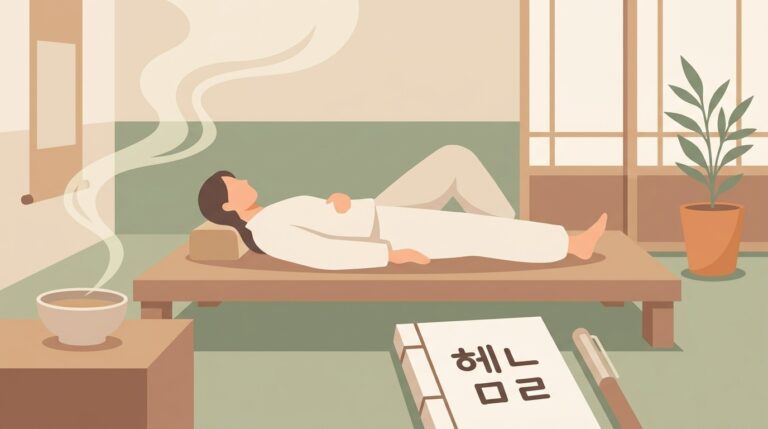
Finding Your Balance: Navigating a Korean Hanuiwon (Traditional Clinic) with Confidence
Phase 1: Empathy (Welcome, K-Wellness Explorer!)
안녕하세요! I’m your Daily Hangul editor and your personal K-culture navigator.
Have you ever watched a historical K-Drama (사극 – sageuk) where a royal physician dramatically places a tiny needle on a patient’s wrist, or boils a dark, steaming pot of herbal medicine? Or perhaps you’ve been walking around Seoul, feeling your lower back ache from carrying your shopping bags, and noticed those beautiful, wooden-interiored clinics labeled 한의원 (Hanuiwon – Korean Traditional Medicine Clinic).
If you’ve hesitated to step inside because you didn’t know how to explain your symptoms or what to expect, you are not alone! Many of our intermediate learners have shared their anxiety: “What if I say ‘acupuncture’ wrong?” “How do I explain that my energy feels blocked?”
Today, we are moving past the clinical, robotic textbook sentences. We will arm you with the actual cultural vocabulary, nuanced phrases, and social cues you need to experience a premium, authentic Korean wellness treatment. Let’s dive in!
Phase 2: Deep-Dive into 3 Essential Expressions
1. 침을 맞다 (Chim-eul mat-da)
- Pronunciation: Cheem-eul mat-da (Sounds like “team” but with a soft ‘ch’ + “mat” with a soft ‘da’)
- Meaning: To get acupuncture (literally, “to be hit/received by a needle”)
- K-Culture Moment: You will hear this constantly in family dramas when grandparents complain about their stiff backs: “아이구, 허리야. 한의원 가서 침 좀 맞아야겠다.” (Oh, my back. I need to go to the Hanuiwon and get some acupuncture.)
- Editor’s Insight: Koreans don’t say “I do acupuncture” (침을 하다 is incorrect). Instead, we use 맞다 (to receive/get hit by). Think of it like getting a shot (주사를 맞다).
- Situation Spectrum:
- Casual: 침 맞았어. (✅)
- Semi-formal: 침 맞았어요. (✅)
- Formal: 침을 맞았습니다. (✅)
- 🤔 Think About It: In Western medicine, we often “take” or “receive” a treatment. In Korean, the verb 맞다 implies accepting physical contact on your body. How does your language frame receiving medical treatment?
2. 기가 허하다 (Gi-ga heo-ha-da)
- Pronunciation: Gee-gah huh-hah-dah (Rhymes with “Key” + “gah” + “her” with a soft ‘h’ + “hah-dah”)
- Meaning: To have weak/depleted ‘Gi’ (vital energy/Qi)
- K-Culture Moment: When a character in a variety show looks exhausted, pale, and lacks appetite, the hosts will jokingly say, “너 요즘 기가 허해 보인다!” (You look like your Gi is depleted lately!)
- Editor’s Insight: This is a core concept in Korean wellness. It’s not just about physical pain; it’s about a lack of vitality, chronic fatigue, or susceptibility to illness. Saying “기가 허해요” immediately tells the doctor you are looking for restorative care, not just a quick painkiller.
- Situation Spectrum:
- Casual: 기가 허해. (✅)
- Semi-formal: 기가 허해요. (✅)
- Formal: 기가 허한 것 같습니다. (✅)
- 🤔 Think About It: How do you describe “feeling run down” in your native language? Is it connected to a concept of “energy” or “flow”?
3. 한약을 지으러 왔다 (Han-yak-eul ji-eu-reo wat-da)
- Pronunciation: Hahn-yahg-eul jee-eu-ruh waht-dah (Sounds like “Hahn” + “yahg” + “eul” + “jee-uh-ruh” + “waht-dah”)
- Meaning: To come to get custom herbal medicine prepared (literally, “to build/make herbal medicine”)
- K-Culture Moment: Newlyweds or parents preparing their children for exams are often seen visiting Hanuiwon to “지어 주다” (order and build herbal medicine) for their loved ones’ stamina.
- Editor’s Insight: The verb 짓다 (to build/make) is used for three main things in Korea: building a house (집을 짓다), making rice (밥을 짓다), and preparing medicine (약을 짓다). It shows the intense care, structure, and customization involved!
- Situation Spectrum:
- Casual: 한약 지으러 왔어. (⚠️ – too casual for the clinic desk)
- Semi-formal: 한약 지으러 왔어요. (✅)
- Formal: 한약을 지으러 왔습니다. (✅)
- 🤔 Think About It: Why do you think Korean culture groups building a house, cooking rice, and preparing medicine under the same verb 짓다?
Phase 3: Textbook Korean vs. Real-Life Korean
Situation 1: Explaining your sore muscles
- 📖 Textbook Korean: “근육통이 심합니다.” (Geun-yuk-tong-i sim-ham-ni-da. / I have severe muscle pain.)
- 🗣️ Real-Life Korean: “어깨랑 목이 많이 뻐근해요.” (Eo-kkae-rang mog-i man-i ppeo-geun-hae-yo. / My shoulders and neck feel really stiff and heavy.)
- 💡 Why the difference?: Textbook Korean uses rigid Sino-Korean medical terms like 근육통 (myalgia). Real Koreans use expressive native adjectives like 뻐근하다 (stiff, heavy, aching) to describe the actual physical sensation.
Situation 2: Inquiring about the acupuncture needles
- 📖 Textbook Korean: “침이 아픕니까?” (Chim-i a-peup-ni-ka? / Are needles painful?)
- 🗣️ Real-Life Korean: “침 맞을 때 많이 찌릿해요?” (Chim maj-eul ttae man-i jji-rit-hae-yo? / Does it tingle/shock a lot when I get the acupuncture?)
- 💡 Why the difference?: Acupuncture rarely hurts like a sharp syringe needle; instead, it creates a unique “de-qi” sensation. Koreans describe this deep, heavy tingling as 찌릿하다 (to feel a mini electric charge/tingle).
Phase 4: K-Culture Deep-Dive & Non-Verbal Manners
4-1. The Art of “Eom-sal” (엄살) and Body Manners
When you receive acupuncture, the doctor will gently tap the needle in. It is polite to lie completely still. If it hurts, do not suddenly jerk away! Instead, make a soft wincing sound (“앗 / 아!” – At / Ah!) or say gently, “좀 아파요” (Jom a-pa-yo). Koreans often tease people who overreact to minor pain as having 엄살 (eom-sal – exaggerating pain/fussiness). Try to show a calm, trusting posture to your practitioner.
4-2. The Scent of Healing: “Hanbang” (한방)
Step into any traditional clinic, and you will instantly smell 한방 (Hanbang – Korean traditional medicine smell). It’s a deep, earthy, slightly sweet, and bitter aroma of boiling herbs. In K-Beauty, “Hanbang” skincare is a premium genre using ingredients like ginseng, licorice root, and ginger. Experiencing a Hanuiwon is a multi-sensory journey of smell, touch, and warmth!
Phase 5: Real-Life Roleplay Scenario
Setting: Ye-won Hanuiwon (예원한의원), a peaceful clinic with a soothing herbal scent.
Characters:
* 수진 (Sujin): The welcoming receptionist (NPC).
* 유미 (Yumi): You (The patient experiencing intermediate-level muscle fatigue and cold hands).
1. 수진: 안녕하세요! 오늘 어디가 불편해서 오셨나요?
   (An-nyeong-ha-se-yo! O-neul eo-di-ga bul-pyeon-hae-seo o-syeot-na-yo?)
   [😊 Welcoming and polite] "Hello! What brings you in today?"

2. 유미: (어깨를 만지며) 요즘 컴퓨터를 많이 해서 그런지 목이랑 어깨가 너무 뻐근해요.
   (Yo-jeum keom-pyu-teo-reul man-i hae-seo geu-reon-ji mog-i-rang eo-kkae-ga neo-mu ppeo-geun-hae-yo.)
   [😣 Touching shoulder, showing discomfort] "Maybe because I've been using the computer a lot lately, but my neck and shoulders feel so stiff and heavy."

3. 수진: 아, 스마트폰이나 컴퓨터 많이 쓰시면 그렇죠. 침 치료 받아보신 적 있으세요?
   (Ah, seu-ma-teu-pon-i-na keom-pyu-teo man-i sseu-si-myeon geu-reot-jyo. Chim chi-ryo bada-bo-sin jeok is-seu-se-yo?)
   [😌 Nodding empathetically] "Ah, yes, that happens a lot when you use smartphones or computers. Have you ever received acupuncture treatment before?"

4. 유미: 아니요, 처음이에요. 조금 무섭긴 한데, 침을 맞으면 많이 찌릿한가요?
   (A-ni-yo, cheo-eum-i-e-yo. Jo-geum mu-seop-gin han-de, chim-eul maj-eu-myeon man-i jji-rit-han-ga-yo?)
   [🥺 Nervous but curious] "No, it's my first time. I'm a bit scared, does it tingle/hurt a lot when getting acupuncture?"

5. 수진: 아주 미세하게 찌릿한 정도예요. 긴장 푸셔도 됩니다! 혹시 한약도 같이 지어보고 싶으신가요?
   (A-ju mi-se-ha-ge jji-rit-han jeong-do-ye-yo. Gin-jang pu-syeo-do doem-ni-da! Hok-si han-yak-do gat-i ji-eo-bo-go sip-eu-sin-ga-yo?)
   [😊 Reassuring smile] "It's just a very slight tingle. You can relax! Would you also like to have some herbal medicine prepared?"

6. 유미: 네, 요즘 소화도 잘 안 되고 기가 허한 느낌이라서 한약도 좀 짓고 싶어요.
   (Ne, yo-jeum so-hwa-do jal an doe-go gi-ga heo-han neu-kkim-i-ra-seo han-yak-do jom jit-go sip-eo-yo.)
   [😔 Sighing softly, pointing to stomach] "Yes, my digestion hasn't been great lately and I feel like my energy is depleted, so I'd love to get some herbal medicine made."

7. 수진: 네, 원장님께 말씀드릴게요. 잠시 대기실에서 대기해 주세요.
   (Ne, won-jang-nim-kke mal-sseum-deu-ril-ge-yo. Jam-si dae-gi-sil-e-seo dae-gi-hae ju-se-yo.)
   [📋 Writing on a clipboard] "Understood, I will let the doctor know. Please wait a moment in the waiting room."

8. 유미: 네, 감사합니다.
   (Ne, gam-sa-ham-ni-da.)
   [🙂 Bowing politely] "Yes, thank you."
🔀 Interactive Choice Points
Now, it’s your turn in the consultation room! The doctor asks: “평소에 몸이 찬 편인가요?” (Do you usually have a cold body/cold hands and feet?)
- Choice A: “네, 수족냉증이 심해요.” (Yes, my cold hands/feet syndrome is severe.)
- Feedback (Best!): Perfect medical self-awareness! 수족냉증 (su-jok-naeng-jeung) is the precise Korean term for chronically cold hands and feet. The doctor will immediately understand and prescribe warming treatments.
- Choice B: “몸이 얼음 같아요.” (My body is like ice.)
- Feedback (Bad/Unnatural): Too literal! While poetic, it sounds like you are literally freezing. Stick to “손발이 차요” (My hands and feet are cold) or Choice A.
- Choice C: “몸이 차갑지 않아요, 뜨거워요.” (My body is not cold, it is hot.)
- Feedback (Risk): Good attempt to clarify your body heat type (체질 – che-jil). However, “뜨거워요” sounds like you have an active fever. A better way to say you run warm is “몸에 열이 많은 편이에요” (I tend to have a lot of heat in my body).
Phase 6: 10-Second Emotional Shadowing Drill
Let’s practice speaking with real-life cadence and emotion. Read these aloud, pausing at the / and channeling the indicated mood!
- [😣 Pain and exhaustion]
요즘 / 기가 허해서 / 목이 너무 뻐근해요.
(Yo-jeum / gi-ga heo-hae-seo / mog-i neo-mu ppeo-geun-hae-yo.)
“Lately… / my energy feels depleted, so / my neck is so stiff.” -
[🥺 Nervous and cute]
침 맞을 때 / 많이 / 찌릿한가요?
(Chim maj-eul ttae / man-i / jji-rit-han-ga-yo?)
“When getting acupuncture… / does it… / tingle a lot?” -
[😊 Hopeful and excited]
한의원에서 / 한약 지어서 / 건강해질 거예요!
(Han-ui-won-e-seo / han-yak ji-eo-seo / geon-gang-hae-jil geo-ye-yo!)
“At the Hanuiwon… / I will get custom herbs / and get super healthy!”
Phase 7: K-Culture Mini Dictionary
- 부항 (Buhang) | Cupping Therapy
- The suction cups placed on your back to draw out stagnant blood. You will get cool round purple marks on your back that look like octopus kisses!
- 뜸 (Tteum) | Moxibustion
- The process of burning dried mugwort over specific acupuncture points to warm your body. It smells deeply herbal and feels intensely warm.
- 맥을 짚다 (Maeg-eul jip-da) | To take the pulse
- The signature Hanuiwon diagnostic method where the doctor places three fingers on your wrist to listen to your internal organ health.
- 보약 (Boyak) | Restorative Tonic
- A premium type of herbal medicine specifically brewed to restore stamina, usually gifted to family members during season changes.
Phase 8: Survivor Kit for Travelers
Survival Expressions TOP 3
- “물리치료도 같이 받나요?” (Mul-ri-chi-ryo-do gat-i ban-na-yo?)
- Pro Tip: “Do I also get physical therapy?” Most Hanuiwon offer massage chairs, hot packs, and tens-machines alongside acupuncture for the same low price!
- “침 맞고 오늘 샤워해도 돼요?” (Chim maj-go o-neul sya-wo-hae-do dwae-yo?)
- Pro Tip: “Can I shower today after acupuncture?” (Doctors usually recommend waiting 2 to 3 hours to prevent infection at the needle sites).
- “한약 택배로 받을 수 있나요?” (Han-yak taek-bae-ro ba-deul su in-na-yo?)
- Pro Tip: “Can I receive the herbal medicine by delivery?” Because custom medicine takes days to brew, they will ship it straight to your hotel or Airbnb!
Editor’s Travel Note
Traditional Hanuiwon are everywhere! To find a highly-rated one near you, download the Kakao Map App and search “한의원”. Do not use standard global map apps as their databases in Korea are outdated. Most treatments are incredibly affordable (usually around 10,000 to 20,000 KRW for basic acupuncture if you have national insurance, and around 30,000 to 50,000 KRW without insurance). Note: Prices and clinic policies are subject to change over time.
Phase 9: “A Step Deeper” (Cultural Reflection)
In Western medicine, treatments often target a specific symptom or virus directly. In contrast, Korean traditional medicine (한의학 – Hanuihak) views the body as a holistic ecosystem where everything is interconnected. If your shoulder hurts, a Korean doctor might put a needle in your ankle because the energy channel (경락 – gyeong-rak) connects the two! This reflects the broader Korean mindset of 조화 (jo-hwa – harmony) and looking at the root cause rather than just the superficial problem.
💬 Your Turn: Have you ever experienced acupuncture, cupping, or herbal medicine in your home country? How did it feel compared to Western clinical environments? Let us know in the comments below!
Phase 10: FAQ & Avoiding Misunderstandings
Q: Can foreigners easily go to a Hanuiwon without a Korean ID card?
A: Absolutely! Just bring your passport to the front desk. They will register you with your name and date of birth.
Q: Is Korean herbal medicine (한약) vegetarian-friendly?
A: Not always! While most of it is plant-derived (roots, bark, leaves), some formulas contain deer antler (녹용) or other animal extracts. Always tell the doctor beforehand: “저는 비건이라 동물성 약재는 빼주세요.” (I am vegan, so please exclude animal ingredients.)
Q: Does the acupuncture hurt a lot?
A: It feels like a tiny pinch, similar to a mosquito bite, followed by a dull, heavy sensation. It is far less painful than standard medical syringes!







