

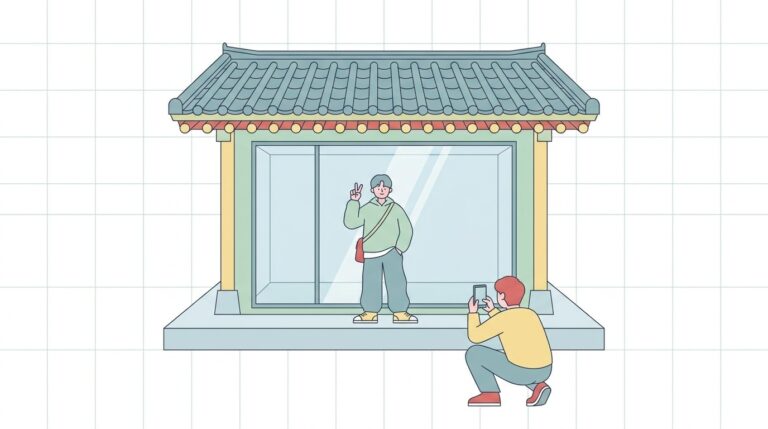
Master the Art of the ‘Insaeng-shot’: How to Guide Your Korean Friends for the Perfect Smartphone Photo
Phase 1: Empathy – The Quest for the Ultimate ‘Insaeng-shot’ (인생샷)
안녕하세요! It’s your favorite K-culture navigator and Daily Hangul editor.
We’ve all been there. You’re standing in front of a gorgeous, pastel-pink cafe in Seongsu-dong, or perhaps under the breathtaking cherry blossoms at Yeouido. You hand your phone to your Korean friend, hoping for a masterpiece. When they hand it back, you’re stunned—you look ten feet tall, your legs look incredibly long, and the composition is absolutely flawless.
But then, it’s your turn. Your friend hands you their phone, smiles expectantly, and says, “예쁘게 찍어줘!” (Ye-ppeu-ge jjig-eo-jwo! / “Take a pretty picture of me!”). Suddenly, panic sets in. You want to give them that coveted 인생샷 (Insaeng-shot)—the “shot of a lifetime”—but you don’t know how to direct them in Korean. You try to tell them to step back, tilt their head, or align themselves with the grid, but the words just won’t come out naturally.
Don’t worry! Today, we are going to master the precise, high-level Korean vocabulary and phrasing needed to direct smartphone photo compositions like a professional photographer. Let’s dive in!
Phase 2: Deep Dive – Three Essential Expressions for Perfect Framing
To direct someone like a pro, you need more than just basic verbs. Here are three sophisticated expressions used by Korean creators and photography enthusiasts.
1. 격자선에 맞춰서 (Gyeog-ja-seon-e mat-chwo-seo)
- Pronunciation: Gyuk-ja-sun-eh mat-chwo-suh (Sounds like “gyuk” as in yuck, “ja” as in jazz, “sun” as in monday)
- Meaning: Aligning with the gridlines
- K-Culture Moment: If you watch behind-the-scenes vlogs of K-Pop idols taking Instagram photos for each other, they always emphasize turning on the gridlines (격자) on their smartphones.
- Editor’s Insight: 격자선 (gridlines) is the technical term, but in daily life, people just say 격자. Using the particle ~에 맞춰서 (in alignment with) shows a high level of linguistic precision.
- Situation Spectrum: Casual ✅ | Semi-formal ✅ | Formal ⚠️
- 🤔 Think About It: In many Western cultures, a candid, slightly tilted shot is seen as “artistic.” In modern Korean youth culture, symmetry, balance, and clean proportions are highly valued. Why do you think symmetry plays such a huge role in Korean social media aesthetics?
2. 여백을 두고 (Yeo-baeg-eul du-go)
- Pronunciation: Yuh-baeg-eul doo-go (Sounds like “yuh” as in young, “baeg” like bag without the heavy ‘g’)
- Meaning: Leaving empty space / negative space
- K-Culture Moment: Often discussed in Korean aesthetic interior design and minimalist photography. A good photo isn’t packed with things; it has beautiful ‘여백의 미’ (the beauty of empty space).
- Editor’s Insight: 여백 refers to the blank space on a canvas or photo. Telling someone to “여백을 두고 찍다” means you are intentionally placing the subject to one side to create a sophisticated, clean look.
- Situation Spectrum: Casual ✅ | Semi-formal ✅ | Formal ✅
- 🤔 Think About It: How does the concept of “여백의 미” (the beauty of blank space) in traditional Korean ink paintings translate to modern-day Instagram grid curation?
3. 발끝을 화면 하단에 맞춰봐 (Bal-kkeut-eul hwa-myeon ha-dan-e mat-chwo-bwa)
- Pronunciation: Bal-kkeut-eul hwa-myun ha-dan-eh mat-chwo-bwa
- Meaning: Try aligning the tips of your feet with the bottom of the screen.
- K-Culture Moment: This is the ultimate golden rule of Korean smartphone photography. To make someone look taller and their legs longer, you must place their feet right at the very bottom edge of the frame.
- Editor’s Insight: 발끝 (tips of the feet) and 화면 하단 (bottom of the screen) are key compound words. Master this sentence, and you will instantly be crowned the best photographer in your friend group.
- Situation Spectrum: Casual ✅ | Semi-formal ✅ | Formal 🚫
- 🤔 Think About It: Why is physical proportion so heavily emphasized in Korean photography tips compared to close-up portrait styles in other cultures?
Phase 3: Textbook Korean vs. Real-Life Korean
Let’s compare the stiff, textbook phrases with what a real Korean trendsetter would say.
Situation 1: Asking someone to step back for a wider angle
- 📖 Textbook: “뒤로 물러서서 서 주십시오.” (Dwi-ro mul-leo-seo-seo seo ju-sip-si-o. – Please step back and stand.)
- 🗣️ 진짜 한국어: “반 걸음만 뒤로 가볼래? 구도가 더 살 것 같아.”
- Pronunciation: “Ban geol-eum-man dwi-ro ga-bol-rae? Gu-do-ga deo sal geot ga-ta.”
- Translation: “Can you step back just half a step? I think the composition will look livelier.”
- 💡 Why the difference? High-level speakers use the verb “살다” (to live/survive) metaphorically to mean “to pop” or “to look great” (e.g., 구도가 살다 – the composition pops).
Situation 2: Suggesting a low-angle shot to look taller
- 📖 Textbook: “카메라의 위치를 낮추어서 촬영하겠습니다.” (Ka-me-ra-ui wi-chi-reul nat-chu-eo-seo chwal-yeong-ha-get-seum-ni-da. – I will lower the camera position and shoot.)
- 🗣️ 진짜 한국어: “폰을 살짝 거꾸로 들고, 아래에서 올려 찍어볼게!”
- Pronunciation: “Pon-eul sal-jjak geo-kku-ro deul-go, a-rae-e-seo ol-ryeo jjig-eo-bol-ke!”
- Translation: “Let me hold the phone slightly upside down and shoot upwards from below!”
- 💡 Why the difference? Holding the phone upside down (거꾸로) puts the lens at the bottom, which is a famous Korean life hack to get a lower angle without bending down completely.
Phase 4: K-Culture Deep Dive & Non-Verbal Etiquette
4-1. The Body Language of a Dedicated Photographer
When taking a photo for a Korean friend, you cannot just stand straight and casually click the button. True dedication—known as 열정 (Yeol-jeong / Passion)—is shown through your posture.
1. The Squat (쩍벌남/녀 자세): To get the lens level with their waist, widen your stance and lower your hips.
2. The Tilt: Tilt the top of your phone slightly toward your chest. This naturally creates an elongated perspective for your subject.
4-2. The Cultural Phenomenon: “인생샷 건지다” (To Scoop Up a Life Shot)
In Korea, photos aren’t just “taken” (찍다); they are “scooped up” or “harvested” (건지다 – Geon-ji-da). This verb is used because a truly great photo is rare—like pulling a precious treasure out of the water. When you take a great picture of your friend, say: “대박, 하나 건졌다!” (Daebak, hana geon-jyeot-da! – “Awesome, we got a great one!”).
Phase 5: Interactive Roleplay Scenario
You are at a trendy Hanok cafe in Bukchon Hanok Village with your stylish Korean friend, Minji (민지). Minji wants you to take her photo against the beautiful wooden wall.
Character Profile:
- Minji (NPC): High energy, loves aesthetics, very detail-oriented about her social media feed.
Minji: "여기 한옥 배경이 너무 예쁘다! 나 사진 한 장만 찍어줄 수 있어?"
        (The Hanok background here is so pretty! Can you take a photo of me?)

You: "당연하지! 폰 이리 줘봐. 어떤 느낌으로 찍고 싶어?"
      (Of course! Give me your phone. What kind of vibe do you want?)

Minji: "음, 그냥 대충 인스타 감성으로, 비율 좋게 나오게 찍어줘!"
        (Hmm, just casual Instagram-vibe, make my proportions look good!)

You: "오케이, 그러면 폰을 거꾸로 들고 찍어볼게."
      (Okay, then I'll hold the phone upside down and take it.)

Minji: "오, 대박! 역시 센스 대박이다. 구도는 어떻게 잡을까?"
        (Oh, awesome! As expected, your sense is amazing. How should we frame the composition?)

You: 🎭 (Squats down slightly) "일단 발끝을 화면 하단에 딱 맞출게."
      (First, I'll align your feet perfectly with the bottom of the screen.)

Minji: "좋아 좋아! 상반신 위주로도 한 장 부탁해!"
        (Nice, nice! One focusing on my upper body too, please!)

You: "그때는 격자선에 맞춰서 눈높이를 중앙에 둘게. 여백도 살짝 두고!"
      (For that, I'll align with the grid and put your eye level in the center. Leaving a bit of empty space too!)

Minji: "우와, 진짜 전문가 같다! 한번 확인해볼래?"
        (Wow, you really sound like a professional! Shall we check it?)
🔀 Interactive Choice Point
Now it’s your turn to respond to Minji after looking at the preview. Which option do you choose?
* A) “완전 잘 나왔어! 대박, 하나 건졌다!”
* B) “사진이 그냥 그래요. 다시 찍읍시다.”
* C) “필터가 이상해서 비율이 안 맞아 보여요.”
💡 Feedback on Your Choice:
- Choosing A (Best): Perfect! You used the highly natural idiom “하나 건졌다” which will make Minji super excited and feel comfortable. (Score: ⭐⭐⭐)
- Choosing B (Bad): Too direct and formal. Using “그냥 그래요” (just so-so) kills the fun, collaborative vibe of taking photos. (Score: ⭐)
- Choosing C (Risk): Complaining about the filter might make your friend self-conscious about her settings. Keep it positive! (Score: ⭐⭐)
Phase 6: 10-Second Emotional Shadowing Drill
Practice saying these lines with the right rhythm and emotion! The slash / represents a natural pause.
- [😊 Confident & Encouraging]
“발끝을 / 화면 하단에 맞추니까 / 확실히 비율이 사네!”- Pronunciation: Bal-kkeut-eul / hwa-myeon ha-dan-e mat-chu-ni-kka / hwak-sil-hi bi-yul-i sa-ne!
- Meaning: Aligning your feet with the bottom of the screen really makes your proportions pop!
- [🤩 Excited & Impressed]
“대박! / 인스타 감성으로 / 제대로 건졌다!”- Pronunciation: Dae-bak! / In-seu-ta gam-seong-eu-ro / je-dae-ro geon-jyeot-da!
- Meaning: Jackpot! We got a perfect shot with that true Instagram vibe!
Phase 7: K-Culture Mini-Dictionary
- 인스타 감성 (Insta-gam-seong) | Instagram Aesthetic | Refers to things, places, or photo styles that have a clean, moody, and visually pleasing aesthetic suitable for Instagram.
- 비율 (Bi-yul) | Proportion / Ratio | In photography, this refers to how well-proportioned someone looks (e.g., long legs, small face).
- 구도 (Gu-do) | Composition / Angle | The framing and alignment of subjects in a photograph.
- 세로 샷 (Se-ro syat) | Vertical Shot | Vertical photos are the standard for personal portraits in Korea, as they maximize vertical proportion.
Phase 8: Traveler’s Survival Kit
Survival Expressions for Photo Spots:
- “가로로 찍어드릴까요, 세로로 찍어드릴까요?”
- Pronunciation: Ga-ro-ro jjig-eo-deu-ril-kka-yo, se-ro-ro jjig-eo-deu-ril-kka-yo?
- Pro Tip: “Should I take it horizontally or vertically?” This polite question is the ultimate sign of a thoughtful photographer in Korea.
- “구도 마음에 드세요?”
- Pronunciation: Gu-do ma-eum-e deu-se-yo?
- Pro Tip: “Do you like the composition?” Ask this after taking the first test shot.
- “다시 찍어드릴게요!”
- Pronunciation: Da-si jjig-eo-deu-ril-ge-yo!
- Pro Tip: “I’ll take it again for you!” If they look slightly hesitant, offer this immediately to win their heart.
Editor’s Travel Note:
When exploring trendy photo spots in Seoul, like Bukchon or Seongsu, download the Naver Map App instead of Google Maps. Google Maps often lacks precise footpaths for hidden alleyway cafes. Disclaimer: App interfaces and local business hours may change, so always double-check before heading out.
Phase 9: “Going Deeper” – The Philosophy of ‘Insaeng-shot’
In Western countries, taking a photo of a friend is often a quick, casual gesture. In Korea, however, taking someone’s photo is considered an act of deep friendship and care. If you spend 5 minutes squatting, angling, and directing your friend to get them their “Insaeng-shot,” you are showing that you value their happiness and respect their desire to present their best self to the world. It is a form of modern, unspoken affection.
💬 Your Turn: How do people in your country usually react when asked to take a photo of a friend? Is there a similar dedication to composition, or is it more relaxed? Let us know in the comments below!
Phase 10: FAQ & Common Mistakes
Q: Can I use the word ‘비율’ (proportions) to anyone?
A: Yes! In Korea, telling someone “비율이 좋다” (Your proportions are great) is a very high compliment meaning they look fit, tall, and photogenic. It is not considered rude or overly physical.
Q: What is the difference between ‘구도’ (Gu-do) and ‘각도’ (Gak-do)?
A: ‘구도’ refers to the overall composition and placement of elements in the frame. ‘각도’ refers to the camera angle (e.g., high angle, low angle).
Q: Is it okay to take photos of strangers in beautiful Korean cafes?
A: Absolutely not. Korea has very strict privacy customs regarding photography. Always ensure strangers are not clearly visible in your shots, or blur/pixelate their faces before posting them online.
🚨 Common Mistakes Warning Board
- Mistake 1: Placing the subject’s head at the very top edge of the screen.
- Why it’s wrong: It makes the person look short and compresses the frame.
- Correct Action: Leave some 여백 (negative space) above the head, and align the feet at the bottom.
- Mistake 2: Keeping the phone tilted backward.
- Why it’s wrong: It distorts the background and makes the subject look wider.
- Correct Action: Tilt the phone slightly forward towards the subject.
Phase 11: Action Mission & K-Culture Hunt
- 🥉 Bronze Mission: Open your phone camera, turn on the “격자” (grid lines), and practice aligning an object with the bottom line.
- 🥈 Silver Mission: Take a photo of a friend or an object using the phrase “여백을 두고 찍어봤어” and share it on your social media, tagging us!
- 🥇 Gold Mission: Next time you meet a Korean speaker, confidently offer: “내가 인생샷 건져줄게!” (I’ll get you a life shot!)
🎮 K-Culture Mission:
Watch a Korean variety show (like Run BTS or I Live Alone). Spot the moments where they take photos of each other and count how many times they squat down or hold the phone upside down!
Phase 12: Interactive Quiz Challenge
Test your knowledge with these three quick questions!
1. Which phrase means “aligning the feet with the bottom of the screen”?
- A) 머리를 중앙에 맞추기
- B) 발끝을 화면 하단에 맞추기
- C) 격자선을 무시하기
Reveal Answer
Correct Answer: B
Explanation: 발끝 (feet tips) + 화면 하단 (bottom of screen) + 맞추기 (aligning) is the golden rule of Korean photography!
2. True or False: In Korea, saying “비율이 좋다” is considered an insult.
- A) True
- B) False
Reveal Answer
Correct Answer: B (False)
Explanation: It is one of the best compliments you can give someone about how photogenic they are!
3. Fill in the blank: “대박, 오늘 진짜 사진 하나 ______!” (Wow, I really scooped up a great photo today!)
- A) 버렸어 (discarded)
- B) 건졌어 (scooped up/harvested)
- C) 샀어 (bought)
Reveal Answer
Correct Answer: B
Explanation: ‘건졌다’ is the perfect casual slang for successfully capturing an amazing photo.







