

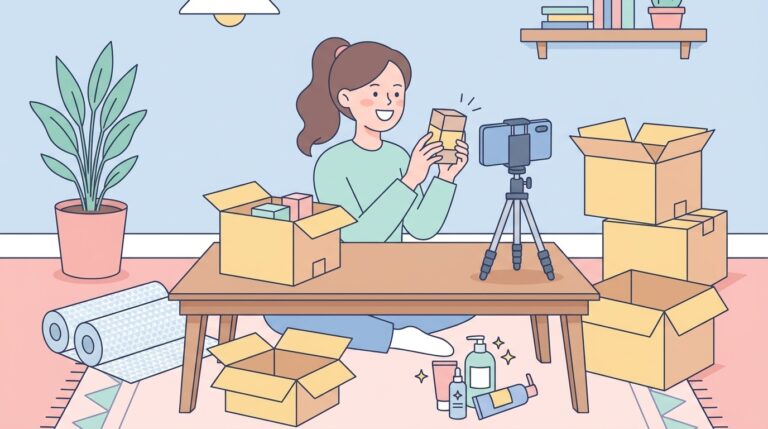
Unboxing Your K-Haul: Mastering the Art of Korean Online Shopping Reviews
Phase 1: Empathy (Welcome to the Ultimate K-Unboxing Guide!)
안녕하세요! It’s your favorite Korean study bestie and senior editor at Daily Hangul.
We’ve all been there: you finally receive that highly anticipated parcel from Korea—whether it’s the latest K-beauty skincare set, limited-edition K-pop albums, or trendy street fashion. You eagerly set up your camera to shoot an “unboxing video” (언박싱 영상) for your socials, or you sit down to write an aesthetic review on Naver Shopping. But as you open the box, you realize… how do I actually express this excitement in natural, native-level Korean?
Translating “This is so pretty!” or “The packaging is great” literally into Korean can sound a bit like a dry textbook. Today, we are moving past the basic “좋아요” (It’s good) and diving deep into the actual slang, emotional nuances, and cultural habits of Korean online shoppers. This guide is based on real feedback from intermediate (B2) learners who wanted to sound exactly like their favorite K-influencers. Let’s level up your unboxing game!
Phase 2: Deep Dive into 3 Essential Unboxing Expressions
1. 내돈내산 (nae-don-nae-san)
- Pronunciation: [neh-don-neh-san] (Rhymes with “play-on-may-sun”)
- Meaning: Lit. “My own money, my own purchase” -> An honest, non-sponsored review.
- K-Culture Moment: You will see this everywhere on YouTube thumbnails and Instagram hashtags (
#내돈내산). It’s a badge of honor for creators to prove they aren’t doing a paid ad (광고). - Editor’s Insight: Trust is huge in Korean online communities. Using “내돈내산” instantly tells your viewers, “Hey, I spent my hard-earned cash on this, so you can trust my brutal honesty.”
- Situation Spectrum: Casual ✅ | Semi-formal ✅ | Formal ⚠️
- 🤔 Think About It: Why do you think Korean culture places such a high premium on clarifying whether a product is sponsored or “내돈내산” compared to your home country?
2. 영롱하다 (yeong-rong-hada)
- Pronunciation: [yeong-rong-ha-da] (Pronounce “yeong” like young, and “rong” with a soft ‘r’ sound)
- Meaning: Lit. “Brilliant, exquisite, or sparkling” -> Aesthetically breathtaking.
- K-Culture Moment: When a K-pop fan opens an album and sees the holographic photocard, they gasp and say, “포카 영롱한 것 좀 봐!” (Look how dazzling this photocard is!).
- Editor’s Insight: While dictionaries define this as “bright and translucent” (like a dewdrop), modern Koreans use it to describe beautiful packaging, high-tech gadgets, or stunning makeup glitter.
- Situation Spectrum: Casual ✅ | Semi-formal ✅ | Formal 🚫
- 🤔 Think About It: Is there a word in your language that transitioned from poetic literature into everyday internet slang to describe something “aesthetic”?
3. 실물 깡패 (sil-mul kkang-pae)
- Pronunciation: [shil-mool kkang-pae] (Lit. “Real-object gangster”)
- Meaning: Looks way better in real life than in photos/videos.
- K-Culture Moment: Unboxing a pair of sneakers and realizing the color is ten times richer than the website preview. “이거 진짜 실물 깡패예요!”
- Editor’s Insight: “깡패” means gangster, but in slang, it refers to something so overwhelmingly superior that it “beats up” the competition. It’s highly colloquial but incredibly common among gen-Z and millennials.
- Situation Spectrum: Casual ✅ | Semi-formal ⚠️ | Formal 🚫
- 🤔 Think About It: Why does Korean slang use aggressive words like “gangster” (깡패) or “thief” (밥도둑 – rice thief) to express high praise?
Phase 3: Textbook Korean vs. Real-Life Korean
Let’s compare the sterile expressions found in standard curricula with the lively Korean used on social media.
Situation 1: Expressing satisfaction with the delivery speed
- 📖 Textbook Korean: 배송이 아주 빠르게 도착했습니다. (The delivery arrived very quickly.)
- 🗣️ 진짜 한국어: 배송 진짜 칼배송이에요! 대박! (The delivery is literally a sword-delivery! Awesome!)
- 💡 Why the difference? Koreans love speed. “칼” (kal – knife/sword) is prefixed to words to mean “razor-sharp, precise, and instant.” “칼배송” means the seller shipped it almost the millisecond you ordered it.
Situation 2: Praising the secure packaging
- 📖 Textbook Korean: 포장이 꼼꼼하게 되어 있어서 안전합니다. (The packaging is meticulous, so it is safe.)
- 🗣️ 진짜 한국어: 뽁뽁이로 완벽 무장해서 흠집 하나 없이 왔어요. (It came perfectly armed with bubble wrap, not a single scratch!)
- 💡 Why the difference? “뽁뽁이” (ppok-ppok-i) is the adorable onomatopoeia for bubble wrap (mimicking the popping sound). Using active military metaphors like “완벽 무장” (perfectly armed/armored) adds dramatic flavor to your review.
Phase 4: K-Culture Deep Dive & Non-Verbal Manners
4-1. The Aesthetics of the “Unboxing Gesture”
In Korean unboxing videos, creators rarely just rip a box open. There is an unspoken etiquette:
1. The ‘Tapping’ Intro: Gently tap the unopened box with your fingernails three times to create a satisfying ASMR sound.
2. The Hand-Behind-Product (The Beauty Hand): When showing a small item (like a lip tint or photocard) to the camera, place your flat palm behind the object. This helps the camera autofocus and is a staple gesture in Korean beauty culture.
4-2. The “Ppalli-Ppalli” (빨리빨리) Delivery Infrastructure
To truly write a good review, you must understand Korea’s legendary logistics. Terms like 새벽배송 (dawn delivery – order by midnight, arrives by 7 AM) and 로켓배송 (rocket delivery) have shaped the expectation of shoppers. When reviewing, acknowledging this hyper-speed delivery is almost mandatory for a 5-star rating!
Phase 5: Real-Life Roleplay Scenario
Here is a realistic dialogue between Minji (민지), an experienced Korean beauty YouTuber, and Sarah (사라), her foreign friend who is filming her very first Korean cosmetic unboxing.
Characters:
- 민지 (Minji): Hyper, encouraging, and uses lots of internet lingo.
- 사라 (Sarah): Enthusiastic but slightly nervous about her Korean pronunciation.
- 민지: 🎭 (카메라를 세팅하며) 사라야, 준비됐어? 오늘 언박싱할 택배 진짜 기대된다!
- 사라: 🎭 (긴장한 듯 손을 풀며) 응! 근데 한국어로 자연스럽게 말할 수 있을지 걱정이야.
- 민지: 🎭 (사라의 어깨를 토닥이며) 걱정 마! 내가 뒤에서 리액션 다 해줄게. 자, 큐!
- 사라: 🎭 (카메라를 보며 밝게 웃으며) 안녕하세요 여러분! 오늘은 드디어 직구한 화장품 언박싱 영상입니다. 이거 진짜 내돈내산 리뷰예요!
- 민지: 🎭 (화면 밖에서 엄지를 치켜세우며) 오, 시작 좋은데?
- 사라: 🎭 (상자를 조심스럽게 열며) 와… 패키지 디자인 좀 보세요. 펄이 들어가서 진짜 영롱해요.
- 민지: 🎭 (카메라 앞으로 고개를 들이밀며) 대박, 진짜 실물 깡패다! 사진보다 백 배 예쁜데요?
- 사라: 🎭 (제품을 손바닥에 올리고 보여주며) 맞아요! 완전 실물 깡패예요. 게다가 어제 주문했는데 오늘 아침에 왔어요. 완전 칼배송!
🔀 Interactive Choice Point
What should Sarah say next to wrap up her unboxing review successfully?
- Option A: “이거 너무 비싸니까 사지 마세요.” (This is too expensive, so don’t buy it.)
- Option B: “진짜 대만족이라 재구매 의사 200%예요!” (I’m totally satisfied, 200% intent to repurchase!)
- Option C: “포장이 너무 안 좋아서 화가 납니다.” (The packaging was so bad, I am angry.)
Feedback:
- Best Choice (Option B): 200% Repurchase Intent (재구매 의사 200%) is the ultimate praise in Korean shopping culture. It sounds highly natural and positive!
- Risk Choice (Option C): While honest, if the product came safely, complaining about packaging might clash with the previous praise of “칼배송”.
- Bad Choice (Option A): Suddenly telling people not to buy it after calling it “영롱하다” and “실물 깡패” makes the review inconsistent and confusing.
Phase 6: 10-Second Emotion Shadowing Drill
Practice these lines with the correct emotional tone and pausing pointers (/).
- [😊 Expressing absolute awe upon opening the box]
- 와… / 이거 실물 / 진짜 대박이에요. / 실물 깡패 인정!
- Wa… / igeo sil-mul / jin-jja dae-bak-i-e-yo. / sil-mul kkang-pae in-jeong!
- [🥺 Playfully complaining about your wallet draining because the item is too pretty]
- 영롱함에 눈멀어서 / 제 통장이 / 텅장이 되었어요. / 흑흑.
- Yeong-rong-ham-e nun-meol-eo-seo / je tong-jang-i / teong-jang-i doe-eot-eo-yo. / heuk-heuk.
- (Note: “통장” means bank account; “텅장” is a pun meaning “empty account”.)
Phase 7: K-Culture Mini-Dictionary
- 택배 (Taek-bae) | Courier / Parcel Service
- Usage: The lifeline of Korean life. If you hear “택배 왔습니다!” (The package is here!), it is universally recognized as the happiest moment of the day.
- 직구 (Jik-gu) | Direct International Purchase
- Usage: Short for 직접 구매 (direct purchase). Used when Koreans buy directly from overseas sites like Amazon or Taobao, or when foreigners buy from Korean websites.
- 득템 (Deuk-tem) | Scoring a Great Item
- Usage: A combination of 득 (gain) and Item (아이템). Used when you purchase something rare, on sale, or highly satisfying.
- 지름신 (Ji-reum-sin) | The God of Impulse Buying
- Usage: “지르다” means to splurge. When you buy things impulsively, Koreans say “지름신이 오셨다” (The shopping god has descended upon me).
Phase 8: The Traveler’s Survival Kit
If you are staying in Korea (Airbnb, hotel, or student housing) and need to deal with parcels:
Survival Phrases
- “문 앞에 두고 가주세요.” (Mun ap-e du-go ga-ju-se-yo.)
- Pro Tip: “Please leave it at the door.” This is the standard contactless delivery request in Korea.
- “경비실에 맡겨주세요.” (Gyeong-bi-sil-e mat-gyeo-ju-se-yo.)
- Pro Tip: “Please leave it in the security office.” Extremely useful for apartment (아파트) residents.
- “송장 번호 알려주실 수 있나요?” (Song-jang beon-ho al-ryeo-ju-shil su in-na-yo?)
- Pro Tip: “Can you give me the tracking/waybill number?” Use this if your shipment is delayed.
Editor’s Travel Note
When ordering online in Korea, download the Naver Shopping App or the Coupang App. Most deliveries require a Korean phone number for SMS tracking. Disclaimer: App interfaces and local payment policies are subject to change; please check the latest registration requirements for foreigners.
Phase 9:
Frequently Asked Questions (FAQ)
Q: What does "내돈내산 (nae-don-nae-san)" mean in Korean and how do you pronounce it?
A: In Korean, "내돈내산 (nae-don-nae-san)" is pronounced [neh-don-neh-san] and means: Lit. "My own money, my own purchase" -> An honest, non-sponsored review.
Q: What does "영롱하다 (yeong-rong-hada)" mean in Korean and how do you pronounce it?
A: In Korean, "영롱하다 (yeong-rong-hada)" is pronounced [yeong-rong-ha-da] and means: Lit. "Brilliant, exquisite, or sparkling" -> Aesthetically breathtaking.
Q: What does "실물 깡패 (sil-mul kkang-pae)" mean in Korean and how do you pronounce it?
A: In Korean, "실물 깡패 (sil-mul kkang-pae)" is pronounced [shil-mool kkang-pae] and means: Looks way better in real life than in photos/videos.







