

Master K-Instagram: How to Post Your Foodie Pics Like a Local (B1 Level)
Phase 1: Empathy (Welcome, K-Foodies! 📸)
안녕하세요! (Annyeonghaseyo!) I’m your Daily Hangul Chief Editor and native culture navigator.
We’ve all been there: You’re sitting in a trendy cafe in Seongsu-dong or a bustling Korean BBQ spot in Hongdae. The food arrives, and it is a literal masterpiece. You take the perfect, aesthetic photo. Your mouth is watering, and you open Instagram, ready to share this masterpiece with the world.
But then… writer’s block hits. You want to write a cool, local-style caption, but the textbook phrase “음식이 맛있습니다” (The food is delicious) feels way too dry and formal. It sounds like a Siri translation! You want to sound fun, trendy, and natural—just like your favorite K-drama characters or K-pop idols when they post their food stories.
Don’t worry! Today, we are going to upgrade your social media Korean from “classroom robot” to “Seoul trendsetter.” Let’s dive into the secret slang, social media etiquette, and natural phrases that will make your Korean friends spam the heart button! ❤️
Phase 2: Top 3 Core Expressions Deep-Dive
Let’s learn the absolute must-know terms for your next foodie post.
1. 맛집 (Mat-jip)
- Pronunciation: mat-jeep (Sounds like “match” + “jeep”)
- Meaning: Food sanctuary / A highly recommended restaurant (Literally: “Taste House”)
- K-Culture Moment: If you watch K-Dramas, you’ll hear characters say, “여기 진짜 맛집이야!” (This place is a real mat-jip!) when trying to impress someone on a date.
- Editor’s Insight: Standard dictionaries say “famous restaurant,” but 맛집 implies a place with authentic flavor, often with a long waiting line. You can even combine it with areas: 홍대 맛집 (Hongdae Mat-jip) or 성수 맛집 (Seongsu Mat-jip).
- Situation Spectrum: Casual ✅ | Semi-formal ✅ | Formal ⚠️
- 🤔 Think About It: In many Western cultures, we search for “best restaurants.” In Korea, the single word 맛집 represents a deeply shared community culture of hunting down the ultimate flavor. Why do you think food culture holds such a massive place in Korean social bonding?
2. 비주얼 대박 (Bi-ju-eol Dae-bak)
- Pronunciation: bee-joo-uhl dae-bahk (Sounds like “visual” + “day-back”)
- Meaning: Incredible food presentation / Stunning looks (Literally: “Visual Jackpot”)
- K-Culture Moment: Used constantly on Korean food variety shows when a massive, cheese-dripping dish is brought to the table.
- Editor’s Insight: 대박 means “jackpot” or “awesome.” Combined with 비주얼 (visual), it expresses that the food looks so beautiful, artistic, or overwhelming that you just have to photograph it before eating.
- Situation Spectrum: Casual ✅ | Semi-formal ✅ | Formal 🚫
- 🤔 Think About It: How does your native language describe food that looks too good to eat? Is there a trendy slang equivalent, or do you use more traditional adjectives?
3. #먹스타그램 (Meok-seu-ta-gurem)
- Pronunciation: muhk-seu-tah-gurem (Sounds like “muck” + “star-gram”)
- Meaning: Foodstagram (Portmanteau of 먹다 [to eat] + 인스타그램 [Instagram])
- K-Culture Moment: The ultimate hashtag used by millions of Koreans daily to catalog their culinary adventures.
- Editor’s Insight: This is the golden key to getting your posts discovered by Korean foodies. Pair it with #맛스타그램 (mat-stagram – taste-gram) and #JMT (John-Mat-Taeng – meaning “crazy delicious”).
- Situation Spectrum: Casual ✅ | Semi-formal ⚠️ | Formal 🚫
- 🤔 Think About It: Why do you think Koreans love combining words to create new social media slang? What does this tell you about the fast-paced nature of Korean internet culture?
Phase 3: Textbook Korean vs. Real-Life Korean
Let’s compare what the textbook teaches you versus what cool Koreans actually write on their feeds.
Situation 1: Expressing that the food tastes absolutely amazing
- 📖 Textbook Korean: 음식의 맛이 아주 좋습니다. (Eumsig-ui masi aju joseumnida.) – “The taste of the food is very good.”
- 🗣️ Real-Life Korean: 여기 진짜 미쳤어요! 존맛탱! (Yeogi jinjja michyeosseoyo! Jon-mat-taeng!) – “This place is seriously crazy! So damn delicious!”
- 💡 Why the difference? Textbook phrases are grammatically flawless but sound like a formal report. On Instagram, using emotive slang like 미쳤다 (to be crazy/insane) or the viral acronym JMT conveys raw enthusiasm and fits the casual vibe of social media.
Situation 2: Saying you are full but can’t stop eating
- 📖 Textbook Korean: 배가 부르지만 계속 먹고 있습니다. (Baega bureujiman gyesok meoggo isseumnida.) – “Although I am full, I keep eating.”
- 🗣️ Real-Life Korean: 배부른데 숟가락을 못 놓겠어… (Baebureunde sutgarageul mot nokesseo…) – “I’m so full, but I can’t put my spoon down…”
- 💡 Why the difference? The real-life version uses a vivid physical action (not putting the spoon down) to paint a funny, relatable picture of struggling to stop eating because the food is just that good.
Phase 4: K-Culture Deep-Dive & Non-Verbal Manners
4-1. The “Aesthetic Silence” (눈치 – Nunchi & Etiquette)
In Korean food culture, there is a golden rule before eating: The Photo Comes First.
* When food is served, do not grab your chopsticks immediately! Look at your dining partners. If they are holding their phones, freeze. This is active Nunchi (tact/situational awareness).
* The Gesture: A polite hand wave over the dish to block eager chopsticks, or saying “잠깐만요! 사진 찍을게요!” (Wait a second! I’ll take a photo!) is highly expected and respected.
4-2. The ” 항공샷” (Hang-gong-syat) Trend
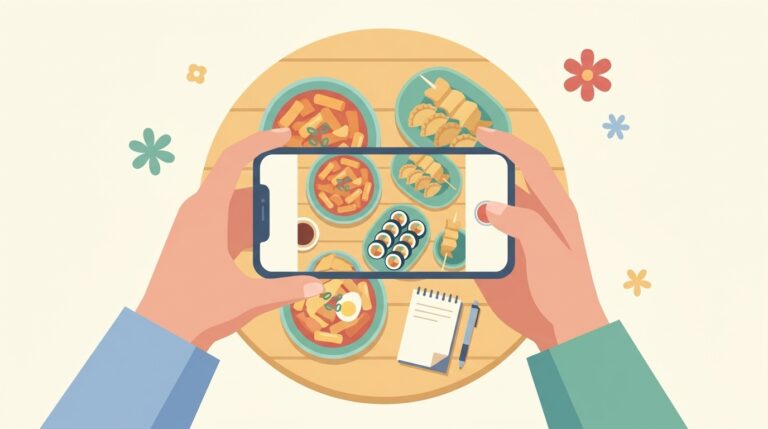
If you want your photos to look truly Korean, use the 항공샷 (aerial shot / drone-view shot). Stand up slightly and take the photo from directly above the table to capture the full spread of side dishes (반찬 – banchan).
Phase 5: Real-Life Roleplay Scenario
Meet Ji-min (지민), a trendy local influencer who is showing you around a hot new dessert cafe in Yeonnam-dong.
- Characters:
- You (유): An excited traveler wanting to capture the perfect moment.
- Ji-min (지민): Your supportive Korean bestie and Instagram expert.
💬 The Dialogue
- 지민: (눈을 반짝이며 디저트를 가리킨다) 🎭 와, 이거 비주얼 대박이지 않아?
(Wa, igeo bi-ju-eol dae-bak-i-ji ana?)
“Wow, doesn’t this look absolutely stunning?” -
유: (핸드폰을 꺼내며) 🎭 응! 사진 먼저 찍을게. 잠깐만 기다려 줘!
(Eung! Sajin meon-jeo jigeul-ge. Jam-kkan-man gi-da-ryeo jwo!)
“Yes! I’ll take a photo first. Please wait just a second!” -
지민: (핸드폰 조명을 비춰주며) 🎭 당연하지! 항공샷으로 찍어봐, 더 잘 나와.
(Dang-yeon-ha-ji! Hang-gong-syat-eu-ro jigeo-bwa, deo jal naw-a.)
“Of course! Try taking an aerial shot, it turns out better.” -
유: (찰칵 소리를 내며 여러 장 찍는다) 🎭 오, 대박! 진짜 잘 나왔다. 이제 먹어볼까?
(Oh, dae-bak! Jinjja jal naw-at-da. Ije meog-eo-bol-ka?)
“Oh, awesome! It turned out so well. Shall we eat now?” -
지민: (디저트를 한 입 먹고 감탄하며) 🎭 대박… 여기 진짜 디저트 맛집 인정이다!
(Dae-bak… yeogi jinjja di-jeo-teu mat-jip in-jeong-i-da!)
“Wow… I officially admit this place is a real dessert heaven!” -
유: (한 입 먹고 눈이 커지며) 🎭 와, 달콤하고 진짜 맛있어! 인스타 올릴 때 해시태그 뭐 쓰지?
(Wa, dal-kom-ha-go jinjja mas-is-seo! In-seu-ta ol-ril ttae hae-si-tae-geu mwo sseu-ji?)
“Wow, it’s sweet and so delicious! What hashtags should I use when uploading to Insta?” -
지민: (미소를 지으며 핸드폰을 톡톡 친다) 🎭 #먹스타그램 이랑 #연남동카페 는 필수야!
(#Meok-seu-ta-gurem-i-rang #Yeon-nam-dong-ka-pe-neun pil-su-ya!)
“#Foodstagram and #YeonnamdongCafe are absolute musts!” -
유: (게시글을 업로드하며) 🎭 완료! 하트 많이 눌러줬으면 좋겠다.
(Wan-ryeo! Ha-teu man-i nul-reo-jwas-eu-myeon jo-ket-da.)
“Done! I hope people press ‘heart’ a lot.”
🔀 Choose Your Path
Ji-min asks you what caption you wrote. Which one do you choose?
- Choice A: “음식의 맛이 아주 훌륭합니다. 여러분도 오세요.”
- Choice B: “여기 진짜 미쳤음… 맛집 인정! 🍰 #먹스타그램”
- Choice C: “배부르지만 맛있다. JMT.”
🧐 Feedback on Your Choice:
- Best Choice: Choice B! This is extremely natural, casual, and perfectly captures modern Korean social media slang (미쳤음 is a cool, truncated verb form often used in writing, paired with excellent hashtags).
- Risk Choice: Choice C! Very natural, but JMT is extremely casual slang. It works perfectly with close friends but might feel a tiny bit too informal if your boss or teacher follows your Instagram.
- Bad Choice: Choice A! Oh no! While grammatically correct, it sounds like an excerpt from a 1990s travel brochure. It lacks that trendy, friendly social media vibe!
Phase 6: 10-Second Emotional Shadowing Drill
Let’s practice speaking with real Korean emotion! Pay attention to the pauses (/) and the emotional cues.
- [😊 Filled with excited anticipation]
- 여기 / 비주얼 / 진짜 대박이다!
- Yeo-gi / bi-ju-eol / jinjja dae-bak-i-da!
- “This visual / is / seriously insane!”
- [🤤 While chewing delicious food, eyes wide]
- 음~/ 진짜 / 숟가락을 못 놓겠어!
- Eum~/ jinjja / sut-ga-rag-eul mot no-kes-seo!
- “Mmh~/ seriously / I can’t put my spoon down!”
- [🥳 Proudly showing off your post]
- 인스타 올렸어! / 하트 / 많이 눌러줘!
- In-seu-ta ol-ryeos-seo! / Ha-teu / man-i nul-reo-jwo!
- “I posted on Insta! / Please press / ‘heart’ a lot!”
Phase 7: K-Culture Mini Dictionary
- 내돈내산 (Nae-don-nae-san) | “My own money, my own purchase” | Highly used on social media to prove that your food review is 100% authentic and not a paid advertisement.
- 피드 (Pi-deu) | “Feed” | Refers to your Instagram profile grid. Koreans say, “피드가 예쁘다” (Your feed looks beautiful/aesthetic).
- 인생샷 (In-saeng-syat) | “Life Shot” | The best photo of your life. Often used when someone takes an amazingly aesthetic picture of you at a cafe.
- 스토리 (Seu-to-ri) | “Story” | Refers to Instagram Stories. Koreans often say, “스토리 올렸어” (I posted a Story).
Phase 8: Survivor’s Kit for Travelers
Survival Phrases TOP 3
- “사진 좀 찍어주실 수 있나요?” (Sajin jom jjigeo-jusil su innayo?)
- Pro Tip: “Could you take a photo of me?” Use this to ask polite locals to capture your perfect shot.
- “여기 뭐가 제일 잘 나가요?” (Yeogi mwoga jeil jal nagayo?)
- Pro Tip: “What is the most popular dish here?” Use this to find the 맛집‘s signature photogenic menu.
- “와이파이 비밀번호가 뭐예요?” (Wa-i-pa-i bi-mil-beon-ho-ga mwo-yeo-yo?)
- Pro Tip: “What is the Wi-Fi password?” Vital for uploading your high-res photos instantly!
Editor’s Travel Note
When hunting for real local 맛집 in Korea, do not rely solely on Instagram hashtags. Download the Naver Map App (네이버 지도) to read authentic local reviews and check star ratings. It’s the ultimate tool used by 99% of Koreans to navigate the culinary scene! Note: App interfaces and restaurant details are subject to change over time.
Phase 9: “Going Deeper” (A Touch of Korean Humanity)
In Korea, food is not just nutrition; it is a language of affection. Historically, asking someone “밥 먹었어?” (Did you eat rice?) was a way of asking “How are you doing?” and showing deep care. Today, sharing gorgeous photos of 맛집 on Instagram is a modern evolution of this care. When Koreans tag friends in food posts, they aren’t just showing off—they are saying, “I love this, and I want to share this happiness with you next time.”
💬 Your Turn: What is the one food in your country that you would immediately post under #먹스타그램? Tell us in the comments below! We’d love to see your local food recommendations!
Phase 10: FAQ & Common Mistakes
Q: Can I use the hashtag #존맛탱 (JMT) when posting a review of a fancy hotel restaurant?
A: It is better to avoid it for very formal or high-end dining reviews. JMT is brilliant for trendy, casual, and street-food spots. For luxury dining, words like 분위기 좋은 (good atmosphere) or 정갈한 (neat/orderly) sound much more sophisticated.
Q: Is it rude to take photos inside a Korean restaurant?
A: Generally, taking photos of the food is completely fine. However, out of respect for other diners’ privacy (deeply valued in Korea’s Nunchi culture), make sure your camera is not pointing directly at other customers’ faces. Many locals use blurring stickers on social media to cover strangers in the background.
Q: What does ‘인스타 감성’ (Insta-gam-seong) mean?
A: It means “Instagram aesthetic.” It usually refers to cafes with minimalist designs, warm lighting, unique plates, and beautifully presented food that are perfect for social media pictures.
🚨 Common Mistakes Alert!
- Mistake 1: Writing “이 식당은 맛있는 집입니다” (This restaurant is a delicious house) on Instagram.
- Correct Action: Just use the simple, trendy noun: “여기 진짜 맛집!”
- Mistake 2: Capitalizing JMT as 존맛탱 but using it in formal business emails.
- Correct Action: Only use 존맛탱 or JMT on personal social media or with very close friends.
- Mistake 3: Not adding location hashtags.
- Correct Action: Always add hashtags like #홍대맛집 or #성수동카페 to connect with local foodies!
Phase 11: Action Mission & K-Culture Hunt
- 🥉 Bronze Mission: Open your Instagram, find a past food photo, and write the caption: “비주얼 대박!”
- 🥈 Silver Mission: Draft a mock Instagram post using at least two hashtags: #먹스타그램 and #[YourCity]맛집.
- 🥇 Gold Mission: Next time you eat, take an 항공샷 (aerial photo) and post it on your real social media tagging
@daily_hangul! Let’s see your progress! - 🎮 K-Culture Mission: Watch a food vlog by a Korean YouTuber or K-pop group. Count how many times they say “대박” or “맛집” and write down the context!
Phase 12: Interactive Quiz Challenge
Test your new K-Instagram skills!
1. Which hashtag is a portmanteau of “to eat” and “Instagram”?
- A) #맛스타그램
- B) #먹스타그램
- C) #인스타푸드
2. What does the slang “비주얼 대박” refer to?
- A) The taste is extremely spicy.
- B) The food’s visual presentation is amazing.
- C) The price is very cheap.
3. True or False: It is completely fine to grab your chopsticks and dig in while your Korean friend is setting up an aerial shot.
- A) True
- B) False
👀 Click here to reveal the answers and explanations!
- Answer: B) #먹스타그램. (From 먹다 [to eat] + 인스타그램 [Instagram]).
- Answer: B) The food’s visual presentation is amazing. (비주얼 = visual, 대박 = jackpot/awesome).
- Answer: B) False. Out of Nunchi (social etiquette), you should wait until they finish taking the picture so they can get the perfect shot of the untouched food!
See you in the next unit! Keep sharing your beautiful food journeys with us! 다음에 또 만나요! (See you next time!)







