

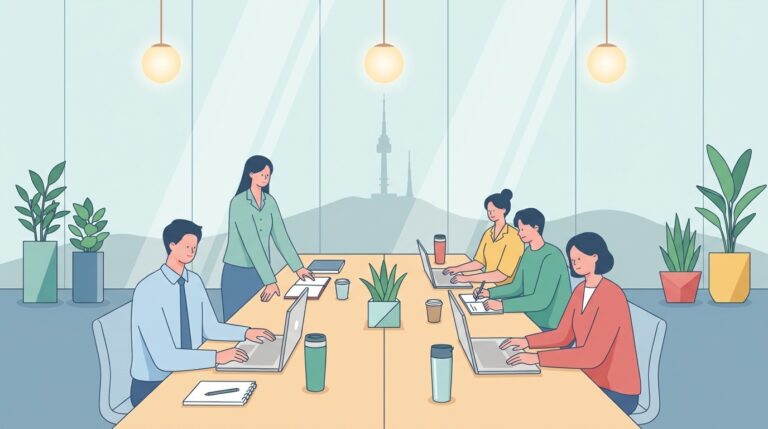
Redefining the Workspace: Navigating Korea’s Shared Office Revolution Like a True Local
Phase 1: Empathy (스토리 몰입형 오프닝)
안녕하세요! Daily Hangul’s Senior Editor and your cultural navigator here.
Imagine walking into a sleek, high-tech skyscraper in Teheran-ro, Seoul’s Silicon Valley. Instead of rigid cubicles and quiet whispers, you are greeted by the aroma of freshly roasted beans, the soft hum of indie music, and open-plan desks where young tech entrepreneurs and creative designers are huddled together. Welcome to the vibrant world of 공유 오피스 (gong-yu opiseu – shared offices).
As a C2-level learner, you already know the basics of business Korean. But when you step into modern, collaborative spaces like Fastfive, Sparkplus, or WeWork Seoul, the linguistic landscape shifts. You aren’t just “reporting to work”; you are “network building,” “hot-desking,” and navigating the delicate nuances of Nunchi in shared communal areas.
Many advanced learners tell me, “I know the formal vocabulary, but I sound so rigid in these highly dynamic, modern workspaces!” Today, we will master the exact idioms, industry jargon, and cultural etiquettes that will make you sound like an innovative Seoulite who thrives in the future of work.
Phase 2: Key Expressions (핵심 표현 3선 심층 분석)
1. 공간을 타다 (gong-gan-eul ta-da)
- Pronunciation: Gong-gan-eul ta-da (Sounds like “gong-gahn-ul tah-dah” – rhyming with the rhythmic glide of “riding a wave”).
- Meaning: Lit. “To ride/float through a space.” Nuance: Creatively utilizing and flowing through flexible workspaces rather than being bound to a fixed desk.
- K-Culture Moment: You will hear this in K-Dramas like Start-Up (스타트업), where characters discuss how a fluid workspace layout inspires breakthrough ideas.
- Editor’s Insight: Just as you ride a trend (트렌드를 타다) or ride the rhythm (리듬을 타다), “riding a space” implies that you are highly adaptable, leveraging different zones (focus zones, lounge zones) of a shared office to maximize productivity.
- Situation Spectrum: Casual (✅) | Semi-formal (✅) | Formal (⚠️)
- 🤔 Think About It: How does your native language describe the transition from static desks to fluid workspaces? Does it carry the same sense of “riding” or “flowing”?
2. 네트워킹의 장 (ne-teu-wo-king-ui jang)
- Pronunciation: Ne-teu-wo-king-ui jang (Sounds like “neh-teu-wah-king-ee jahng”).
- Meaning: Lit. “The field/arena of networking.” Nuance: A physical or metaphorical space primed for organic professional collaborations.
- K-Culture Moment: Shared office community managers often send weekly newsletters inviting members to a “네트워킹의 장” featuring craft beers or expert panels.
- Editor’s Insight: The word ‘장 (場)’ carries historical weight, referring to traditional marketplaces. In modern terms, it signifies a bustling, fertile ground where ideas are traded.
- Situation Spectrum: Casual (⚠️) | Semi-formal (✅) | Formal (✅)
- 🤔 Think About It: Why does Korean retain traditional words like ‘장’ to describe cutting-edge tech networking events?
3. 자율 좌석제 (ja-yul jwa-seok-je)
- Pronunciation: Ja-yul jwa-seok-je (Sounds like “jah-yool jwah-suk-jeh”).
- Meaning: Hot-desking / Flexible seating system.
- K-Culture Moment: Mentioned in workplace documentaries discussing how traditional conglomerates are breaking hierarchy by adopting open seating.
- Editor’s Insight: ‘자율’ means autonomy. In hierarchical Korean corporate culture, where your desk location used to reflect your rank, this system represents a massive cultural shift toward flat, egalitarian communication.
- Situation Spectrum: Casual (⚠️) | Semi-formal (✅) | Formal (✅)
- 🤔 Think About It: Does hot-desking truly dismantle hierarchy, or does it create a new form of subtle, spatial competition?
Phase 3: Textbook vs. Real Korean (교과서 한국어 vs 진짜 한국어)
Situation 1: Describing your new flexible workspace
- 📖 Textbook: “저는 매일 다른 자리에 앉아서 근무합니다.” (I sit at a different seat every day to work.)
- 🗣️ Real Korean: “우리 회사는 이번에 자율 좌석제로 바꾸면서 공간을 좀 더 타기 시작했어요.” (Since our company switched to hot-desking, we’ve started utilizing our spaces much more fluidly.)
- 💡 Why the difference? The textbook version is grammatically correct but sterile. The real Korean version shows deep cultural adaptation by using advanced business-spatial idioms.
Situation 2: Inviting someone to use the shared lounge
- 📖 Textbook: “공동 구역에서 차를 마시며 이야기합시다.” (Let us drink tea and talk in the common area.)
- 🗣️ Real Korean: “라운지 존에서 가볍게 리프레시하면서 아이디어 스케치나 좀 해볼까요?” (Shall we get a quick refresh in the lounge zone and sketch out some ideas?)
- 💡 Why the difference? Young professionals in Seoul heavily blend English-derived corporate terms like “refresh” and “zone” with Korean structures to sound contemporary and agile.
Phase 4: K-Culture Deep-Dive & Non-Verbal Manners
4-1. Nunchi & Shared Office Etiquette
- The Visual Eye Contact: In Korean shared offices, maintaining professional Nunchi (눈치) is all about how you handle shared amenities. When using the phone booths (폰부스), keeping your voice slightly lowered and keeping track of time is key. Occupying a phone booth for over an hour without reservation is considered highly inconsiderate.
- The Tumbler Rule: Always bring your own tumbler. While coffee is free, leaving disposable cups around signals a lack of spatial ownership.
4-2. Cultural Code: The Evolution of ‘Space’
In Korea, space is historically collective. Traditionally, Sarangbang (사랑방) was a shared reception room in traditional Hanok houses where scholars debated and socialized. Modern 공유 오피스 are the 21st-century reincarnations of Hanok’s Sarangbang—highly social, collaborative, yet deeply respectful of boundaries.
Phase 5: Interactive Roleplay Scenario
Setting: The vibrant, light-filled lounge of a top-tier shared office in Gangnam. You are chatting with Min-ji, a Community Manager who is passionate about spatial design.
Characters
- 민지 (Min-ji): Highly energetic, tech-savvy, always looking to connect members.
- You (Advanced Professional): Keen to adapt your team to the new flexible workspace trends.
8-Turn Dialogue
- 민지: (😊 Brightly waving) “안녕하세요! 오늘 라운지 분위기 정말 활기차지 않나요? 오늘 오피스 이용은 어떠세요?”
- You: “안녕하세요, 민지 씨! 아주 좋아요. 확실히 자율 좌석제를 도입하니까 직원들이 알아서 공간을 타는 느낌이에요.”
- 민지: (💡 Nodding enthusiastically) “맞아요! 정형화된 공간에서 벗어나니까 확실히 부서 간 장벽도 허물어지는 것 같더라고요.”
- You: “네, 특히 저번 주에 열린 네트워킹의 장 덕분에 다른 스타트업 분들과 협업할 수 있는 기회도 생겼어요.”
- 민지: “와, 정말 다행이네요! 사실 이번 달에는 ‘업무 공간의 심리학’을 주제로 공간 세미나를 기획 중인데, 참석해 보시겠어요?”
- You: “아, 아주 흥미로운 주제네요. 저희 디자인 팀원들에게도 꼭 추천해서 같이 들으러 갈게요.”
- 민지: “감사합니다! 혹시 이용하시면서 공간에 대해 아쉽거나 건의하고 싶으신 점도 편하게 말씀해 주세요.”
- You: “공간 배치는 완벽한데, 오후 집중 근무 시간대에 폰부스가 조금 더 확보되면 완벽할 것 같습니다.”
🔀 Interactive Choice Points
Min-ji asks you: “If you could redesign one area of this shared office, what would you prioritize?”
- Choice A: “더 많은 칸막이가 있는 개인 독서실 같은 공간이요.” (An individual study-room style space with more partitions.)
- Choice B: “창의적인 영감을 주는 열린 테라스와 네트워킹 라운지 존을 더 넓히고 싶어요.” (I want to expand the open terrace and networking lounge zones that spark creative inspiration.)
- Choice C: “그냥 지금 이대로가 제일 좋은 것 같은데요? 고칠 게 없어요.” (I think it’s perfect just the way it is now. Nothing to change.)
📊 Feedback on Choices
- Choice A (Risk): Too traditional. In a shared office context, asking to return to rigid partitions might make you seem resistant to collaborative workspace trends.
- Choice B (Best): Demonstrates sophisticated C2 vocabulary and aligns perfectly with the contemporary philosophy of flexible, collaborative workspaces.
- Choice C (Bad): A bit of a conversation killer. Misses the chance to showcase your vocabulary regarding constructive feedback.
Phase 6: 10-Second Shadowing Drill
Practice matching the exact rhythm and emotional tone of an innovative spatial designer.
- Sentence: “공간의 변화가 / 생각을 바꾸고, / 결국 우리 비즈니스의 / 방향성을 결정하더라고요.”
- Pronunciation Guide: Gong-gan-ui byeon-hwa-ga / saeng-gak-eul ba-ggu-go, / gyeol-guk u-ri bi-ji-ni-seu-ui / bang-hyang-seong-eul gyeol-jeong-ha-deo-ra-go-yo.
- Emotional Cue:
[😎 Confidently, with a warm and visionary smile]
Phase 7: K-Culture Mini-Dictionary
- 거점 오피스 (geo-jeom opiseu) | Satellite Office
- Usage: Large companies set up smaller branch offices closer to employees’ residential areas to reduce commute fatigue.
- 워케이션 (wo-ke-i-shyeon) | Workation (Work + Vacation)
- Usage: Working remotely from Jeju Island or Busan’s beachside shared spaces.
- 데스크테리어 (de-seu-keu-te-ri-eo) | Deskterior (Desk + Interior)
- Usage: Decorating one’s workspace with plants, figures, and aesthetic keyboards to express individuality.
- 공간 브랜딩 (gong-gan beu-raen-ding) | Spatial Branding
- Usage: Designing a physical space so that every corner reflects the company’s core values and identity.
Phase 8: Traveler’s Survival Kit
Survival Expressions TOP 3
- “여기 와이파이 비밀번호가 어떻게 되나요?” (Yeo-gi wa-i-pa-i bi-mil-beon-ho-ga eo-tteo-ke doe-na-yo?)
- Pro Tip: Look around the reception desk; it’s usually written on a small wooden plaque or coaster.
- “이 좌석은 예약이 완료된 자리인가요?” (I jwa-seok-eun ye-yak-i wan-ryeo-doen ja-ri-in-ga-yo?)
- Pro Tip: Crucial when trying to sit in quiet focus zones that might have digital reservation tags.
- “공용 프린터 사용법 좀 가르쳐 주실 수 있나요?” (Gong-yong peu-rin-teo sa-yong-beop jom ga-reu-chyeo ju-sil su in-na-yo?)
- Pro Tip: Shared office printers usually require you to enter a personal registration pin code.
Editor’s Travel Note
If you plan to experience Korea’s dynamic work culture, try booking a day pass using the Naver Map App. Simply search for “공유오피스 당일권” (Shared office day pass) to find beautifully curated architectural spaces in Gangnam, Seongsu, or Hongdae. Note: Prices and availability are subject to change depending on seasonal demand.
Phase 9: “Going Deeper” (생각 질문)
In Korea, the shift toward shared offices is not merely an architectural trend; it represents a major challenge to the traditional, strictly hierarchical corporate mindset. By dissolving fixed desks and high cubicle walls, companies are actively encouraging lower-ranking employees to speak up and share ideas on equal footing with executives.
💬 Your Turn: Do you believe that changing the physical architecture of an office can truly dismantle deep-rooted social hierarchies? Leave your thoughts in the comments below—let’s discuss in Korean!
Phase 10: FAQ & Common Mistakes
Q: Can I use shared offices in Korea even if I am a tourist?
A: Yes! Many Korean coworking spaces offer day passes (일일권) or weekly passes that can be booked online or directly at the community desk.
Q: Is it okay to make business calls in the lounge area?
A: Brief, quiet calls are acceptable, but for longer or highly confidential business discussions, it is polite to book a private 폰부스 (Phone Booth) or meeting room.
Q: What is the difference between ‘공유 오피스’ and ‘소호 사무실’?
A: ‘소호 사무실’ (SOHO office) usually refers to small, traditional individual rented office rooms focusing on cost efficiency. ‘공유 오피스’ refers to modern, community-driven collaborative spaces with extensive shared amenities.
🚨 Common Mistakes Alert!
- Incorrect: “오늘 자율 의자제에 앉았어요.”
- Correct: “오늘 자율 좌석제를 이용했어요.” (The term is specifically ‘좌석’ (seat), not ‘의자’ (chair).)
- Incorrect: “이 공간은 매우 소통적이에요.”
- Correct: “이 공간은 소통이 유기적으로 이루어지는 구조예요.” (In Korean, describing a physical space directly as ‘communicative’ sounds awkward. Instead, describe how communication flows naturally within the space’s structure.)
Phase 11: Action Mission & Participation
- 🥉 Bronze: Leave a comment below sharing which of the 3 Key Expressions was your favorite, using the term in a short Korean sentence.
- 🥈 Silver: Share this post on your socials with your own desk setup and the hashtag
#데스크테리어! - 🥇 Gold: Next time you work from a cafe or a shared office, use the phrase “오늘 공간 제대로 타네!” (I’m really flowing through my workspace today!) to your coworkers or in your daily journal.
Phase 12: Interactive Quiz Challenge
1. Vocabulary Match
What is the Korean term for a “satellite office” designed to reduce employee commute times?
* A) 워케이션
* B) 거점 오피스
* C) 자율 좌석제
Reveal Answer & Explanation
Correct Answer: B) 거점 오피스
Explanation: ‘거점 오피스’ refers to a strategically located branch/satellite office used to enhance remote work flexibility.
2. True or False
In Korean shared offices, leaving your personal items to “reserve” a premium hot-desk for several hours while you go out for lunch is considered standard, acceptable etiquette.
* True
* False
Reveal Answer & Explanation
Correct Answer: False
Explanation: This is considered a breach of basic etiquette (Nunchi). If you leave the space for an extended period, you should clear your items so others can utilize the seat.






