

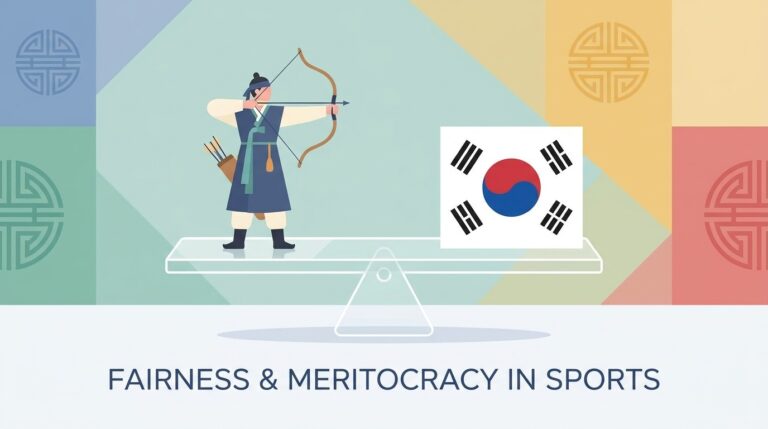
Fairness on the Line: Navigating the Intense World of Korean National Team Selection
Phase 1: Empathy (Welcome to the Arena! 🇰🇷)
안녕하세요! Welcome back to Daily Hangul, your trusted K-culture navigator!
Imagine this: You are watching a gripping K-drama like Twenty-Five Twenty-One (스물다섯 스물하나). The tension in the fencing club is thick enough to cut with a blade. Two athletes have poured years of sweat, tears, and broken bones into a single dream: wearing the Korean national flag (태극마크) on their chest. But behind the scenes, whispers of favoritism, regional bias, or outdated selection systems begin to surface.
If you’ve ever felt the sting of an unfair system or argued passionately with your friends about who truly deserves to represent a country on the world stage, this guide is for you.
As a C1 learner, you are ready to move beyond basic greetings and dive into the high-stakes, passionate debates of Korean society. Today, we are exploring the heavy concepts of fairness (공정성), meritocracy (능력주의), and sportsmanship (스포츠 정신). Let’s unpack the vocabulary that native speakers use when discussing national team selections, Olympic controversies, and the eternal Korean pursuit of a “level playing field.”
Phase 2: Deep Dive into 3 Essential Expressions
1. 공정성 시비 (Gong-jeong-seong si-bi)
- Pronunciation: gong-jung-sung she-bee (Sounds like “gong” as in a temple bell, “jung” as in jungle, “sung” as in a song, and “she-bee” like the English letters C-B)
- Meaning: Controversy over fairness / Dispute regarding equity
- K-Culture Moment: You will see this headline splashed across sports news portals like Naver Sports whenever a national coach selects a player based on “experience” rather than current tryout rankings.
- Editor’s Insight: 시비 (si-bi) originally comes from the Hanja meaning “right and wrong” (是非), but in modern Korean, 시비를 가리다 means to distinguish right from wrong, while 시비가 붙다 means to get into a dispute. Combining it with 공정성 (fairness) highlights a public debate where people are actively questioning if a process was truly clean.
- Situation Spectrum: Casual (⚠️) | Semi-formal (✅) | Formal (✅)
- 🤔 Think About It: Does your home country select national athletes purely based on a one-time trial (like the US Olympic Trials), or is there room for a committee’s subjective choice? Which system do you think is more “공정” (fair)?
2. 학연과 지연 (Hag-yeon-gwa ji-yeon)
- Pronunciation: hahg-yuhn-gwa jee-yuhn (Rhymes with “clog-yawn-gwa G-yawn”)
- Meaning: School ties (academic nepotism) and regional ties (regional bias)
- K-Culture Moment: In movies like As One (코리아) or sports documentaries, you often hear athletes lamenting that they were excluded from the starting lineup not because of their skills, but because they didn’t graduate from the “right” powerhouse university.
- Editor’s Insight: These two terms represent the historic structural obstacles in Korean society. 학연 (學緣) represents connections formed through school alumni networks, and 지연 (地緣) represents connections based on sharing the same hometown. When discussing sports selection, critics often say, “실력이 아니라 학연과 지연으로 뽑았다” (They selected them based on school and regional ties, not talent).
- Situation Spectrum: Casual (✅) | Semi-formal (✅) | Formal (✅)
- 🤔 Think About It: How does nepotism manifest in your own culture’s sports or corporate systems? What are the equivalent terms in your language?
3. 실력 위주 (Sil-ryeog wi-ju)
- Pronunciation: sheel-ryuhk wee-joo (Sounds like “sheel” as in shield, “ryuhk” like yuck with an R, and “wee-joo” like the French ‘oui’ followed by ‘June’ without the ‘ne’)
- Meaning: Merit-based / Talent-first / Performance-oriented
- K-Culture Moment: Archery (양궁) is highly revered in Korea because the Korea Archery Association is famous for its absolute 실력 위주 system. Former Olympic gold medalists must compete from scratch every year in blind selections, with no free passes.
- Editor’s Insight: 위주 means “focused on” or “putting main emphasis on.” When you say 실력 위주, you are asserting that political connections, age, seniority, and past glory should be completely ignored in favor of current capability.
- Situation Spectrum: Casual (✅) | Semi-formal (✅) | Formal (✅)
- 🤔 Think About It: Korean archery is a global powerhouse because of this ruthless 실력 위주 system. Do you think this level of competition is healthy, or does it burn out athletes too quickly?
Phase 3: Textbook Korean vs. Real-Life Korean
Let’s compare the sterile sentences in standard textbooks with how passionate Korean sports fans actually express these sentiments in online communities or at the pub.
Scenario 1: Criticizing an unfair selection process
- 📖 Textbook Korean: “국가대표 선발 과정에 공정하지 못한 부분이 있었다고 생각합니다.” (I think there was an unfair part in the national team selection process.)
- 🗣️ 진짜 한국어: “이번 국가대표 선발은 솔직히 인맥으로 밀어주기 한 거 아니야?” (Honestly, wasn’t this national team selection just pushing someone through via personal connections?)
- 💡 왜 다를까?: Native speakers rarely use passive, academic phrases like “공정하지 못한 부분” in casual debates. Instead, they use sharp, active words like 인맥 (personal network) and 밀어주기 (pushing/backing someone up unfairly) to call out nepotism directly.
Scenario 2: Demanding pure meritocracy
- 📖 Textbook Korean: “선수들의 실력만을 기준으로 삼아야 합니다.” (We must use only the athletes’ skills as the standard.)
- 🗣️ 진짜 한국어: “과거 명성 다 떼고, 오직 현재 폼으로만 정정당당하게 붙어야지!” (Strip away past fame; they should go head-to-head fairly, based purely on their current form!)
- 💡 왜 다를까?: The phrase 정정당당하게 (fair and square) is a deeply embedded sports idiom in Korea. Using terms like 폼 (form/condition) and ~다 떼고 (stripping away/excluding ~) makes you sound incredibly natural and culturally fluent.
Phase 4: K-Culture Deep Dive & Non-Verbal Manners
4-1. The Body Language of Sportsmanship
In Korea, sportsmanship isn’t just about following the rules; it is heavily tied to 예의 (courtesy) and 겸손 (humility).
* The Deep Bow (폴더 인사): Even when an athlete is frustrated by an unfair referee decision or a controversial trial, they must maintain composure. Exploding in anger on court is often heavily criticized by the public as lacking “인성” (character). When greeting coaches, opponents, or fans, a deep 90-degree bow (often called a folder bow) is expected to show respect, regardless of the drama behind the scenes.
* Eye Contact during Debates: When discussing sensitive topics like 공정성 시비 with seniors, Koreans will state their opinions clearly but avoid aggressive, unwavering eye contact, which can be perceived as confrontational. Soften your gaze to show you are attacking the issue, not the person.
4-2. The Archery Code: Korea’s Ultimate Fair Play
If you want to understand the Korean obsession with fairness, look no further than Korean Archery (한국 양궁).
In many Korean sports associations, senior athletes (선배) are sometimes given preferential treatment. But not in archery. Even if you won a gold medal at the previous Olympics, you must shoot alongside high school amateurs in the next year’s trials. There are no exemptions. This absolute transparency is why Koreans often say, “양궁 협회처럼만 해라” (Just do things the way the Archery Association does) whenever they want to criticize corruption in other fields, such as soccer or baseball.
Phase 5: Real-Life Roleplay Scenario
Context: You are having a heated post-match discussion at a chicken-and-beer (치맥) spot with your Korean friend, Min-woo (민우), a passionate sports fan who is furious about the recent football national team roster announcement.
Characters:
- 민우 (Min-woo): Your local friend who lives and breathes sports. He is incredibly cynical about sports politics.
- You (C1 Learner): A well-informed friend who can analyze the nuances of selection systems.
민우: 🎭 (한숨을 쉬며 맥주잔을 내려놓는다)
      아니, 진짜 이번 명단 발표 봤어? 어떻게 그 선수가 또 뽑히냐?
      (Seriously, did you see the roster release? How did that player get selected again?)

You: 🎭 (고개를 끄덕이며 공감하는 표정으로)
     나도 뉴스 봤어. 팬들 사이에서 공정성 시비가 엄청 뜨겁더라고.
     (I saw the news too. The controversy over fairness is burning up among the fans.)

민우: 🎭 (억울하다는 듯 가슴을 치며)
      뜨거운 정도가 아니라 난리 났지! 이건 백퍼센트 학연이랑 지연이 작용한 거야. 감독이랑 대학 동문이잖아!
      (It’s not just hot, it's absolute chaos! This is 100% academic and regional ties at work. He went to the same university as the coach!)

You: 🎭 (진지한 톤으로)
     단순히 과거 인연 때문에 뽑힌 거라면, 현재 폼이 좋은 다른 선수들한테 너무 불공평하네.
     (If he was selected simply due to past connections, that is highly unfair to other athletes who are in great form right now.)

민우: 🎭 (테이블을 가볍게 치며)
      내 말이! 양궁 협회 좀 보고 배웠으면 좋겠어. 거기는 철저하게 실력 위주잖아.
      (Exactly my point! I wish they would learn something from the Archery Association. They are strictly merit-based.)

You: 🎭 (생각에 잠기며)
     맞아, 양궁처럼 정정당당하게 경쟁할 수 있는 시스템이 정착되어야 스포츠 정신이 사는 건데 말이야.
     (Right. Only when a system where people can compete fair and square—like archery—is established, can the true spirit of sports survive.)

민우: 🎭 (잔을 들며)
      아무튼 이번 일은 쉽게 안 넘어갈 것 같아. 협회 게시판 지금 마비됐대.
      (Anyway, I don't think this will blow over easily. They say the association's online board is crashed right now.)

You: 🎭 (잔을 부딪히며)
     여론이 이렇게 안 좋으니 협회 측에서도 제대로 된 해명을 해야겠네. 건배하자!
     (With public opinion this bad, the association will have to offer a proper explanation. Let's clink glasses! Cheers!)
🔀 Interactive Choice Points
How would you respond if Min-woo asks: “야, 네가 감독이라면 실력은 살짝 부족해도 경험 많은 베테랑을 뽑겠어, 아니면 경험은 없어도 폼이 미친 신인을 뽑겠어?” (Hey, if you were the coach, would you pick an experienced veteran who is slightly lacking in skill, or an inexperienced rookie in insane form?)
- Option A: “나는 무조건 실력 위주로 뽑을 거야. 과거의 명성보다는 현재의 실력이 공정하니까.”
- Feedback (Best): Fantastic! You used “실력 위주” and “공정” flawlessly. This shows you value absolute meritocracy, which aligns perfectly with modern Korean youth values.
- Option B: “그냥 대충 타협해서 둘 다 반반 섞어서 뽑으면 안 돼?”
- Feedback (Risk): While pragmatic, saying “대충 타협해서” (compromising sloppily) might make you sound like you don’t take the intense competitive nature of Korean sports seriously.
- Option C: “난 감독 마음에 드는 사람 뽑는 게 맞다고 봐. 감독 권한이잖아.”
- Feedback (Bad): Oops! Supporting absolute unilateral authority might spark an even bigger argument with a passionate fan like Min-woo, who hates “인맥” and “낙하산” (parachuting/favoritism).
Phase 6: 10-Second Emotion Shadowing Drill
Practice speaking like a native speaker during an intense sports debate. Pay close attention to the pause markers (/) and emotional cues!
- [🔥 Frustrated & Passionate]
- 이번 선발은 / 진짜 실력 위주가 아니라 / 완전히 인맥으로 / 밀어준 거야!
- I-beon seon-bal-eun / jin-jja sil-ryeog wi-ju-ga a-ni-ra / wan-jeon-hi in-maeg-eu-ro / mil-eo-jun geo-ya!
- (This selection / is truly not merit-based / it’s completely through connections / pushed forward!)
- [😔 Disappointed & Sighing]
- 정정당당하게 겨뤄야 할 스포츠에서 / 아직도 학연이랑 지연이 통하다니 / 정말 실망스럽다.
- Jeong-jeong-dang-dang-ha-ge gyeo-rweo-ya hal seu-po-cheu-e-seo / a-jik-do hag-yeon-i-rang ji-yeon-i tong-ha-da-ni / jeong-mal sil-mang-seu-reob-da.
- (In sports, where we must compete fair and square / that school and regional ties still work / is truly disappointing.)
Phase 7: K-Culture Mini-Dictionary
- 인맥 (In-maeg): Personal connections / Networking. While building a network is positive globally, in Korea, 인맥 is often used negatively to imply favoritism or nepotism in professional spaces.
- 정정당당 (Jeong-jeong-dang-dang): Fair and square / Justly. This is the ultimate Korean idiom for clean play. You will hear it in preschool games, Olympic matches, and corporate statements alike.
- 파벌 싸움 (Pa-beol ssau-eum): Factional infighting. Often used to describe political cliques within sports associations (e.g., the Skating Union or Gymnastics Association) competing for power.
- 국가대표 (Gug-ga-dae-pyo): National Representative (National Team Athlete). In Korea, this title carries massive prestige, national pride, and societal responsibility.
Phase 8: The Traveler’s Survival Kit
If you are traveling to Korea to watch a live game or visit sports hubs like the Seoul Olympic Park (올림픽공원), keep these in mind!
Survival Expressions
- “경기 예매 어떻게 해요?” (Gyeong-gi ye-mae eo-tteoh-ge hae-yo?)
- Pro Tip: “How do I book tickets for the match?” Sports tickets in Korea sell out in seconds on apps like Interpark.
- “오늘 라인업 진짜 대박이다!” (O-neul ra-in-eop jin-jja dae-bak-i-da!)
- Pro Tip: “Today’s lineup is absolutely crazy!” Use this to bond with nearby fans.
- “심판 판정이 좀 아쉬운데요.” (Sim-pan pan-jeong-i jom a-swi-un-de-yo.)
- Pro Tip: “The referee’s decision is a bit disappointing.” A polite, C1-level way to express disagreement with a referee without swearing.
🗺️ Editor’s Travel Note
When navigating stadium ticketing or trying to find live sports bars in Seoul, avoid Google Maps as it lacks local updates. Download Naver Map (네이버 지도) or KakaoMap to find stadiums like the Sangam World Cup Stadium or Jamsil Baseball Stadium smoothly.
Phase 9: “Going One Step Deeper” (Thought Reflection)
In South Korea, the obsession with “공정성” (fairness) is deeply tied to the intense competition of everyday life. From the college entrance exam (수능) to hiring practices at corporate giants like Samsung, young Koreans have grown up in a hyper-competitive society. Because life itself feels like an uphill battle, sports are viewed as the last sacred sanctuary where rules must be applied perfectly and equally. When sports associations violate this trust through 학연 (school ties) or 지연 (regional ties), it triggers widespread public outrage because it mirrors the systemic injustices young people fight against daily.
💬 Your Turn: Do you think sports should be a pure, emotionless meritocracy, or is there value in a coach using their subjective intuition and personal relationships to build a cohesive team? Let us know in the comments below!
Phase 10: FAQ & Avoiding Common Mistakes
Q: What is the difference between 공평 (Gong-pyeong) and 공정 (Gong-jeong)?
A: Excellent question! 공평 (Equity/Equality) means dividing resources or giving opportunities to everyone in the same amount (e.g., giving everyone 10 minutes of playtime). 공정 (Fairness/Justice) means playing strictly by the rules and ensuring merit dictates the outcome, even if the results are unequal (e.g., the best athlete plays 90 minutes, and the rookie plays 5).
Q: Can I use the word “낙하산” (parachute) in sports?
A: Yes! 낙하산 (Nak-ha-san) literally means parachute, but metaphorically refers to someone appointed to a high position due to nepotism rather than merit. If a player is selected because of their father’s connection with the association, fans will call them a 낙하산 선수.
Q: How do I criticize a system politely in Korean?
A: To keep it professional, use nominalized endings and formal vocabulary. Instead of saying “이거 비리 있네요” (This is corrupt), say “선발 시스템의 객관성과 투명성을 제고할 필요가 있습니다” (There is a need to enhance the objectivity and transparency of the selection system).
🚨 The “Common Mistakes” Warning Board
- Mistake: Confusing “실력 위주” (merit-based) with “실적 위주” (results-oriented).
- Correct Action: While they sound similar, 실적 (performance/sales numbers) is for corporate revenue. For human capability and athletic skills, always use 실력 (ability/competence).
- Mistake: Pronouncing “지연” (regional ties) and “지연” (delay) without context.
- Correct Action: They are homophones! In a sports debate, context will make it clear you mean regional bias, but keep your pronunciation clean so it doesn’t sound like “delayed selection.”
- Mistake: Using slang like “빽” (back/connections) in a formal essay.
- Correct Action: While “빽으로 들어왔다” (He got in through his connections) is fine over beer, use 인맥 or 연고 in writing.
Phase 11: Action Mission & Engagement
- 🥉 Bronze Medal Mission: Write a 2-sentence comment below using 공정성 시비 and 실력 위주.
- 🥈 Silver Medal Mission: Share this post on your social media with your thoughts on your country’s national team selection process, using the hashtag
#DailyHangul_Sports. - 🥇 Gold Medal Mission: Watch a Korean sports documentary (like Team Korea on Netflix or YouTube clips of archery trials) and try to spot the moment they discuss selection pressure!
Phase 12: Interactive Quiz Challenge
1. Contextual Judgment
Your Korean friend says: “국가대표 선발은 무조건 학연과 지연을 따라야 해!” What is the correct response to point out the flaw in this statement?
* A) 맞아요, 스포츠는 혈연이 가장 중요하죠.
* B) 아니지, 학연과 지연을 따르는 건 공정하지 않아. 오직 실력 위주로 가야 해.
* C) 저도 지연되는 경기는 보기 싫어요.
Reveal Answer & Explanation
Correct Answer: B
Explanation: B correctly points out that relying on academic and regional ties is unfair, advocating for a merit-based system. A confuses it with family ties, and C confuses 지연 (regionalism) with 지연 (delay).
2. Fill in the Blank
“이번 대표팀 선발 과정에 대한
(_____________)가 끊이지 않고 있어, 협회장이 공식 사과했습니다.”
* A) 정정당당
* B) 공정성 시비
* C) 실력 위주
Reveal Answer & Explanation
Correct Answer: B
Explanation: “공정성 시비” (Controversy over fairness) fits perfectly in the blank, making the sentence: “Since the controversy over the fairness of this national team selection has not ceased, the association head made an official apology.”
3. True or False Culture Quiz
In Korean archery national selections, previous Olympic gold medalists are automatically given a spot on the next Olympic roster to honor their experience. (True / False)
Reveal Answer & Explanation
Correct Answer: False
Explanation: Korean archery is famous for its absolute 실력 위주 system. Even reigning Olympic champions must compete in the trials from the bottom level every single year.







