

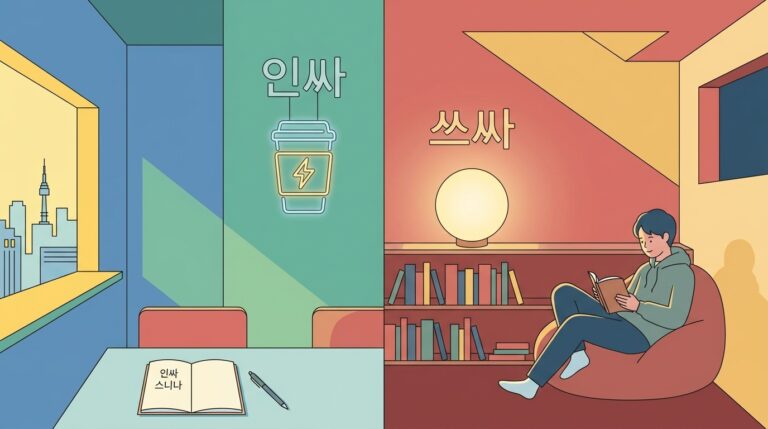
Are You an ‘Inssa’ or ‘Assa’? Navigating Korea’s Insider-Outsider Culture like a True Native
Phase 1: Empathy (Welcome, My Friend!)
안녕하세요! (Annyeonghaseyo! – Hello!) Your friendly editor from Daily Hangul is here.
Imagine this: You are sitting at a trendy cafe in Seongsu-dong, sipping a black sesame latte. Nearby, a group of fashionable locals is laughing hysterically. You catch words like 인싸 (in-ssa) and 아싸 (as-sa), followed by a sudden mock-dramatic sigh: “Ah, I’m totally an assa today…”
You know the literal translations of “insider” and “outsider,” but the way they use it sounds way more nuanced, almost like a social status symbol wrapped in playful self-deprecation.
If you’ve ever felt left out of Korean group chats, or struggled to decipher the subtle vibes (nunchi) of Korean social dynamics, don’t worry. This guide is built from years of coaching advanced global learners who, just like you, wanted to transition from grammatically perfect textbook speakers to culturally fluent, witty conversationalists. By the end of this article, you will master the sharpest slang of Korea’s social spectrum and know exactly how to use them without sounding try-hard.
Phase 2: Deep-Dive into Key Slang
Let’s dissect the holy trinity of modern Korean social classification.
1. 인싸 (Inssa)
- Pronunciation: In-ssa (Rhymes with “spin-sah”)
- Meaning: Short for “Insider.” Not just someone with many friends, but someone who naturally leads trends, adapts effortlessly to any group, and radiates charismatic energy.
- K-Culture Moment: Think of K-pop idols hosting variety shows, effortlessly initiating TikTok dance challenges with complete strangers.
- Editor’s Insight: Being an inssa isn’t just about extroversion; it is about social flexibility. However, calling yourself an inssa unironically can sound boastful. It’s usually better to let others label you as one.
- Situation Spectrum: Casual ✅ | Semi-formal ⚠️ | Formal 🚫
- 🤔 Think About It: How does this differ from the Western concept of “popular”? Is there a pressure in your home culture to always seem socially active?
2. 아싸 (Assa)
- Pronunciation: As-sa (Rhymes with “ah-sah”)
- Meaning: Short for “Outsider.” Someone who prefers solitude, doesn’t follow mainstream trends, or willingly disconnects from intense social circles.
- K-Culture Moment: Often depicted in K-dramas as the quiet, genius protagonist who prefers reading in a corner to attending loud university drinking parties (OT/MT).
- Editor’s Insight: While “outsider” might sound negative in English, assa is frequently used in Korea as a badge of comfortable, voluntary solitude (often called 자발적 아싸 – jabaljeok assa, “voluntary outsider”). It’s highly common to self-deprecatingly claim assa status to avoid tedious social obligations.
- Situation Spectrum: Casual ✅ | Semi-formal ⚠️ | Formal 🚫
- 🤔 Think About It: Why do you think modern Koreans embrace the label of a “voluntary outsider”?
3. 핵인싸 (Haeg-inssa)
- Pronunciation: Haeg-in-ssa (sounds like “heck-in-sah” but with a very crisp, tense ‘g’ at the end of the first syllable)
- Meaning: “Nuclear Insider.” The ultimate social butterfly. Someone who is the absolute life of the party, introducing new trends and connecting different social circles.
- K-Culture Moment: The character who walks into a crowded room and knows every single person’s name, TMI, and favorite drink.
- Editor’s Insight: The prefix ‘핵’ (haeg) literally means nuclear, used as an intensifier. Use this to playfully compliment a friend who is incredibly popular.
- Situation Spectrum: Casual ✅ | Semi-formal 🚫 | Formal 🚫
- 🤔 Think About It: Is there an equivalent prefix in your native language that denotes “nuclear-level” intensity?
Phase 3: Textbook Korean vs. Real Korean
Let’s compare the sterile sentences of standard dictionaries with the vivid realities of Seoul’s social vocabulary.
Scenario 1: Describing someone who loves being the center of attention
- 📖 Textbook Korean: “그 사람은 대인 관계가 아주 원만하고 사교적입니다.” (Geu sarameun daein gwangyega aju wonmanhago sagyojeogimnida. – “That person has very smooth interpersonal relationships and is sociable.”)
- 🗣️ Real Korean: “그 사람 진짜 핵인싸예요. 텐션이 장난 아니에요!” (Geu saram jinjja haeginssayeyo. Tensyeoni jangnan aniyeyo! – “That person is a total nuclear-insider. Their energy/tension is no joke!”)
- 💡 Why the difference? The textbook phrase sounds like a formal evaluation on a corporate resume. In daily life, Koreans use loanwords like “텐션” (tension – meaning high energy/hype) paired with haeginssa to paint a lively picture.
Scenario 2: Declining a weekend gathering to rest alone
- 📖 Textbook Korean: “저는 주말에 혼자 집에 있고 싶어서 모임에 가지 않겠습니다.” (Jeoneun jumare honja jibe itgo sipeoseo moime gaji angetseumnida. – “I want to stay home alone on the weekend, so I will not attend the gathering.”)
- 🗣️ Real Korean: “저 주말엔 그냥 집돌이/집순이 모드로 아싸 생활 하려고요.” (Jeo jumaren geunyang jipdori/jipsuni modeuro assa saenghwal haryeogoyo. – “I’m just going to go ‘homebody’ mode and live the outsider life this weekend.”)
- 💡 Why the difference? Declining invitations directly can feel cold in Korea’s collective culture. By humorously calling yourself a jipdori (male homebody) or jipsuni (female homebody) living an assa life, you soften the rejection with relatable humor.
Phase 4: K-Culture Deep-Dive & Non-Verbal Manners
4-1. The Body Language of an “Inssa”
To truly embody these concepts, you must master the associated physical cues.
* The Inssa Greeting: An inssa doesn’t just bow politely; they might offer a playful “half-bow peace sign” or initiate the latest trending handshake. They maintain warm, direct eye contact but keep it playful to avoid looking aggressive.
* The Assa Defense: An assa in a crowded social setting often exhibits “defensive body language”—holding their drink close to their chest, scrolling through their phone with intense mock-concentration, or subtly executing the nunchi look (scanning the room to find the perfect moment to slip away quietly, a move known as 스텔스 탈출 – stealth escape).
4-2. The Cultural Underpinnings
Historically, Korean society has valued collective harmony (jeong – 정). Being an assa used to carry a heavy stigma of being excluded. However, the rise of the MZ generation has flipped this script. Today, identifying as an assa is often a proud declaration of independence from exhausting societal expectations—like forced after-work drinking sessions (hoesik). It is an assertion of personal boundaries in a historically boundary-less collective culture.
Phase 5: Real-Life Roleplay Scenario
Setting: A vibrant pocha (street-style pub) in Hongdae. You are out with Min-jun (a textbook inssa) and Soyeon (a comfortable assa).
Characters:
* Min-jun (민준): Outgoing, loves introducing people, constantly suggesting new drinking games.
* Soyeon (소연): Calm, witty, enjoys small talk but hates massive crowds.
The Conversation
- 민준: (신나서 술잔을 두드리며) 야, 오늘 여기 분위기 진짜 대박이다! 완전 인싸들만 모인 것 같아!
(Ya, oneul yeogi bunwigi jinjja daebagida! Wanjeon inssadeulman moin geot gata!)
(“Hey, the vibe here today is seriously awesome! It feels like only insiders gathered here!”) - Soyeon (소연): (고개를 저으며 절레절레) 난 벌써 기가 빨린다… 민준아, 난 그냥 아싸 할래.
(Nan beolsseo giga ballyeonda… Minjuna, nan geunyang assa hallae.)
(Shaking her head: “My energy is already drained… Min-jun, I’ll just be an outsider.”) - You (우리의 주인공): (웃으며) 소연아, 걱정 마. 나도 오늘 자발적 아싸 모드야. 우리 구석에서 조용히 마시자.
(Soyeona, geokjeong ma. Nado oneul jabaljeok assa modeuya. Uri guseogeseo joyonghi masija.)
(Smiling: “Soyeon, don’t worry. I’m in ‘voluntary outsider’ mode today too. Let’s just drink quietly in the corner.”) - 민준: (눈을 동그랗게 뜨며) 에이, 둘 다 왜 이래? 여기까지 와서 아싸 모드라니! 우리 저 테이블이랑 게임 해야지!
(Ei, dul da wae irae? Yeogikkaji waseo assa modeurani! Uri jeo teibuliraang geim haeyaji!)
(Widening eyes: “Come on, what’s wrong with you two? Outsider mode after coming all the way here? We have to play a game with that table over there!”) - Soyeon (소연): (단호하게) 저기요, 민준 씨. 그건 핵인싸나 하는 짓이고요. 우린 조용히 안주 맛이나 볼 겁니다.
(Jeogiyo, Minjun ssi. Geugeon haeginssana haneun jitsigoyo. Urin joyonghi anju masina bol geomnida.)
(Firmly: “Excuse me, Mr. Min-jun. That’s what nuclear insiders do. We are quietly going to enjoy the food.”) - You (우리의 주인공): 맞아요. 저는 안주파예요. 황도랑 닭발은 다 우리 아싸들이 먹을게요!
(Majayo. Jeoneun anjupayeyo. Hwangdorang dakbareun da uri assadeuri meogulgeyo!)
(“Exactly. I’m of the ‘side-dish-lover’ faction. The canned peaches and chicken feet are all for us outsiders!”) - 민준: (결국 웃음을 터뜨리며) 아, 진짜 못 말린다. 그래, 그럼 오늘은 아싸 테이블, 인싸 테이블 따로 노는 거다?
(A, jinjja mot mallinda. Geurae, geureom oneulreun assa teibul, inssa teibul ttaro noneun geoda?)
(Laughing: “Ah, you guys are hopeless. Okay, so today we play as the outsider table and insider table separately, got it?”) - Soyeon (소연): 콜! 민준이는 저기 가서 핵인싸처럼 놀고 와!
(Call! Minjunieun jeogi gaseo haeginssacheoreom nolgo wa!)
(“Deal! Min-jun, you go over there and play like a nuclear-insider!”)
🔀 Choose Your Path
At this moment, Min-jun drags a new group of friends to your table. How do you react?
- Option A: “반갑습니다! 혹시 MBTI가 어떻게 되세요?” (Greet them warmly and immediately ask for their MBTI to break the ice.)
- Option B: (Quietly look down at your plate and mutter) “안녕하세요…” then pretend to read a text message.
- Option C: (Smile warmly and say) “반가워요! 전 소문난 아싸라 낯을 좀 가리는데, 잘 부탁해요!”
Feedback:
- Best Choice: Option C – Acknowledging your own assa nature with a smile is the ultimate social cheat-code in modern Korea. It makes you look incredibly confident, self-aware, and ironically, very inssa-like because of your high emotional intelligence.
- Bad Choice: Option B – While understandable, completely ignoring them might create an awkward tension (gapbunssa) at the table.
- Risk Choice: Option A – Excellent if you actually have the social energy to sustain a high-tempo conversation, but if you’re feeling drained, this might backfire into burnout quickly!
Phase 6: 10-Second Emotion Shadowing Drill
Speak like a native by practicing these natural pauses (/) and emotional cues!
[😊 Playfully teasing a popular friend]
“너 요즘 / SNS 보니까 / 완전 핵인싸 다 됐더라?”
(Neo yojeum / SNS bonikka / wanjeon haeg-inssa da dwaetdeora?)
(“Looking at your social media lately… you’ve become a total nuclear-insider, huh?”)-
[🥺 Relieved, seeking a quiet companion]
“나 오늘 / 기가 진짜 빨려서… / 그냥 아싸들이랑 / 조용히 있을래.”
(Na oneul / giga jinjja ballyeoseo… / geunyang assadeul-iraang / joyonghi isseullae.)
(“My energy is so drained today… I just want to stay quietly with the outsiders.”)
Phase 7: K-Culture Mini-Dictionary
- 기 빨린다 (Gi ballyeonda) | “Energy is drained”
- Used when loud crowds or excessive social interactions exhaust your spiritual stamina (gi).
- 아싸 탈출 (Assa talchul) | “Escaping outsider status”
- The process or desire to become more social and trendy.
- 갑분싸 (Gap-bun-ssa) | “Sudden cold atmosphere”
- Short for 갑자기 분위기가 싸해짐. When someone says something so awkward that the room goes dead silent.
- 자발적 아싸 (Jabaljeok Assa) | “Voluntary Outsider”
- Someone who has the social skills to be an insider but chooses solitude for peace of mind.
Phase 8: The Traveler’s Survival Kit
Survival Phrases
- “여기 가장 인기 있는 메뉴가 뭐예요?” (Yeogi gajang ingi inneun menyuga mwoyeyo?)
- Pro Tip: Use this to easily find the “Inssa menu” at any trendy cafe.
- “조용한 자리로 부탁드립니다.” (Joyonghan jariri butakdeurimnida.)
- Pro Tip: Excellent for assa days when you want a quiet corner booth away from loud speakers.
- “요즘 여기 인싸들은 어디로 가요?” (Yojeum yeogi inssadeureun eodiro gayo?)
- Pro Tip: Ask a local boutique shop owner this to discover hidden spots not listed on tourist blogs.
Editor’s Travel Note
When traveling through Seoul, navigating like an insider requires the right digital tools. Skip standard global maps; they do not update fast enough for Korea’s lightning-fast trend cycles. Instead, download the Naver Map Application for flawless subway routing and localized reviews, and use Catch Table to book seats at the hottest restaurants that local inssas queue up for hours to enter.
Phase 9: “Going Deeper” (A Pocket Essay)
In the West, individualism is often the default setting, and being an “outsider” might carry connotations of rejection or eccentricity. In Korea, however, the linguistic evolution of inssa and assa reflects a fascinating negotiation of identity. Because Korea’s social framework historically demanded deep integration—such as mandatory drinking with coworkers or family reunions—using slang like assa acts as a linguistic shield. By jokingly branding oneself as an assa, a person can politely claim personal space without violating the collective harmony. It is a brilliant modern tool for mental health disguised as playful internet banter.
💬 Your Turn: Are you more of an inssa or an assa in your own country? Does your culture have a similar slang term for someone who happily avoids social gatherings? Let me know in the comments below!
Phase 10: FAQ & Common Mistakes
Q: Can I use the word “아싸” (Assa) in a business meeting?
A: Absolutely not. Assa and Inssa are highly casual internet/slang terms. Using them in a formal presentation or with a business client will make you sound unprofessional. Stick to standard vocabulary like 사교적인 분 (sagyojeogin bun – sociable person) for formal settings.
Q: Is calling someone an “아싸” considered offensive?
A: It depends entirely on the tone. If said with a warm smile among friends (“Ah, you total assa!”), it is playful banter. However, if used behind someone’s back to exclude them, it can be hurtful. When in doubt, only use it as self-deprecation.
Q: What is the difference between “인싸” (Inssa) and “인기인” (Ingiin)?
A: Ingiin (인기인) is a standard, dictionary word meaning “a popular person.” Inssa is modern slang that implies not just popularity, but someone who is actively trendy, energetic, and highly adaptive to youth subcultures.







