

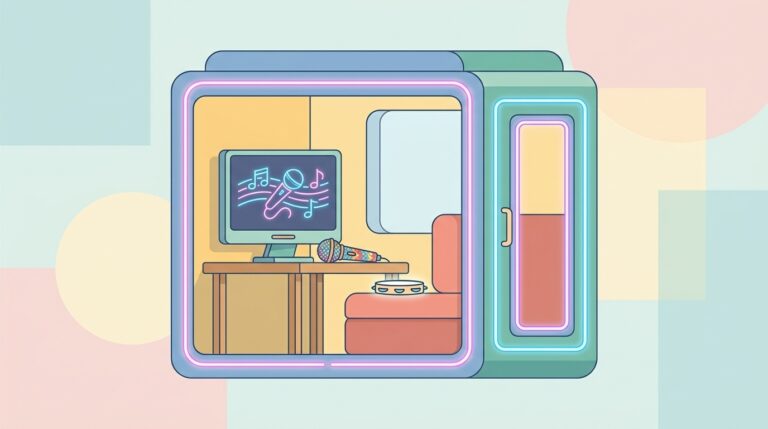
Release Your Stress at a Korean Coin Noraebang (코인 노래방) Like a True Local!
Phase 1: Empathy (Dive Into the Beat)
안녕하세요! (Annyeonghaseyo!) It’s your friendly neighborhood Korean editor from Daily Hangul! 👋
Have you ever had one of those days where your boss drove you crazy, or a difficult assignment left your brain feeling fried? In many cultures, people go for a run, grab a beer, or vent to a friend. But in Korea, there is a sacred, neon-lit sanctuary designed specifically for releasing that heavy energy: the 코인 노래방 (Koin Noraebang – Coin Karaoke), affectionately dubbed ‘코노’ (Kono) by locals.
Imagine walking into a tiny, private, soundproof booth. You drop a few 500-won coins (or tap your card), grab a mic cover, dim the lights, and sing your lungs out to your favorite K-Pop anthem. No audience, no judgment—just pure, unadulterated stress relief.
However, many intermediate Korean learners (B2) face a unique roadblock here. You know the basic vocabulary, but when you are inside the booth with a Korean friend, you might freeze up. How do I politely ask to take turns? How do I say my favorite song is coming up? What is the social etiquette when someone else is hitting a high note?
Don’t worry! Today, we are moving past textbook stiffness to master the real, raw slang and cultural nuances used in Korea’s favorite musical escape rooms. Let’s get singing! 🎤
Phase 2: In-Depth Analysis of 3 Key Expressions
To sound like a true Korean native inside the Kono, you need to master these three core expressions.
1. 달달하다 (Daldal-hada)
- Pronunciation: [Dal-dal-ha-da] (Sounds like “dull-dull-hah-dah”)
- Meaning: Literally “to be sweet,” but in the Kono, it refers to sweet, romantic, or soothing acoustic songs/duets (ballads that make your heart flutter).
- K-Culture Moment: Think of those iconic K-Drama OSTs where the main leads walk under cherry blossoms. If your friend selects a soft acoustic song like “Everytime” (Chen x Punch), you would use this word.
- Editor’s Insight: While “달콤하다” (dalkom-hada) is used for sugary food, 달달하다 is the go-to slang for romantic vibes, cozy music, or even watching a cute couple.
- Situation Spectrum: Casual (✅) | Semi-formal (⚠️) | Formal (🚫)
- 🤔 Think About It: In English, we might call music “soft” or “chilled.” Why do you think Koreans use a taste-related word like “sweet” (달달하다) to describe a musical vibe?
2. 마이크 욕심 (Maikeu Yoksim)
- Pronunciation: [My-keu yok-sim] (Sounds like “mic” + “yoke-seem”)
- Meaning: “Mic greed” (being a mic hog).
- K-Culture Moment: You are in a room with three friends, but one person keeps singing every single song—even the ones they didn’t reserve—or singing over everyone else’s tracks.
- Editor’s Insight: This is a combination of 마이크 (microphone) and 욕심 (greed/ambition). While calling someone a “mic hog” sounds aggressive in English, jokingly saying “마이크 욕심 부리지 마~” (Don’t be greedy with the mic!) is a lighthearted, playful way to keep the rotation fair.
- Situation Spectrum: Casual (✅) | Semi-formal (⚠️) | Formal (🚫)
- 🤔 Think About It: Korean social culture highly values collective harmony (눈치 – Nunchi). How does the existence of the word “마이크 욕심” reflect this cultural value?
3. 목이 쉬다 (Mogi swida)
- Pronunciation: [Mog-i swi-da] (Sounds like “mokee shee-dah”)
- Meaning: To go hoarse / to lose one’s voice from singing or screaming too much.
- K-Culture Moment: After belt-out tracks by IU, Tears by So Chan-whee, or high-energy BTS anthems, your voice sounds like a squeaky hinge.
- Editor’s Insight: “쉬다” usually means “to rest,” but when paired with “목” (throat/voice), it means your vocal cords are exhausted or “sour/spoiled” (as in spoiled food, another meaning of 쉬다).
- Situation Spectrum: Casual (✅) | Semi-formal (✅) | Formal (✅)
- 🤔 Think About It: How does your native language describe losing your voice? Is it passive (“I lost my voice”) or active (“My throat went hoarse”)?
Phase 3: Textbook Korean vs. Real Native Korean
Let’s compare stiff, grammatically perfect textbook phrases with what young Koreans actually say in the booth.
Situation 1: Suggesting to sing a high-energy song to shake off stress.
- 📖 Textbook: “스트레스를 풀기 위해서 신나는 노래를 부릅시다.”
(Seuteureseureul pulgi wihaeseo sin-naneun noraereul bureupsida.)
Translation: Let us sing an exciting song to relieve stress. - 🗣️ Real Native: “야, 우리 텐션 좀 올리자! 신나는 걸로 예약해 봐.”
(Ya, uri tensyeon jom ollija! Sin-naneun geollo yeyakhae bwa.)
Translation: Hey, let’s get our energy (tension) up! Reserve something high-energy. - 💡 Why the Difference? Koreans love using Konglish words like “tension” (텐션) to describe mood and energy levels. Saying “텐션 올리자” (raise the tension) is the ultimate way to hype up a party.
Situation 2: When you want your friend to sing next.
- 📖 Textbook: “이제 당신이 노래를 부를 차례입니다.”
(Ije dangsini noraereul bureul charye-imnida.)
Translation: Now it is your turn to sing the song. - 🗣️ Real Native: “다음 곡 네 거임. 마이크 토스!”
(Daeum gok ne geo-im. Maikeu toseu!)
Translation: Next song is yours. Passing the mic! (Mic toss!) - 💡 Why the Difference? Textbook Korean uses formal pronouns like “당신” (which is actually rare and can sound cold or confrontational in real life). In casual settings, noun-ending slang like “~거임” (it is) and sport-derived terms like “마이크 토스” (mic toss/pass) flow much better.
Phase 4: K-Culture Deep Dive & Non-verbal Manners
4-1. Nunchi (눈치) & Micro-Gestures in the Noraebang
Singing in Korea is a team sport, even in a small Kono. To show excellent manners:
* The Tambourine Duty (템버린 흔들기): If you aren’t singing, you aren’t just looking at your phone! Grab the glowing tambourine and shake it to the beat of your friend’s song. It shows you are actively supporting their performance.
* The Key-Changer Etiquette (키 조절): If a song is too high, you can change the key using the remote controller. However, never change the key or press “Cancel” (취소) while someone else is singing unless they explicitly ask you to! Doing so is considered highly disrespectful.
4-2. Cultural Code: The Evolution of Noraebang
Traditionally, Koreans went to massive Noraebangs after dinner and drinks (2차 – Second round) with colleagues. But today’s youth prefer 코인 노래방 (Kono). It is cheaper, fits 1-3 people perfectly, and allows solo-singing (혼코노 – Hon-kono) for introverts who just need to scream out their frustrations after a tough day.
Phase 5: Real-Life Roleplay Scenario
Setting: You are at a trendy Kono in Hongdae with your close Korean college classmate, Ji-hoon (지훈). You both just finished final exams and desperately need a dopamine hit.
Dialogue (8 Turns)
- 지훈: 🎭 (Stretches his arms and sighs) 아, 시험 끝났다! 진짜 이번 주 내내 스트레스 대박이었어.
(Ah, siheom kkeutnatda! Jinjja ibeon ju naenae seuteureseu daebag-ieosseo.)
“Ah, exams are over! Seriously, the stress this entire week was insane.” - You: 🎭 (Grinning, holding two microphone covers) 그러니까요! 우리 오늘 스트레스 제대로 풀고 가요. 일단 마이크 커버 씌우고…
(Geureonikkayo! Uri oneul seuteureseu jedaero pulgo gayo. Ildan maikeu keobeo ssi-ugo…)
“I know, right! Let’s shake off all our stress today. First, let’s put the mic covers on…” - 지훈: 🎭 (Grabbing the remote controller) 너 뭐 부를래? 발라드? 아니면 댄스?
(Neo mwo bureullae? Balleadeu? Animyeon daenseu?)
“What do you want to sing? Ballad? Or dance?” - You: 🎭 (Pointing at the screen) 음… 처음부터 너무 달달한 노래는 좀 그렇고, 텐션 좀 올리게 신나는 걸로 가요!
(Eum… cheoeumbuteo neomu daldalhan noraeneun jom geureotgo, tensyeon jom ollige sin-naneun geollo gayo!)
“Hmm… a song that is too sweet right from the start is a bit much. Let’s go with something high-energy to get our spirits up!” - 지훈: 🎭 (Nodding enthusiastically) 오, 좋아 좋아! 역시 뭘 좀 아네. 내가 첫 곡 예약한다?
(O, joa joa! Yeoksi mwol jom ane. Naega cheot gok yeyakhanda?)
“Oh, nice, nice! You know how to party. Shall I reserve the first song?” - You: 🎭 (Shaking the tambourine) 네, 형이 선빵(?) 치세요! 다음 곡은 제 마이크 토스고요!
(Ne, hyeongi seonppang(?) chiseyo! Daeum gok-eun je maikeu toseugoyo!)
“Yeah, you go first! (Slang: Land the first blow!) Next song, toss the mic to me!” - 지훈: 🎭 (Singing passionately, hitting a crazy high note, then gasping for air) 헉헉… 아, 고음 질렀더니 벌써 목이 쉬려고 해.
(Heokheok… ah, goeum jilleotdeoni beolsseo mog-i swiryeogo hae.)
“Phew, phew… Ah, screaming those high notes, my voice is already going hoarse.” - You: 🎭 (Passing him a bottle of water) 마이크 욕심 너무 부린 거 아니에요? 자, 물 마시면서 목 좀 쉬어 가면서 해요!
(Maikeu yoksim neomu burin geo anieyo? Ja, mul masimyeonseo mok jom swieo gamyeonseo haeyo!)
“Didn’t you get a bit too greedy with the mic? Here, drink some water and take a rest as you go!”
🔀 Interactive Choice Point
Ji-hoon finishes his song and gets a score of 100 on the screen! He is hyped up. How do you react?
- Choice A: “와, 100점 대박! 가수 데뷔해도 되겠어요!” (Wow, 100 points is amazing! You should debut as a singer!)
- Choice B: “대충 불렀는데 100점이 나오네? 기계 고장 난 듯ㅋㅋ” (You sang half-heartedly but got 100? I think the machine is broken lol)
- Choice C: “대박! 기운 받아서 저 다음 곡 예약할게요.” (Amazing! Riding on your high energy, I’ll reserve the next song.)
💡 Feedback on Your Choice:
- Best Choice: A – Encouraging and extremely friendly! In Korean casual culture, dramatic over-the-top compliments (“데뷔해도 되겠다” – You can debut) build immense rapport.
- Risk Choice: B – Only use this with incredibly close best friends of the same age. If used with older classmates (선배), it can sound slightly rude.
- Bad Choice: C – A bit dry. It doesn’t acknowledge his awesome achievement enough before focusing on yourself.
Phase 6: 10-Second Emotion Shadowing Drill
Practice speaking with authentic emotion using these rhythm/intonation maps!
- [🔥 Super excited & energized]
- “야, / 우리 오늘 / 텐션 끝까지 / 올려보자!”
- (Ya, / uri oneul / tensyeon kkeutkkaji / ollyeoboja!)
- “Hey! Let’s raise our energy to the absolute limit today!”
- [😩 Playfully whining & exhausted]
- “아… / 소리 질렀더니 / 벌써 / 목이 쉬었어…”
- (Ah… / sori jilleotdeoni / beolsseo / mog-i swieosseo…)
- “Ah… since I screamed so much, my voice is already gone…”
Phase 7: K-Culture Mini-Dictionary
- 혼코노 (Hon-kono)
- Definition: Solo Coin Karaoke (혼자 + 코인 노래방).
- Usage: A popular modern hobby where Koreans go to sing alone without worrying about what others think.
- 선곡 (Seongok)
- Definition: Song selection.
- Usage: Having “좋은 선곡” (good song selection) means you choose songs that fit the group’s current mood perfectly.
- 고음 (Goeum)
- Definition: High pitch / high notes.
- Usage: Belt-out high notes that usually cause people to go hoarse.
- 간주 점프 (Ganju Jeompeu)
- Definition: Skipping the musical interlude.
- Usage: Pressing the “간주점프” button on the remote to skip the instrumental bridge of a song to save precious time.
Phase 8: Survivor Kit for Travelers
Survival Phrases TOP 3
- “마이크 커버 어디에 있어요?” (Maikeu keobeo eodie isseoyo?)
- Pro Tip: Ask the staff (or look near the entrance counter) for the sanitary microphone covers.
- “카드 결제 돼요?” (Kadeu gyeolje dwaeyo?)
- Pro Tip: Most modern coin noraebangs accept cards, but it is always good to check.
- “간주 점프 눌러도 돼요?” (Ganju jeompeu nulleodo dwaeyo?)
- Pro Tip: Ask your partner before skipping the instrumental break of a song.
Editor’s Travel Note 🗺️
Most popular Kono spots are fully automated now. When you enter, check the digital kiosk at the entrance. It will show you which rooms are empty (공실) and which are occupied. You can search for the nearest and cleanest locations using the Kakao Map App or Naver Map App.
(Note: Service availability and prices may change depending on the location.)
Phase 9: A Step Deeper (Reflection)
In Western cultures, karaoke is often a public spectacle—you stand on a stage in a busy bar, singing in front of strangers. In Korea, however, Noraebang is an intimate, closed-door affair. It is a shared bubble of vulnerability where close friends, coworkers, or lovers let down their guards.
By screaming, laughing, and shaking tambourines together, Koreans practice what is called 정 (Jeong – deep emotional attachment/bonding). It’s not about singing perfectly; it is about sharing the vibe and supporting each other.
💬 Your Turn: Would you prefer singing in a private booth with 2-3 friends, or on a stage in front of 50 strangers? Share your thoughts in the comments below!
Phase 10: FAQ & Avoiding Common Mistakes
Q: Can I pay with cash/coins only, or are credit cards allowed?
A: Most modern Kono (especially near university districts like Sinchon or Hongdae) accept credit cards, Samsung Pay, and even Kakao Pay directly at the machine inside the room. However, keeping a few 1,000-won bills is highly recommended for older machines.
Q: Is it weird to go to a coin noraebang completely alone?
A: Not at all! In fact, 혼코노 (Hon-kono) is incredibly trendy. The rooms are tiny, cozy, and perfectly set up for one person. It is a very normal way for students and workers to unwind by themselves.
Q: Can I bring my own drinks or snacks inside?
A: Usually, outside food and alcohol are strictly prohibited. However, there are vending machines inside selling bottled water or canned drinks to soothe your throat. Drinking alcohol inside a non-licensed Kono can get you or the owner in trouble!
🚨 Common Mistakes Alert!
- Mistake 1: Grabbing the microphone with bare hands without a cover.
- Correct Action: Always take a free microphone cover (마이크 커버) from the front desk or kiosk. It’s a hygiene must-do!
- Mistake 2: Pressing “취소” (Cancel) on someone else’s song because you don’t know it.
- Correct Action: Let the song play, grab a tambourine, or ask: “혹시 이 노래 넘길까요?” (Shall we skip this song?)
- Mistake 3: Singing your own song while your friend is singing theirs.
- Correct Action: Unless it is marked as a duet (듀엣), respect their solo time!
Phase 11: Action Mission!
- Bronze Medal 🥉: Go to YouTube, search for a “TJ 노래방” (TJ Karaoke) accompaniment track of your favorite K-Pop song, and practice singing at home!
- Silver Medal 🥈: Record a short 10-second clip of yourself singing a sweet Korean song and post it on your Instagram Story with the caption: “오늘 완전 달달한 곡 선곡함! 🎤”
- Gold Medal 🥇: Grab a friend, walk into a real Korean Kono, and successfully ask for/use the sanitary mic covers using the phrases learned today!
🎮 K-Culture Mission: Watch a clip of your favorite Korean variety show (like Running Man or Knowing Bros). Spot how they react when someone sings a ballad vs. a high-energy dance track!
Phase 12: Interactive Quiz Challenge
Test your new Kono knowledge below!
1. Which word refers to a “sweet, cozy, romantic” song?
- A) 목이 쉬다
- B) 달달하다
- C) 마이크 욕심
🔍 Click here to see the answer!
Correct Answer: B) 달달하다
Explanation: ‘달달하다’ is the informal slang for romantic, sweet vibes. ‘목이 쉬다’ means to go hoarse, and ‘마이크 욕심’ means being a mic hog!
2. True or False: It is completely fine to press “Cancel” (취소) on your friend’s song if they are struggling with high notes, without asking them first.
- A) True
- B) False
🔍 Click here to see the answer!
Correct Answer: B) False
Explanation: Even if your friend is struggling, canceling their song without asking hurts their pride and is a breach of Noraebang etiquette! Always ask first.







