

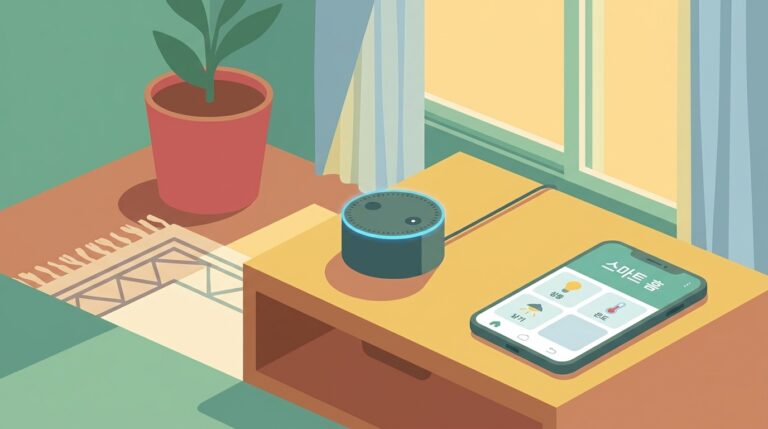
Speak Like a Local: Mastering Smart Speaker & IoT Integration in Korean
Phase 1: Empathy (스토리 몰입형 오프닝)
안녕하세요! Welcome back to Daily Hangul! It’s your favorite local culture navigator and Korean bestie.
Imagine this: You’ve just arrived at your sleek, IoT-integrated Airbnb in Gangnam. You’re exhausted from your flight and want to dim the lights, play some soft K-indie tunes, and turn on the AC. You confidently look at the Kakao Mini or GigaGenie speaker sitting on the counter and say:
“스피커, 불을 끄세요.” (Speaker, turn off the lights.)
Silence.
Then, a polite but robotic voice responds: “죄송해요, 잘 알아듣지 못했어요.” (Sorry, I didn’t quite understand.)
Ugh, frustrating, right? Controlling smart homes in a foreign language is a major pain point. It’s not just about grammar; it’s about using the exact phrases, natural intonations, and cultural speech patterns that Korean AI engines are programmed to recognize. Today, we’re going to elevate your Korean to a C1 level by mastering voice recognition technology and AI speaker integration. No more robotic textbook commands—let’s get you talking to your smart devices like a tech-savvy Seoulite!
Phase 2: Core Expressions Deep-Dive (핵심 표현 3선 심층 분석)
1. 연동해 줘 (yeon-dong-hae jwo)
- Pronunciation: yeon-dong-hae jwo (Sounds like “yawn-dong-hey jwo”)
- Meaning: Link it / Sync it / Integrate it.
- K-Culture Moment: In the smart-home era of K-dramas, you’ll often see characters walking into their apartments and commanding their home networks to sync their phones with their smart TVs or speakers.
- Editor’s Insight: While ‘연결’ (yeon-gyeol) means a simple physical or network “connection,” 연동 (yeon-dong) specifically refers to data synchronization, system linkage, or IoT integration where two devices work in tandem.
- Situation Spectrum:
- Casual (반말): 연동해 줘 (✅)
- Semi-formal (해요체): 연동해 주세요 (✅)
- Formal (하십시오체): 연동해 주시기 바랍니다 (⚠️ – reserved for app instructions)
- 🤔 Think About It: Koreans value seamless integration and efficiency (빨리빨리 – ppalli-ppalli culture). Why do you think Korean smart systems use “interlocking” (연동) rather than just “connecting” (연결) in daily tech jargon?
2. 음성 인식률이 떨어지네 (eum-seong in-sing-nyu-ri tteo-reo-ji-ne)
- Pronunciation: eum-seong in-sing-nyu-ri tteo-reo-ji-ne (Sounds like “um-seong een-sheeng-nyu-ree tuh-ruh-jee-nay”)
- Meaning: The voice recognition rate is quite low / is acting up.
- K-Culture Moment: When K-youtubers review the latest tech gadgets, you will constantly hear them complain about the “인식률” (recognition rate) when testing smart devices in noisy environments.
- Editor’s Insight: This is a highly sophisticated C1-level phrase. Instead of saying “이거 내 말 못 알아들어” (This doesn’t understand my words), using 음성 인식률이 떨어지다 shows a deep comprehension of technical Korean terminology.
- Situation Spectrum:
- Casual (반말): 음성 인식률이 떨어지네 (✅)
- Semi-formal (해요체): 음성 인식률이 떨어지네요 (✅)
- Formal (하십시오체): 음성 인식률이 떨어집니다 (✅)
3. 기기 등록 다시 해야겠다 (gi-gi deung-nok da-si hae-ya-get-da)
- Pronunciation: gi-gi deung-nok da-si hae-ya-get-da (Sounds like “ghee-ghee deung-nock dah-shee hay-yah-get-dah”). Note the sound change: ‘등록’ is pronounced as [등녹] due to nasalization!
- Meaning: I should re-register the device.
- K-Culture Moment: Commonly used when an IoT app (like Samsung SmartThings) suddenly loses connection with your smart lightbulbs or robot vacuum cleaner.
- Editor’s Insight: The suffix -해야겠다 expresses a self-directed decision or realization (“I guess I should…”). It sounds far more natural than the dry textbook requirement “등록해야 합니다.”
- Situation Spectrum:
- Casual (반말): 기기 등록 다시 해야겠다 (✅)
- Semi-formal (해요체): 기기 등록 다시 해야겠어요 (✅)
- Formal (하십시오체): 기기를 다시 등록해야겠습니다 (✅)
Phase 3: Textbook Korean vs. Real Korean (교과서 한국어 vs 진짜 한국어)
Scenario 1: Controlling the volume / Waking up the speaker
- 📖 Textbook Korean: “스피커의 음량을 조절하십시오.” (Adjust the volume of the speaker.)
- 🗣️ Real Korean: “지니야, 볼륨 좀 키워봐 / 스피커 좀 깨워줘.” (Genie, turn up the volume / Wake up the speaker.)
- 💡 Why is it different? Textbook phrases are written for instruction manuals. Real Koreans treat their AI assistants as pseudo-pets or friendly companions, using casual commanding tones and waking them up with affectionate nicknames.
Scenario 2: When the AI fails to connect to the Wi-Fi
- 📖 Textbook Korean: “네트워크 연결 상태를 확인하십시오.” (Please check the network connection state.)
- 🗣️ Real Korean: “와이파이 먹통 됐어. 연동이 아예 안 되네.” (The Wi-Fi is completely dead. The sync isn’t working at all.)
- 💡 Why is it different? Koreans rarely say “네트워크 연결 상태” in casual conversation. 먹통 (meok-tong) is the ultimate colloquial term for any device or connection that is frozen, unresponsive, or “dead.”
Phase 4: K-Culture Deep-Dive & Non-Verbal Manners
4-1. Nunchi & Pronunciation Gestures
When speaking to Korean AI, your pronunciation spacing (띄어쓰기) is just as important as your accent. Korean voice engines are highly sensitive to batchim (final consonants).
* The Gesture Tip: When invoking the AI speaker (e.g., “헤이 카카오”), pause for a brief half-second before delivering your command. Lean slightly toward the device and enunciate the first syllable of your action verb with a clean, crisp tone. Do not drag out the vowels!
4-2. Cultural Code: The Rise of “Smart” K-Life
From the popular drama Start-Up (where an AI speaker named ‘Yeong-sil’ serves as a crucial plot device) to real-life smart apartments in Songdo, South Korea is obsessed with home automation. Koreans love controlling their underfloor heating (온돌 – ondol), home security, and even rice cookers via voice. Knowing these tech terms will help you blend into any modern Korean household effortlessly.
Phase 5: Real-Life Roleplay Scenario (실전 롤플레이 시나리오)
Background & Characters
- Ji-ah (지아): A tech-savvy Korean graphic designer who has fully automated her studio apartment.
- Min-woo (민우): Ji-ah’s friend who is visiting her apartment but is struggling to get the AI speaker to play his playlist.
Ji-ah: 민우야, 왜 그렇게 스피커 앞에서 소리를 지르고 있어?
       (Min-woo, why are you screaming in front of the speaker like that?)

Min-woo: 🎭 (Frustrated, rubbing his neck)
         아니, 스피커가 내 말을 완전히 씹어. "노래 틀어줘"라고 했는데 대답이 없어.
         (No, the speaker is completely ignoring me. I said "Play some music," but there's no reply.)

Ji-ah: 🎭 (Giggling)
       너 발음이 뭉개져서 그래. 그리고 이 스피커는 네 폰이랑 아직 연동이 안 됐잖아.
       (It's because your pronunciation is slurred. And this speaker isn't synced with your phone yet.)

Min-woo: 아, 진짜? 블루투스만 켜면 자동으로 연동되는 거 아니었어?
         (Ah, really? I thought it synced automatically just by turning on Bluetooth?)

Ji-ah: 🎭 (Shaking her head)
       아니지! 앱 들어가서 '기기 추가' 누르고 이 스피커랑 직접 연동해 줘야 돼.
       (No way! You have to go into the app, tap 'Add Device', and link it with this speaker directly.)

Min-woo: 그렇구나... 근데 방금 기기 검색했는데 계속 오류가 뜨네.
         (I see... but I just searched for the device and an error keeps popping up.)

Ji-ah: 🎭 (Examining Min-woo's phone)
       어라? 와이파이 신호가 약해서 그래. 음성 인식률이 떨어지는 것도 그것 때문이야.
       (Huh? It's because the Wi-Fi signal is weak. That's also why the voice recognition rate is dropping.)

Min-woo: 아하! 공유기 옆으로 가서 기기 등록 다시 해야겠다. 고마워!
         (Aha! I should go near the router and re-register the device. Thanks!)
🔀 Interactive Choice Points
Now, imagine you are Min-woo. The smart speaker is still not responding to your voice. What do you say to Ji-ah?
- Option A: “야, 이거 기계 고장 난 거 아니야? 그냥 버려!” (Hey, isn’t this machine broken? Just throw it away!)
- Option B: “지아야, 스마트폰 연동하는 것 좀 도와줄 수 있어? 아직 기기 등록 단계를 잘 모르겠어.” (Ji-ah, can you help me sync my smartphone? I’m not sure about the device registration steps yet.)
- Option C: “말귀를 전혀 못 알아먹네. 내가 표준어가 아니라서 그러나?” (It doesn’t understand spoken words at all. Is it because I don’t use standard Korean?)
Feedback & Analysis
- Best Choice – Option B: Perfect! It naturally uses the core concepts of 연동 (linkage) and 기기 등록 (device registration) in a highly polite and native-like manner.
- Risk Choice – Option C: While “말귀” is an amazing colloquial word, blaming your lack of “표준어” (standard dialect) might sound a bit too self-deprecating when it’s usually just a simple Wi-Fi lag.
- Bad Choice – Option A: A bit too aggressive! Saying “그냥 버려” (just throw it away) to someone’s expensive IoT device is quite impolite.
Phase 6: 10-Second Emotion Shadowing Drill (10초 감정 섀도잉 드릴)
Let’s practice your emotional range! Speak these sentences out loud, paying attention to the pauses (/) and emotional cues.
- [😊 Bright & Friendly – Waking up the device]
- “지니야! / 오늘 날씨에 맞는 / 잔잔한 플레이리스트 / 좀 틀어줘!”
- (Jini-ya! / Play a relaxing playlist / that matches today’s weather!)
- [🥺 Whining & Annoyed – Connection issue]
- “아, 진짜… / 또 연동 끊겼어. / 기기 등록을 / 얼마나 더 해야 돼?”
- (Ugh, seriously… / it disconnected again. / How many times / do I have to re-register this device?)
- [🧐 Sophisticated Tech Critic]
- “이 모델은 / 가성비는 좋은데, / 확실히 / 음성 인식률이 떨어지네.”
- (This model / has good cost-performance, / but indeed, / the voice recognition rate is low.)
Phase 7: K-Culture Mini-Dictionary (K-Culture 미니 사전)
- 버벅거리다 (beobeok-georida): To lag, stutter, or glitch. (Used for slow computers, lagging streams, or even people stuttering over their words.)
- 먹통 (meoktong): A completely frozen system or dead device. Originally referred to an old ink well, now used whenever Wi-Fi or screen goes unresponsive.
- 인식률 (insing-nyul): Recognition rate. Crucial for talking about facial recognition, fingerprint scanners, or voice recognition.
- 말귀 (malgwi): The ability to understand spoken words. Often used like “말귀를 못 알아듣는다” (Cannot catch the drift of what someone is saying).
Phase 8: Traveler’s Survival Kit (여행자를 위한 생존 키트)
Survival Phrases TOP 3
- “에어컨이랑 스피커 연동 어떻게 해요?” (How do I link the air conditioner with the speaker?) -> Use this to ask your Airbnb host.
- “기기 등록 비밀번호가 뭐예요?” (What is the device registration password?) -> Essential for syncing with local smart hubs.
- “음성 제어 말고 수동으로 켤게요.” (I will turn it on manually instead of using voice control.) -> Your ultimate escape card when technology fails!
💡 Editor’s Travel Note:
When traveling in South Korea, make sure to download the SmartThings App on Google Play or Kakao Home App beforehand. Most modern Korean rentals and hotels utilize these ecosystems for smart lighting and temperature control.
Phase 9: “One Step Deeper” (생각 질문)
Have you ever wondered if you should use honorifics (존댓말) to AI speakers? Interestingly, while Korean AI devices are programmed to speak to you in polite 해요체 (-요), humans almost exclusively use 반말 (casual speech) or short direct commands when talking to them. Some linguists note that treating inanimate smart objects with casual speech reinforces the social boundary between humans and machines, while others feel uncomfortable commanding an entity without a polite “-요.”
💬 Your Turn: Do you think we should be polite to AI? How do you command smart devices in your native language compared to Korean? Let us know in the comments below!
Phase 10: FAQ & Common Mistakes (FAQ Schema)
Q: Why does the smart speaker keep saying “잘 못 알아들었어요” to me?
A: Korean AI engines are trained on native speech flow. If you pronounce consonants separately (e.g., saying “기-기 등-록” with sharp breaks), the machine will fail. Try to slide your words together using natural Liaison rules (e.g., pronounce ‘등록’ as [등녹]).
Q: What is the difference between 연동 (yeondong) and 연결 (yeongyeol)?
A: 연결 is a basic physical or virtual connection (like plugging in a cable or joining a Wi-Fi network). 연동 is a dynamic sync where actions in one device trigger responses in another (like your smartwatch syncing fitness data to your phone in real time).
Q: Can I use “꺼줘” instead of “꺼주세요” to an AI speaker?
A: Yes! AI speakers do not have feelings (yet!), so using casual command forms like “꺼줘” (turn it off), “켜줘” (turn it on), or “노래 틀어줘” (play music) is the standard, most natural way to control them.
🚨 Common Mistakes Alert!
- ❌ “와이파이를 연결해 주세요.” (Sounds like you want to physically plug in the Wi-Fi router.)
- ✅ “와이파이 잡아 주세요” or “와이파이 연결해 주세요” (Use “잡다” for catching wireless signals!)
- ❌ “스피커를 깨우세요.” (Sounds too literal, like shaking a sleeping person awake.)
- ✅ “지니야” (calling the wakeup name) or “음성 인식 활성화해 줘.”
Phase 11: Action Mission & Participation
- Bronze Mission: Say “지니야, 노래 틀어줘” with perfect emotional shadowing in your room!
- Silver Mission: Share a screenshot of your phone’s smart device list on Instagram and tag us using the phrase #기기연동.
- Gold Mission: Next time you stay at a hotel or Airbnb in Korea, try setting up the temperature or lights using voice commands only!
🎮 K-Culture Mission
Watch the Korean drama Start-Up (스타트업). Spot the scenes where Han Ji-pyeong talks to his AI speaker ‘Yeong-sil’ and write down at least one voice command phrase he uses in the comments!
Phase 12: Interactive Quiz Challenge (인터랙티브 퀴즈 챌린지)
Test your tech-savvy Korean skills! Click the toggles below to reveal the answers.
1. Which term represents “linking devices so they synchronize dynamically”?
- A) 연결 (yeongyeol)
- B) 연동 (yeondong)
- C) 연합 (yeonhap)
정답 확인하기 (Click to reveal)
정답은 B) 연동 입니다!
연결 is just connection, and 연합 means alliance. 연동 is the perfect word for smart device integration.
2. True or False: You must always use highly polite 존댓말 (e.g., 하십시오체) when speaking to a smart speaker to avoid errors.
정답 확인하기 (Click to reveal)
정답은 False 입니다!
Korean AI engines are perfectly optimized for short, casual commands like “불 켜줘” (turn on the light) or “볼륨 줄여줘” (lower the volume). Using overly long, formal sentences can actually decrease the recognition rate!







