

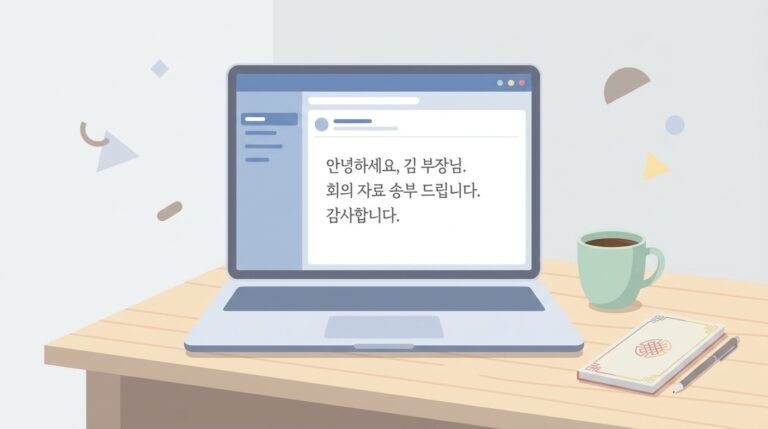
Write Like a Pro: How to Politely Reschedule a Business Meeting in Korean
Phase 1: Empathy (Welcome to the K-Workplace!)
안녕하세요! (An-nyeong-ha-se-yo!) I’m your Daily Hangul Chief Editor and your Korean best friend in the professional world.
Imagine this: You’ve been preparing for a crucial meeting with your Korean business partners for weeks. But suddenly, an unexpected emergency crops up, and you have to reschedule. Your heart sinks. You open your email client, stare at the blank screen, and think: “How do I say this in Korean without sounding incredibly rude, lazy, or unprofessional?”
In Korean corporate culture, time is a sign of respect. Asking to change a schedule can feel like walking on thin ice. If you translate English phrases literally, you might accidentally sound demanding or unapologetic.
Don’t worry! Today, we are going to master the exact, polished intermediate (B2) phrases that native Korean professionals use to reschedule politely. By the end of this guide, you will be able to turn an awkward situation into an opportunity to showcase your impeccable Korean etiquette and build even deeper trust with your partners.
Phase 2: Deep Dive into 3 Key Business Expressions
Here are the three golden phrases you need to know. Let’s break them down word by word.
1. 일정을 부득이하게 변경하게 되었습니다. (Il-jeong-eul bu-deuk-i-ha-ge byeon-gyeong-ha-ge doe-eot-seum-ni-da.)
- Pronunciation Analogy: “Il-jeong-ool boo-deuk-ee-ha-ge (sounds like ‘boo-deuk’ as in ‘boot’ + ‘ick’) byun-gyung-ha-ge doe-eot-soom-nee-da.”
- Meaning: “I have inevitably had to change the schedule.”
- K-Culture Moment: You will hear this exact phrase in corporate K-Dramas like Start-Up or What’s Wrong with Secretary Kim when a secretary has to break some unexpected news to the CEO.
- Editor’s Insight: The magic word here is 부득이하게 (bu-deuk-i-ha-ge), which means “inevitably” or “against one’s will.” Using this word signals to the recipient that you did not make this decision lightly and that it was truly out of your control.
- Situation Spectrum: Casual (🚫) | Semi-formal (⚠️) | Formal (✅)
- 🤔 Think About It: Why do you think Korean business culture prefers saying “it became changed” (변경하게 되었습니다) rather than “I changed it” (변경했습니다)? (Hint: It deflects direct personal blame and sounds softer!)
2. 너그럽게 양해해 주시기 바랍니다. (Neo-greop-ge yang-hae-hae ju-si-gi ba-ram-ni-da.)
- Pronunciation Analogy: “Nuh-geu-rop-ge (rhymes with ‘cup-ge’) yang-hae-hae joo-shee-gee ba-ram-nee-da.”
- Meaning: “We ask for your generous understanding/forbearance.”
- K-Culture Moment: This phrase is commonly found in official public announcements in Korea, such as when a subway line is delayed or when a K-Pop agency announces the postponement of a concert.
- Editor’s Insight: 양해 (yang-hae) is a beautiful Korean concept that blends “understanding,” “excuse,” and “consent.” By asking for their “generous” (너그럽게) understanding, you show immense respect for their feelings and time.
- Situation Spectrum: Casual (🚫) | Semi-formal (⚠️) | Formal (✅)
- 🤔 Think About It: Contrast this with a simple “I’m sorry.” Asking for “양해” actively invites the other party to be the bigger, more generous person in the relationship.
3. 편하신 시간을 말씀해 주시면 맞추겠습니다. (Pyeon-ha-sin si-gan-eul mal-sseum-hae ju-si-myeon mat-chu-get-seum-ni-da.)
- Pronunciation Analogy: “Pyun-ha-seen she-gan-ool mal-soom-hae joo-shee-myun mat-choo-get-soom-nee-da.”
- Meaning: “If you let me know your convenient time, I will accommodate it.”
- K-Culture Moment: This is the ultimate client-service phrase. In Korea’s fast-paced business world, the client’s schedule is king.
- Editor’s Insight: The verb 맞추다 (mat-chu-da) means “to adjust” or “to match.” Saying 맞추겠습니다 shows that you are willing to bend your schedule entirely to suit their convenience as a token of apology.
- Situation Spectrum: Casual (🚫) | Semi-formal (✅) | Formal (✅)
- 🤔 Think About It: How does offering to match their schedule change the power dynamic of a business negotiation? It shows high humility and professional courtesy.
Phase 3: Textbook Korean vs. Real-World Business Korean
Many textbooks teach phrases that are grammatically correct but sound too blunt, childish, or even demanding in a real office. Let’s look at the difference.
Scenario 1: Proposing a schedule change
- 📖 Textbook Korean: 시간을 바꾸고 싶습니다. (Si-gan-eul ba-kku-go sip-seum-ni-da.)
- Why it’s tricky: It literally means “I want to change the time.” It sounds very demanding and self-centered.
- 🗣️ Real Business Korean: 일정 조정이 가능할지 여쭙고자 합니다. (Il-jeong jo-jeong-i ga-neung-hal-ji yeot-jup-go-ja ham-ni-da.)
- 💡 Why it’s better: It translates to “I would like to ask if schedule adjustment might be possible.” It frames the change as a polite question rather than a statement of your desire.
Scenario 2: Saying sorry for the inconvenience
- 📖 Textbook Korean: 미안합니다. (Mi-an-ham-ni-da.)
- Why it’s tricky: “미안합니다” is too casual for a formal business email. It can make you look unprofessional.
- 🗣️ Real Business Korean: 불편을 드려 대단히 송구스럽습니다. (Bul-pyeon-eul deu-ryeo dae-dan-hi song-gu-seureop-seum-ni-da.)
- 💡 Why it’s better: This translates to “I am extremely apologetic for causing you inconvenience.” Using 송구스럽다 (song-gu-seureop-da) instead of 죄송하다/미안하다 shows a much deeper level of professional regret.
Phase 4: K-Culture Deep Dive & Non-Verbal Manners
4-1. “Nunchi” (눈치) and Email Etiquette
In Korea, 눈치 (Nunchi)—the art of reading the room and sensing others’ feelings—extends to written emails. When requesting a schedule change, “Nunchi” dictates that you must never sound like you are taking their time for granted.
* The “Buffer” Rule: Always start the email with a polite greeting about the season or their well-being before dropping the bad news. Jumping straight to “I need to change the meeting” shows a complete lack of Nunchi.
* The Choice Rule: Always offer at least two or three specific alternative time slots, or ask them to propose a time. Never just say “Let’s meet later.”
4-2. The Respect for “Gap-Eul” (갑을 관계) Culture
While modern Korean companies are trying to move away from hierarchical structures, the concept of 갑 (Gap – the client/partner) and 을 (Eul – the service provider) still subtly exists. If you are in the position of “Eul,” changing a meeting requires maximum humility. Even if you are “Gap,” showing polite deference by using high honorifics builds incredible loyalty and respect.
Phase 5: Interactive Roleplay Scenario
Meet the Characters
- You (민우 – Min-woo): An intermediate business development manager.
- 김 팀장님 (Team Leader Kim): Your respected partner at a major Korean tech firm.
[Setting: An email exchange that needs to be followed up via a quick phone call]
- You (Min-woo): 김 팀장님, 안녕하십니까. 매일한글의 민우입니다.
(Kim tim-jang-nim, an-nyeong-ha-sim-ni-da. Mae-il-han-geul-ui Min-woo-im-ni-da.)
🎭 [Typing carefully with two hands on the keyboard, taking a deep breath]
“Team Leader Kim, hello. This is Min-woo from Daily Hangul.” -
Team Leader Kim: 아, 민우 씨! 안녕하세요. 무슨 일 있으신가요?
(Ah, Min-woo ssi! An-nyeong-ha-se-yo. Mu-seun il it-seu-sin-ga-yo?)
🎭 [Answering with a professional yet busy tone]
“Ah, Min-woo! Hello. Is everything okay?” -
You (Min-woo): 다름이 아니라, 저희 내부 사정으로 인해 다음 주 미팅 일정을 부득이하게 변경해야 할 것 같습니다.
(Da-reum-i a-ni-ra, jeo-hui nae-bu sa-jeong-eu-ro in-hae da-eum ju mi-ting il-jeong-eul bu-deuk-i-ha-ge byeon-gyeong-hae-ya hal geot gat-seum-ni-da.)
🎭 [Speaking softly and apologetically]
“Actually, due to our internal circumstances, it seems we inevitably have to change next week’s meeting schedule.” -
Team Leader Kim: 아, 그러시군요. 무슨 일인지 걱정되네요. 언제쯤으로 변경하면 좋을까요?
(Ah, geu-reo-si-gun-yo. Mu-seun il-in-ji geok-jeong-doe-nae-yo. Eon-je-jjeum-eu-ro byeon-gyeong-ha-myeon jo-eul-kka-yo?)
🎭 [Checking his digital calendar on his monitor]
“Ah, I see. I hope everything is fine. Around when should we reschedule?” -
You (Min-woo): 갑작스럽게 일정을 조정하게 되어 대단히 송구스럽습니다.
(Gap-jak-seu-reop-ge il-jeong-eul jo-jeong-ha-ge doe-eo dae-dan-hi song-gu-seureop-seum-ni-da.)
🎭 [Lowering your head slightly, even though it's a phone call]
“I am extremely sorry for adjusting the schedule so suddenly.” -
Team Leader Kim: 아닙니다, 비즈니스를 하다 보면 그럴 수 있죠. 괜찮습니다.
(An-ip-ni-da, bi-zi-ni-seu-reul ha-da bo-myeon geu-rel su it-jyo. Gwaen-chan-seum-ni-da.)
🎭 [Smiling warmly to reassure Min-woo]
“No worries, that can happen in business. It’s perfectly fine.” -
You (Min-woo): 너그럽게 양해해 주셔서 정말 감사합니다. 혹시 목요일 오후 2시나 금요일 오전 10시 중에 편하신 시간이 있으신지요?
(Neo-greop-ge yang-hae-hae ju-syeo-seo jeong-mal gam-sa-ham-ni-da. Hok-si mok-yo-il o-hu du-si-na geum-yo-il o-jeon yeol-si jung-e pyeon-ha-sin si-gan-i it-eu-sin-ji-yo?)
🎭 [Presenting clear options politely]
“Thank you so much for your generous understanding. Would you happen to prefer Thursday at 2 PM or Friday at 10 AM?” -
Team Leader Kim: 금요일 오전 10시가 좋겠네요. 그때 뵙겠습니다.
(Geum-yo-il o-jeon yeol-si-ga jo-get-nae-yo. Geu-tae boep-get-seum-ni-da.)
🎭 [Confirming the schedule on his calendar]
“Friday at 10 AM would be great. I will see you then.”
—
🔀 Your Turn: How should Min-woo respond to finish the conversation?
- Option A: “오케이, 금요일에 봐요!” (Ok, see you Friday!)
- Option B: “바쁘신 와중에 시간 내어 주셔서 감사합니다. 메일로 재초대장을 보내드리겠습니다.” (Thank you for taking the time out of your busy schedule. I will send you a calendar re-invite via email.)
- Option C: “네, 그때 꼭 오셔야 합니다.” (Yes, you must definitely come then.)
Feedback:
- Option A (Bad – 🚫): Extremely casual (반말). This will instantly destroy your professional relationship.
- Option B (Best – ✅): Perfect! It expresses gratitude for their busy time and outlines the next professional step (sending an email invite).
- Option C (Risk – ⚠️): Too commanding. Saying “you must come” sounds aggressive in Korean.
Phase 6: 10-Second Emotional Shadowing Drill
To sound natural, you must master the pauses (/) and the emotional undertones. Try reading this out loud:
- [😔 Deeply apologetic and polite]
갑작스러운 일정 변경으로 / 불편을 드려 / 진심으로 송구스럽습니다.
(Gap-jak-seu-reoun il-jeong byeon-gyeong-eu-ro / bul-pyeon-eul deu-ryeo / jin-sim-eu-ro song-gu-seureop-seum-ni-da.)
“Due to the sudden schedule change / for causing you inconvenience / I am sincerely, deeply sorry.” -
[😊 Relieved and extremely grateful]
너그럽게 양해해 주셔서 / 대단히 감사합니다. / 금요일에 뵙겠습니다.
(Neo-greop-ge yang-hae-hae ju-syeo-seo / dae-dan-hi gam-sa-ham-ni-da. / Geum-yo-il-e boep-get-seum-ni-da.)
“For generously understanding / thank you so very much. / I will see you on Friday.”
Phase 7: K-Culture Mini Dictionary
- 일정 조정 (Il-jeong jo-jeong): Schedule adjustment. A very common business compound noun used when rescheduling meetings.
- 송구스럽다 (Song-gu-seureop-da): Highly apologetic. A premium formal synonym for 죄송하다, used primarily to superiors or valued clients.
- 양해 (Yang-hae): Understanding/consent. To ask for “양해” is to ask the other party to overlook a mistake or inconvenience with grace.
- 회신 (Hoi-sin): Formal email reply. Instead of 답장 (dap-jang), professionals write “회신 부탁드립니다” (Please reply).
Phase 8: The Business Traveler’s Survival Kit
If you are on a business trip in Seoul and need to quickly message your counterpart via KakaoTalk, use these quick survival expressions!
Survival Expressions TOP 3
- “일정 변경이 가능할까요?” (Il-jeong byeon-gyeong-i ga-neung-hal-ka-yo?)
- Meaning: “Would a schedule change be possible?”
- Pro Tip: Soft, polite, and perfect for KakaoTalk.
- “갑작스럽게 연락드려 죄송합니다.” (Gap-jak-seu-reop-ge yeon-rak-deu-ryeo joe-song-ham-ni-da.)
- Meaning: “I apologize for reaching out so suddenly.”
- Pro Tip: Use this when texting outside of standard business hours.
- “메일로 자세한 내용을 보내드렸습니다.” (Me-il-lo ja-se-han nae-yong-eul bo-nae-dryeot-seum-ni-da.)
- Meaning: “I have sent the details via email.”
- Pro Tip: Shows that you follow proper business protocol.
Editor’s Travel Note 🗺️
When coordinate business schedules in Seoul, download the Naver Map App to calculate your travel times accurately before proposing a meeting time. Seoul traffic during rush hour (8-9 AM, 6-7 PM) can be brutal, so always give yourself a 30-minute buffer!
(Note: Traffic conditions and subway schedules in Seoul may vary based on live updates and weather conditions.)
Phase 9: “Go Deeper” – The Philosophy of Indirectness
In Western business cultures, directness is often equated with honesty and efficiency. “I can’t make it at 2 PM, let’s do 4 PM instead” is seen as clear communication. However, in Korea, directness can sometimes be perceived as abrasive.
Korean communication is highly context-dependent and revolves around maintaining 기분 (Gibun – feelings/mood/prestige). By using passive verbs like “되었습니다” (it became) and expressing deep apology through words like “송구스럽다,” you preserve the partner’s Gibun. You acknowledge that by changing the schedule, you have slightly disrupted their universe, and you are taking full responsibility for smoothing it over.
💬 Your Turn: Have you ever noticed a similar cultural focus on indirectness in your own language or culture? Let’s talk in the comments below!
Phase 10: FAQ & Avoiding Common Mistakes
FAQ
Q: Can I use “미안해요” (Mi-an-hae-yo) in a business email if I am close to the partner?
A: It is highly discouraged. Even if you have a friendly relationship, emails leave a paper trail. Keep your written emails strictly formal with “죄송합니다” (Joe-song-ham-ni-da) or “송구스럽습니다” (Song-gu-seureop-seum-ni-da) to maintain professional boundaries.
Q: What is the best way to suggest multiple alternative dates?
A: List them clearly using bullet points to make them easy to read on mobile screens. For example:
– 1안: 10월 24일(목) 오후 2시
– 2안: 10월 25일(금) 오전 11시
Q: Should I explain the detailed reason why I am rescheduling?
A: You do not need to give overly personal details. Simply saying “회사 내부 사정으로” (due to internal company circumstances) or “갑작스러운 개인 사정으로” (due to sudden personal circumstances) is respectful and sufficient.
🚨 The “Oops!” Board: Common Foreigner Mistakes
- Mistake 1: Using “너가 시간을 정해줘” (Neo-ga si-gan-eul jeong-hae-jwo – You decide the time).
- Correct Action: Use “편하신 시간을 제안해 주시면 감사하겠습니다” (It would be appreciated if you could suggest a convenient time).
- Mistake 2: Forgetting the recipient’s title (e.g., calling a Manager just by their name like “민수 씨” instead of “김민수 과장님”).
- Correct Action: Always use their last name + Title + 님 (e.g., 김 과장님).
- Mistake 3: Saying “늦을 것 같습니다” (I think I will be late) five minutes before the meeting instead of rescheduling in advance.
- Correct Action: If you are going to be more than 15 minutes late, formally request a schedule adjustment at least a few hours beforehand.
Phase 11: Action Mission & K-Culture Challenge
Are you ready to put this into practice? Choose your level of challenge today!
- 🥉 Bronze Mission: Copy the key phrase “일정을 부득이하게 변경하게 되었습니다” and write it down in your study notebook three times while saying it out loud.
- 🥈 Silver Mission: Write a mock business email requesting a schedule change in the comments section below. I will personally review it and give you feedback!
- 🥇 Gold Mission: Use one of the survival phrases in your next KakaoTalk or email correspondence with a Korean speaker.
🎮 K-Culture Mission:
Watch an episode of any office-based K-Drama (like Misaeng or Business Proposal). Try to spot the moment characters write or receive emails. Listen closely to how many times they say “양해” or “송구스럽습니다”!
Phase 12: Interactive Quiz Challenge
Test your Business Korean IQ!
1. Which word is the most polite synonym for “I am sorry” in a formal email?
- A) 미안해
- B) 송구스럽습니다
- C) 미안합니다
2. What does “부득이하게” mean?
- A) Happily
- B) Inevitably / Unavoidably
- C) Quickly
3. True or False: It is perfectly polite to say “시간을 바꾸고 싶습니다” to a client.
- A) True
- B) False
🎉 Click here to reveal the answers and explanations!
Answers:
- B) 송구스럽습니다 – This is the highest level of formal apology, perfect for emails to clients or superiors.
- B) Inevitably / Unavoidably – It shows that you did not want to change the schedule but had no choice.
- B) False – It sounds like a demand. Instead, use “일정 조정이 가능할지 여쭙고자 합니다.”







